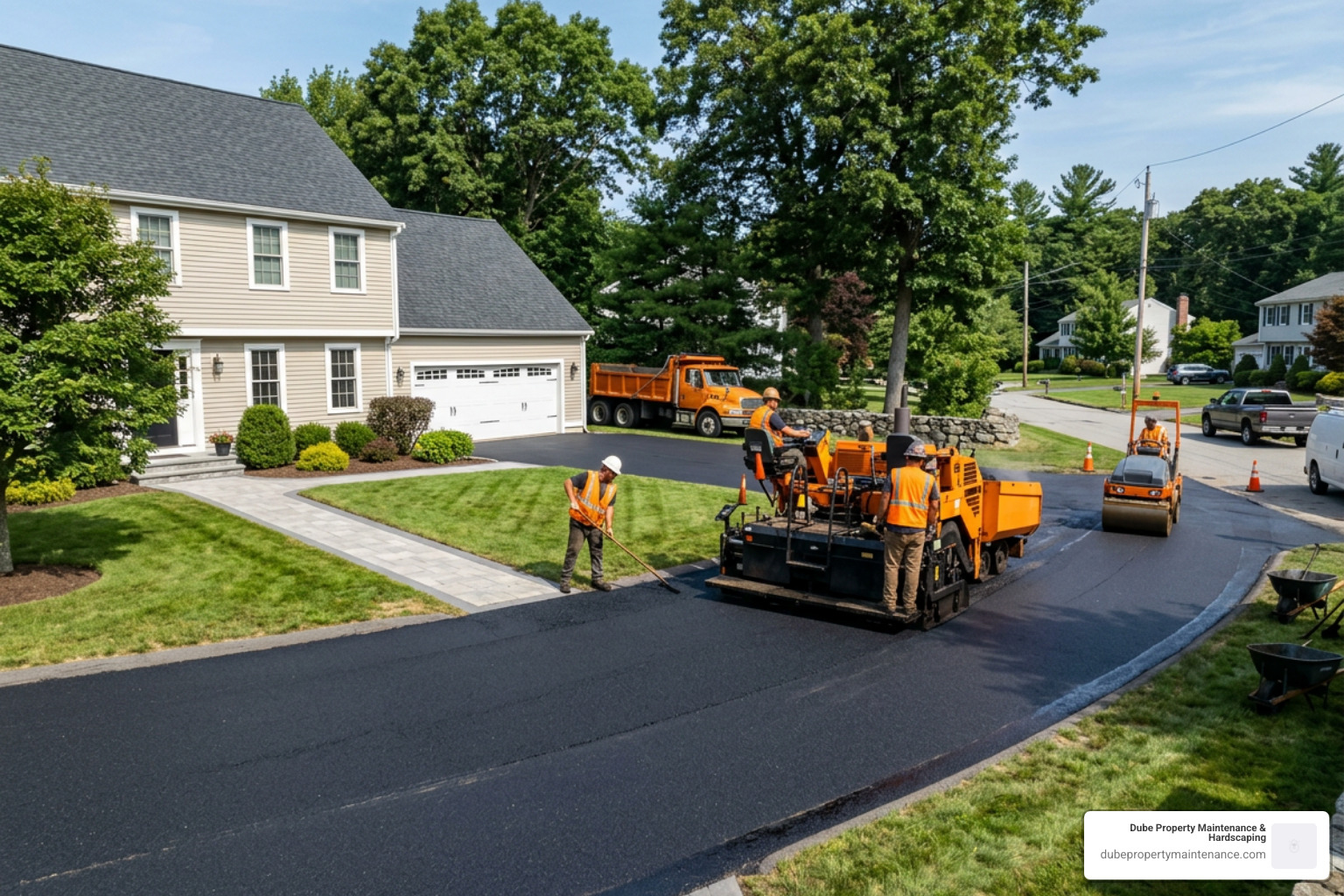
Driveway resurfacing industry standards in MA exist for a good reason: Massachusetts winters are brutal on pavement. Freeze-thaw cycles crack asphalt, heave concrete slabs, and destroy poorly prepared surfaces fast.
Here’s a quick snapshot of what MA driveway resurfacing standards cover:
| Standard Area | What It Means for Your Driveway |
|---|---|
| MassDOT material specs | Asphalt binder grade and concrete PSI requirements |
| Subbase preparation | Proper gravel depth and compaction before any overlay |
| Drainage requirements | Correct pitch to move water away from the surface |
| Surface preparation | Crack repair and cleaning before resurfacing begins |
| Overlay thickness | Minimum asphalt or concrete depth for structural integrity |
These aren’t just technical details for contractors. They directly affect how long your driveway lasts — and how much you’ll spend maintaining it.
Consider this: routine sealcoating alone can extend an asphalt driveway’s lifespan by up to 50%. Proper drainage can reduce surface deterioration by up to 40%. And catching problems early can cut long-term resurfacing costs by as much as 60%.
For residential and commercial property owners in Methuen MA, Andover MA, Lawrence MA, and North Andover MA, understanding these standards helps you hire the right contractor, ask the right questions, and protect a real investment. A professionally installed driveway can increase property value by up to 10% in competitive markets.
This guide walks you through everything — from MassDOT specifications to local permitting to materials that actually hold up in Massachusetts and New Hampshire conditions.

When evaluating residential or commercial driveway paving, we must look to the benchmark of engineering in the Commonwealth: the Massachusetts Department of Transportation (MassDOT). While MassDOT standards are primarily designed for public highways, they serve as the foundational blueprint for high-quality private construction. Adhering to these specifications supports structural integrity and long-term durability.
According to the MassDOT 2026 Standard Specifications, any high-performing asphalt or concrete surface relies heavily on the quality of its underlying subbase. For properties across Massachusetts and New Hampshire, a substandard base means a driveway can fail within a few seasons due to shifting ground and freeze-thaw pressure.
For concrete surfaces, the standard requires specific mix designs. We look to the concrete driveway resurfacing contractors guide to understand how these technical material requirements translate to residential and commercial properties. Concrete used in exterior slabs must meet strict compressive strength limits, typically requiring a minimum of 4,000 PSI (pounds per square inch) to survive heavy traffic, deicing exposure, and winter conditions.
Additionally, the performance grade of the asphalt binder is highly regulated. In Massachusetts, the binder must be flexible enough to resist thermal cracking during sub-zero January nights, yet stiff enough to prevent rutting during humid July afternoons.
Beyond statewide material specifications, driveway projects are governed by local municipal codes. Navigating these rules is a critical step before any heavy machinery arrives at your property. Each city and town across Massachusetts and southern New Hampshire has specific rules regarding the public right-of-way, particularly where your private driveway meets the municipal street—known as the driveway apron.
For example, municipal guidelines such as the Lowell Driveway Permit Regulations detail strict requirements for any work performed on city roadways or adjacent aprons. These rules help ensure that water runoff from private properties does not overload municipal storm systems and that sightlines remain safe for passing motorists.
When planning a resurfacing project, we always check local town bylaws. In places like Methuen MA and Andover MA, you may need a specific trench or driveway permit if the resurfacing extends to the edge of the public roadway.
Key municipal compliance areas include:

Massachusetts and southern New Hampshire experience volatile weather, from deep winter freezes to summer heatwaves. The primary enemy of any paved surface in this region is frost heaving, which occurs when water seeps under the driveway, freezes, expands, and lifts the pavement.
To combat this, choosing the right materials and techniques is paramount. Whether you are opting for asphalt or concrete, understanding the engineering differences is key. You can explore these options in detail in our concrete driveway resurfacing complete guide.
Asphalt is highly favored in Massachusetts and New Hampshire because of its natural flexibility. When the ground shifts due to frost, asphalt can bend slightly without immediately cracking. However, a standard overlay (paving a new layer directly over the old one) must be executed flawlessly to prevent “reflective cracking,” where old cracks transfer up into the new surface.
Industry best practices for asphalt resurfacing include:
To review how these asphalt methods stack up against other surface treatments, take a look at our guide on driveway refinishing options.
Concrete resurfacing requires an entirely different set of technical standards. You cannot simply pour standard concrete over an old, cracked slab; it will quickly delaminate and break apart. Instead, professional contractors utilize advanced polymer-modified cementitious overlays and micro-toppings.
According to driveway resurfacing industry standards in MA, successful concrete resurfacing requires:
To find out more about selecting the right professional for this technical process, read our guide on concrete driveway resurfacing contractors.

You can use the most expensive asphalt or concrete in the world, but if your base is weak or your drainage is poor, your driveway will fail. Surface preparation is where high-quality contractors separate themselves from cut-rate operations.
According to the MassDOT Construction Standard Details, subgrade preparation requires removing all organic material, soft clay, and loose soil. This is followed by placing a compacted layer of processed gravel borrow. In Massachusetts and New Hampshire soils where clay and moisture retention are common, a sturdy 6-to-12-inch gravel base is essential to provide structural support and allow water to drain away from the pavement.
Proper drainage standards require a minimum slope or “pitch” of 1% to 2% (a 1/8-inch to 1/4-inch drop per foot) directing water away from your building foundation and toward a safe runoff area or a municipal catch basin.
Before any resurfacing material is laid down, existing structural defects must be fully resolved. Simply paving over active cracks is a temporary band-aid that will fail within a single winter.
Our standard process for prep work includes:
Property owners often wonder whether they need a simple repair, a complete resurfacing, or a total excavation and replacement. Paving a driveway that has systemic foundation failure is a waste of money, while fully replacing a structurally sound driveway is unnecessarily expensive.
Here is a breakdown of how we evaluate these options for residential and commercial properties in Lawrence MA, North Andover MA, and surrounding Massachusetts and New Hampshire communities:
| Condition / Symptom | Recommended Action | Why This Choice? |
|---|---|---|
| Isolated hairline cracks, minor surface wear | Targeted Repair & Sealcoating | Economical; prevents water intrusion before damage spreads. |
| Deep cracks, minor pitting, but subbase is stable and solid | Driveway Resurfacing (Overlay) | Restores a brand-new wearing surface without the cost of full excavation. |
| Extensive “alligator” cracking, deep ruts, sinking areas | Full Replacement | Indicates structural subbase failure; new asphalt over this will fail immediately. |
If you have a concrete driveway with only one or two damaged sections, a complete replacement might not be necessary. You can explore targeted options in our guide on replacing a piece of concrete driveway.
When researching driveway projects, it is important to understand the typical financial investment required for professional-grade work in Massachusetts and New Hampshire.
Please note: All prices mentioned below are average industry costs sourced from publicly available internet data. They do not represent the actual pricing of Dube Property Maintenance & Hardscaping, nor do they serve as guarantees. Every site has unique grading, access, drainage, and material requirements.
Due to complex site preparation, strict environmental regulations, and high material standards in this region, local project costs can vary widely. If online data shows a baseline average around $7.50 to $11.00 per square foot, a more conservative planning range that accounts for industry variability is approximately $15.00 to $55.00+ per square foot depending on the specific material, prep work, and drainage solutions required. For more details on budgeting, you can review our breakdown of concrete driveway resurfacing cost per square foot.
When hiring a contractor, always verify their licensing and quality control standards. A reputable contractor in Massachusetts should carry full liability insurance, worker’s compensation, and a valid Home Improvement Contractor (HIC) registration. Professional projects should also include a clear written warranty—typically covering materials and workmanship for at least one to two years.
A professionally resurfaced asphalt or concrete driveway built to driveway resurfacing industry standards in MA typically lasts between 10 and 15 years. Its ultimate lifespan depends heavily on regular maintenance, such as sealcoating every 2 to 3 years and sealing cracks immediately to prevent winter water infiltration.
The ideal window for driveway resurfacing in Massachusetts is from late spring to early autumn (typically May through October). Asphalt plants close during the winter months, and hot mix asphalt requires ambient air and ground temperatures of at least 50°F (and rising) to compact properly before cooling.
In many Massachusetts and New Hampshire municipalities, yes. If the work is a straightforward resurfacing of your existing footprint, some towns only require a simple notification or building permit. However, if you are expanding the driveway, altering the slope, or replacing the apron where it meets a public road, you must secure the proper driveway or street opening permit from the local Public Works department.
Investing in your driveway is one of the most practical ways to protect your property’s value, enhance curb appeal, and ensure safe access throughout Massachusetts and New Hampshire winters. By insisting on professional driveway resurfacing industry standards in MA, you support a durable, attractive surface designed to stand up to heavy traffic, drainage challenges, and frost heaves.
At Dube Property Maintenance & Hardscaping, we provide high-quality exterior property solutions for residential and commercial clients, including driveway resurfacing, hardscaping, lawn installation, lawn care, artificial lawn planning, and landscaping-related site improvements. Our professional team serves properties throughout Methuen MA, Andover MA, and nearby communities.
Ready to transform worn-out pavement into a smooth, durable surface? Explore our comprehensive resurface driveway services to see how we can help.
Use our quote form to get started today: Request a Quote.