
Ever wondered how those lush green fields stay vibrant even during dry spells? That’s the magic of irrigation at work! So what is an irrigation system, exactly? At its heart, it’s a thoughtfully designed network of components that deliver water to plants when Mother Nature isn’t being generous enough with rainfall. These systems come in all shapes and sizes—from the humble garden hose with a spray nozzle to sophisticated computerized networks that water vast areas with incredible precision.
“Irrigation can offer crop yields that are two to four times greater than is possible with rainfed farming, and it currently provides 40 percent of the world’s food from approximately 20 percent of all agricultural land.” – Worldwatch Institute
This striking statistic highlights just how crucial irrigation is to our food security and agricultural productivity.
| Feature | Description |
|---|---|
| Definition | A mechanical setup that distributes water to plants and landscapes |
| Purpose | To supplement rainfall and ensure consistent plant hydration |
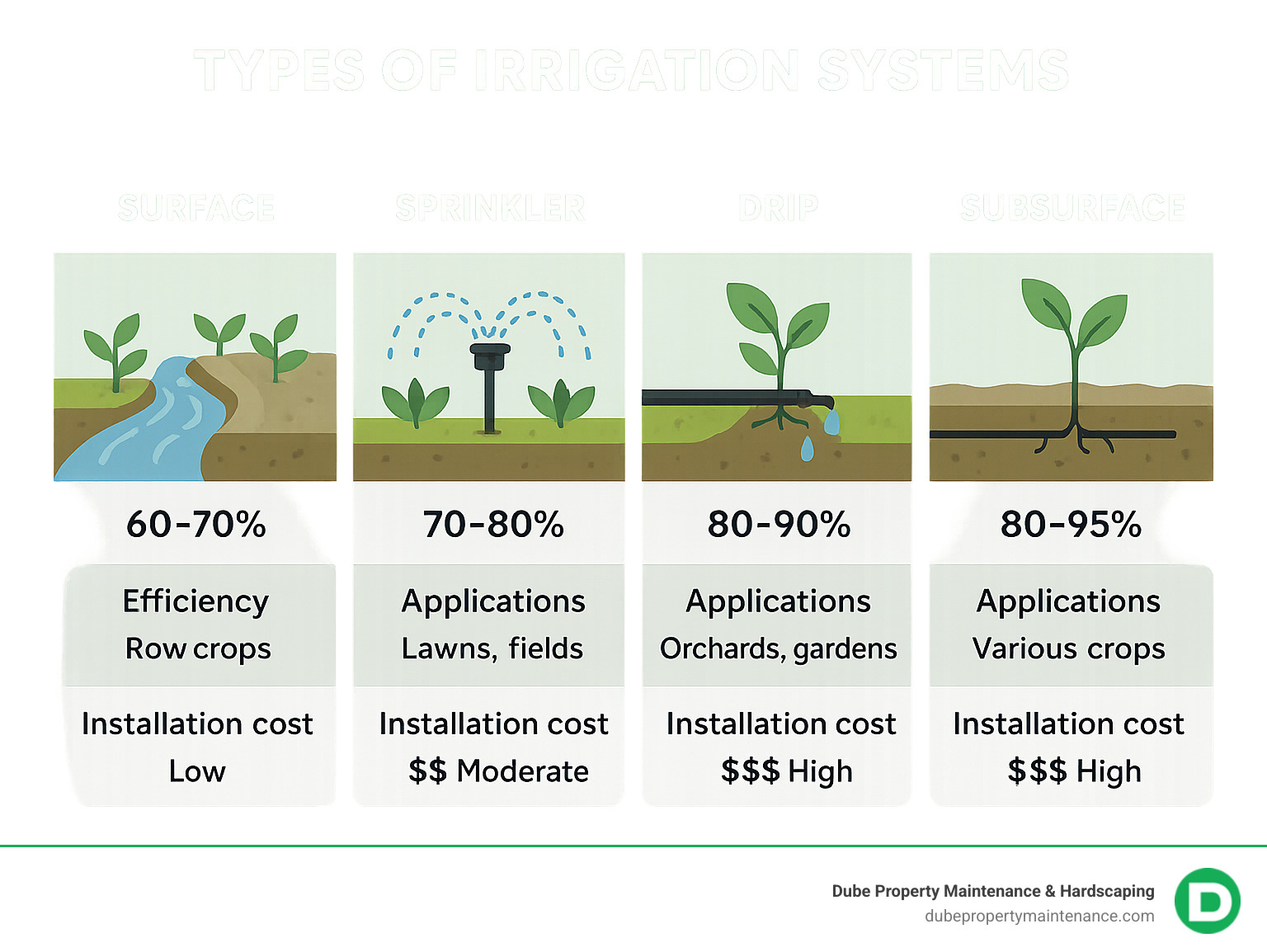
| Components | Water source, delivery system (pipes/canals), distribution method (sprinklers/drip emitters) |
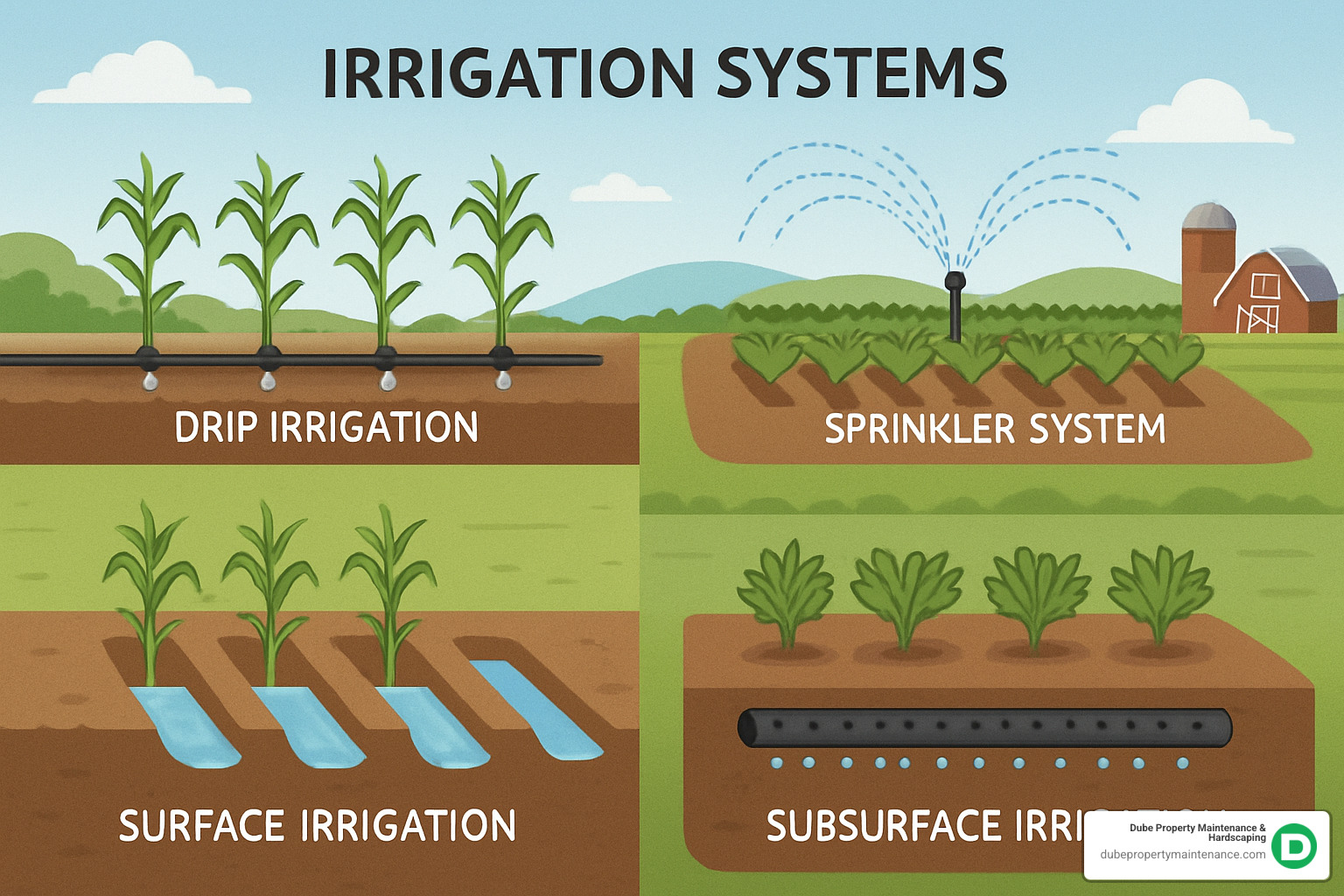
| Main Types | Surface, Sprinkler, Drip, Subsurface |
| Benefits | Water conservation, consistent plant health, time savings, precision watering |
Humans have been tinkering with irrigation for over 5,000 years—it’s one of our oldest and most impactful technologies! These systems have transformed agriculture and landscaping by providing reliable water exactly when and where it’s needed. Whether you’re a farmer growing crops, a homeowner proud of your lawn, or managing commercial green spaces, a good irrigation system takes the guesswork and back-breaking labor out of keeping plants hydrated and happy.
The beauty of irrigation technology lies in its versatility. Some systems are wonderfully simple—just gravity-fed furrows guiding water through fields (a method ancient civilizations would recognize). Others are marvels of modern engineering with sensors that monitor soil moisture and adjust watering schedules based on tomorrow’s weather forecast. Finding the right match for your needs depends on several factors: your soil type, what you’re growing, local climate patterns, and of course, your budget.
For folks in Methuen, MA and nearby communities, irrigation systems are particularly valuable. New England’s seasonal changes—especially those hot summer stretches and unexpected dry periods—can be tough on landscapes. A well-designed irrigation system helps your outdoor spaces stay resilient and beautiful year-round.
Looking to learn more about specific irrigation system options? We’ve got you covered with detailed information about:
– drip irrigation system
– lawn sprinkler system contractors
– irrigation installation
At Dube Property Maintenance & Hardscaping, we understand that a well-designed irrigation system isn’t just about keeping plants alive—it’s about creating thriving outdoor spaces while being responsible with our water resources. Our team specializes in creating custom irrigation solutions that work with your specific landscape needs throughout the changing New England seasons.
Ever noticed how some lawns stay lush even during dry spells? That’s the magic of an irrigation system at work! Simply put, an irrigation system is a network that delivers water to plants when Mother Nature isn’t cooperating. These systems use tubes, pumps, and various sprays to bring artificial rainfall right where it’s needed.
Think of irrigation as your plants’ personal water delivery service. It ensures they get exactly what they need, when they need it—supporting everything from the first tender sprouts to the final harvest or bloom. For folks in Massachusetts and New Hampshire dealing with unpredictable weather, these systems provide peace of mind and consistent results.
When it comes to farming, an irrigation system is practically a superhero. These systems break through the limitations of depending solely on rainfall, delivering water directly to crops and creating ideal growing conditions regardless of what’s happening in the sky.
The impact on food production is nothing short of remarkable. Did you know that irrigated land makes up only about 20% of all agricultural land but produces approximately 40% of the world’s food? That’s efficiency in action! Farmers using irrigation can see their crop yields multiply two to four times compared to those relying solely on rain.
“Irrigation systems literally change people’s lives,” explains Mike Garcia, an irrigation specialist. “Moreover, irrigation systems change whole societies by enabling food security and economic stability in regions that would otherwise struggle with inconsistent rainfall.”
For farmers, these systems aren’t just convenient tools—they’re insurance against drought and crop failure. As climate change brings more extreme weather patterns, having reliable irrigation becomes even more critical for consistent food production.
For your home or business property, an irrigation system is like having a professional gardener who never takes a day off. These systems deliver precise amounts of water to your lawn, flowerbeds, and ornamental plants, keeping everything looking picture-perfect while actually using less water than manual methods.
A well-designed landscape irrigation system transforms property maintenance in several important ways. Your plants develop deeper, stronger roots thanks to consistent watering patterns. You’ll save countless hours that would otherwise be spent dragging hoses around the yard. And with zone-specific watering, your thirsty vegetable garden can get more moisture while your drought-resistant native plants receive just what they need.
“Maintaining a vibrant, healthy lawn takes more than just fertilization—it requires consistent, precise watering,” notes Eric Romano, a sprinkler technician. “A good irrigation system removes the guesswork by delivering exactly what your landscape needs, when it needs it.”
For property owners in Methuen and surrounding areas, investing in irrigation means protecting your landscape investment. Those beautiful plantings and lush lawns represent significant value—both in terms of property worth and quality of life. Why risk letting them wither during the next dry spell when automated irrigation can keep everything thriving year after year?
More info about Lawn Irrigation Systems
Irrigation systems have evolved dramatically from ancient flood methods to today’s computer-controlled precision networks. Each type offers distinct advantages and is suited to different applications, soil conditions, and water availability scenarios.
Surface irrigation is the oldest and most widely used method worldwide, particularly in developing regions and for certain crops like rice. This method harnesses the simple power of gravity to distribute water across fields through various channels.
When you see surface irrigation in action, water flows over the soil surface through furrows (those channels between crop rows), borders (strips of land between parallel ridges), or basins (level areas surrounded by barriers). For this method to work effectively, fields need careful grading—typically with a gentle slope of 0.15-0.3%—to ensure the water flows evenly across the entire area.
The beauty of surface irrigation lies in its simplicity. As water flows across the field, it gradually infiltrates the soil, with any excess typically collected in drainage systems for reuse. This method shines when used with heavy soils that allow slow horizontal water movement, relatively flat terrain, and in regions blessed with abundant water supplies.
While you won’t see much surface irrigation in Massachusetts or New Hampshire due to our varied topography and smaller field sizes, it remains popular in many parts of the world. Though it has lower water-use efficiency (often below 60%) compared to more modern methods, its minimal equipment needs and low startup costs make it accessible for many farmers.
Sprinkler irrigation creates artificial rainfall by spraying water through pressurized nozzles over crops, lawns, or landscapes. This versatile method is the one most of us are familiar with, whether we’re watching those rotating sprinklers keeping golf courses lush or the pop-ups that keep neighborhood lawns green.
The world of sprinkler systems is surprisingly diverse. Fixed spray heads cover smaller areas of 5-18 feet, making them perfect for compact lawns and gardens. Rotor heads handle larger spaces, covering 30-50 feet with their rotating streams. For agricultural applications, impact sprinklers operate at higher pressures, delivering impressive volumes of water. The big guns of the sprinkler world—center pivot systems—are those massive wheeled structures you might spot from an airplane, rotating around a central point and irrigating circles up to 500 acres. Their cousins, lateral move systems, work similarly but travel in straight lines across rectangular fields.
“For residential applications, pop-up sprinklers are ideal because they remain hidden when not in use, allowing for easier mowing and better aesthetics,” explains Eric Romano. “The height you choose should depend on the type of grass, plants, or groundcover you’re working with.”
Here in Methuen and surrounding communities, sprinkler systems are the go-to choice for homeowners who want reliable lawn irrigation without the hassle of dragging hoses around. While they’re versatile and relatively easy to install, they do lose some efficiency through evaporation, which is why we typically program them to run in the cool, calm early morning hours.
Drip irrigation represents one of the most significant advances in water conservation technology. Think of it as precision watering at its finest—delivering moisture directly to plant root zones through low-pressure, low-volume applications.
In a drip system, water travels through small-diameter tubing (typically ½” or ¼”) with emitters spaced along the line that release water at slow rates—usually just 1-7 liters per hour. This gentle approach delivers water precisely where plants need it most, with minimal waste. Because these systems operate at low pressure (15-30 PSI), they also reduce energy requirements.
The efficiency advantages are truly remarkable. Drip systems achieve 80-90% field water efficiency compared to 60-70% for sprinklers, with water savings that can exceed 50% compared to conventional methods. Another brilliant feature is the ability to apply fertilizers through the system (called fertigation), improving nutrient uptake efficiency. As an added bonus, weed growth is reduced since water is only applied near desired plants.
“Drip irrigation is probably the most efficient way of fertilizing crops when it comes to precision and uptake efficiency,” notes an industry expert. “It delivers nutrients directly to the root zone exactly when plants need them.”
For Massachusetts and New Hampshire homeowners, drip irrigation is a game-changer for vegetable gardens, flower beds, and shrub areas. At Dube Property Maintenance & Hardscaping, we often recommend a hybrid approach—combining drip irrigation for planting beds with sprinklers for turf areas—to maximize both efficiency and convenience.
Drip Irrigation System Underground
Subsurface drip irrigation (SDI) takes water efficiency to the next level by placing irrigation lines below the soil surface, directly in the root zone. It’s like giving your plants a hidden water source that keeps them thriving without any visible equipment or surface water.
In these systems, drip lines are buried anywhere from 2-18 inches deep, depending on what you’re growing. The water is applied directly to the root zone with minimal surface wetting, which virtually eliminates evaporation losses and significantly reduces weed germination. When properly designed, these systems can achieve nearly 100% water use efficiency—a remarkable achievement in conservation.
SDI systems come in two main flavors. Shallow subsurface drip irrigation (S3DI) is buried just 2-4 inches deep, making it ideal for shallow-rooted plants and easier to maintain if issues arise. Deep subsurface drip irrigation goes down 8-18 inches and is designed as a permanent installation with an impressive lifespan of 15-20 years.
The real magic happens when smart technologies enter the picture. Modern systems can include soil moisture sensors that provide real-time feedback on water needs, weather-based controllers that adjust schedules according to local conditions, and flow sensors that detect leaks and system malfunctions. Many systems now offer remote management via smartphone apps, allowing you to monitor and adjust your irrigation from anywhere—perfect for when you’re on vacation or at the office.
While subsurface systems represent a higher initial investment, they’re particularly valuable for Massachusetts properties where water conservation is critical or where surface irrigation methods aren’t practical. The long-term savings in water bills and plant health often justify the upfront costs.
Drip vs Sprinkler Irrigation: Which is Right for Your Garden?
Understanding how irrigation systems function requires knowledge of their components, water sources, and the science behind effective scheduling. Modern systems integrate hydraulic engineering with digital technology to deliver precise amounts of water exactly when and where needed.
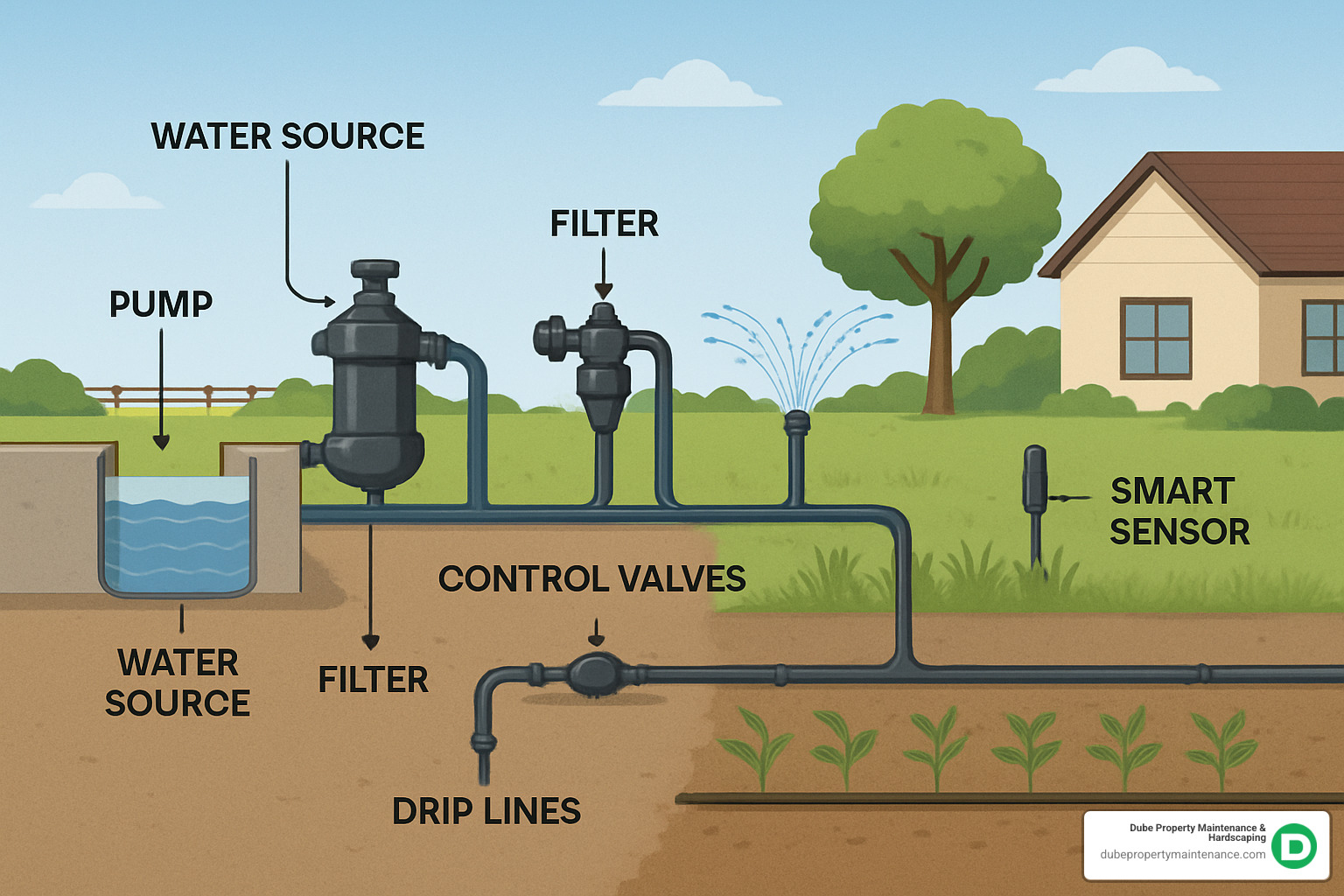
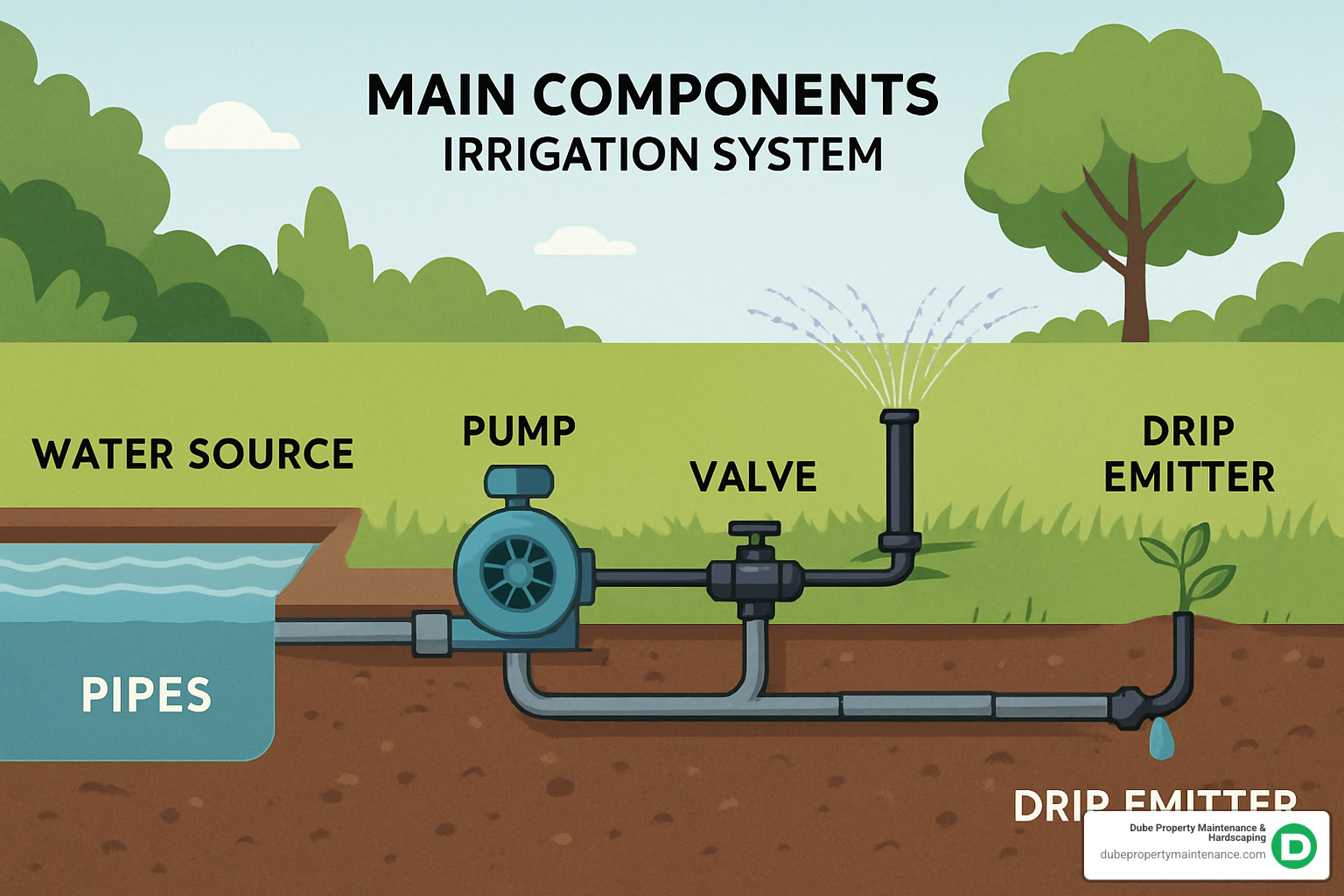
Every irrigation system is like a well-orchestrated team where each player has a crucial role. Let’s break down these essential components:
The journey begins with your water source. For most homes in Methuen and surrounding areas, this means a municipal connection, though some properties rely on private wells or even rainwater harvesting systems. Larger agricultural operations might even use treated wastewater – a sustainable approach gaining popularity.
Safety comes first with the backflow preventer – a non-negotiable component that keeps irrigation water from flowing backward into your drinking water. As one local irrigation specialist puts it, “Think of it as the security guard that never sleeps, protecting your family’s drinking water from potential contaminants.”
The controller serves as the brain of your system. From simple timers to sophisticated smart controllers that check weather forecasts before deciding whether to water, this component has seen remarkable innovation. Modern controllers can connect to your smartphone, learn from past performance, and even integrate with soil sensors to make real-time decisions about your lawn’s needs.
Valves act as the traffic directors of your system, controlling which zones receive water and when. A typical home in Massachusetts might have 4-12 zones, each designed to address different watering needs throughout the property.
The pipes and tubing form the circulatory system of your irrigation setup. Main lines (typically 1″ PVC buried 8-12″ deep) feed smaller lateral lines, which connect to individual sprinklers or drip zones. For drip irrigation, smaller ½” or ¼” tubing delivers water right to the plant’s root zone.
Water reaches your plants through various distribution devices – from pop-up sprinklers that create those familiar arcs of water to drip emitters that slowly release moisture directly to roots. The right choice depends on what you’re watering and your conservation goals.
For drip systems, filtration is essential to prevent tiny emitters from clogging. The cleaner your water source, the simpler your filtration needs will be. Finally, pressure regulators ensure everything operates at the optimal pressure – not too high to damage components, not too low to compromise coverage.
For our New England customers, we always design systems with winter in mind, incorporating proper drainage or blowout capabilities to prevent freeze damage during those cold Massachusetts winters.
How Do Irrigation Systems Work?
Gone are the days when irrigation meant simply turning on a spigot or setting a timer. Today’s systems are getting remarkably intelligent, making decisions based on multiple factors to deliver just the right amount of water.
The science of evapotranspiration (ET) drives modern irrigation scheduling. This fancy term simply refers to the combined water loss from soil evaporation and plant transpiration. Smart controllers calculate ET using temperature, sunlight intensity, wind speed, humidity, and even plant type to determine precisely how much water your landscape needs.
Soil moisture monitoring takes the guesswork out completely. Buried sensors measure available water in the root zone and wirelessly transmit readings to your controller. One customer told us, “It’s like my lawn now tells me when it’s thirsty rather than me having to guess.”
Weather integration is perhaps the most visible smart feature for homeowners. There’s nothing more frustrating than seeing sprinklers running during a rainstorm! Modern systems check both current conditions and weather forecasts before deciding whether to water. Many of our Methuen customers have saved 20-50% on their water bills after upgrading to weather-responsive controllers.
For larger agricultural applications, satellite and aerial imagery can detect plant stress and soil moisture variations across entire fields, allowing for incredibly precise irrigation management. One innovative platform called Manna even provides irrigation recommendations using satellite data without requiring ground sensors.
The beauty of these smart systems is their ability to learn and adapt. They analyze soil conditions, plant needs, and weather patterns to create increasingly efficient watering schedules over time. And with smartphone connectivity, you can monitor and adjust your system from anywhere – perfect for snowbirds or those traveling during summer months.
For homeowners in Massachusetts communities like Methuen, Andover, and North Andover, these smart controllers are particularly valuable given our region’s variable weather patterns. A system that can adapt to our unpredictable New England climate means healthier plants, lower water bills, and one less thing for you to worry about.
Scientific research on irrigation efficiency/02%3A_Environmental_Dynamics_and_Drivers/05%3A_Food_and_Water/5.01%3A_Water_resources_and_Food_Production/5.1.05%3A_Irrigation_Efficiency)
Let’s talk dollars and sense when it comes to irrigation systems. Whether you’re considering beautifying your Methuen property or ensuring your North Andover garden thrives through summer dry spells, understanding the investment involved helps you plan better.
Installing an irrigation system isn’t quite as simple as laying some pipes and calling it a day. It’s a thoughtful process that requires careful planning and execution.
At Dube Property Maintenance & Hardscaping, we approach each installation with meticulous attention to detail. The journey begins with a comprehensive site assessment where we evaluate everything from your soil type to existing landscaping. We map out sunny and shady areas, check your water pressure, and design zones based on what your plants actually need.
Before the first shovel hits dirt, we handle all the necessary permits (which vary depending on your town) and mark underground utilities—a step that’s absolutely non-negotiable for safety.
The actual installation involves precision trenching (typically 8-12 inches deep), connecting to your water source, installing the backflow preventer (required by code), laying main and lateral lines, and placing sprinkler heads or drip emitters exactly where they’ll work best. We carefully backfill trenches and replace sod, leaving your lawn looking like we were never there.
“The safest bet when it comes to installing an irrigation system is to leave all aspects of the job to experienced professionals,” as one industry expert puts it. This is especially true for technical components like backflow preventers, which must meet strict code requirements.
For Massachusetts homeowners, professional installation ensures your system can handle our unique climate challenges—particularly those freeze-thaw cycles that can wreak havoc on improperly installed systems.

Think of your irrigation system like a car—regular maintenance keeps it running smoothly and prevents costly breakdowns. In our New England climate, seasonal maintenance is particularly important.
During growing season, we recommend monthly check-ups: inspecting sprinkler heads for damage, clearing away debris that inevitably collects around emitters, and watching for signs of uneven watering like dry patches or soggy areas.
The seasonal rhythm of maintenance is especially important in Massachusetts. Spring startup involves carefully bringing your system back to life after winter dormancy—slowly pressurizing lines, checking for freeze damage, and adjusting your controller for spring conditions.
Mid-summer maintenance often means tweaking watering times to compensate for heat and checking that everything’s performing well during peak demand. If you’re using pond or stream water, you’ll need more frequent filter cleaning during summer months.
Perhaps most crucial for New England homeowners is proper fall winterization. Skip this step and you’ll likely face expensive repairs come spring. “We completely drain all water from the system and use compressed air to blow out any remaining droplets,” explains our winterization team. “Every component needs to be properly protected from freezing temperatures.”
As irrigation expert Mike Garcia colorfully puts it: “Push on it, and it’ll be good as new.” Simple maintenance like replacing broken nozzles or repairing punctured drip lines can often be straightforward—but knowing exactly what to fix and how to fix it comes with experience.
Cost Considerations
Let’s talk numbers. What is irrigation system pricing really like? The investment varies widely depending on your property size and system complexity.
For sprinkler systems, materials typically cost between $0.20–$1.00 per square foot. Professional installation for average residential properties ranges from $1,700–$10,500. If you’re interested in upgrading to a smart controller (which we highly recommend), budget an additional $200–$900.
Drip irrigation tends to be more affordable for smaller areas, with materials running $80–$300 per 100 feet of tubing. Complete systems for typical garden areas range from $225–$1,250, with professional installation adding 50-100% to material costs.
Don’t forget ongoing maintenance costs: Spring startup services average $50–$150, while proper winterization runs $75–$250. Many of our clients opt for annual service contracts ($300–$900) for peace of mind and consistent care.
These are average costs based on internet data and not actual costs for Dube Property Maintenance and Hardscaping. While the upfront investment might seem substantial, most homeowners find it pays for itself through water savings, healthier plants that need less frequent replacement, and increased property value.
For more detailed information about costs and services, check out our dedicated pages on Irrigation System Cost and Irrigation Services.
Irrigation systems have profound impacts beyond their immediate water delivery function. Understanding these broader implications helps property owners make informed decisions about system selection, design, and operation.

Environmental Considerations
When we talk about irrigation, we’re really talking about our relationship with one of earth’s most precious resources. The environmental footprint of irrigation systems extends far beyond your property line.
Water resources face significant challenges from poorly managed irrigation. Groundwater depletion occurs when we extract water faster than nature can replenish it. As one Britannica expert explains, “Otherwise, the water is said to be ‘mined,’ meaning that it is being used up as a natural resource and its use is considered unsustainable.”
Similarly, surface water diversion can dramatically affect streams, rivers, and the wildlife that depends on them. In Massachusetts, where our watersheds support diverse ecosystems, responsible irrigation practices help maintain this delicate balance.
The soil beneath our feet tells its own story too. Improper irrigation can lead to salinity buildup in poorly drained soils, essentially poisoning the ground over time. On the flip side, maintaining proper soil moisture supports beneficial microorganisms that create healthier, more resilient landscapes.
Perhaps most concerning is the issue of runoff carrying fertilizers and pesticides into our local water bodies. Here in Massachusetts, this runoff can eventually reach our beloved coastline, affecting marine life and water quality.
Regulatory Framework
If you’re installing an irrigation system in Massachusetts or New Hampshire, you’ll need to steer several regulations designed to protect our shared resources.
Massachusetts has particularly stringent water withdrawal permits for systems tapping into surface or groundwater sources. These regulations help ensure that individual usage doesn’t compromise community water supplies.
Backflow prevention isn’t just good practice—it’s required by law to protect public water supplies from contamination. During drought conditions, you may face seasonal water use restrictions that limit when and how much you can irrigate.
Many local municipalities actually incentivize water conservation through rebate programs. Some communities offer up to $300 back when you install water-efficient equipment like smart controllers. These programs acknowledge that individual actions collectively make a big difference in regional water conservation.
Social and Economic Impacts
Irrigation systems create ripples throughout our communities in ways you might not immediately recognize.
For homeowners in Methuen, Lawrence, and Haverhill, a well-designed irrigation system can boost property values significantly. Real estate professionals consistently note that established, healthy landscaping—made possible through proper irrigation—commands premium prices in our local market.
There’s also the matter of quality of life. The psychological benefits of green spaces are well-documented, and irrigation systems help maintain these spaces even during dry periods. When your lawn stays green without hours of hand-watering, you gain back precious time to actually enjoy your outdoor space.
From a broader perspective, irrigation supports food security by enabling reliable crop production, even as climate patterns become less predictable. The irrigation industry itself creates jobs in installation, maintenance, and manufacturing—contributing to our local economy right here in Massachusetts.
The irrigation world is experiencing a renaissance of innovation, with exciting developments that promise to make systems more efficient, sustainable, and user-friendly.
Precision agriculture technologies are changing how we approach irrigation. Imagine drones flying over your property, using thermal imaging to detect exactly which areas need water. This isn’t science fiction—it’s happening now. Machine learning algorithms can predict water needs based on countless variables, allowing for truly optimized watering schedules.
Water sources themselves are evolving. Graywater recycling systems capture water from sinks and showers for landscape irrigation, while rainwater harvesting systems with smart storage management make the most of every downpour. Here in coastal Massachusetts, some are even exploring desalinated water for irrigation purposes.
The components that make up irrigation systems are becoming smarter too. Biodegradable drip lines reduce environmental impact for temporary applications, while self-cleaning emitters cut down on maintenance headaches. Solar-powered pumps and controllers reduce energy consumption, making systems more self-sufficient and environmentally friendly.
“Waterscapes guarantees we have the best drip irrigation system UK,” notes a company specializing in irrigation technology. This global innovation benefits Massachusetts property owners as advances from around the world make their way to our local communities.
For homeowners in Methuen and surrounding areas, these innovations translate to more efficient systems that require less oversight while delivering better results. At Dube Property Maintenance & Hardscaping, we continuously evaluate new technologies to offer our clients the most effective, sustainable irrigation solutions.
The integration of irrigation with other building systems represents perhaps the most exciting frontier. Modern systems can connect to smart home platforms, allowing you to control watering alongside other home functions. Some innovative designs even capture condensate from air conditioning systems to supplement irrigation water—a perfect example of efficiency through integration.
National Geographic research on irrigation
Irrigation efficiency isn’t just a technical measurement—it’s the key to responsible water management and healthy plants. When we talk about field water efficiency, we’re looking at a simple formula: (Water transpired by the crop ÷ Water applied to the field) × 100.
The difference between irrigation systems can be dramatic. Drip irrigation systems achieve an impressive 80-90% efficiency, while traditional surface irrigation methods might only reach 40-60%. This efficiency gap translates directly to your water bill and your plants’ health.
Efficient irrigation creates a virtuous cycle for your landscape. When plants receive consistent moisture at their roots, they develop stronger root systems and show less stress. Nutrients in the soil become more available, and plants can actually use them better. You’ll also notice fewer disease problems since foliage stays drier with targeted watering. As an added bonus, when water goes precisely where it’s needed, weeds get less opportunity to compete with your desired plants.
For homeowners in Massachusetts, where summer water restrictions are becoming more common, an efficient system means your landscape can stay vibrant even during conservation periods. Your plants get what they need without waste, and you stay in compliance with local regulations.
Your irrigation system can tap into several different water sources, each with its own set of advantages and considerations.
Municipal water supply is the most common choice for residential properties in developed areas like Methuen and surrounding towns. City water offers reliability, consistent pressure, and doesn’t require additional filtration. The downside? You’ll pay for every drop, and during drought conditions, you might face restrictions on when and how much you can use.
If you have a private well, you’re essentially sitting on your own water supply. While there’s no monthly water bill, you’ll need to consider the electricity costs for pumping and potential issues with mineral content that might affect your system components. Wells work beautifully for rural Massachusetts properties with good groundwater resources.
Properties near ponds, lakes, or streams can tap these surface water sources, which is often more economical than municipal water. However, you’ll need good filtration to prevent clogging, and seasonal fluctuations can affect availability. Many of our clients with water features on their property integrate them into their irrigation planning.
Rainwater harvesting has gained popularity as an environmentally friendly option. The water is free and naturally soft (great for plants), but you’ll need adequate storage capacity to make it through dry periods. Many Massachusetts homeowners use rain barrels as a supplemental source for smaller gardens.
For larger commercial properties, recycled water offers sustainability benefits and often comes at a lower cost. However, it requires meeting certain regulatory requirements and may contain higher salt levels that need to be managed.
Your water source choice significantly impacts your system design and maintenance needs—something we carefully consider when planning irrigation installations for our Massachusetts clients.
If there’s one irrigation upgrade that consistently delivers outstanding returns, it’s a smart controller. These intelligent devices have transformed irrigation from a set-it-and-forget-it proposition to a responsive, adaptive system that works with nature rather than on a rigid schedule.
The water savings alone make smart controllers worth considering. Most users see a 20-50% reduction in water consumption compared to traditional timers. For a typical Massachusetts property, this can translate to hundreds of dollars saved annually on water bills. With investment costs ranging from $200 for simpler models to $900 for advanced systems, most homeowners recoup their costs within 1-3 years through water savings alone.
Beyond the financial benefits, smart controllers simply make life easier. Imagine adjusting your irrigation schedule from your smartphone while you’re on vacation, or knowing your system automatically skipped today’s watering because it rained last night. These controllers learn from weather patterns and soil conditions to make intelligent watering decisions without constant input from you.
“A smart controller uses local weather and site-specific landscape data to customize watering schedules,” explains an irrigation expert, “while a conventional controller runs on a preset schedule that must be manually adjusted.”
Your landscape benefits too. Plants receive more consistent moisture, developing stronger root systems and showing better resilience during hot periods. You’ll notice fewer puddles and less runoff since the system only waters when needed and at appropriate rates.
At Dube Property Maintenance & Hardscaping, we often suggest smart controllers as the first upgrade for existing irrigation systems. They’re relatively easy to install, immediately impact your water conservation efforts, and provide convenience that our busy Massachusetts clients appreciate. For most properties, they represent the perfect balance of technological advancement and practical benefit.
What is an irrigation system? As we’ve explored throughout this article, it’s far more than just pipes and sprinklers—it’s a sophisticated water management solution that transforms landscapes, conserves precious resources, and provides real peace of mind for property owners. From the ancient furrows that first channeled water to crops thousands of years ago to today’s satellite-controlled smart systems, irrigation technology continues to evolve in response to water scarcity challenges and environmental sustainability concerns.
For homeowners and businesses in Methuen, MA and surrounding communities throughout Massachusetts and New Hampshire, a properly designed irrigation system represents a valuable investment that pays dividends in multiple ways. Your lush, healthy lawn becomes the envy of the neighborhood. Your gardens thrive even during dry spells. And perhaps most importantly, you gain the freedom from constantly worrying about whether your landscape is getting enough water.
The right irrigation solution delivers consistent results while minimizing water consumption and reducing the time you spend on maintenance. Whether you’re maintaining a modest residential lawn, nurturing extensive gardens with specific watering needs, or managing sprawling commercial grounds, modern irrigation technology makes it all manageable with the touch of a button—or even automatically.
At Dube Property Maintenance & Hardscaping, we bring decades of hands-on experience to every irrigation project. We understand that no two properties are exactly alike, which is why our comprehensive approach ensures that your system is custom to your specific property conditions, plant requirements, and water conservation goals. From the initial consultation where we assess your needs through seasonal maintenance that keeps everything running smoothly year after year, our team provides the expertise needed for efficient, reliable irrigation that stands the test of time.
As water becomes an increasingly precious resource in our changing climate, efficient irrigation isn’t just a convenience—it’s a responsibility we all share. By implementing modern irrigation technology and following best practices, you’re making a meaningful contribution to water conservation efforts while simultaneously enjoying healthier, more beautiful landscapes that improve your property’s value and your quality of life.
Ready to explore irrigation solutions that make sense for your unique property? We’d love to help. Contact Dube Property Maintenance & Hardscaping for a friendly, no-pressure consultation. Our dedicated team serves communities throughout Massachusetts and New Hampshire, including Methuen, Lawrence, Andover, North Andover, and beyond—bringing professional irrigation expertise right to your doorstep.
More info about our complete irrigation systems
