
Shopping center snow removal requires specialized expertise that goes far beyond residential snow clearing. While a missed driveway might inconvenience a homeowner, inadequate snow management at a retail property can shut down business operations, create serious liability risks, and put hundreds of customers and employees at risk.
Quick Overview: Shopping Center Snow Removal Essentials
The stakes are dramatically higher for commercial properties. New Hampshire receives an average of 60 inches of snow annually, and each storm presents shopping centers with a complex puzzle: how to quickly clear massive areas while maintaining customer access, employee safety, and business continuity.
Unlike residential properties where snow can sit for days, shopping centers operate on zero tolerance policies. Customers expect safe, accessible parking and walkways from the moment doors open. A single slip-and-fall incident can result in costly lawsuits, while blocked access means lost revenue during critical shopping periods.
The complexity extends beyond just moving snow. Shopping centers feature unique obstacles like cart corrals, parking lot islands, loading docks, and pedestrian crosswalks that require specialized equipment and techniques. Standard residential snow removal approaches simply don’t work at this scale.
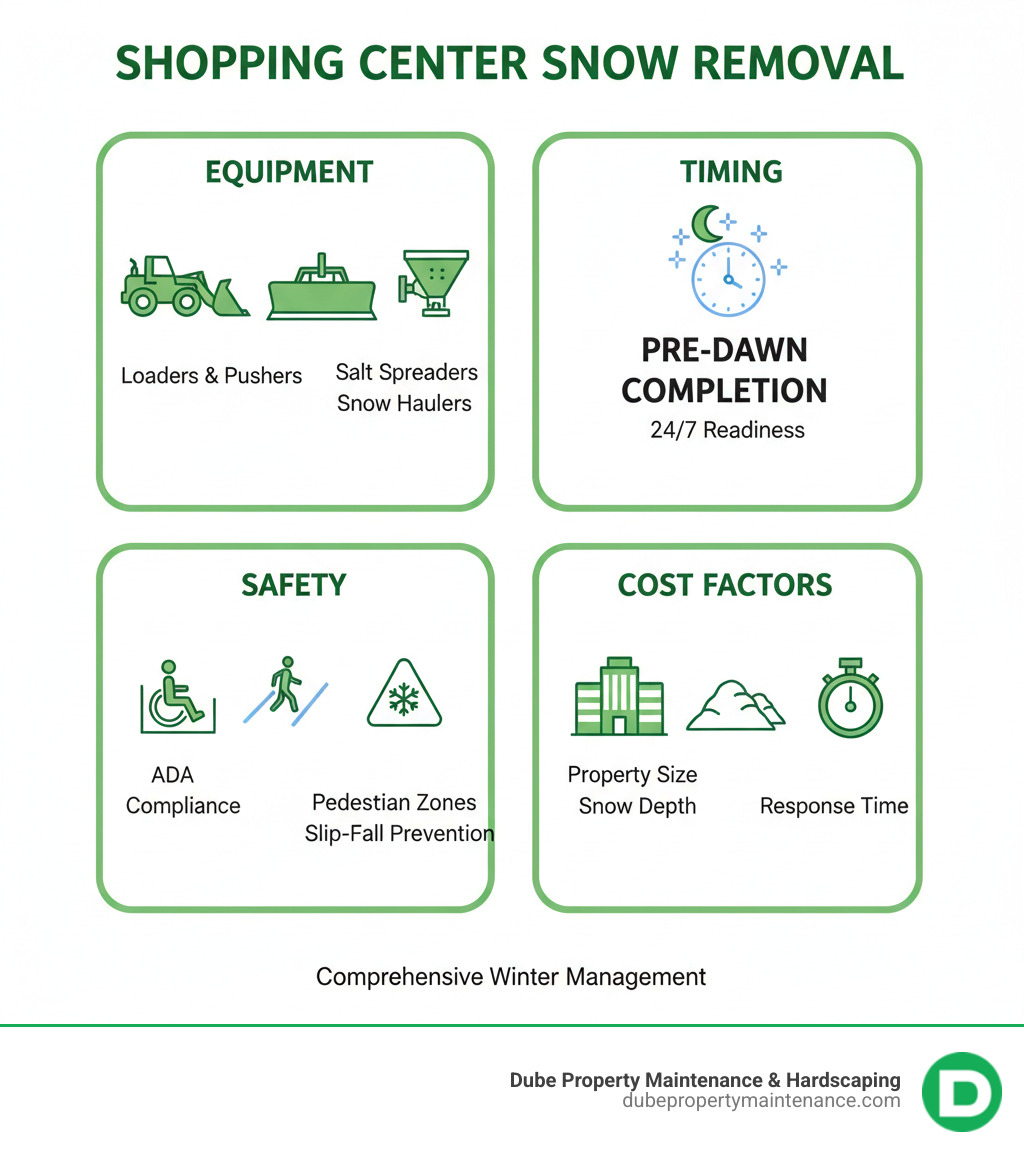
Shopping center snow removal terms made easy:
When winter storms hit, shopping center snow removal becomes a high-stakes operation that’s worlds apart from residential work. The scale, complexity, and public-facing nature of retail properties create challenges that demand specialized expertise, professional-grade equipment, and a level of precision most people never see.
Retail properties operate on zero tolerance policies to ensure customer access and employee safety from the moment they open. A blocked entrance means lost revenue, while an icy walkway can lead to costly slip-and-fall lawsuits. Furthermore, strict ADA compliance for parking, ramps, and walkways is a legal requirement, not just good practice. The penalties for non-compliance can be severe, and the liability risks keep property managers up at night.

Professional shopping center snow removal focuses as much on risk management as it does on moving snow.
More info about Business Snow Removal
A shopping center isn’t just a big parking lot; it’s an obstacle course that becomes exponentially more challenging when covered in snow and ice. Specialized attention is needed for:
The difference between residential and commercial snow removal is about more than just size—it’s about equipment, expectations, and consequences.
Effective shopping center snow removal requires a strategic approach that begins months before the first storm. It’s about proactive management—thinking several moves ahead, positioning resources, and executing with precision timing to keep your business running smoothly no matter what winter brings.
Our approach rests on comprehensive pre-season planning, continuous weather monitoring, smart resource allocation, site-specific execution plans, and technology integration to keep you informed.
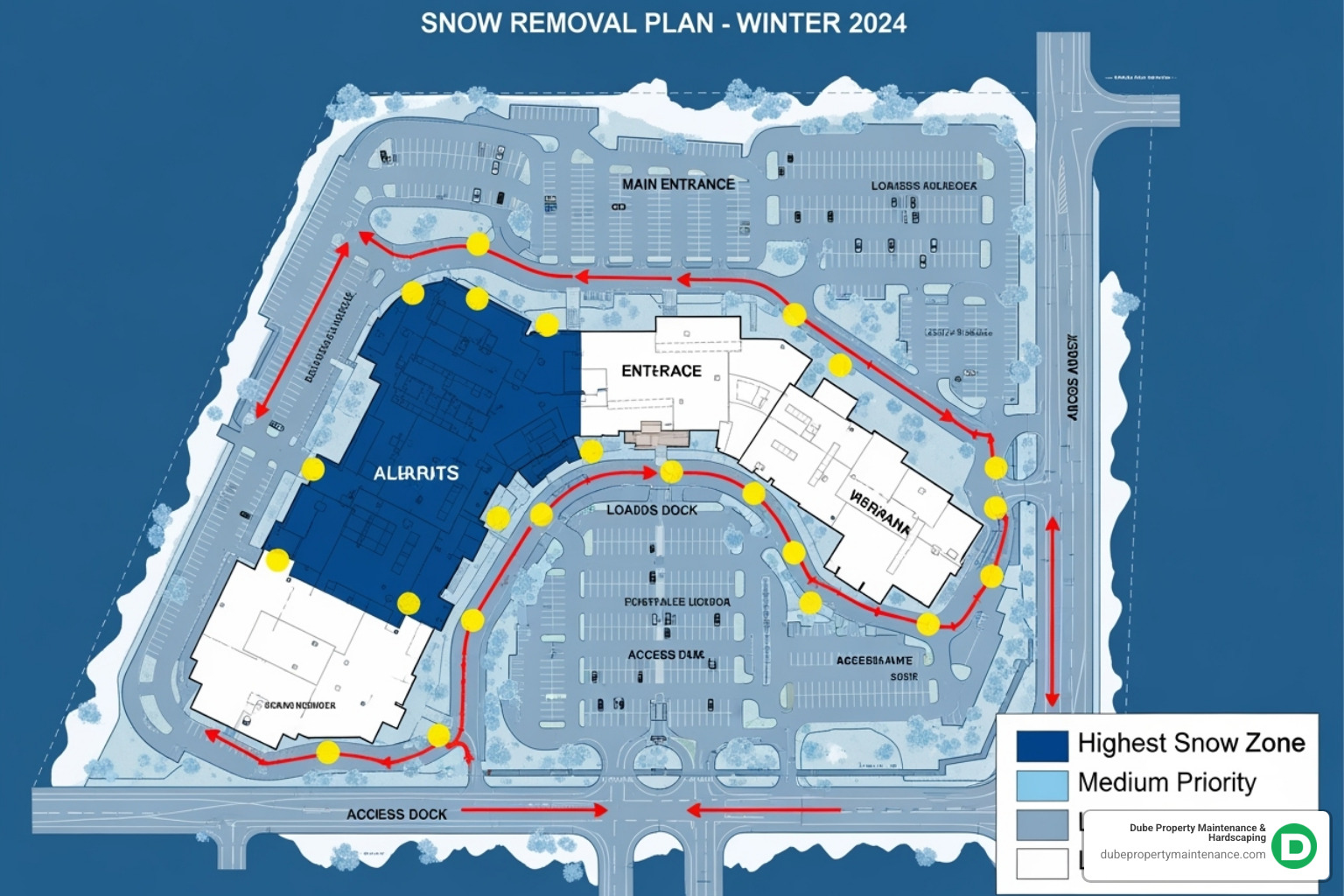
The best shopping center snow removal starts long before winter. We treat each property like a unique puzzle to be solved ahead of time.
SNOW REMOVAL BEST PRACTICES: BEFORE, DURING & AFTER THE SEASON
More info about Commercial Snow and Ice Management
Having the right tools is non-negotiable. Our fleet is purposefully assembled for the unique demands of retail properties.
Regular maintenance and backup units ensure our equipment is ready when you need it most.
More info about Commercial Snow Removal Equipment: What You Need to Know
Great equipment is only half the battle. Our techniques are refined for unpredictable New England winters.
Choosing the right de-icing agent involves balancing effectiveness, cost, and environmental impact.
| De-icing Agent | Effectiveness | Temperature Range | Environmental Impact |
|---|---|---|---|
| Rock Salt (Sodium Chloride) | Good, but corrosive | Down to 20°F (-6°C) | High (corrosive, harms plants, water runoff) |
| Calcium Chloride | Very good, fast-acting | Down to -25°F (-32°C) | Moderate (some corrosion, less harmful to plants than rock salt) |
| Magnesium Chloride | Good, less corrosive | Down to -15°F (-26°C) | Low (less corrosive, safer for plants and pets) |
| Potassium Chloride | Good, less corrosive | Down to 15°F (-9°C) | Low (safer for plants and pets) |
| Calcium Magnesium Acetate (CMA) | Excellent, non-corrosive | Down to 15°F (-9°C) | Very Low (environmentally friendly, non-corrosive) |
We select materials based on forecasts and your property’s specific needs to protect your landscaping investment.
More info about Snow Salting Service
Disclaimer: The following price ranges are based on general industry data and are for informational purposes only. They do not represent actual quotes from Dube Property Maintenance & Hardscaping. Costs can vary significantly based on specific needs and location.
Budgeting for shopping center snow removal can feel unpredictable, but understanding pricing structures turns the guessing game into smart financial planning. The most successful property managers conduct a thorough cost-benefit analysis, balancing budget concerns with the high costs of being unprepared.
The cost of professional snow removal is an investment in preventing liability from slip-and-fall lawsuits and revenue lost when customers can’t safely access your stores.
More info about Cost-Effective Snow Management for Small Businesses
Choosing the right pricing model is like picking the right winter coat—it needs to fit your situation. Here are the most common approaches in the industry:
We work with you to determine which model best aligns with your budget and local snowfall patterns.
More info about Commercial Snow Plow Cost
Several key factors impact your investment in professional snow management:
For a shopping center, shopping center snow removal is fundamentally about managing business risk. You’re not just dealing with snow; you’re protecting customers, employees, and your bottom line from the devastation of a slip-and-fall lawsuit or business closure.
A reliable snow removal partner understands that liability protection and slip-and-fall prevention are just as critical as moving snow. This focus on risk management is what separates a professional service from someone with just a plow truck.

A well-written contract is your first line of defense. It ensures everyone knows what to expect when snow starts flying. Key elements include:
More info about Commercial Snow Removal Contract
Safety is about creating an environment where everyone can work and shop confidently, even in harsh winter conditions.
When you’re managing a shopping center, you need straight answers to your snow removal questions. Here are some of the most common ones we hear.
A reliable contractor provides 24/7 availability and carries adequate insurance ($2 million+ in liability is standard for commercial work). They should have a large fleet of appropriate equipment, including heavy-duty loaders and skid steers with backups available. Look for professionals who conduct detailed pre-season planning, provide post-event reporting, and can offer references from other retail properties. They must prioritize commercial clients and understand the urgency of your business needs.
When on-site space is limited, snow hauling and removal is the solution. This process involves using large loaders to fill dump trucks, which then transport the snow to an off-site disposal location, often called a snow farm. This service is critical for urban properties or any shopping center that cannot afford to lose valuable parking spaces to snow piles. The need for hauling should be identified during pre-season planning and included in the contract.
A comprehensive pre-season plan is your roadmap for a safe winter. It must include:
Winter doesn’t have to be the season that keeps your customers away. With the right approach to shopping center snow removal, those snowy months can be just as profitable as any other time of year. The secret? Proactive planning that starts long before the first forecast calls for snow.
We’ve learned that the best snow management strategies begin with understanding your property inside and out. Every shopping center has its own personality – from the way traffic flows through the parking lot to where snow naturally drifts against buildings. Specialized equipment isn’t just about having the biggest plow; it’s about having the right tools for your specific challenges.
When a storm hits, professional execution makes all the difference. There’s something reassuring about knowing your snow removal team has done this hundreds of times before. They know which areas to clear first, how to keep pedestrian pathways safe, and when to switch from plowing to hauling snow off-site.
But perhaps most importantly, effective snow removal is about risk mitigation. Every slip-and-fall prevented, every accessible parking space maintained, and every clear walkway is protecting both your customers and your business. Insurance claims, liability lawsuits, and lost revenue from inaccessible stores – these are the real costs of inadequate snow management.
At Dube Property Maintenance & Hardscaping, we understand that your success during winter depends on more than just moving snow around. It’s about creating a comprehensive strategy that keeps your doors open and your customers safe, no matter what Mother Nature throws at us.
Choosing a reliable partner is the most critical step in ensuring your shopping center remains safe, accessible, and open for business all winter long. The difference between a contractor who “does snow removal” and one who specializes in commercial properties can mean the difference between a successful winter season and a stressful one.
For a comprehensive strategy custom to your property’s unique needs, explore our Commercial Plowing Service. Because when winter arrives, you’ll want a team that’s as committed to your success as you are.
