
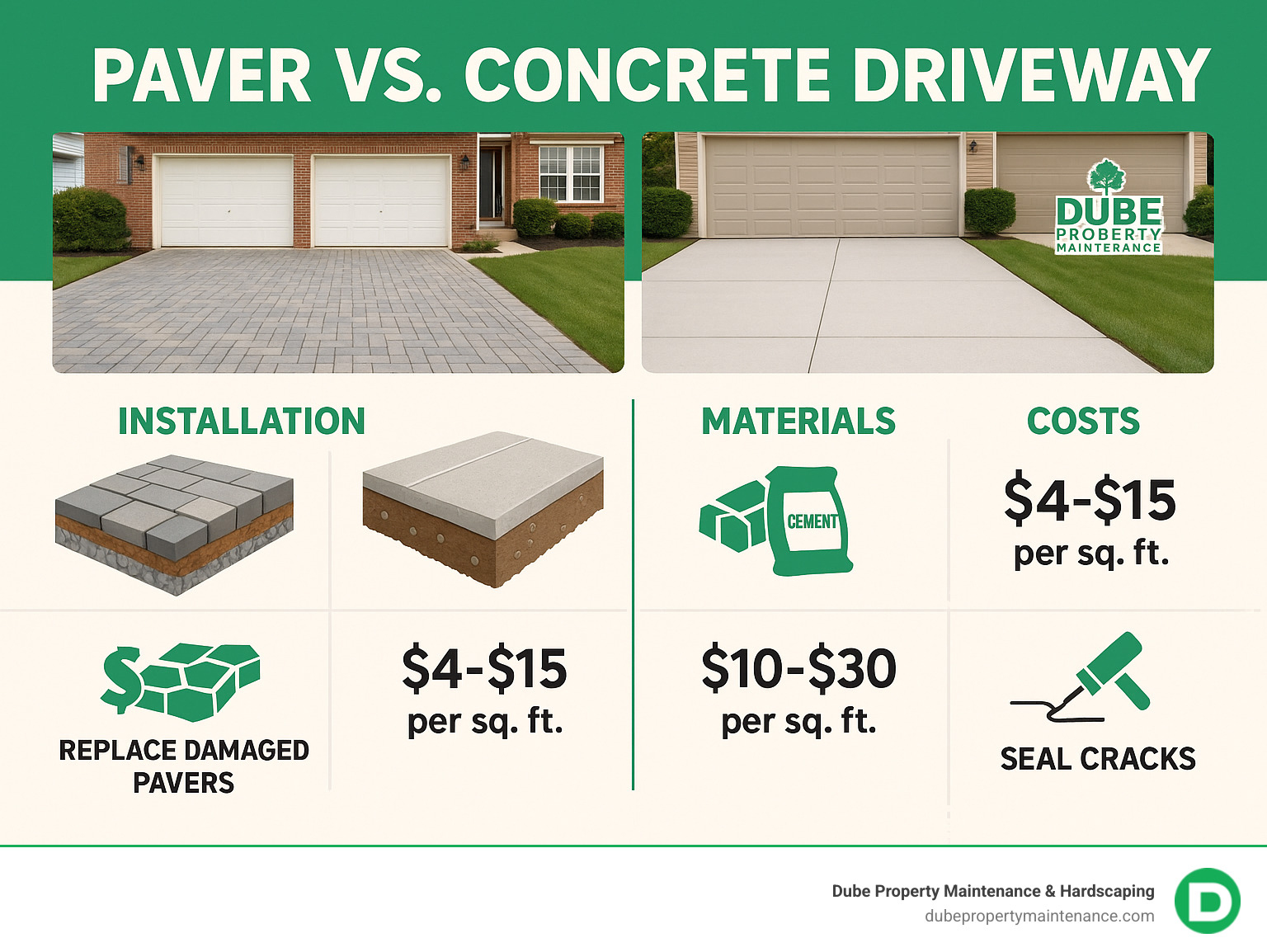
If you’re researching paver driveway cost vs concrete, here’s the quick comparison:
| Feature | Concrete Driveways | Paver Driveways |
|---|---|---|
| Cost per sq ft | $4-$15 installed | $10-$30 installed |
| Average 2-car driveway | $1,600-$4,600 | $5,700-$17,200 |
| Lifespan | 30-50+ years | 25-75+ years |
| Strength | 3,500-4,000 PSI | 8,000-12,000 PSI |
| Repair cost | $8-$500+ per repair | $15-$125+ per paver |
Standing at the edge of your property, you’re faced with an important decision that impacts both your home’s curb appeal and your wallet. Paver driveway cost vs concrete considerations go beyond just the initial price tag, extending into decades of ownership.
Homeowners in Methuen and across New England must weigh upfront expenses against long-term value. While concrete offers a lower initial investment at $4-$15 per square foot installed, pavers provide superior strength, easier repairs, and more design flexibility at $10-$30 per square foot.
“Many paving stone driveways we’ve installed almost 20 years ago still look amazing,” notes one industry professional, highlighting the lasting value despite higher upfront costs.
Your decision involves more than just materials. You’re choosing between:
The New England climate adds another layer of complexity, with freeze-thaw cycles testing the durability of both options. While concrete may develop cracks over time, properly installed pavers can flex with ground movement, often providing better long-term performance in our region.
Note: The prices listed represent average costs based on national data and not actual costs for Dube Property Maintenance and Hardscaping services. Local factors will influence your final price.
Basic paver driveway cost vs concrete glossary:
– cost to seal driveway pavers
– cost to widen driveway with pavers
– cost of permeable paver driveway
Looking ahead to 2025, the financial gap between paver driveway cost vs concrete remains significant, but understanding the full picture can help you make the right investment for your home.
Concrete driveways typically run between $4 and $15 per square foot installed. This price covers your basics – materials, labor, and standard site prep work. If you’re eyeing something with a bit more character, colored or textured concrete options sit at the higher end of this range, giving your driveway more visual appeal without jumping to premium pricing.
Paver driveways command a higher investment, generally ranging from $10 to $30 per square foot installed. This wider price spectrum reflects the incredible variety available – from budget-friendly concrete pavers to stunning natural stone options that can transform your property’s entire appearance.
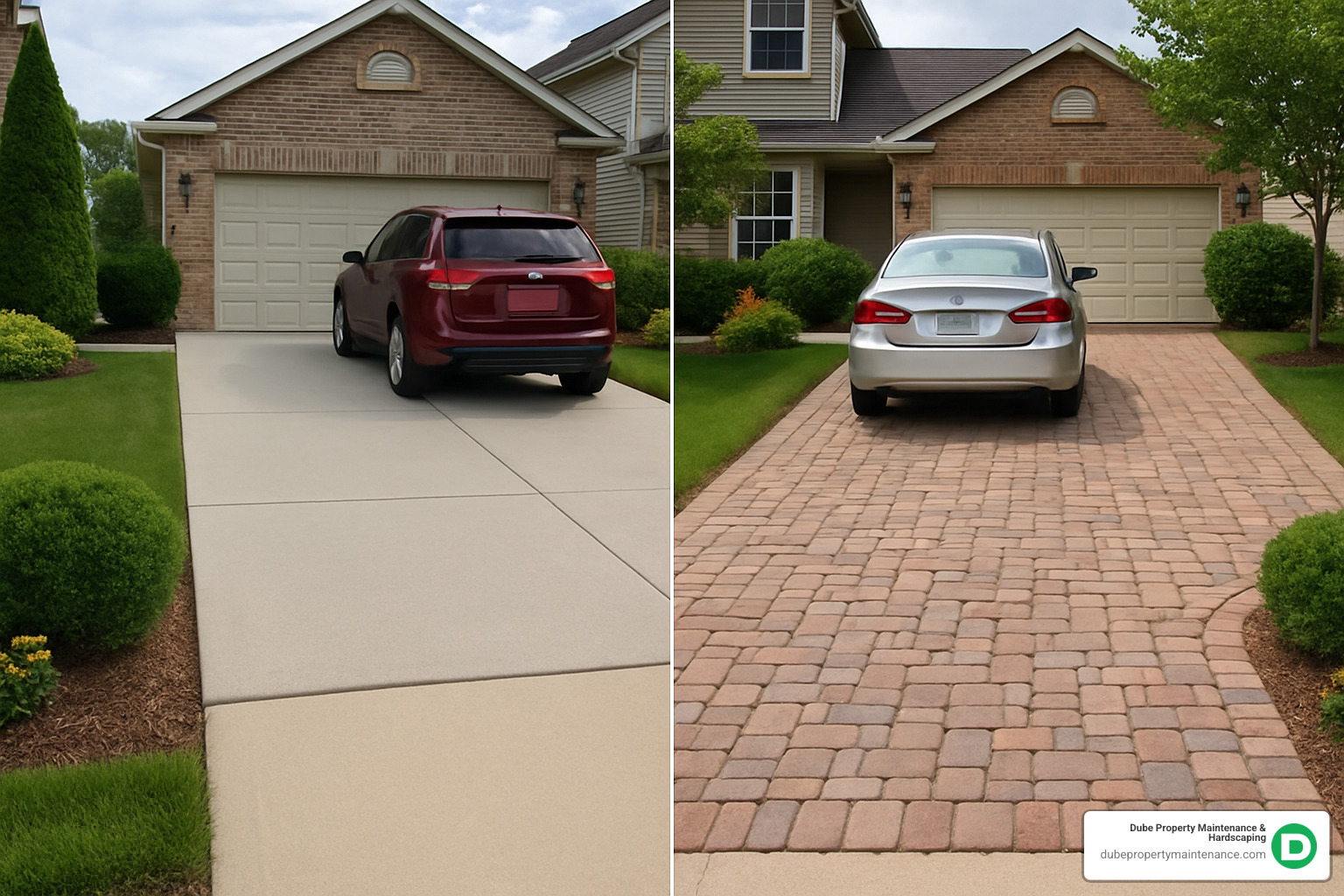
When we break down where your money goes, labor takes up about 40-60% of your total concrete installation cost. Paver installation is even more hands-on, with labor often representing 60-70% of the final bill. This difference makes perfect sense when you consider pavers require careful hand-placement, while concrete can be poured more mechanically.
“The labor cost difference reflects the craftsmanship involved,” explains a Dube Property Maintenance technician. “Each paver is placed individually, creating a stronger, more flexible surface that can last generations.”
To make this concrete (pun intended!), let’s look at what these numbers mean for a typical two-car driveway measuring 24′ x 24′ (576 square feet):
Concrete Driveway
– Basic gray concrete: $2,304 – $4,608 ($4-$8 per sq ft)
– Colored concrete: $3,456 – $6,912 ($6-$12 per sq ft)
– Stamped decorative concrete: $6,912 – $10,368 ($12-$18 per sq ft)
Paver Driveway
– Concrete pavers: $5,760 – $11,520 ($10-$20 per sq ft)
– Brick pavers: $8,640 – $17,280 ($15-$30 per sq ft)
– Natural stone pavers: $14,400 – $28,800 ($25-$50 per sq ft)
Here’s an interesting twist – stamped or decorative concrete can actually cost as much as (or more than) basic paver options. This narrows the price gap considerably for homeowners who want something more visually appealing than plain concrete.
When budgeting for your driveway project, several sneaky costs can catch you by surprise if you’re not prepared:
Permits and Inspections: Here in Massachusetts and New Hampshire, permit fees typically run $50 to $250. Many towns require these permits for new driveways or major changes to existing ones. It’s a small line item that’s easy to overlook.
Old Driveway Removal: Tearing out that existing concrete driveway? That’ll cost you $2-$6 per square foot, potentially adding $1,152-$3,456 to our example 576 sq ft driveway. Asphalt removal is slightly cheaper at $1-$3 per square foot.
Site Preparation and Grading: Proper water drainage isn’t just nice to have – it’s essential for your driveway’s lifespan. Extensive grading work can add $1-$2 per square foot. If your property has challenging soil conditions, you might need additional excavation and base materials.
Drainage Solutions: New England’s weather demands proper drainage. Adding systems like French drains or catch basins can add $1,500-$5,000 to your project, but they’re worth every penny when spring rains come.
Material Disposal: Hauling away old materials costs $300-$1,800 depending on volume and distance to disposal facilities – another easily forgotten expense.
One Methuen homeowner shared with us: “I nearly fell over when my concrete quote jumped by $2,000 after they finded poor soil under my old driveway. The extra base preparation wasn’t optional – it was necessary for a driveway that would last.”
Note: The prices listed represent average costs based on national data and not actual costs for Dube Property Maintenance and Hardscaping services. Local factors will influence your final price.
When planning your driveway project, several key factors will influence the final cost—whether you choose the affordability of concrete or the premium appeal of pavers.
Size and layout complexity plays a major role in your budget calculations. While square footage is the most obvious cost driver, those curved edges or circular designs you’re dreaming about? They’ll add 15-30% to your total investment. That neat circular driveway requires more precise cutting and fitting, translating to additional labor hours.
“Many homeowners don’t realize how much layout complexity affects their bottom line,” shares one of our Dube Property Maintenance team members. “A simple rectangular driveway is much more economical than one with multiple curves or sections.”
Material grade and quality significantly impact both performance and price. For concrete driveways, higher PSI ratings (4,000+ compared to standard 3,000-3,500) provide better durability but at a higher cost. With pavers, thickness matters—vehicles need at least 2⅜” thick pavers, while premium options reaching 3″ offer superior longevity but at a premium price point.
Here in Methuen and surrounding communities, local labor rates tend to run higher than national averages. This reflects the specialized expertise required for proper hardscaping installation. Quality craftsmanship isn’t cheap, but it’s an investment that pays dividends through fewer repairs and longer lifespan.
Our New England soil conditions demand thorough site preparation. For paver driveway cost vs concrete comparisons, it’s worth noting that pavers typically require:
– 8-14″ excavation depth
– 6-12″ of compacted gravel base
– 1-3″ of bedding sand
Concrete installations still need:
– 6-8″ excavation
– 4″ of compacted gravel base
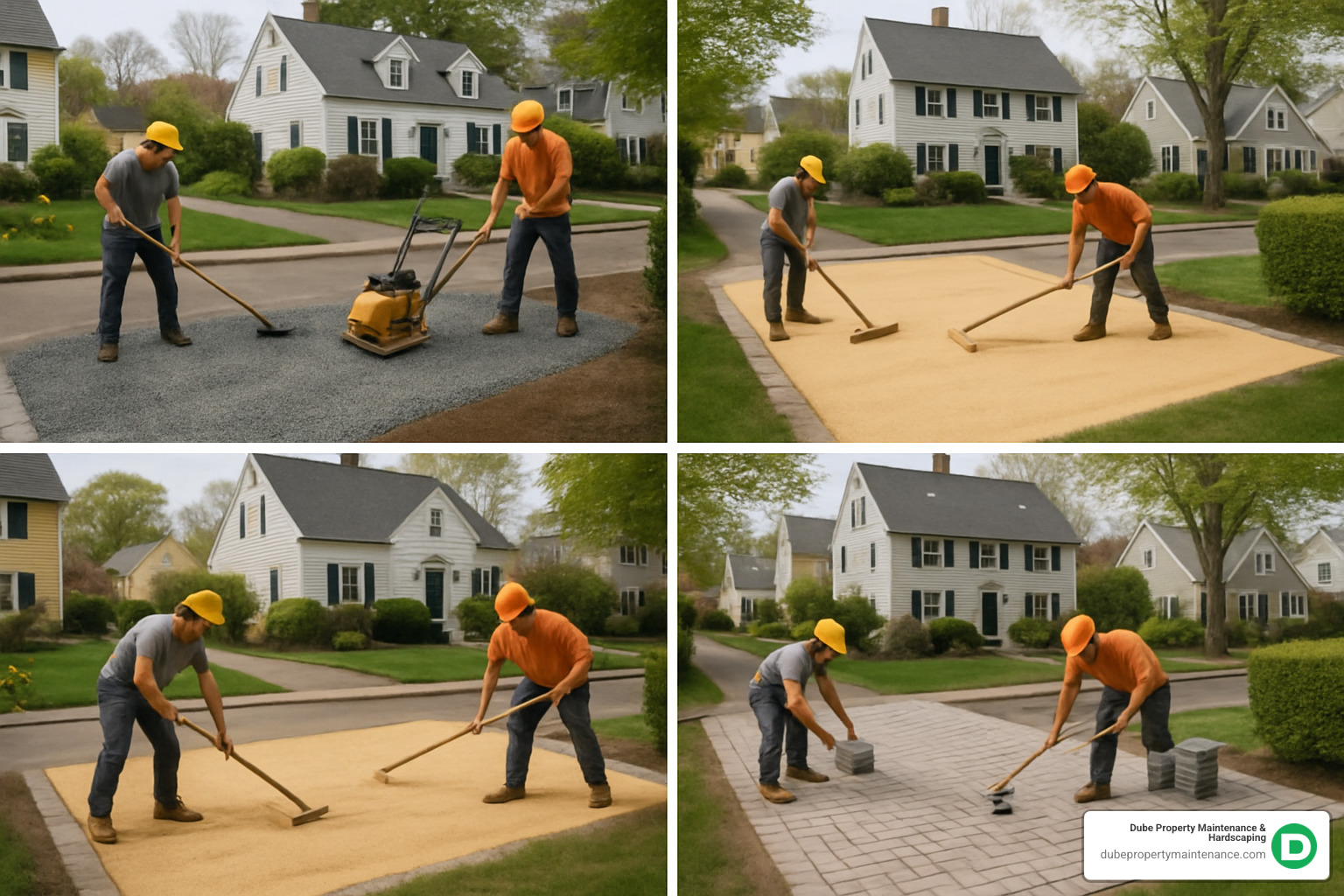
The harsh freeze-thaw cycles we experience in Massachusetts demand special attention. Proper base depth isn’t just a recommendation—prevent frost heave damage. While this increases your initial installation costs, it saves considerable money long-term by preventing premature failure. We’ve seen too many driveways with inadequate bases fail after just a few New England winters.
Don’t underestimate how design complexity affects your investment. Paver patterns like herringbone or basketweave require more cutting and precision than simple running bonds. Similarly, concrete finishes beyond basic broom textures—like exposed aggregate or stamped patterns—require specialized skills and more labor hours. Those beautiful border details and accent inlays add both visual interest and cost to your project.
For more detailed information about our installation process, visit our Driveway Installation page.
The specific materials you select within each category dramatically impact both your budget and long-term satisfaction.
Concrete finishes range widely in price and appearance. Basic broom finish concrete ($4-$8/sq ft) provides an economical, slip-resistant surface. Exposed aggregate ($6-$10/sq ft) reveals decorative stone within the concrete for improved visual interest. For those seeking color, integral colored concrete ($6-$12/sq ft) offers consistent hues throughout the slab.
Homeowners wanting the look of pavers without the price tag often consider stamped concrete ($12-$18/sq ft), which can mimic stone or brick patterns. For modern homes, polished concrete ($15-$30/sq ft) creates a smooth, reflective finish that’s becoming increasingly popular.
Within the paver options category, concrete pavers ($10-$20/sq ft installed) offer the most economical entry point while still providing the flexibility and repair advantages of individual units. Clay brick pavers ($15-$30/sq ft installed) bring classic charm with natural color variations that often improve with age.
For luxury projects, natural stone pavers ($25-$50/sq ft installed) provide best character and uniqueness. Modern homes often benefit from porcelain pavers ($20-$40/sq ft installed), which resist staining and fading exceptionally well. Environmentally-conscious homeowners increasingly choose permeable pavers ($15-$30/sq ft installed) that allow water infiltration to reduce runoff.
“Concrete pavers offer that sweet spot between affordability and performance,” notes our hardscaping team. “They give you the look and flexibility of pavers with pricing that’s easier on the wallet than natural stone.”
Living in New England means our driveways face challenges that Sun Belt residents simply don’t encounter.
Frost heave protection is non-negotiable in our region. With frost lines extending 48-60″ deep in Massachusetts and New Hampshire, proper base preparation becomes critical. This typically means deeper excavation and more substantial base material than southern installations, adding to overall project costs but providing essential protection.
Salt exposure represents another regional challenge. Road salt and deicing chemicals can be particularly harsh on concrete, causing scaling and spalling over time. Higher-quality concrete with proper air entrainment helps, but paver driveway cost vs concrete comparisons should factor in concrete’s greater vulnerability to salt damage.
Winter maintenance brings snowplow considerations into focus. The edges of concrete driveways can chip from snowplow contact, creating permanent damage. Pavers offer a distinct advantage here—if damage occurs, we can simply replace individual units rather than patching or replacing entire sections.
Many local code requirements throughout Essex County and southern New Hampshire specifically address driveway materials, slopes, and drainage solutions. Some communities now offer incentives for permeable paving options that reduce stormwater runoff, potentially offsetting some of the higher initial costs.
After decades of serving communities from Methuen to North Andover and beyond, we’ve observed that properly installed paver driveways typically outperform concrete in our freeze-thaw climate. Their flexible nature allows slight movement without cracking, and their individual unit construction makes repairs simpler and less noticeable.
Note: The prices listed represent average costs based on national data and not actual costs for Dube Property Maintenance and Hardscaping services. Local factors will influence your final price.
When you’re weighing paver driveway cost vs concrete, understanding the installation process reveals why there’s such a price difference between these options. It’s not just about materials—it’s about time, labor, and equipment too.
Concrete Driveway Installation:
– Crew size: Typically 3-5 workers
– Equipment: Excavator, forms, concrete truck, power trowel, finishing tools
– Timeline: 3-5 days total (1-2 days prep, 1 day pour, 3-7 days curing)
– DIY difficulty: Moderate to high (timing critical, finishing requires skill)
– Curing time: 7 days before light vehicle use, 28 days for full strength
Paver Driveway Installation:
– Crew size: Typically 3-6 workers
– Equipment: Excavator, plate compactor, cutting tools, laser level
– Timeline: 5-10 days total for a standard driveway
– DIY difficulty: Moderate to high (labor-intensive, precision required)
– Curing time: None (immediate use after installation)
One major advantage of pavers often gets overlooked in the cost conversation. As one of our hardscaping professionals likes to point out, “Pavers require no curing time and can be used immediately upon installation.” For busy families in Methuen who can’t park on the street for days or weeks, this immediate usability can be worth the extra investment.
Ready to skip the DIY headaches? You can Find Pros Now who specialize in your preferred material and get your project started right.
If you’re the hands-on type considering a DIY approach, here’s what you should know before heading to the rental center:
For a DIY concrete driveway, expect material costs around $3-$7 per square foot. You’ll need to rent equipment like a mixer, power trowel, and forms, adding $150-$500 to your budget. The time investment is typically 3-7 days, and timing is everything—once that concrete truck arrives, there’s no pause button! While you might save 40-50% compared to professional installation, concrete finishing is genuinely skilled work that takes practice to master.
A DIY paver driveway requires materials costing $5-$15 per square foot, plus equipment rentals (plate compactor, saw, laser level) totaling $200-$600. The process is more forgiving time-wise but physically demanding. Expect to spend 7-14 days on an average driveway, with potential savings of 30-40% over professional installation.
John from North Andover told us about his DIY paver experience: “I saved money, but my knees haven’t forgiven me yet! The cutting was the trickiest part—getting those edge pieces just right took patience.”
Before starting any DIY project, remember to:
– Call 811 to locate underground utilities before digging
– Check with your town about permits (many Massachusetts towns require them)
– Add 10% to your material calculations to account for inevitable waste
– For pavers especially, don’t skimp on base preparation—it’s 70% of your project’s success
When you hire professionals, you’re paying for both expertise and efficiency. Here’s how the labor costs typically break down:
For concrete driveways, the labor portion runs about $2-$6 per square foot. If you’re eyeing decorative or stamped concrete, add another $2-$5 per square foot for that specialized finishing work. Most concrete contractors offer warranties ranging from 1-5 years.
Paver installation labor is more intensive, running $9-$15 per square foot. This reflects the hand-placement of hundreds or thousands of individual units. Complex patterns with multiple colors or sizes can add $2-$5 per square foot to that labor cost. The good news? Paver installation typically comes with longer warranties—often 2-10 years on the installation work itself, with some manufacturers offering lifetime product warranties.
“Be skeptical of unusually low bids,” advises our installation team leader. “They often indicate corners being cut on proper base preparation or the use of substandard materials.” This is particularly true for concrete work, where the invisible elements—proper reinforcement, mix design, and curing techniques—directly impact how long your driveway will last in our harsh New England climate.
When reviewing professional quotes, make sure they include:
– Detailed specifications for base materials and depth
– Clear outline of drainage solutions
– Specific product information for materials
– Comprehensive warranty information
– Timeline expectations
At Dube Property Maintenance & Hardscaping, we believe in transparent pricing that accounts for proper preparation and quality materials suited specifically to our local Methuen and greater New England conditions. We’d rather explain the price once than apologize for quality issues for years to come.
Note: The prices listed represent average costs based on national data and not actual costs for Dube Property Maintenance and Hardscaping services. Local factors will influence your final price.
When comparing paver driveway cost vs concrete, the story doesn’t end after installation. The true value becomes apparent when you consider the decades of ownership ahead.
Think of your driveway as a long-term relationship rather than a one-time purchase. Like any relationship, it requires ongoing care and occasional intervention to keep things running smoothly.
Concrete driveways demand regular attention to maintain their appearance and functionality. You’ll need to apply a fresh coat of sealer every 2-5 years, costing between $0.50-$2.50 per square foot. Annual or bi-annual power washing ($100-$300) keeps the surface clean, while crack filling at $8-$15 per linear foot becomes increasingly necessary as the years pass. After about 15-20 years, most concrete driveways benefit from resurfacing at $3-$7 per square foot to restore their appearance.
“I wish someone had told me about the maintenance schedule when I installed my concrete driveway,” shares one Methuen homeowner. “The crack repairs weren’t in my budget planning.”
Paver driveways follow a different maintenance rhythm. Sealing occurs less frequently (every 3-5 years) though at a slightly higher cost of $0.75-$3.00 per square foot. Joint sand refreshing every 2-3 years ($0.50-$1.50 per square foot) helps maintain the structural integrity. The game-changer comes with repairs – individual pavers can be lifted and replaced for $15-$125+ per paver without disturbing the entire surface.
Winter maintenance also differs significantly between the two. Concrete can be particularly sensitive to deicing salts, which can cause surface scaling. Pavers generally tolerate salt better, though snowplow operators should take care not to catch edges.

For more details about concrete replacement options, our Cost to Remove and Replace Concrete Driveway page provides comprehensive information.
When it comes to standing the test of time, concrete and pavers each have their own story to tell.
Concrete driveways typically last 30-50+ years when properly installed and maintained. With a compression strength of 3,500-4,000 PSI, they provide reliable performance for most residential needs. However, their monolithic structure means that stress affects the entire slab, and New England’s freeze-thaw cycles can be particularly challenging, often leading to cracking over time. Colored concrete may also fade with prolonged sun exposure.
Paver driveways often outlast their concrete counterparts, with lifespans ranging from 25-75+ years. The most impressive statistic? Their compression strength of 8,000-12,000 PSI – up to three times stronger than poured concrete.
“Pavers are rated to be four times as strong as a typical concrete slab, meaning they can handle four times as much weight before cracking,” explains a hardscaping expert at Dube Property Maintenance. “Plus, their interlocking system distributes weight more effectively.”
Pavers truly shine in our New England climate. Their individual units can shift slightly during freeze-thaw cycles without cracking, providing excellent long-term performance in our challenging weather conditions.
Let’s talk dollars and cents over the long haul for a standard 576 sq ft driveway:
For a concrete driveway, your 20-year maintenance journey might include:
– Minor crack filling around years 5-10: $200-$600
– Major crack repair between years 10-15: $500-$1,500
– Partial resurfacing around years 15-20: $1,728-$4,032
– Potential full replacement after year 20: $2,304-$8,640
All told, you’re looking at potential 20-year repair costs between $4,732-$14,772.
For a paver driveway, the 20-year maintenance picture looks quite different:
– Joint sand refreshing every 3 years: $864-$2,592 total
– Individual paver replacements as needed: $300-$1,500 total
– Releveling of any settled areas if needed: $500-$2,000
Your potential 20-year repair costs range from $1,664-$6,092 – potentially less than half the long-term maintenance costs of concrete.
“The beauty of pavers is their repairability,” notes one of our Methuen customers. “When my delivery truck damaged a section, we simply replaced a few pavers rather than dealing with an unsightly patch or complete replacement.”
This repair flexibility often translates to lower lifetime costs, despite the higher initial investment. As we tell our clients in Methuen and beyond, “Concrete driveways cost less up front, but higher maintenance and repair costs may make them more expensive over the long term compared to pavers.”
Note: The prices listed represent average costs based on national data and not actual costs for Dube Property Maintenance and Hardscaping services. Local factors will influence your final price.
When you’re standing in your driveway imagining an upgrade, the debate of paver driveway cost vs concrete comes down to more than just dollars. Let’s look at what each option really offers your home.
Concrete driveways have earned their popularity for good reason. They give you a clean, uniform surface that installs relatively quickly and won’t break the bank upfront. Many homeowners appreciate concrete’s smooth finish, especially when improved with decorative techniques like stamping or coloring. With fewer joints than pavers, you’ll spend less time battling weeds and more time enjoying your driveway.
“I went with concrete because I wanted something simple and cost-effective,” shares one Methuen homeowner. “Five years in, it’s held up well despite our harsh winters.”
However, concrete isn’t without drawbacks. Those beautiful New England winters we endure can be tough on concrete surfaces. Freeze-thaw cycles often lead to cracking over time, and when repairs are needed, they typically remain visible no matter how carefully they’re done. Concrete can also become surprisingly slippery when wet or icy – something to consider when planning for our regional weather.
Pavers, on the other hand, offer remarkable strength – typically 8,000-12,000 PSI compared to concrete’s 3,500-4,000 PSI. This exceptional durability comes with flexibility; the individual units can move slightly with ground shifts without cracking. Perhaps most appealing to busy families is that paver driveways are ready for immediate use after installation, with no curing time required.
“The design options with pavers are practically endless,” notes a Dube Property Maintenance & Hardscaping specialist. “From classic brick patterns to modern concrete pavers in various colors, we can create something truly unique for each homeowner.”
The slip-resistant surface of pavers provides better traction when wet – a significant safety advantage for New England properties. And should damage occur, you can replace individual pavers rather than dealing with an entire slab.
The downside? Pavers do require a higher initial investment of both money and installation time. The joints between pavers need periodic maintenance, including sand refreshing every few years. Some homeowners find that weeds can be persistent in these joints unless properly maintained, and snowplow operators need to take care not to catch plow edges on the pavers.
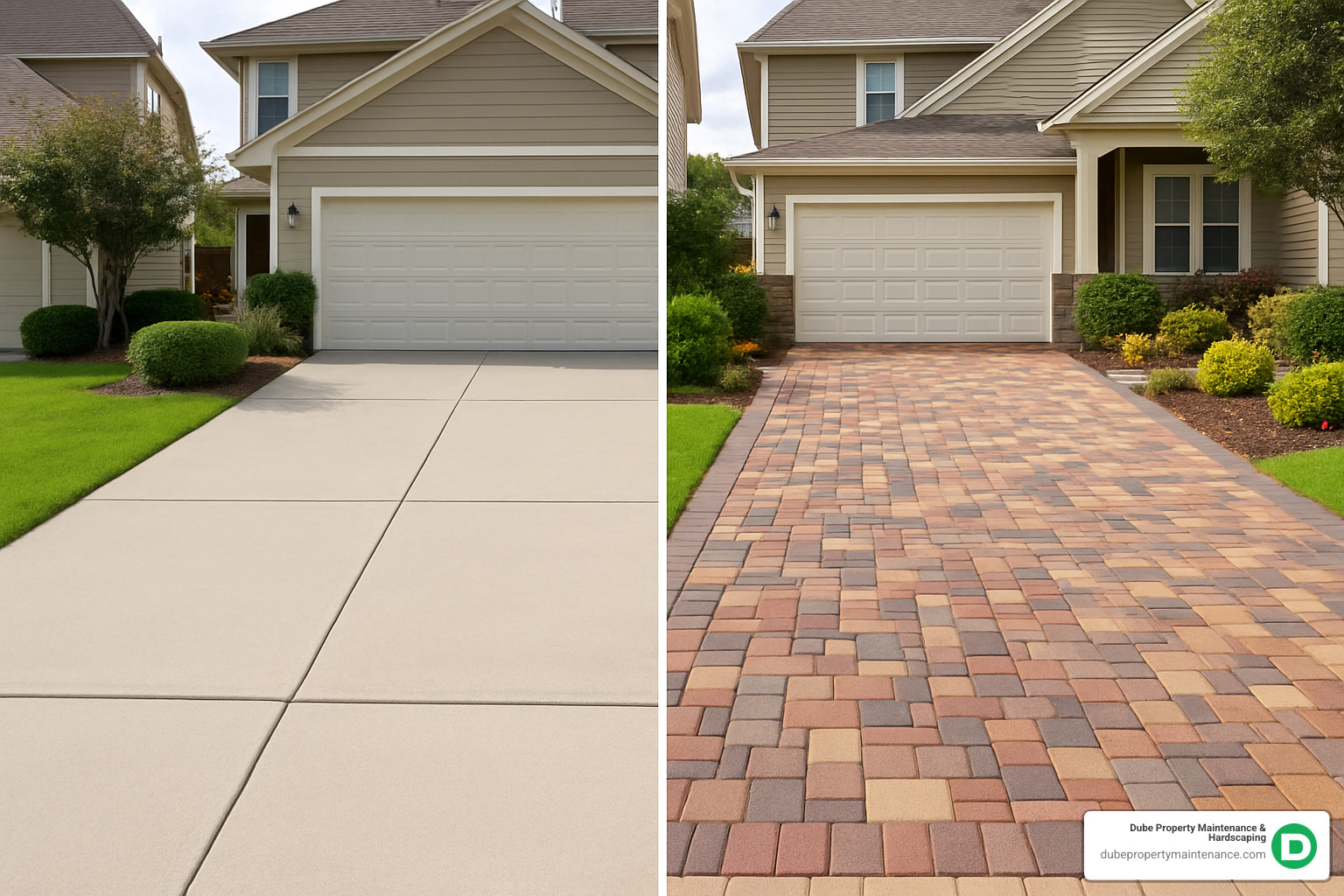
When it comes to curb appeal, pavers typically offer superior design flexibility. “Pavers provide a high-end aesthetic and limitless color, shape, and design flexibility that poured concrete cannot match,” notes one design professional. This versatility allows you to create a driveway that truly complements your home’s architecture rather than just providing a functional surface.
In our experience serving Methuen and surrounding communities, we’ve found that climate considerations often tip the scales in favor of pavers despite their higher initial cost. Their ability to flex with ground movement during freeze-thaw cycles often results in better long-term performance in our New England weather.
The right choice ultimately depends on your priorities – immediate budget concerns might point toward concrete, while longer-term value and design flexibility might make pavers worth the investment for your property.
When comparing paver driveway cost vs concrete, many homeowners overlook two crucial factors: how each option affects your property’s market value and its environmental footprint.
Property Value Impact:
Your driveway isn’t just functional—it’s a significant contributor to your home’s curb appeal. Real estate professionals consistently note that first impressions matter tremendously when selling a home, and your driveway is often the first thing potential buyers see.
Concrete driveways typically have a neutral impact on property value—they neither hurt nor significantly help your resale prospects. They’re expected rather than exceptional. Basic paver driveways, however, can provide a 5-10% return on investment at resale time, while high-end designer paver installations may recover up to 75% of their cost, particularly in upscale neighborhoods around Methuen and North Andover.
“I’ve seen beautifully designed paver driveways become the talking point during home showings,” shares one local real estate agent. “They create that ‘wow factor’ that concrete simply can’t match, regardless of stamping or coloring.”
Environmental Considerations:
Your driveway choice also leaves an environmental footprint worth considering:
Concrete production carries a substantial carbon impact—cement manufacturing alone accounts for approximately 8% of global CO2 emissions. Traditional concrete slabs also create impermeable surfaces that contribute to stormwater runoff issues, which can be particularly problematic in New England’s heavy rain and snow melt seasons.
Paver options vary in their environmental impact. Concrete pavers have a production footprint similar to slabs, while natural stone options generally have lower manufacturing emissions. The real environmental advantage comes from permeability—standard pavers allow some water infiltration through their joints, while specialized permeable paver systems can dramatically reduce or eliminate runoff entirely.
These permeable systems are gaining popularity as local municipalities implement stricter stormwater management regulations. They offer impressive benefits:
– Natural groundwater recharge instead of contributing to flooding
– Filtration of pollutants that would otherwise enter waterways
– Potential qualification for local stormwater credits or incentives
– Reduced need for additional drainage systems
For more comprehensive information about drainage solutions, check out HomeAdvisor research on drainage.
New England homes benefit from driveway styles that complement our region’s distinctive architecture and climate challenges:
Popular Concrete Styles in New England tend toward exposed aggregate finishes featuring locally-sourced stone, stamped patterns that mimic traditional cobblestone or slate, and even simple broom-finished surfaces with decorative saw-cut joints that add visual interest.
Popular Paver Styles in New England include traditional brick patterns that perfectly complement colonial architecture, concrete pavers designed to resemble bluestone for that classic New England aesthetic, authentic granite cobblestone for historic properties, and clean-lined large-format pavers for contemporary homes.
Many savvy homeowners are finding the benefits of hybrid approaches that combine both materials. A concrete main field with paver borders offers cost savings while adding visual interest. Another popular option is installing a decorative paver apron near the home’s entrance, transitioning to more economical concrete in less visible areas.
“I always remind clients that material choice matters less than proper installation and maintenance,” notes one industry professional. “A well-designed and properly maintained concrete driveway can add more resale value than a neglected paver installation that’s uneven or weed-infested.”
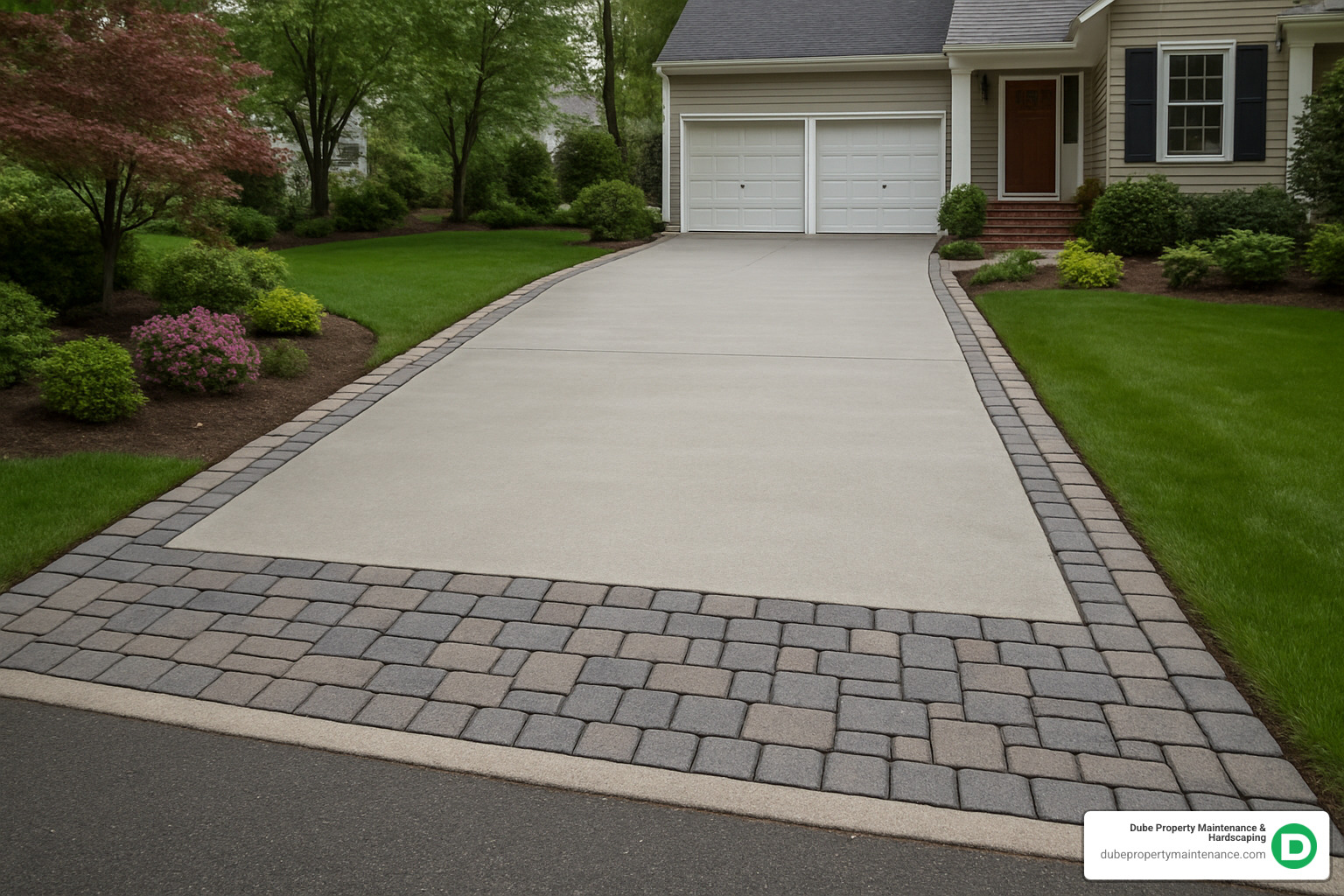
When considering the full picture of paver driveway cost vs concrete, value extends beyond the installation price tag. The right choice improves not just your daily living experience, but potentially your home’s marketability and the environmental health of your community.
When you’re trying to decide between pavers and concrete, understanding the complete financial picture over time can make all the difference. Let’s break down what your investment really looks like across the lifespan of your driveway.
In the early years (0-5 years), concrete clearly wins the affordability contest. With initial savings of $3,000-$12,000 for a typical driveway, it’s no wonder many homeowners are drawn to this option. During these first few years, both materials require minimal maintenance, making concrete seem like the obvious choice for budget-conscious homeowners.
As your driveway ages into the middle period (5-15 years), the financial equation starts to shift. This is when concrete typically begins showing its vulnerability, requiring crack repairs and potentially even partial resurfacing. Meanwhile, paver driveways generally need only occasional joint sand refreshing and routine cleaning. The cost gap that seemed so wide at installation gradually narrows as concrete repair expenses begin to add up.
“Many of our customers are surprised when they realize how the maintenance costs for concrete can accumulate over time,” notes a hardscaping professional. “What seemed like a bargain initially doesn’t always stay that way.”
The long-term picture (15+ years) often reveals a complete reversal in cost-effectiveness. Concrete driveways frequently need significant repairs or even complete replacement after two decades. Pavers, with their individual unit replaceability, rarely require full reinstallation. This is typically when pavers become the more economical choice, with the break-even point occurring somewhere between years 15-25.
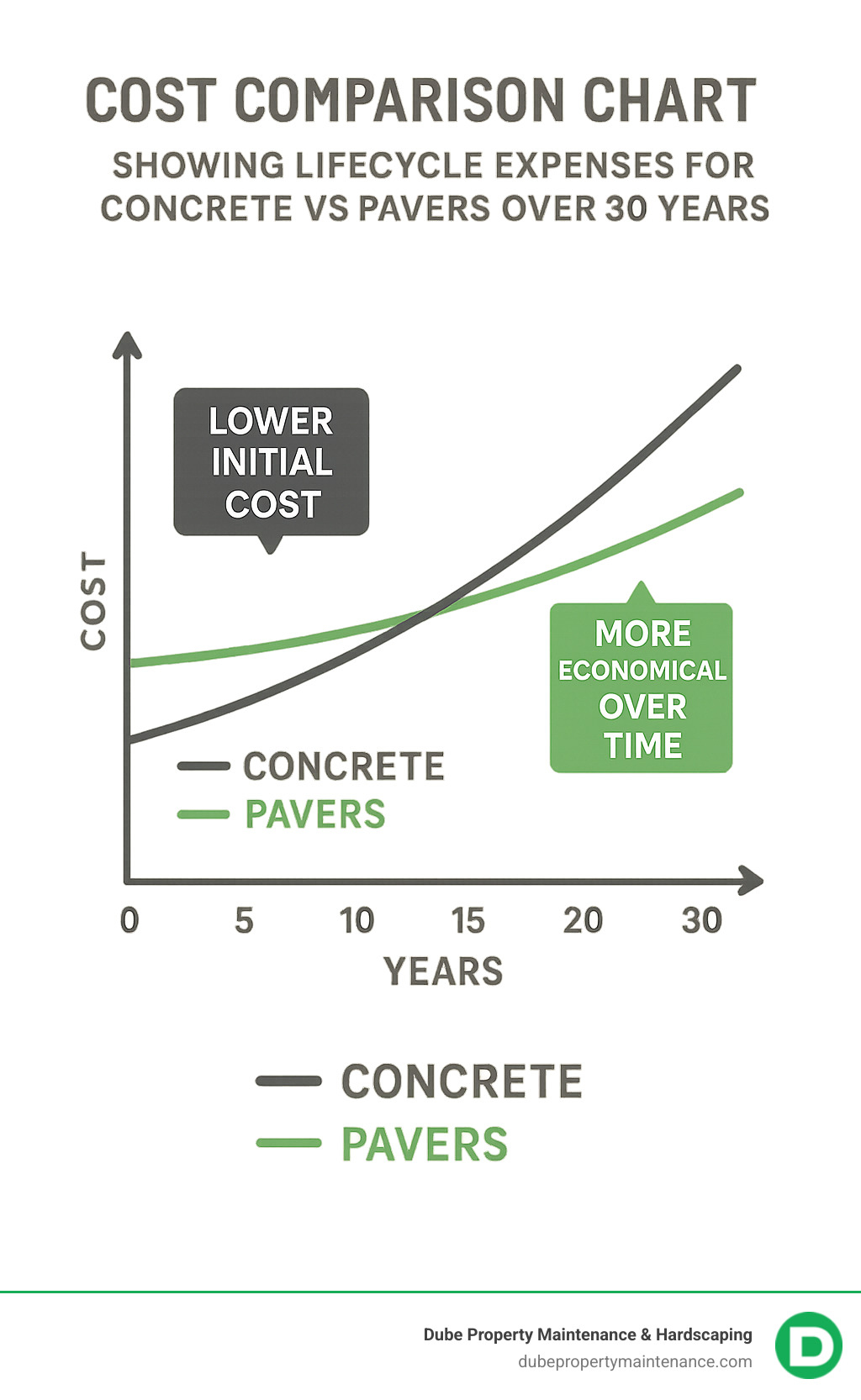
Several factors influence exactly when this break-even occurs:
Our New England climate significantly impacts this timeline. The harsh freeze-thaw cycles in Massachusetts and New Hampshire tend to accelerate concrete deterioration, while properly installed pavers accommodate ground movement much better. For local homeowners, this often tips the long-term value scale toward pavers.
The quality of installation plays a crucial role too – proper base preparation can extend the life of either material by years. Similarly, diligent maintenance through regular sealing and prompt repairs can significantly postpone major expenses. And of course, choosing higher-grade materials from the start typically results in better longevity.
From a sustainability perspective, the true cost comparison should consider more than just dollars. Paver driveway cost vs concrete calculations should include factors like longevity (longer-lasting materials mean fewer replacements), repairability (localized fixes use fewer resources), permeability (reduced need for stormwater infrastructure), and end-of-life recyclability (both materials can be recycled, but pavers more easily).
You don’t have to compromise quality to make your driveway more affordable. Here are some smart ways to manage costs while still getting excellent results:
For both concrete and pavers, timing your project can make a big difference. Scheduling installation during off-peak seasons (late fall or early spring) often means better contractor availability and possibly lower prices. Always gather multiple detailed estimates – at least 3-5 – to ensure you’re getting fair pricing.
If you’re handy, consider handling some site preparation or demolition yourself. Many homeowners also find that phasing larger projects over time helps spread out the financial impact while still achieving their dream driveway.
For concrete savings, stick with standard gray concrete with a simple broom finish for the most economical option. If you want some visual interest, decorative sawcuts provide pattern without the premium cost of stamping. Should you desire color, surface staining is typically more affordable than integral coloring throughout the mix.
For paver savings, concrete pavers offer substantial savings over natural stone while still providing excellent durability. A simple running bond pattern requires less cutting and less installation time than complex designs. Some homeowners also choose to install paver borders with less expensive infill material for a high-end look at a more moderate price.
“Although pavers cost more upfront, the long-term benefits often make them more economical than concrete,” explains one industry expert. “It’s really about viewing your driveway as a long-term investment in your property rather than just an immediate expense.”
When maintenance is factored in, proper installation becomes even more important than initial price. As one satisfied customer shared, “We spent a bit more on our paver driveway five years ago, but our neighbor has already had to repair cracks in their concrete twice. We haven’t touched ours except for an occasional rinse.”
Regardless of which material you choose, regular maintenance is the key to maximizing your investment and extending the life of your driveway for decades to come.
When you’re researching paver driveway cost vs concrete, those handy online calculators seem like a great place to start. While they do provide helpful ballpark figures, take those numbers with a grain of salt when planning your Methuen area project.
These calculators typically offer national averages that can miss the mark by 20-40% in New England. Why such a big difference? Several local factors come into play:
The New England premium on skilled labor rates often exceeds national averages. Our unique soil conditions and freeze-thaw cycles require more extensive preparation. Plus, material costs fluctuate seasonally, and recent supply chain challenges have created pricing volatility that online tools simply can’t predict.
“They provide rough national averages but may not reflect local labor, material, and site conditions; local pro estimates are more accurate,” explains one contractor who’s seen countless homeowners surprised by the gap between calculator estimates and actual quotes.
Consider online calculators as your starting point—a way to understand general price ranges—but always follow up with detailed estimates from local professionals who understand New England’s specific challenges and requirements.
Good news for budget-conscious homeowners! In many cases, you can indeed install pavers directly over your existing concrete driveway, potentially saving significant demolition and removal costs of $2-$6 per square foot.
This overlay approach works beautifully when your concrete is structurally sound with minimal cracking. You’ll need adequate height clearance to accommodate the additional 2.5-3 inches of materials, and your existing drainage patterns should still work with the raised surface.
The process is relatively straightforward: repair any significant cracks first, add a thin bedding layer of sand (about 1 inch), install thinner overlay pavers (typically 1-2 inches instead of standard 2.375 inches), and secure everything with proper edge restraints to prevent shifting.
I’ve seen many homeowners in Methuen and surrounding communities successfully transform aging but structurally sound concrete driveways into beautiful paver surfaces at a fraction of the cost of full replacement. However, this method isn’t ideal if your concrete shows major structural damage or improper drainage issues.
Our challenging New England weather demands special attention to sealing schedules for both concrete and paver driveways. The freeze-thaw cycles, road salt exposure, and seasonal temperature swings all take their toll on outdoor surfaces.
For concrete driveways, wait until the initial 28-day curing period passes before applying the first sealer. After that, plan on resealing every 2-3 years, though decorative or stamped concrete may need more frequent attention. You’ll know it’s time when water begins soaking into the surface rather than beading up. Budget between $0.50-$2.50 per square foot depending on sealer quality.
Paver driveways benefit from immediate sealing after installation, with reapplication typically needed every 3-5 years. Watch for fading color and water absorption as signs it’s time to reseal. Expect to pay $0.75-$3.00 per square foot based on the sealer type and quality.
“Seal concrete and pavers after installation and reseal every few years,” as one maintenance expert succinctly puts it. This simple maintenance step dramatically extends the lifespan of both materials.
If your home is near the coast or surrounded by trees, you might need more frequent sealing. Coastal salt exposure accelerates wear, while tree coverage can lead to staining and organic growth that compromises sealer effectiveness.
Timing matters too—avoid applying sealers when temperatures drop below 50°F, which is why many New England homeowners schedule this maintenance in late spring or early fall.
When weighing paver driveway cost vs concrete for your Methuen home, this decision impacts your property for decades to come. While concrete offers a budget-friendly starting point at $4-$15 per square foot, pavers deliver superior durability, simpler repairs, and improved curb appeal at $10-$30 per square foot.
For those of us braving New England winters, pavers offer compelling advantages despite their higher initial investment. Their interlocking design handles our freeze-thaw cycles beautifully, with strength ratings 2-3 times higher than typical concrete. When damage occurs, you can replace individual units rather than patching or replacing an entire slab. Plus, you’ll appreciate being able to park on your new paver driveway immediately after installation, unlike concrete’s lengthy curing period.
“I was initially hesitant about the higher cost of pavers,” shares one Methuen homeowner, “but after seeing my neighbor’s concrete driveway crack after just two winters, I’m glad I made the investment.”
That said, concrete remains an excellent choice when your priorities include:
– Keeping initial costs as low as possible
– Creating a simple, clean-looking surface
– Completing your project quickly
– Planning for eventual replacement regardless of material choice
As we tell our customers, “Even the best materials will fail without proper installation.” This wisdom applies equally to both options—quality workmanship forms the foundation of long-term satisfaction with either material.
At Dube Property Maintenance & Hardscaping, we understand that every property in Methuen, North Andover, and throughout our service area has unique needs. Our experienced team provides personalized guidance based on your specific site conditions, design preferences, and budget considerations.
When you consider maintenance costs, repair flexibility, and potential resale value, many homeowners find that pavers offer better long-term value despite higher upfront costs. This is especially true in our region, where weather conditions put extra stress on outdoor surfaces.
For personalized advice on your driveway project and to explore our comprehensive hardscaping services, visit our Cost to Install Paver Driveway page or contact us directly. We’re happy to help you steer this important decision for your home.
Your driveway welcomes you home every day—choosing the right material and installation team ensures it does so beautifully for years to come.
