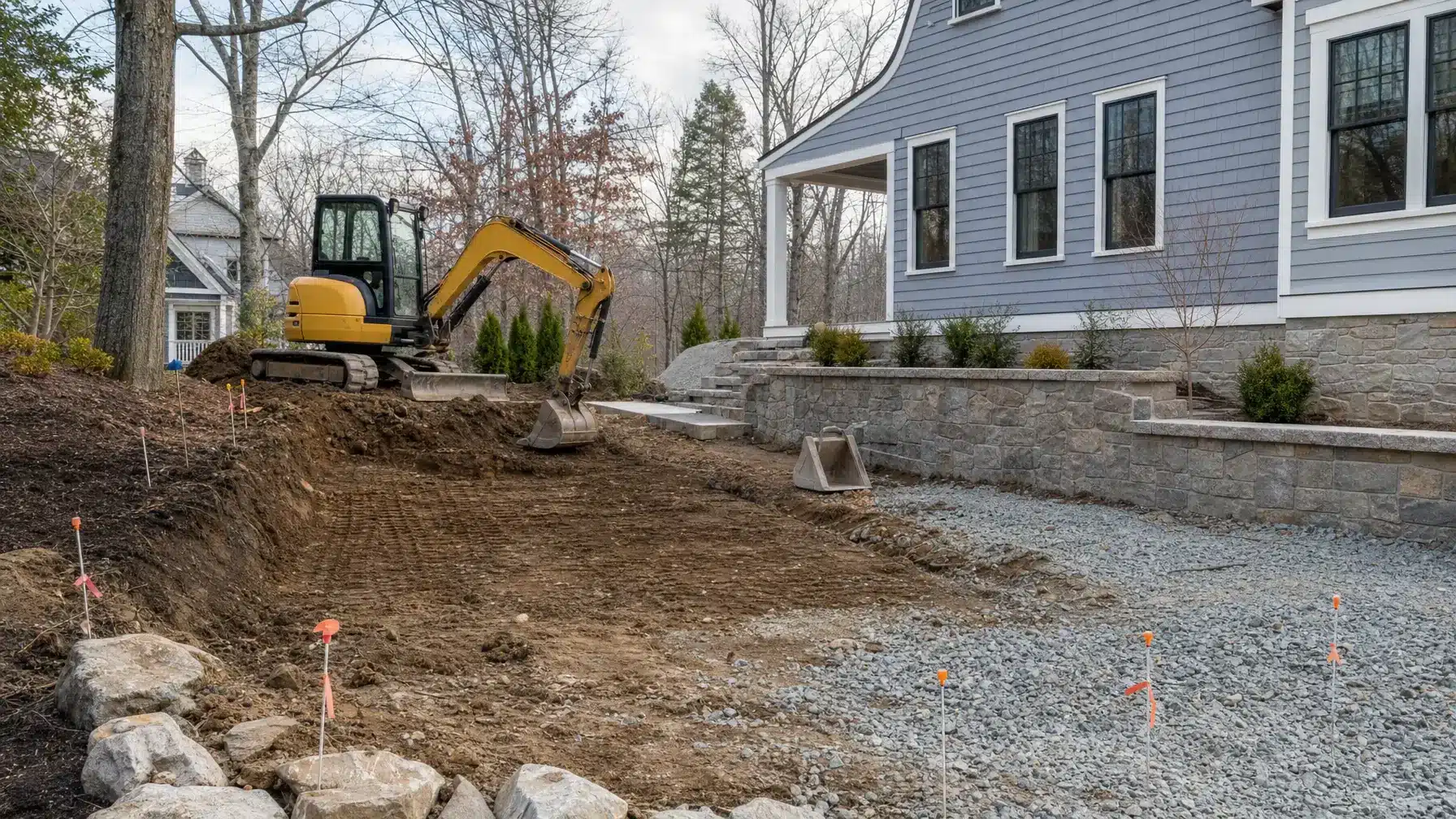
Before agreeing to landscape excavation, the written scope should explain what part of your property will change, what will be removed, what will remain and where the work stops. It should also identify who handles removed materials and what condition the area will be left in for the next stage.
Broad phrases such as “excavate the yard,” “clear the area” or “prepare for landscaping” leave room for different expectations. Use the questions below to turn those phrases into an agreement you can understand—not to choose excavation methods or write technical specifications yourself.
Describe what you want the property to be ready for when excavation ends. Keep that goal separate from the contractor’s proposed method. The scope should connect the work to the intended outcome without implying that excavation includes the entire landscape or hardscape project.
Ask: “Which part of my goal does this scope cover, and what work will still be needed afterward?” If the proposal includes grading, clearing or drainage-related excavation, ask what each category means for your property. A category name alone does not explain the tasks included or the endpoint.
Note Describe concerns you have observed, but leave drainage solutions, grades, excavation depths and engineering decisions to property-specific assessment. A homeowner’s observation is a question to investigate, not a technical specification.
The work area should be identifiable without relying on a remembered conversation. Ask for a written description tied to recognizable features or an agreed marked plan or photo. If the scope refers to an attachment, confirm that the attachment reflects the same boundaries you discussed.
Identify what stays as carefully as what goes. If a feature’s retention depends on conditions that have not been assessed, ask that the uncertainty be stated rather than treating retention as settled.
Read the proposed tasks as a sequence: what is being removed, what is being changed and what happens before the contractor hands the area over. Ask for clarification wherever a broad term could describe different amounts of work.
For clearing, ask which materials or vegetation are covered. For grading, ask what area is being addressed and how the intended result will be described after assessment. For drainage-related excavation, clarify whether the scope covers excavation alone or other specified work. Do not assume that mentioning drainage includes a complete drainage installation.
Exclusions deserve the same attention. Ask whether subsequent planting, lawn establishment, hardscape installation or restoration outside the work area is included, excluded or covered by a separate agreement. These are questions to resolve, not assumptions about what any contractor normally provides.
Removing material from the excavation area is not necessarily the same as removing it from your property. Ask how soil, rocks, roots and debris will be handled, and have the agreed responsibilities recorded.
If material handling depends on what is uncovered, ask how that decision will be made and documented. Also clarify how proposed work outside the agreed scope will be discussed and authorized before it proceeds.
“Ready” needs a named next stage and a described handoff condition. An excavated area is not automatically a finished landscape, and preparation for later work does not necessarily include that later work.
Ask what surface condition will remain, whether materials will still be stored on site and what tasks must happen before the next stage begins. Where another contractor will take over, clarify who confirms that the excavation endpoint matches the next stage’s requirements. Resolve that connection before agreement rather than leaving it for handoff.
Mark each topic as agreed, unresolved or requiring assessment. “Discussed” is not the same as “recorded in the scope.” Use this checklist to identify what needs clarification:
Preferences and responsibilities can be written down, but site-dependent technical questions need assessment. If an unresolved question could change what is removed, the work boundaries or the handoff condition, ask for it to be addressed before you agree.
Dube Property Maintenance offers landscape excavation services for homeowners near Andover, MA. Use your scope-review notes to discuss the intended outcome and the questions that need property-specific assessment.
Once the scope is agreed, move on to preparing the property for the work. Keep that readiness step separate: preparation should follow a clear agreement about what will change, what will remain and what happens next.