
Installing a concrete paver patio is one of the most rewarding home improvement projects you can tackle. Done right, it adds curb appeal, creates usable outdoor living space, and can last decades — potentially up to 100 years with proper installation. For industry-standard guidelines on durable paving, the Interlocking Concrete Pavement Institute provides excellent technical resources.
Here’s a quick overview of the core steps:
Based on general internet data, the average cost for a professional paver patio installation is approximately $10,000, with project totals typically ranging from $4,000 to $45,000 depending on size and material selection. These figures represent broad market averages and do not reflect the specific pricing of Dube Property Maintenance & Hardscaping. For homeowners in Methuen, MA and surrounding communities in Massachusetts and southern New Hampshire, the freeze-thaw climate makes proper base preparation especially critical — shortcuts here lead to shifting, sinking, and cracked pavers within a few seasons.
This guide walks you through every step clearly, so you know exactly what’s involved — whether you’re doing it yourself or hiring a pro.

Installing concrete paver patio vocab explained:
Before we pick up a shovel, we need a rock-solid plan. Site selection is more than just picking a sunny spot; it involves looking at how water moves across your yard. In our region, from Lawrence, MA to Salem, NH, we deal with significant runoff during spring thaws. Your patio must be designed to move that water away from your home’s foundation. You can find detailed technical demonstrations on How To Install Concrete Pavers from authoritative sources like This Old House.
When you start sketching your layout, consider the “Five Ps”: Proper Planning Prevents Poor Performance. Use graph paper or a digital tool to draw your space to scale. We often recommend using a garden hose or marking paint to “draw” the patio on the grass. This helps you visualize the size and ensure it fits your furniture comfortably. For more inspiration, check out these paver patio design ideas.
One of the most important steps in the planning phase is calling 811. Whether you are in Andover, MA or Windham, NH, you must have your underground utilities marked before you dig. It’s a free service, and it prevents dangerous (and expensive) run-ins with gas, water, or electric lines.
To figure out how many pavers you need, calculate the total square footage (length x width) and add a 10% waste factor. If your design involves lots of curves or a complex herringbone pattern, increase that waste factor to 15–20%. You don’t want to be three pavers short on a Sunday afternoon!
Proper drainage requires a slope. We aim for a 1/4-inch drop for every foot of distance away from the house. To set this up, use wood stakes and mason line (string). Level the string, then measure down at the far end to establish your pitch. This ensures that after a heavy New England rain, your patio stays dry and your basement stays flood-free. For a deeper dive into what goes underneath, see our guide on the base for pavers.
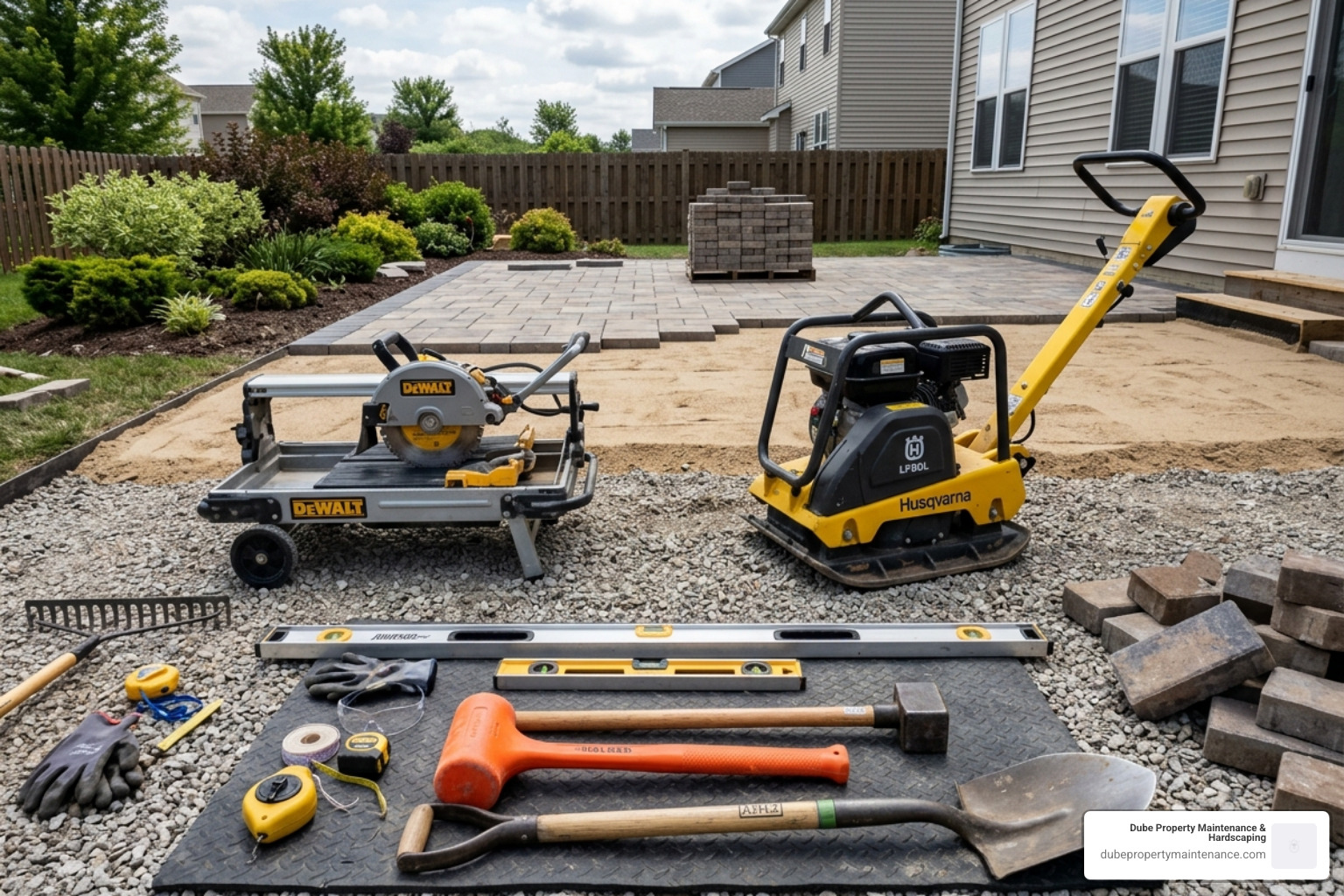
To get professional results when installing concrete paver patio units, you need the right gear. While you can hand-tamp a small walkway, a patio requires a power plate compactor. You can rent these at most local equipment yards in towns like Haverhill or Dracut.
Your Shopping List:
For a broader look at different styles and options, visit our page on paver patios.
Concrete pavers are incredibly versatile. They are manufactured to be uniform, which makes the installation process much smoother than working with natural flagstone. When choosing pavers for your project in Massachusetts or New Hampshire, look for frost-resistant units that can handle our harsh winters.
If you are building a pool patio with pavers, look for textures that are slip-resistant when wet. Also, remember to pull pavers from multiple pallets as you work. This “blending” technique prevents large patches of slightly different color shades, giving the finished patio a more natural, uniform look.
Now for the heavy lifting. We start by excavating the area. For a standard residential patio, we typically dig 7–9 inches deep. This accounts for 6 inches of compacted gravel, 1 inch of sand, and the thickness of the paver itself (usually about 2 to 2 3/8 inches).
Once the soil is clear of roots and debris, we compact the “subgrade” (the bare dirt). Then, we lay down a high-quality geotextile landscape fabric. This is a pro secret: it prevents the expensive gravel base from migrating down into the native soil over time, which is the number one cause of sinking patios.
Next, we add the gravel base in 2-inch layers. After each layer, we use the plate compactor. We lightly mist the gravel with water to help the particles lock together. By the time we are done, that base should feel as hard as concrete. For more details on the full scope of work, explore our patio installation services.
With the base set, it’s time for the “screeding” process. We lay two parallel 1-inch PVC pipes on the gravel. We pour coarse sand between them and use a straight 2×4 board to “saw” across the pipes, leaving a perfectly flat 1-inch bed of sand. Pro Tip: Once you screed the sand, do not step on it!
When laying the pavers, we use the “click and drop” method. Place the paver against the edge of the previous one and drop it straight down. This prevents you from sliding the paver and disturbing the smooth sand bed. We work from a corner outward, often in a “V” shape, to keep the lines straight. If you’re curious about the technical nuances, we have a guide on building a paver patio that goes even deeper.
We’ve seen many DIY projects go south because of a few avoidable errors. Here are the big ones:
Looking for more ways to avoid pitfalls? Check out our backyard paver patio ideas for successful layouts.
Once the pavers are down, we install the edge restraints and sweep polymeric sand into the joints. We then run the plate compactor over the pavers (using a protective mat) to settle them into the sand. Finally, we sweep off every bit of excess sand and mist the patio with water to activate the polymers.
Maintenance is relatively simple. We recommend sweeping regularly and checking the joints every few years. If the sand has eroded, simply add a bit more. Sealing is a great way to protect against oil stains from the grill and UV fading.
| Feature | Poured Concrete Slab | Concrete Paver Patio |
|---|---|---|
| Initial Cost | Lower | Higher |
| Durability | Prone to cracking | Extremely high |
| Repairability | Difficult/Patchy | Easy (replace single units) |
| Lifespan | 20–30 years | 50–100 years |
| Freeze-Thaw | Low resistance | High flexibility |
Based on general internet data, a professionally installed paver patio typically averages around $12,000, with total costs ranging from $5,000 to $55,000, depending on size, material choice, and site complexity. A small, simple 10×10 patio might be on the lower end, while a multi-level outdoor kitchen space in a town like Boxford or Concord could reach the higher end. These are average market ranges and do not reflect our specific pricing.
Sometimes, if you have an existing concrete patio that is in good structural shape, we can perform an overlay. This involves installing thinner pavers directly over the old concrete, which can save on excavation costs. However, this requires careful planning for height transitions and drainage. If you’re considering this, it’s best to consult a patio contractor.
Yes, this is possible! It’s called an overlay. The key is ensuring the existing surface is stable and not crumbling. We often use a “sand set” or “mortar set” method. It is crucial to drill weep holes in the concrete to allow water to drain through the sand layer; otherwise, the pavers will “float” and shift during a freeze. For more localized assistance, see our patio installation near me page.
When installed with a proper base, a paver patio can last up to 100 years. Unlike solid concrete, the joints between pavers allow the system to flex during our New England freeze-thaw cycles. If one paver ever breaks, you simply pop it out and replace it — no jackhammers required!
While not strictly required for structural integrity, we highly recommend it. Sealing protects against stains (like red wine or grease), prevents UV rays from fading the colors, and helps stabilize the joint sand. It’s best to wait about a year after installation to allow any “efflorescence” (natural salt deposits) to work its way out of the concrete before sealing.
Installing a concrete paver patio is a significant investment in your home’s value and your quality of life. While the DIY route is possible for those with a strong back and a free weekend, achieving a perfectly level, professional finish that survives twenty New England winters is a tall order.
At Dube Property Maintenance & Hardscaping, we take the guesswork and the heavy lifting out of the equation. Our professional team serves residential and commercial clients throughout Massachusetts and Southern New Hampshire, from Methuen and Andover to Salem, NH. We pride ourselves on providing high-quality, comprehensive outdoor solutions that stand the test of time.
Ready to start your transformation? Explore our paver patio installation services and let’s build something beautiful together.
