

If you’re looking to expand your parking space, the cost to widen driveway with pavers typically ranges from $10 to $30 per square foot installed. For a standard 3-foot widening on each side of a 20-foot driveway (120 square feet total), you can expect to pay:
| Project Size | Low End | Average | High End |
|---|---|---|---|
| 3′ x 20′ (60 sq ft) | $600 | $1,200 | $1,800 |
| 3′ x 40′ (120 sq ft) | $1,200 | $2,400 | $3,600 |
| 5′ x 20′ (100 sq ft) | $1,000 | $2,000 | $3,000 |
Running out of driveway space is a common frustration for growing households. That second car, the teenager’s first vehicle, or simply the need for easier maneuvering can all make driveway expansion a necessity rather than a luxury.
Widening your existing driveway with pavers not only solves the practical problem of space but can dramatically improve your home’s curb appeal. Unlike pouring more concrete or asphalt, pavers offer design flexibility and a premium finish that complements your home’s architecture.
For New England homeowners, pavers also provide excellent durability against the harsh freeze-thaw cycles that often crack solid concrete driveways. With proper installation, a paver driveway extension can last 25-75 years while adding approximately 69% return on investment to your property value.
Before you start planning your driveway expansion, it’s important to understand that several factors will influence your final project cost, including material choice, site preparation requirements, and whether you’re tackling this as a DIY project or hiring professionals.
Basic cost to widen driveway with pavers terms:
– cost to seal driveway pavers
– cost of permeable paver driveway
– cost to pave a driveway
Planning to expand your driveway? The cost to widen driveway with pavers goes beyond just the pretty stones you see on the surface. Most homeowners in our region spend between $10-$25 per square foot for professionally installed paver extensions – though this can vary widely based on your specific project needs.
This investment isn’t just about solving your parking woes. Paver driveways typically last 25-75 years with proper care, outlasting both asphalt (15-20 years) and standard concrete (20-30 years). Plus, they deliver approximately 69% return on investment when you sell your home – making them one of the smartest exterior improvements you can make.
Here’s how your budget typically breaks down:
“Many homeowners focus solely on the paver cost, but proper base preparation is where quality installation truly begins,” says our team at Dube Property Maintenance & Hardscaping. “In Massachusetts, with our significant freeze-thaw cycles, investing in a proper base can prevent costly repairs down the road.”

Want a deeper dive into full driveway installation costs? Check out our comprehensive guide on the Cost to Install Paver Driveway.
Your final price tag will vary based on material quality, installation complexity, and regional factors. Here in Massachusetts and southern New Hampshire, our unique climate and local labor rates influence pricing significantly.
| Material | Low-End Cost/sq ft | Average Cost/sq ft | High-End Cost/sq ft | Lifespan |
|---|---|---|---|---|
| Concrete Pavers | $10 | $15 | $30 | 25-50 years |
| Clay Brick Pavers | $12 | $20 | $40 | 25+ years |
| Natural Stone | $15 | $25 | $60 | 50-75 years |
| Permeable Pavers | $15 | $20 | $50 | 30-50 years |
| Asphalt (comparison) | $7 | $10 | $20 | 15-20 years |
| Concrete (comparison) | $6 | $10 | $25 | 20-30 years |
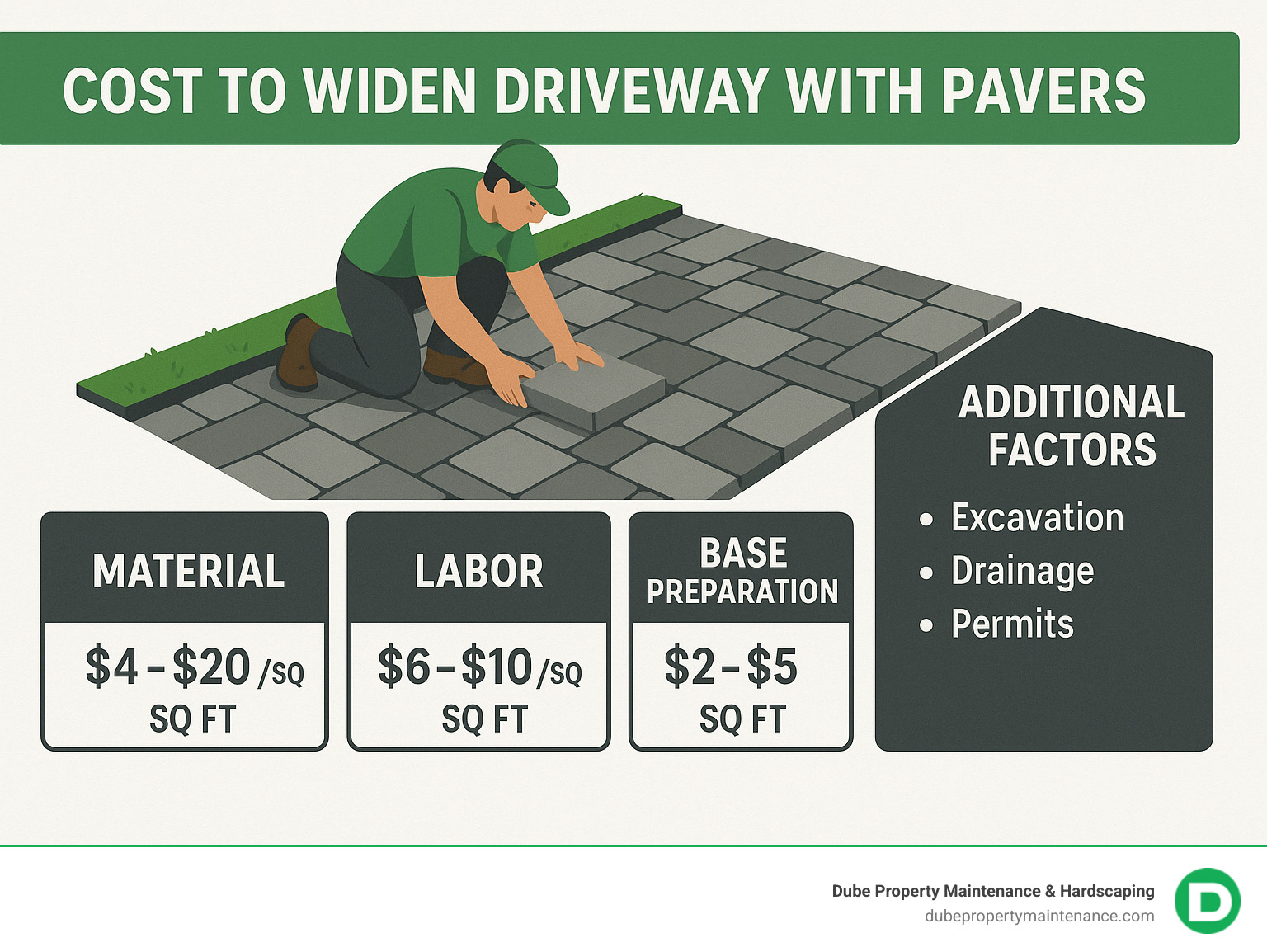
Labor typically makes up 40-60% of your total project cost. In our Northeast region, experienced paver installers generally charge between $6-$12 per square foot for labor alone. This covers everything from initial site prep and excavation to the finishing touches of joint sand application and final compaction.
Material costs swing widely based on your paver selection. Basic concrete pavers start around $4 per square foot, while those gorgeous premium natural stone options can easily reach $20+ per square foot. The difference isn’t just aesthetic – premium materials often offer improved durability and unique character that can’t be replicated.
“My driveway is too narrow!” We hear this constantly at Dube Property Maintenance & Hardscaping. The most popular solution? Adding 3 feet to each side of an existing driveway. For a typical 40-foot long driveway, this creates an additional 240 square feet of paved surface (3′ × 40′ × 2 sides).
The cost to widen driveway with pavers for this common scenario ranges between:
– Low-end: $2,400 (240 sq ft × $10/sq ft)
– Average: $4,800 (240 sq ft × $20/sq ft)
– High-end: $7,200 (240 sq ft × $30/sq ft)
Smart homeowners budget an additional 10-20% for contingencies, bringing the total estimated range to $2,640-$8,640.
“When widening an existing driveway, there are often unexpected costs related to tying in the new section with the old,” explains our team. “Proper drainage solutions and edge transitions require attention to detail that can impact the final cost.”
Working with a tighter budget? Consider widening just one side of your driveway. This approach still delivers significant benefits at roughly half the cost – particularly effective when your main goal is adding parking space rather than creating a wider driving lane.
For more information on overall driveway paving costs, visit our detailed guide on the Cost to Pave a Driveway.
When planning your driveway expansion, understanding what influences the cost to widen driveway with pavers helps you create a realistic budget. Let’s explore the factors that will shape your final investment.

Square footage is obviously important, but don’t overlook the shape of your extension. Those clean, straight lines aren’t just visually pleasing – they’re easier on your wallet too. Curved designs require more intricate cutting work, creating more waste and adding $1-$3 per linear foot to your project cost. As we often tell our clients, “Simple lines save dimes!”
If your property has limited access, your costs might climb significantly. When our crew needs to wheelbarrow materials rather than bringing equipment directly to your site, labor costs typically increase 20-30%. One of our contractors recently shared, “A job that took three days ended up taking five because we couldn’t get our equipment close enough. Those extra hours add up quickly.”
Here in New England, proper base preparation isn’t optional – it’s essential. Our frost line typically extends 48-54 inches below grade in Massachusetts and New Hampshire. While you don’t need to dig quite that deep, you’ll need:
Standard recommendation: 6-8 inches of compacted crushed stone
Clay soil areas: 8-10 inches (clay holds moisture that expands when frozen)
Sandy soil areas: 6 inches may be sufficient (better natural drainage)
Skimping on base depth is like building a house on a shaky foundation – you’ll pay for it later with an uneven, shifting driveway.
New England’s freeze-thaw cycles can wreak havoc on poorly drained driveways. Proper drainage prevents base erosion, paver shifting, and premature failure. Adding solutions like channel drains or modifying your driveway’s grade can add $500-$2,000 to your project, but this investment protects everything else you’re spending.
For driveways that will support vehicles, you need pavers at least 2⅜ inches thick. Thinner options might look identical, but they’ll crack under pressure – literally. Material choices range widely in both appearance and price:
Basic concrete pavers offer great value at $4-$10 per square foot, while premium concrete options with special finishes run $8-$15. For a more traditional look, clay brick pavers ($8-$20) provide rich color that won’t fade. If you’re after luxury, natural stone starts around $15 and can exceed $30 per square foot.
If you’re replacing existing hardscape, factor in removal costs. Concrete removal runs $3-$5 per square foot, while asphalt is slightly less at $2-$4. Don’t forget disposal fees ranging from $100-$500 depending on volume. That old material has to go somewhere, and unfortunately, it’s not free.
Even the most precise installation creates some waste. For standard layouts, add 5-10% to your material order. If you’re dreaming of herringbone or other complex patterns, bump that up to 15-20%. Curved designs can require up to 25% extra material. Better to have a few leftover pavers than to halt your project waiting for more to arrive!
For more detailed information on creating the proper foundation for your project, check our guide on Base for Pavers.
Local regulations can significantly impact both your budget and timeline. Here in our service area, requirements vary by town, so it’s worth checking early in your planning process.
In Methuen and neighboring communities, permits for driveway widening typically run between $50-$250. Most municipalities will ask for a site plan showing your proposed expansion, verification of property lines, a drainage plan, and curb cut approval if you’re widening at the street.
“Many homeowners are surprised to learn they need permits for driveway work,” notes our permitting specialist. “Because driveways connect to public roads, towns have a vested interest in regulating them.” Most communities also specify minimum distances from property lines, typically 2-5 feet.
If you live in an HOA community, you’ll likely need their blessing too. Homeowners Associations often have specific guidelines about approved paver styles, colors, maximum driveway width, and required setbacks. We’ve seen beautiful designs rejected because they didn’t match the neighborhood aesthetic, so check those covenants early!
Expect at least one inspection during your installation process, typically after excavation but before base installation, after base installation but before paver laying, or upon final completion. These inspections ensure your project meets local standards for safety and drainage.
For specific information about permits in Dracut, MA, you can check Do I need a permit on the town’s website.
The pavers you select will impact both your driveway’s looks and longevity. This isn’t just about aesthetics – it’s about making an investment that will serve you for decades.
For driveways, don’t go below these industry standards:
– Minimum thickness: 2⅜ inches (60mm)
– Heavy-duty applications: 3⅛ inches (80mm)
“Using pavers that are too thin for driveway applications is one of the most common and costly mistakes we see,” explains our installation team. “They might look identical to thicker options, but they simply can’t handle the weight over time.”
Concrete Pavers offer excellent value and versatility. Priced between $4-$20 per square foot, they come in countless colors and styles with consistent dimensions. While they may fade slightly over decades, they typically last 25-50 years with proper installation and maintenance.
Clay Brick Pavers provide timeless appeal at $8-$25 per square foot. Their rich colors come from the natural clay firing process and won’t fade over time. While color options are more limited than concrete, their classic look complements many architectural styles, and they can last 25+ years.
Permeable Pavers represent the eco-friendly option at $15-$30 per square foot. These specially designed pavers allow water to filter through rather than run off, reducing puddles and helping replenish groundwater. They require specific base preparation but may qualify for local environmental incentives and typically last 30-50 years.
Cobblestone/Natural Stone delivers best beauty and durability starting at $20 and often exceeding $50 per square foot. While they represent the highest cost option and require more skilled installation, they also offer the longest lifespan – often 50-75+ years with proper care.
Your chosen layout pattern affects both visual impact and installation cost. A simple running bond (brick-like) pattern is most economical with minimal cutting. The popular herringbone pattern adds medium complexity and requires more cutting. Circular or fan patterns create stunning visual interest but come with the highest complexity and significant cutting requirements.
“Complex patterns can add 15-30% to your labor costs,” our design team points out. “But they also create a truly custom look that sets your property apart.”
These prices reflect industry averages based on internet data, not actual costs for Dube Property Maintenance and Hardscaping services. Your specific project may vary based on site conditions and design choices.
When you understand what goes into a proper installation, it becomes clear why the cost to widen driveway with pavers involves much more than just the paver materials themselves. Let’s walk through the process that ensures your driveway expansion will stand the test of time.
Before the first shovel hits the ground, careful planning sets the stage for success:
“The most important day of your project happens before we even break ground,” our team often tells clients. You’ll need to finalize your design layout, select materials, acquire necessary permits, and have utilities marked by calling 811 at least 72 hours before digging begins. This crucial preparation prevents costly surprises later.
Now the physical change begins. We’ll remove existing landscaping and excavate the extension area to a depth of 6-10 inches, going deeper for problematic clay soils. A proper excavation ensures:
The excavation stage often reveals soil conditions that might require adjustments to the base depth – something experienced contractors are trained to identify.
Think of this as the foundation of your home – it’s invisible once completed but absolutely critical for longevity:
We start by installing geotextile fabric over the excavated soil to prevent material mixing. Then we add 6-8 inches of crushed stone base in multiple 2-3 inch layers, compacting each layer to 95% compaction with a plate compactor. This methodical approach prevents future settling and maintains that crucial 1-2% drainage slope.

Edge restraints are the unsung heroes of paver installations. These borders prevent lateral movement and keep your pavers locked in place for decades. Options include plastic edging, metal edging, or concrete curbing, all secured with 10-12 inch spikes every foot for maximum stability.
This thin but crucial layer creates the perfect setting bed for your pavers. We spread a uniform 1-inch layer of coarse, clean sand and screed it perfectly flat using pipes and a straight board. This requires a delicate touch – once screeded, we avoid walking on this prepared sand to maintain its perfect level.
Finally, the visible portion of your investment takes shape. Starting from a fixed edge or perfectly straight line, we carefully place each paver according to your chosen pattern. String lines ensure absolutely straight rows, while a masonry saw makes precise cuts around curves or obstacles. The change starts to become visible as your new driveway extension takes form.
The finishing touches make all the difference. We compact the installed pavers using a plate compactor with a rubber pad to protect the paver surface. Then we spread polymeric sand over the entire surface, sweeping it into the joints until completely filled. After removing excess sand, we activate the polymeric sand according to manufacturer instructions, creating solid, weed-resistant joints.
While technically optional, sealing protects your investment and improves its appearance. After allowing the installation to cure for 30 days, we apply a quality paver sealer that improves color and provides stain protection. With reapplication every 3-5 years, your driveway extension will maintain its beauty for decades.

For a typical 3-foot widening along a 40-foot driveway, our professional installation generally takes 3-5 days, depending on weather, site conditions, and design complexity.
The temptation to DIY your driveway widening project is understandable – the immediate cost savings can seem attractive. But let’s weigh the full picture.
If you’re considering the DIY route, budget for equipment rentals including a plate compactor ($60-$75/day), masonry saw ($50-$70/day), and possibly a mini-excavator ($200-$300/day). Then there’s materials: pavers ($4-$20/sq ft), base materials ($2-$5/sq ft), edge restraints ($1-$3/linear ft), polymeric sand ($25-$40/bag), and geotextile fabric ($0.30-$0.50/sq ft).
The time investment is substantial. For a 240 square foot extension, expect to spend 5-8 full days of physical labor between excavation, base preparation, paver installation, and finishing work.
“I thought my weekend project would take two days,” one Methuen homeowner told us. “Two weekends later, I was still cutting pavers and my back was letting me know it wasn’t happy!”
While hiring professionals costs more upfront, the benefits extend far beyond convenience:
Quality and Durability makes the difference between a driveway that lasts 5 years versus 25+ years. Professional crews bring specialized equipment that ensures proper compaction, precise grading, and expert installation techniques that prevent costly future problems.
Productivity means your project finishes faster. Our crews typically install about 100 square feet of pavers daily – significantly faster than most DIY efforts – meaning less disruption to your property and daily life.
Warranty Protection offers peace of mind. Most professional installations include a 1-2 year workmanship warranty, plus access to manufacturer warranties that often require professional installation to remain valid.
“The biggest cost difference isn’t in the initial installation but in the long-term performance,” our installation manager often reminds clients. “We regularly repair DIY installations that failed prematurely due to inadequate base preparation or improper compaction.”
For Massachusetts and New Hampshire homeowners facing significant freeze-thaw cycles, professional installation is particularly valuable for ensuring your driveway extension stands the test of time.
For more information about our professional driveway installation services, visit our Driveway Installation page.
The cost to widen driveway with pavers can unexpectedly balloon when common installation mistakes require repairs down the road. Here are the pitfalls we see most often:
Inadequate Base Preparation is the most expensive mistake we see. Skimping on base depth or proper compaction leads to settling, dips, and ruts within 1-2 years. Repairs can cost 50-80% of the original installation! Always use proper base depth (minimum 6-8 inches) and compact in 2-inch layers to prevent this costly error.
Poor Drainage Planning invites water damage. When water pools or erodes your base, problems like frost heave quickly follow. Drainage retrofits can cost $1,000-$3,000 or more. Prevention is simple: ensure a 1-2% slope away from structures and consider permeable paver options for problem areas.
Missing or Improper Edge Restraints allow pavers to spread apart and shift over time. Edge repairs cost $8-$15 per linear foot, but can be completely avoided by installing proper restraints on all open sides during the initial installation.
Incorrect Joint Sand leads to weeds, ant infestations, and paver movement. Removing old sand and replacing with polymeric sand costs $2-$4 per square foot – an expense easily avoided by using the right materials from the start.
Skipping Sealer Application leaves your pavers vulnerable to staining, color fading, and premature wear. Power washing and sealing costs $0.50-$1.50 per square foot, but this simple maintenance step protects your investment for years.
“We’ve seen homeowners save $1,000 on installation only to spend $3,000 on repairs within two years,” our repair specialist often shares. “Proper installation from the beginning is always the most economical approach in the long run.”
When weighing the cost to widen driveway with pavers, thinking beyond the initial price tag reveals the true value of your investment. Let’s face it—your driveway isn’t just functional; it’s one of the first things people notice about your home.

At first glance, pavers might seem like the pricier option. A paver driveway expansion typically runs $10-$30 per square foot, while concrete comes in at $6-$12, asphalt at $7-$15, and gravel at a mere $1-$3 per square foot.
But here’s where things get interesting—installation complexity varies dramatically. While you might be tempted to tackle a gravel project yourself, paver installation requires moderate skill, concrete demands professional expertise, and asphalt is almost exclusively a professional job.
“Many homeowners get sticker shock with pavers until they understand what they’re really getting,” says our team at Dube Property Maintenance & Hardscaping. “It’s like comparing a custom-built piece of furniture to something assembled from a box store.”
The longevity comparison is where pavers truly shine:
A well-installed paver driveway can last an impressive 25-75 years—potentially outlasting your mortgage! Compare that to concrete’s 20-30 years, asphalt’s 15-20 years, or gravel’s mere 5-10 years before major maintenance becomes necessary.
For New England homeowners, this durability factor is crucial. Our harsh freeze-thaw cycles wreak havoc on solid surfaces like concrete and asphalt. Pavers, with their individual units and flexible joints, can handle these seasonal shifts without cracking. When winter’s worst hits, you’ll be glad you chose wisely.
Your driveway’s ongoing care requirements dramatically affect its true cost:
With pavers, maintenance is surprisingly simple—occasional sweeping and rinsing keeps them looking fresh. Every 3-5 years, you’ll need to replenish joint sand ($0.20-$0.50/sq ft), and every 5-7 years, a fresh coat of sealer ($0.15-$0.75/sq ft) maintains their vibrant appearance. If damage occurs, you can replace individual pavers for about $5-$10 each without disturbing the entire surface.
Concrete requires annual power washing to prevent staining and mildew. Sealing every 3-5 years ($0.15-$0.50/sq ft) helps prevent water penetration, but crack repairs ($3-$8 per linear foot) become inevitable in our climate. Once cracks begin, they typically worsen each year, and major repairs often require replacing entire sections—a costly proposition.
Asphalt demands the most frequent attention. Annual crack filling prevents water intrusion, while sealcoating every 2-3 years ($0.15-$0.25/sq ft) maintains its appearance. The bigger expense comes with resurfacing every 7-10 years ($3-$7/sq ft), and eventually, complete replacement.
Gravel seems economical until you factor in regular regrading ($0.25-$0.50/sq ft annually), adding new gravel every 1-2 years ($0.50-$1.00/sq ft), and the constant battle against weeds and erosion. Not to mention the gravel that inevitably finds its way onto your lawn or into your home.
In today’s eco-conscious world, pavers offer compelling advantages:
Permeable paver options allow rainwater to filter naturally into the ground rather than contributing to stormwater runoff. This feature is increasingly valuable as more municipalities implement stormwater management regulations.
The modular nature of pavers means damaged sections can be replaced without wasteful demolition of the entire surface. Many paver materials can even be recycled at the end of their useful life, making them a more sustainable choice than asphalt or concrete.
Let’s talk curb appeal—because your home’s exterior makes a statement:
Pavers create a high-impact first impression with their timeless elegance. Available in countless colors, textures, and patterns, they can complement any architectural style from colonial to contemporary.
Stamped concrete offers medium-high impact with decorative patterns, though it lacks the dimensional quality of genuine pavers.
Standard concrete provides a clean but unremarkable medium impact.
Asphalt delivers low-medium impact with its utilitarian appearance.
Gravel creates a casual, low-impact look that can appear unfinished or temporary.
“From a real estate perspective, a well-designed paver driveway can add 5-10% to a home’s perceived value,” notes a local realtor. “It’s often one of the first things potential buyers notice when approaching a home.”
For a visual demonstration of professional paver installation techniques, you can watch a step-by-step video tutorial.
When calculating the true cost to widen driveway with pavers, the 25-year picture tells a compelling story:
A paver driveway typically requires about $1.75-$6.25 per square foot in maintenance over 25 years. This includes periodic joint sand replenishment, sealing applications, and minor repairs.
A concrete driveway accrues similar maintenance costs of $1.90-$6.50 per square foot over the same period, including sealing, crack repairs, and potential partial replacement as cracks worsen.
An asphalt driveway demands substantially more—$7.50-$23.80 per square foot over 25 years—with frequent sealcoating, crack filling, and multiple resurfacing projects.
A gravel driveway tops the maintenance chart at $12.75-$25.50 per square foot over 25 years, with constant regrading, new gravel additions, and weed control measures.
“When clients focus solely on initial installation costs, they’re often surprised to learn that premium materials like pavers can actually be more economical over the long term,” explains our maintenance specialist at Dube Property Maintenance & Hardscaping. “It’s like buying quality shoes—they cost more upfront but last so much longer that the per-year cost is actually lower.”
These figures represent average costs based on internet data and not actual costs for Dube Property Maintenance & Hardscaping services. Your specific project may vary based on site conditions, material selections, and regional factors.
When planning your driveway expansion in Massachusetts or New Hampshire, you’ll need to steer the local permitting process before breaking ground. Most towns and cities in our region have specific requirements that protect both you and your neighbors.
Zoning permits are typically the first hurdle – these ensure your widened driveway maintains proper distance from property lines, usually 2-5 feet depending on your local regulations. If you’re extending your driveway closer to the street, you’ll likely need a curb cut permit to modify that crucial connection between your property and public roads.
In our New England climate where water management is crucial, many municipalities also require drainage permits to verify your project won’t create runoff issues for neighboring properties or overtax the local stormwater system.
“I always tell our clients to start with a quick call to their building department,” shares our permitting specialist at Dube Property Maintenance & Hardscaping. “That fifteen-minute conversation can save days of headaches and potential rework later.”
Expect to budget between $50-$250 for these permits, though costs vary widely depending on your location and project specifics. Some towns offer simple over-the-counter permits for straightforward projects, while others might request engineered drawings for more complex situations.
And don’t forget – if you live in an HOA community, you’ll need to secure their blessing before heading to town hall. Those architectural review committees often have specific guidelines about driveway materials, colors, and dimensions that must be addressed first.
Yes, you can often install pavers directly over existing concrete – a technique called an overlay that can save you considerable demolition costs when widening your driveway. However, this approach isn’t right for every situation.
For a successful paver overlay, your existing concrete needs to be in relatively good shape – no major cracks, significant settling, or drainage problems. Think of it as building on a foundation – if that foundation is compromised, your new pavers won’t perform well over time.
The process involves thoroughly cleaning the concrete surface, repairing minor imperfections, then installing a thin layer of sand or specialized adhesive before laying thinner overlay pavers (typically 1-1.5 inches thick). We’ll carefully finish with polymeric sand in the joints and a quality sealer to protect your investment.
From a budget perspective, overlays typically run between $12-$20 per square foot – often less than full removal and replacement, though this varies based on your specific situation.
“Overlays can be perfect for certain projects,” our installation manager notes, “but we always evaluate each driveway carefully first. Sometimes what seems like a money-saving approach actually costs more in the long run if the base isn’t suitable.”
The real benefit comes in the finished height – overlays minimize the transition between your existing driveway and the new paver extension, creating a more seamless look while working harmoniously with your landscape, walkways, and garage entrance.
One of the biggest advantages of choosing pavers for your cost to widen driveway with pavers project is the quick accessibility compared to poured concrete. While concrete needs days or even weeks to properly cure before bearing vehicle weight, a properly installed paver driveway can be used much sooner.
For basic foot traffic, you can walk on your new paver extension immediately after our team completes the final compaction. For standard passenger vehicles, we recommend waiting 24-48 hours to allow the joint sand to fully settle and the entire system to stabilize.
If you own heavier vehicles like RVs, work trucks, or equipment trailers, a bit more patience pays off – waiting 3-5 days ensures the base materials have fully settled and compacted under the initial traffic load.
The timeline extends slightly when sealers are applied. After sealing, plan for:
– 24 hours before resuming foot traffic
– 48-72 hours before driving on the surface, depending on the specific sealer used and weather conditions
“While technically you could drive on a properly installed paver surface right away, that extra day of patience helps ensure everything is properly set,” explains our installation team. “It’s like letting a good meal rest before serving – that little bit of waiting time makes all the difference in the long-term performance.”
When we use polymeric sand in your installation (which we typically recommend for its superior joint stability), following the manufacturer’s curing guidelines is essential – usually 24-48 hours depending on temperature and humidity levels. A good rain can actually extend this timeline, as the polymeric sand needs to dry completely to reach full strength.
Widening your driveway with pavers is more than just a home improvement project—it’s an investment that improves both how your property functions and how it looks. While the cost to widen driveway with pavers typically ranges from $10-$30 per square foot installed, what you’re really buying is decades of durability, minimal upkeep, and a boost to your property’s value that often exceeds what you initially spend.
After guiding hundreds of Massachusetts homeowners through this process, we’ve learned that successful projects share some common elements:
First, don’t rush the planning phase. Take time to secure proper permits, select materials that complement your home, and prepare your site thoroughly. This upfront effort prevents headaches down the road and ensures your project stays on budget.
Second, never compromise on base preparation. Here in New England, where freeze-thaw cycles can wreak havoc on poorly installed hardscapes, what lies beneath your pavers often determines whether your driveway lasts 5 years or 50. That extra depth of crushed stone might seem unnecessary when you’re paying by the ton, but it’s the best insurance policy for your investment.
Third, choose your pavers thoughtfully. The material you select impacts not just how your driveway looks today, but how it performs through decades of New England weather. Premium options might cost more initially, but often deliver better long-term value through extended durability and improved curb appeal.
Fourth, consider the value of professional installation. While DIY might seem attractive when you’re looking at labor costs, professional crews bring specialized equipment and years of experience that translate to fewer problems and longer-lasting results. We’ve repaired enough DIY projects to know that doing it right the first time is almost always more economical.
Finally, look at the complete picture when comparing materials. When you factor in maintenance and replacement costs over 25+ years, pavers often emerge as the most cost-effective option despite higher upfront costs. That asphalt driveway might save you money today, but multiple resurfacings and eventual replacement can make it more expensive in the long run.
At Dube Property Maintenance & Hardscaping, we’ve built our reputation on delivering paver installations that stand the test of time throughout Methuen and neighboring communities in Massachusetts and southern New Hampshire. Our comprehensive approach ensures your widened driveway improves both your daily life and your property’s value for decades.
The pricing information shared in this article represents average costs based on internet data and industry standards—not actual costs for Dube Property Maintenance & Hardscaping services. Every property has unique characteristics that affect pricing, which is why we offer personalized consultations to provide accurate quotes for your specific project.
For more information about our driveway paver services, please visit our Cost to Install Paver Driveway page.
