
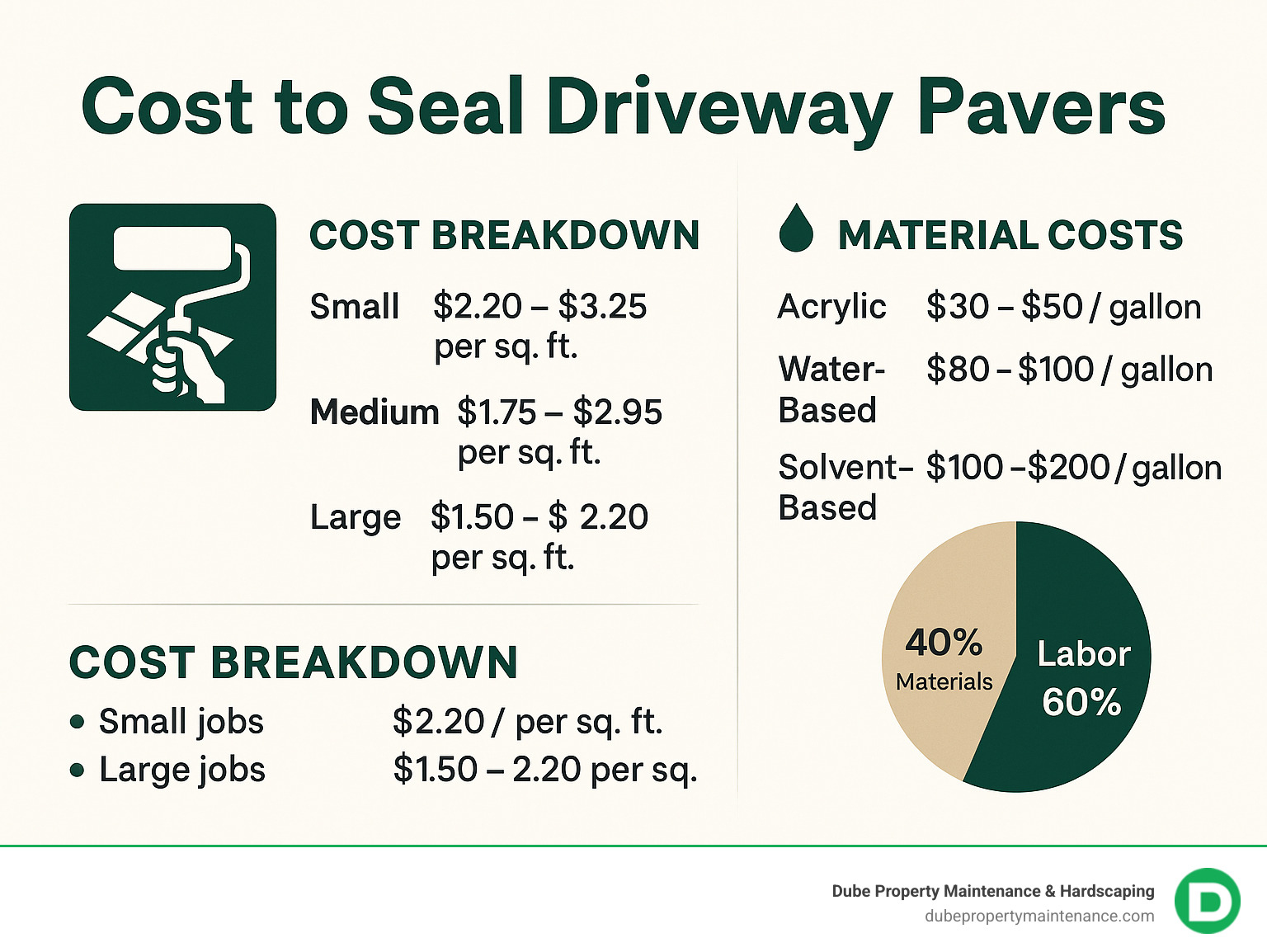
The cost to seal driveway pavers typically ranges from $1.50 to $3.25 per square foot, including cleaning, prep work, and sealing. For a standard 500 square foot driveway, expect to pay between $750 and $1,625 for professional sealing.
Quick Cost Breakdown:
– Average cost per square foot: $1.50 – $3.25
– Small jobs (under 500 sq ft): $2.20 – $3.25 per sq ft
– Medium jobs (501-2,000 sq ft): $1.75 – $2.95 per sq ft
– Large jobs (over 2,000 sq ft): $1.50 – $2.20 per sq ft
– DIY cost: Under $1.00 per sq ft (materials only)
– Professional service: $1.50 – $3.25 per sq ft (labor and materials)
Note: These are average costs based on internet data, not actual costs from Dube Property Maintenance & Hardscaping. Your actual costs may vary significantly.
Are those beautiful paver driveways in your neighborhood catching your eye? Or perhaps you’ve already invested in one and want to protect it? Either way, understanding the cost to maintain these surfaces is essential for smart homeownership.
Sealing your driveway pavers isn’t just about aesthetics – it’s about protection. Just like applying sunscreen before heading to the beach, sealer shields your pavers from damaging UV rays, prevents weed growth, stabilizes joint sand, and makes cleaning easier. But what will this protection cost you?
The price varies based on your project size, paver condition, geographic location, and whether you choose DIY or professional application. Larger projects benefit from economies of scale, with per-square-foot costs decreasing as total area increases.
Professional sealing typically lasts 3-5 years, making the investment a reasonable maintenance expense when calculated annually. And while DIY might seem cheaper upfront, professional application often provides superior longevity and appearance.
Let’s break down everything you need to know about budgeting for this important home maintenance task.
Relevant articles related to cost to seal driveway pavers:
– cost of permeable paver driveway
– cost to install paver driveway
– cost to pave a driveway
“How much will it cost?” This is the question we hear most often at Dube Property Maintenance & Hardscaping when homeowners call about sealing their paver driveways. While the national average for cost to seal driveway pavers typically falls between $1.50 and $3.25 per square foot, there’s much more to the story than just a simple number.
“Many homeowners are surprised to learn that the square footage is just the starting point,” our lead hardscaping specialist often explains. “The condition of your pavers, the type of sealant selected, and even your location in Massachusetts or New Hampshire can significantly impact the final price.”
Project size makes a substantial difference in what you’ll pay:
| Project Size | Square Footage | Price Per Sq Ft | Total Cost Range |
|---|---|---|---|
| Small | Under 500 sq ft | $2.20 – $3.25 | $1,100 – $1,625 |
| Medium | 501-2,000 sq ft | $1.75 – $2.95 | $876 – $5,900 |
| Large | Over 2,000 sq ft | $1.50 – $2.20 | $3,000 – $4,400+ |
These price differences reflect economies of scale—larger projects allow contractors to spread fixed costs like setup, equipment, and travel time across more square footage. Think of it like buying in bulk at the grocery store; the price per unit drops as you purchase more.
When you consider that most professional sealants last 3-5 years, your investment breaks down to approximately $0.30-$1.08 per square foot annually. That’s a small price to pay to protect the thousands you’ve invested in those beautiful pavers!
Note: These are average costs based on internet data, not actual costs from Dube Property Maintenance & Hardscaping. Your specific project may vary significantly.
The cost to seal driveway pavers varies considerably depending on where you live. Here in the Northeast, particularly in Massachusetts and New Hampshire where we operate, prices tend to run higher than the national average. This is primarily due to higher labor rates and our shorter seasonal working windows—Mother Nature doesn’t always cooperate with our scheduling in New England!
For homeowners in communities like Methuen, North Andover, and Salem, NH, you’ll likely find quotes toward the higher end of the national ranges, especially for smaller projects where minimum service fees often apply.
“We occasionally hear from customers who’ve received quotes as low as $0.90 per square foot or as high as $12.00 per square foot,” our operations manager shares with a smile. “Those extremes usually indicate either incomplete services or premium add-ons like specialized color improvement or extensive repairs.”
Most reputable contractors establish minimum job charges, which means very small projects might cost more per square foot than larger areas. For instance, if a company has a $500 minimum service fee, a 100-square-foot walkway would effectively cost $5.00 per square foot even if their standard rate is much lower. It’s simply not economical for professionals to mobilize equipment and crew for very small jobs without covering their basic costs.
Your final bill can be affected by several important variables beyond just square footage:
Area Size makes a significant difference, as our table above shows. Larger areas generally benefit from better per-square-foot pricing.
Paver Condition plays a major role too. Older, more porous pavers will drink up sealant like a sponge, increasing your material costs. Similarly, pavers caked with years of grime require more intensive cleaning, adding labor hours to your project.
Joint Sand Condition can add unexpected costs. If the polymeric sand between your pavers needs replacement, you’re looking at an additional $0.25-$0.50 per square foot.
Access Difficulty can quickly increase labor costs. One customer in Haverhill found this out firsthand: “I was quoted $2.75 per square foot for my 400-square-foot driveway, but when the contractor saw it was on a steep incline with limited water access, the price increased to $3.25 per square foot due to the additional labor required.”
Regional Labor Rates in our New England service area tend to be higher than in other parts of the country, affecting overall pricing.
Weather Windows in Massachusetts and New Hampshire are shorter than in southern states, creating seasonal demand that can influence pricing, especially during peak seasons.

Understanding these factors helps explain why pricing can vary so widely and why getting an on-site estimate is so important for accurate budgeting. Every driveway tells its own story, and experienced contractors like our team can “read” that story to provide the most appropriate solution and pricing.
For more information about driveway paver basics and installation, check out our driveway pavers page.
Ever wonder what exactly you’re paying for when you get that quote to seal your driveway pavers? Let’s pop open the hood and look at the components that make up the final price tag.
The cost to seal driveway pavers breaks down into two main categories: materials and labor. And believe it or not, it’s usually the labor that takes the bigger bite out of your budget.
On the materials side, you’re looking at:
– Sealant costing between $32-$70 per gallon (with each gallon typically covering 100-200 square feet)
– Polymeric sand running $25-$40 per 50-pound bag (enough for about 75-100 square feet)
– Cleaning solutions at $15-$30 per gallon
– Equipment costs if you’re going DIY (like a $50/day pressure washer rental)
When it comes to labor, expect this to account for 50-70% of your total bill, typically ranging from $100 for small jobs up to $500 or more for larger, more complex projects. This higher percentage makes sense when you consider what’s involved: thorough cleaning, joint sand replacement, careful application, and all that detailed edge work that makes the finished job look professional.

“Most homeowners focus on the sealant price,” explains our team at Dube Property Maintenance & Hardscaping, “but they’re often surprised by how much work goes into proper preparation. That’s where much of your investment is actually going.”
One important choice affecting your bottom line is between high-VOC and low-VOC sealants. High-VOC products (Volatile Organic Compounds) tend to be cheaper but may face restrictions in certain regions due to environmental regulations. If you’re curious about the health and environmental impacts of VOCs, the EPA’s information on indoor air quality provides excellent research.
Your sealant choice dramatically impacts both your wallet and your results. Let’s compare:
Water-Based Sealants ($42-$70 per gallon)
These eco-friendly options have come a long way in recent years. They’re perfect if you’re environmentally conscious or if your pavers are relatively new. The low odor makes application more pleasant, and you can even apply them to slightly damp pavers (a huge plus in our unpredictable New England weather). The downside? They typically last just 2-3 years and don’t improve paver colors as dramatically.
Solvent-Based Sealants ($32-$55 per gallon)
Looking for that rich, “wet look” that makes your pavers pop? Solvent-based sealers deliver superior color improvement and typically last 4-5 years before needing reapplication. They’re also champions at repelling stains, making them ideal for high-traffic areas. The trade-offs are the strong odor during application and the requirement for bone-dry pavers before application.
“I remember debating between the two types for my own home,” shares one of our Dube Property Maintenance technicians. “I ultimately chose solvent-based for my driveway and water-based for my backyard patio near the pool. Different spaces, different needs.”
For those researching product options, you can find basic supplies at Home Depot’s paint section, though for best results, we recommend professional-grade products applied by experienced contractors.
When we provide quotes at Dube Property Maintenance & Hardscaping, we’re accounting for a comprehensive process that includes:
Surface Cleaning that goes well beyond a simple rinse. We’re talking about removing years of grime, oil spots, and organic matter through pressure washing and specialized cleaners.
Joint Re-Sanding to ensure those spaces between pavers are properly filled with fresh polymeric sand. This prevents weed growth and insect nesting while stabilizing your pavers.
Minor Repairs to address small issues like slightly uneven pavers that might have shifted over time.
Edge Masking to protect your home’s foundation, landscaping, and other adjacent surfaces from accidental overspray.
Two-Coat Application for maximum protection and a more uniform appearance. That second coat makes a world of difference in the final look.
Thorough Cleanup so your property looks better than when we arrived.
Workmanship Warranty that gives you peace of mind that the job was done right.
A homeowner in Salem, NH recently told us, “What impressed me most was watching how carefully they masked off my garage doors and foundation before applying the sealer. That attention to detail is exactly why I didn’t try to DIY this project!”
While these price ranges give you a general idea of costs, they’re average costs based on internet data, not actual costs from Dube Property Maintenance & Hardscaping. Your specific project may vary significantly based on your unique property conditions.
The DIY route certainly catches your eye when you see materials alone costing under $1.00 per square foot compared to professional services at $1.50-$3.25. But as many homeowners find, sometimes the cheapest option up front becomes the most expensive in the long run.

When you’re figuring out what you’ll really spend on a DIY paver sealing project, you need to look beyond just the sealer itself. For a typical 500 square foot driveway, your shopping list gets lengthy pretty quickly.
You’ll need to calculate how much sealant to buy by dividing your square footage by the coverage rate (usually around 200 sq ft per gallon). For our example driveway, that’s about 2.5 gallons at $40-$70 each, totaling $100-$175 just for the sealer.
Equipment isn’t free either. That pressure washer rental will set you back $50-$75 per day. Add a pump sprayer ($15-$30), rollers and accessories ($25-$50), polymeric sand if your joints need refreshing ($25-$40 per bag), cleaning solutions ($15-$30), and don’t forget protective gear ($20-$30).
“I thought I’d save a bundle doing it myself,” shares Robert from Salem, NH. “By the time I added up all the supplies and equipment rentals, my ‘bargain’ project was only about 30% cheaper than the professional quote—and that’s not counting the value of my weekend!”
Always toss in a 10% contingency for those inevitable surprises. All told, your DIY 500 sq ft project might cost around $385 or about $0.77 per square foot. The savings look good on paper, but remember—you’re trading your time (often 1-2 full days), risking mistakes, and typically getting shorter-lasting results.
The real expense of DIY often reveals itself weeks or months later. Re-do work is perhaps the most common hidden cost—those streaks, bubbles, or peeling sections that require complete stripping and reapplication.
Joint failure happens when polymeric sand isn’t properly installed, leading to weeds popping through or pavers shifting over time. Color haze is another DIY pitfall—that cloudy, blotchy appearance from uneven application that’s nearly impossible to fix without starting over.
There’s also the resale impact to consider. As real estate agents frequently note, professionally maintained hardscaping can boost your property value, while visibly amateur work might actually detract from it.
Don’t overlook safety hazards either. Improperly sealed pavers can become dangerously slippery, especially on sloped driveways—a liability no homeowner wants.
“I tried DIY sealing to save money,” admits Jennifer from North Andover, MA. “The first rain after application created puddles because I didn’t allow proper drying time. Then the sealer started peeling in those areas. I ended up paying a professional to strip everything and reseal correctly—costing me nearly double what professional application would have been initially.”
The truth is, professional sealing typically averages around $2 per square foot for good reason. You’re not just paying for materials, but for expertise, proper equipment, warranties, and peace of mind. When you factor in the longevity of professional results—often 1-2 years longer than DIY applications—the annual cost difference shrinks considerably.
For many homeowners in our Massachusetts and New Hampshire service area, the real value comes from knowing the job was done right the first time. After all, your driveway makes a first impression every single day.
Looking to reduce your cost to seal driveway pavers without sacrificing quality? You’re not alone. Many of our customers want to protect their investment without breaking the bank.
“We were initially shocked at the quotes we received,” admits Sarah from Andover, “but then we learned about timing our project strategically.”
Sarah finded what many homeowners don’t realize – scheduling makes a difference. Booking your sealing project during slower periods (early spring or late fall) often means contractors offer better rates. The work quality remains the same, but you might save 15-20% simply by avoiding the summer rush.
Another smart approach is bundling multiple areas together. If you have a paver patio, walkway, or pool deck in addition to your driveway, sealing them all at once creates economies of scale. Most contractors, including our team at Dube Property Maintenance & Hardscaping, offer noticeable discounts when treating multiple surfaces during the same visit.
“We saved almost $300 by having our driveway and backyard patio sealed together,” explains Michael from Salem, NH. “The crew was already on-site with all their equipment, so it just made sense.”
Regular maintenance also pays dividends. Simple routine cleaning with a garden hose and mild detergent can extend your sealant’s life by a year or more. This means less frequent professional reapplications – a direct savings to your wallet over time.
Don’t underestimate the power of multiple quotes, either. Always request estimates from at least three reputable contractors. This not only ensures competitive pricing but also gives you insight into different approaches and materials. Just be wary of quotes that seem too good to be true – they usually are.
For more detailed information about factors affecting paver driveway costs, visit our comprehensive guide on the cost to pave a driveway.
The conversation you have before hiring can make all the difference in your final results and satisfaction. When interviewing potential contractors, be sure to ask these essential questions:
“Is your company fully licensed and insured?” This isn’t just a formality – it protects you from liability if accidents occur on your property. Always verify coverage rather than just accepting a “yes.”
“What specific brand and type of sealer do you use?” Professional-grade products typically cost more but deliver superior longevity and appearance. The contractor should be able to explain why they’ve chosen their particular product.
Ask about preparation steps – proper cleaning isn’t optional, it’s essential for adhesion and appearance. A good contractor will detail their cleaning process, including how they’ll handle tough stains or problem areas.
“How many coats will you apply?” Two coats are the industry standard for optimal protection, though some situations might require more or less. Understanding this upfront helps you evaluate if you’re getting good value.
Don’t forget to discuss curing time (typically 24-72 hours) and whether they provide a written warranty (look for at least 1-2 years of coverage). Requesting references from similar projects lets you check their work quality firsthand.
Rolling up your sleeves before the professionals arrive can meaningfully reduce your final bill.
DIY debris removal makes a bigger difference than you might think. Spending 30 minutes sweeping away leaves, sticks, and loose dirt saves valuable contractor time. As Tom from Methuen tells us, “I cleared everything myself the day before. The crew mentioned it saved them nearly an hour of prep time, which they passed on as a $75 discount.”
Weed elimination is another task worth tackling yourself. Those persistent plants growing between pavers take time to remove properly. Pulling them a few days before your scheduled sealing (roots and all) helps the professionals move more efficiently.

Clear access is crucial. Remove vehicles, patio furniture, planters, and anything else sitting on the paver surfaces. This not only speeds up the work but prevents awkward unsealed spots that would require touch-ups later.
Ensure your outdoor water source is functioning and easily accessible. Professionals need water for cleaning, and having to search for or troubleshoot water access wastes valuable time.
Finally, providing accurate measurements helps contractors quote precisely. Measure the length and width of your driveway or patio area before requesting quotes. This simple step prevents estimation errors that could lead to higher bills or insufficient materials.
By combining these money-saving strategies, you’ll get professional-quality sealing at the best possible price – protecting both your pavers and your budget.
Planning your paver sealing project doesn’t have to be overwhelming. With a thoughtful approach to budgeting, you can avoid surprise costs and ensure you’re making smart decisions about protecting your investment.
Start by measuring your area accurately. Grab a tape measure and calculate the square footage (length × width) of all areas you plan to seal. Don’t just eyeball it—precise measurements lead to more accurate quotes and help you avoid buying too much or too little sealant.
Next, select your sealer type based on what matters most to you. Are you looking for that rich, wet look that improves paver colors? A solvent-based sealer might be worth the extra cost. Concerned about environmental impact? Water-based options offer a more eco-friendly approach, though they typically require more frequent reapplication.
“When I was deciding between sealers,” shares a homeowner from Salem, NH, “I realized the solvent-based option would cost me about $120 more for my driveway, but would last two years longer. That actually saved me money in the long run.”
Once you’ve chosen your sealer, research current material prices at local suppliers or online. Professional-grade products may cost more initially but typically provide superior performance and longevity compared to big-box store options.
Now comes the big decision: professional installation or DIY? Factor in professional quotes or, if going the DIY route, honestly assess the value of your time and skill level. That “savings” of $500 might not seem so significant if you spend an entire weekend on the project and don’t achieve professional-quality results.
Always add a 15% buffer to your budget. Even the most careful planning can’t anticipate every variable—from finding damaged pavers that need replacement to needing more sealant than expected for particularly porous surfaces.
Plan your project during dry weather periods. In New England, the optimal sealing windows are typically late spring and early fall. Scheduling during peak summer can lead to higher costs due to contractor demand, while winter applications are generally not recommended.
Finally, consider ongoing maintenance costs in your long-term budget. Regular cleaning can extend your sealer’s life significantly, potentially pushing that resealing timeline from three years to five.

Understanding when to reseal helps you plan financially for this recurring maintenance expense. Most professionals recommend following the 3-5 year rule for resealing frequency, but several factors might adjust this timeline for your specific situation.
If your driveway sees heavy traffic with multiple vehicles coming and going daily, you’ll likely need to reseal closer to the three-year mark. The mechanical wear from tires gradually breaks down even the best sealants.
Living in freeze-thaw climates like Massachusetts and New Hampshire also impacts sealer longevity. Our harsh New England winters, with their cycle of freezing and thawing, can cause sealants to deteriorate more quickly than in milder climates.
“After moving from Georgia to Massachusetts,” one Dube Property Maintenance customer told us, “I was surprised to learn I’d need to reseal my pavers almost twice as often. The winter weather here is much harder on outdoor surfaces.”
Pay attention to visual cues that it’s time to reseal. When your pavers begin looking faded or water no longer beads on the surface after rain, the protective seal is failing. Catching this early can prevent more expensive repairs down the road.
To make budgeting easier, calculate the cost-per-year of your protection. If professional sealing costs $1,500 and lasts four years, you’re effectively spending $375 per year to protect and beautify your paver investment. When viewed this way, regular sealing becomes a reasonable maintenance expense rather than a major project cost.
Different areas of your property may even need different resealing schedules. North-facing or heavily shaded sections that retain moisture longer often require more frequent attention than sunnier areas. This is particularly true in our New England climate, where damp conditions can promote moss and algae growth that deteriorates sealants faster.
Where you live plays a surprisingly big role in what you’ll pay to protect those beautiful pavers. Here in the Northeast, particularly in Massachusetts and New Hampshire where we work, homeowners often see higher prices than the national average.
“The first time I got quotes for sealing my driveway, I was shocked at how much higher they were than what my Florida relatives paid,” shares one of our Methuen customers. “But when you think about our shorter working season and higher cost of living, it makes sense.”
Several geographic factors influence your cost to seal driveway pavers:
Labor rates tend to be significantly higher in regions like New England and California, where the cost of living exceeds the national average. Specialty sealants might cost more in certain areas simply due to shipping expenses from manufacturing centers. If you live in a region with strict environmental regulations, you might be required to use more expensive low-VOC sealants that meet local standards.
There’s also a noticeable difference between coastal and inland properties. Coastal areas often command premium rates due to higher demand and property values. Based on internet data (not actual Dube Property Maintenance & Hardscaping prices), the same sealing job might cost up to $3.00 per square foot in the Northeast and California, while running closer to $1.50 per square foot in Florida.
Even the most straightforward paver sealing job can encounter complications that affect your bottom line. Being aware of these potential add-ons helps you budget more accurately.
Major repairs often top the list of unexpected costs. If your contractor finds sunken areas or damaged pavers during the prep phase, fixing these issues could add $10-$30 per square foot for those specific sections. One Salem, NH homeowner told us: “What started as a simple sealing job turned into a partial rebuild when they found three cracked pavers that had been hidden under my grill for years.”
Deep oil stains present another common challenge. That spot where your teenager’s car has been leaking might require specialized cleaning solutions and extra labor, potentially adding $2-$5 per square foot in those areas.
If your property features steep slopes or difficult access, expect a potential 10-20% premium as contractors account for the additional labor and safety measures required. Similarly, if your project requires a second coat of sealer for optimal protection, that could add $0.50-$1.00 per square foot to your total.
For those looking to improve the appearance of faded pavers, color-enhancing sealers typically add 15-25% to material costs but can dramatically improve the final look.
And don’t forget about minimum service fees. For small projects under a certain threshold (often 200-300 square feet), many contractors charge minimum fees of $300-$500 regardless of the actual square footage.
As more homeowners prioritize environmental responsibility, eco-friendly sealing options have become increasingly available—though they typically come with a price premium.
Low-VOC formulas generally cost 10-20% more than standard sealers but significantly reduce harmful emissions. These environmentally safer options limit the release of volatile organic compounds that contribute to air pollution and potential health concerns.
Water-based sealants represent another eco-friendly alternative. While they may offer less dramatic color improvement and slightly shorter lifespan than their solvent-based counterparts, they provide safer application conditions with minimal odor.
“We chose a low-VOC sealer for our driveway because we have children and pets,” explains a homeowner from Woburn, MA. “It cost about 15% more, but the peace of mind was worth it, plus we could use the patio much sooner after application since there weren’t strong fumes.”
The environmental benefits extend beyond just reduced air pollution. These products typically create safer working conditions for the application team and allow homeowners to resume normal outdoor activities sooner after application.
While the initial investment might be higher, some eco-friendly products require less frequent reapplication due to improved formulations, potentially saving money over time. When you factor in the health benefits and reduced environmental impact, many of our clients find the premium well worth it.
If environmental concerns are important to you, be sure to ask potential contractors about their eco-friendly options and how they might affect both your immediate budget and long-term maintenance costs.
When you protect your paver driveway with professional sealing, you’re making a smart investment in your home’s future. Though the initial cost to seal driveway pavers ranges from $1.50 to $3.25 per square foot (based on internet data), this expense makes perfect sense when you consider the benefits: extended paver life, improved curb appeal, and significantly less maintenance headaches down the road.
Think of it this way – when you break down that cost over the typical 3-5 year protection period, you’re really only spending cents per square foot annually to protect what was likely a substantial investment in your home’s exterior. That’s the kind of math that makes homeowners smile!
Remember though, these figures represent average costs gathered from internet research, not actual pricing from Dube Property Maintenance & Hardscaping. Your specific project may cost significantly more or less depending on your unique circumstances – the size and condition of your driveway, your location in Massachusetts or New Hampshire, and the particular materials you select all play important roles in determining your final investment.
For the best outcome and value, I recommend reaching out to professional hardscaping experts early in your planning process. We at Dube Property Maintenance & Hardscaping serve communities throughout Massachusetts and New Hampshire with comprehensive outdoor solutions, including expert paver installation, regular maintenance, and protective sealing.
Whether you’ve just installed a beautiful new paver driveway or you’re looking to breathe new life into an existing one, proper sealing represents one of the most cost-effective ways to safeguard your hardscaping investment. The protection it provides against staining, weed growth, and erosion is truly invaluable.
Want to learn more about installing or upgrading your paver driveway? Visit our detailed guide on the cost to install paver driveway for more information.
Ready to protect your paver investment? Contact our friendly team at Dube Property Maintenance & Hardscaping today for a free, no-obligation estimate. Our experienced professionals will help you determine the best approach for your specific needs and budget, ensuring your outdoor spaces remain beautiful for years to come.
