Property Maintenance
& Hardscaping
Headquarters In
Methuen, MA

Coping with Saltwater: What Materials Will Last?

Saltwater pool coping: Best Materials 2025


Why Choosing the Right Materials Matters for Your Saltwater Pool

Saltwater pool coping requires careful material selection to withstand the unique challenges of salt exposure. While saltwater pools are popular for their gentler feel, the salt poses a hidden threat to your pool’s surrounding materials.

Quick Answer: Best Saltwater Pool Coping Materials

  • Dense granite – Superior durability and salt resistance
  • High-quality travertine – Heat-resistant with proper sealing
  • Precast concrete – Engineered for low absorption and strength
  • Porcelain pavers – Non-porous and highly durable
  • Dense bluestone – Modern look with excellent performance

Materials to Avoid:

  • Porous sandstone and limestone
  • Low-density flagstone
  • Standard poured concrete without proper treatment

The science behind salt damage is simple but destructive. As noted by construction experts, salt penetrates tiny fissures in the surface. When water evaporates, salt crystals are left behind to grow and expand, fracturing the material from within and causing it to flake or crumble.

This process can turn beautiful stone into an unsightly mess in just a few years. The key is understanding which materials can resist this damage and how proper maintenance protects your investment.

For homeowners in Methuen and surrounding Massachusetts areas, where harsh winters already challenge outdoor materials, choosing salt-resistant coping is even more critical.
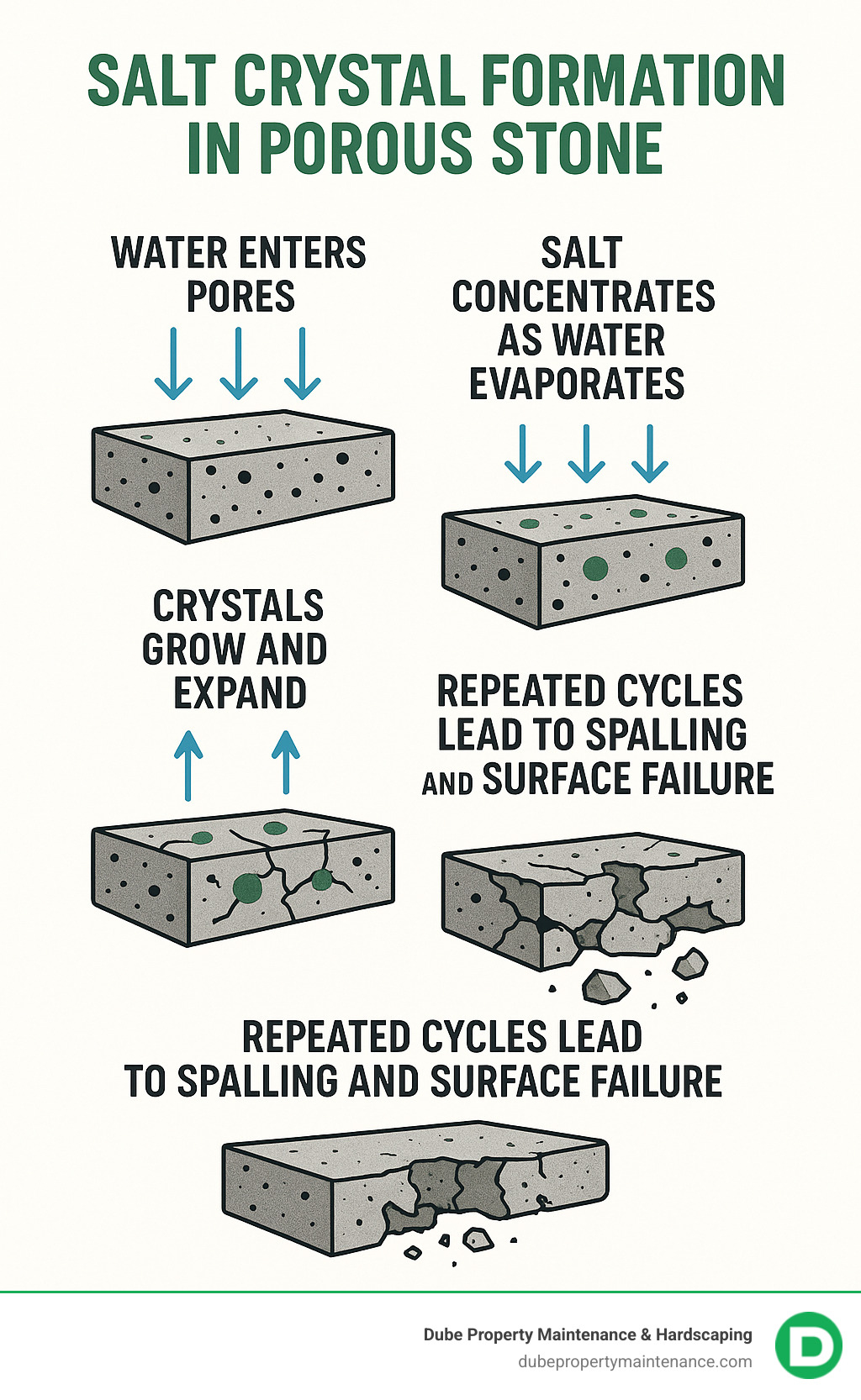
Infographic showing salt crystal formation in porous stone: water enters stone pores, salt concentrates as water evaporates, crystals grow and expand causing cracks, repeated cycles lead to spalling and surface failure - Saltwater pool coping infographic

The Science of Salt: Why It Damages Pool Coping

Understanding why salt damages saltwater pool coping starts with your pool’s system. Saltwater pools use a salt-chlorine generator that converts ordinary salt into chlorine through a process called electrolysis. This creates silky-smooth water, but it also means salt is constantly present in your pool environment.

The real trouble begins when this salty water splashes onto your coping. If the material is porous, the water seeps in like a sponge. When the sun evaporates the water, salt crystals are left behind. These crystals then grow and expand with tremendous force, pushing the material apart from the inside.
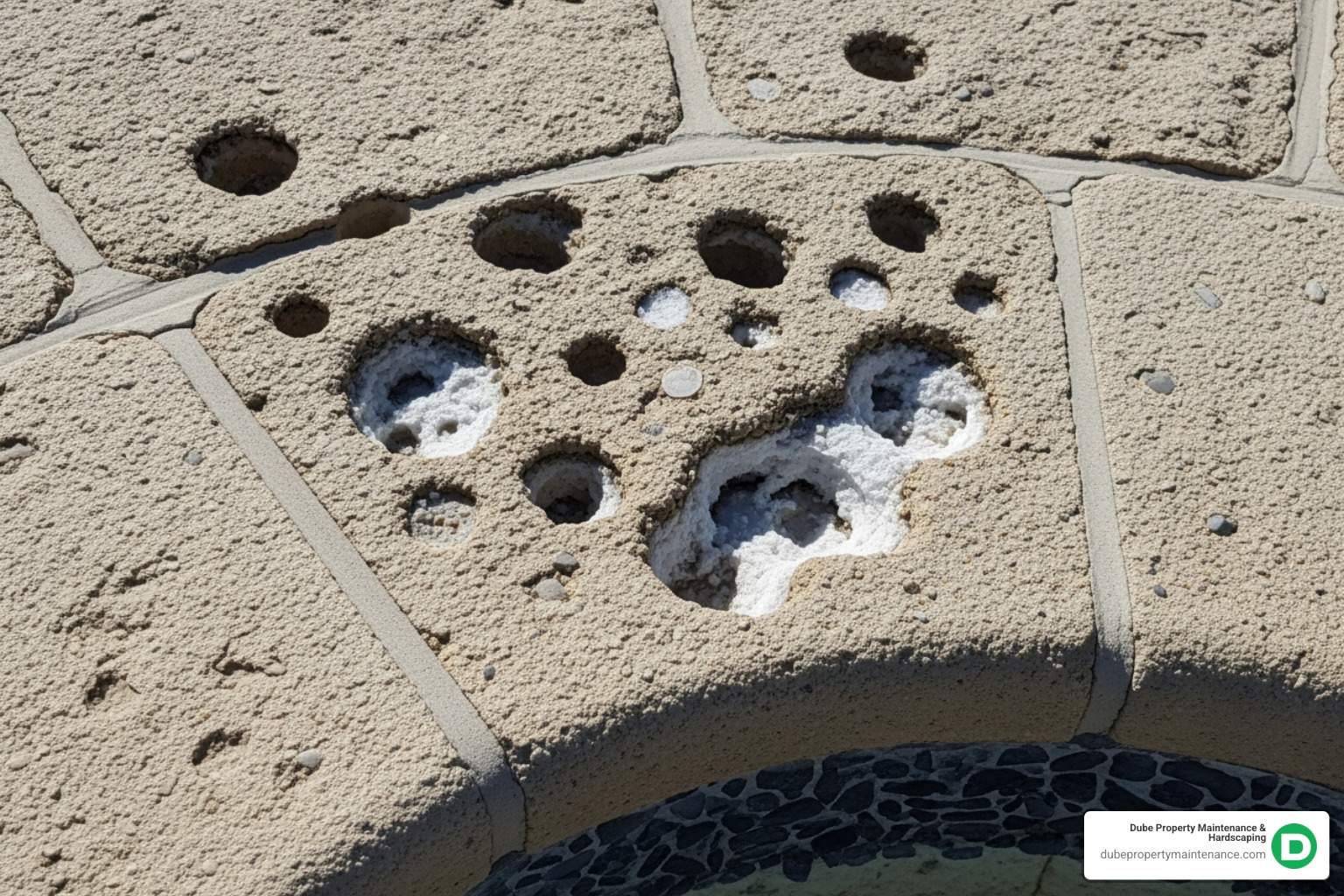
close-up showing salt-damaged, pitted stone coping - Saltwater pool coping

A material’s porosity and absorption rate determine its vulnerability. Highly porous materials like sandstone, limestone, or standard concrete soak up saltwater, giving crystals plenty of room to form. This leads to visible damage like pitting (small holes), spalling (chunks flaking off), and flaking (surface peeling). You can learn more from expert insights on salt damage and how it affects pool hardscapes.

Water chemistry also plays a huge role. When your pool’s pH levels are unbalanced or total dissolved solids are too high, the corrosive effects accelerate dramatically. Choosing the right materials and maintaining proper water chemistry are essential for protecting your investment.

Best and Worst Materials for Saltwater Pool Coping

When it comes to saltwater pool coping, some materials are built to withstand the assault of salt, while others surrender quickly. Let’s explore which materials will protect your investment.

Materials to Use with Caution

These materials often struggle with saltwater exposure and require significant maintenance to avoid costly repairs.
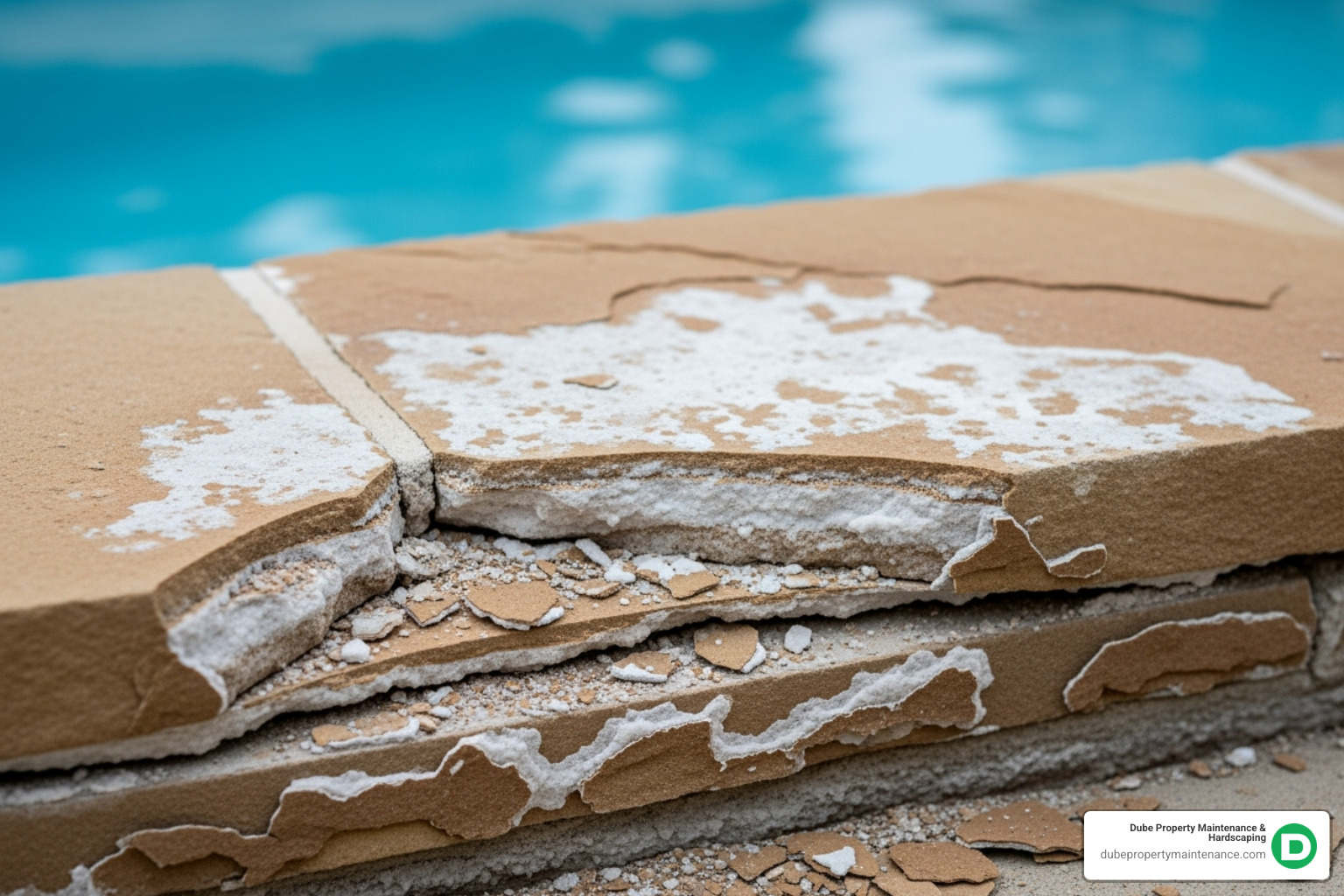
  • Porous natural stones like sandstone and limestone are highly absorbent. They invite saltwater deep into their pores, where expanding salt crystals cause pitting and flaking from the inside out.
  • Low-density flagstone varieties are also vulnerable. The more porous the stone, the more likely it is to deteriorate.
  • Standard poured concrete can also be damaged, as salt penetrates its tiny capillaries, leading to surface erosion and pop-outs.
  • Even bluestone requires careful selection, as some less dense varieties are prone to salt damage. For more details, see our guide on bluestone options.

flaking sandstone coping next to a saltwater pool - Saltwater pool coping

These materials are the champions of saltwater pool coping, engineered to resist salt crystallization.

  • Dense natural stones like granite are a top choice. This igneous rock is incredibly dense and non-porous, making it virtually immune to salt damage.
  • High-quality travertine performs beautifully when properly sealed. It also has the natural benefit of staying cool underfoot on hot days.
  • Dense bluestone, particularly from Pennsylvania, offers a sophisticated, modern look with excellent resistance to flaking.
  • High-density precast concrete is engineered in controlled conditions for low absorption and high strength, making it highly resistant to salt. It also offers incredible design flexibility.
  • Porcelain pavers are extremely dense and non-porous, making them nearly impervious to salt damage. They are available in a vast array of styles.

For a comprehensive look at paver options, explore our guide to the best pavers for pool decks.

Material Salt Resistance Durability Maintenance Aesthetics
Granite Excellent Excellent Low Natural, high-end, wide color range
Precast Concrete Excellent Excellent Low Versatile, mimics natural stone, consistent
High-Quality Travertine Good-Excellent Good-Excellent Moderate (sealing) Classic, neat, stays cool
Porcelain Excellent Excellent Very Low Modern, sleek, vast design options

Choosing a recommended material is an investment in durability that pays off in reduced maintenance and replacement costs.

A Closer Look at Top Saltwater Pool Coping Choices

Understanding the nuances of each top material helps you make the best choice for your saltwater pool coping.

Natural Stone: The Best of Travertine, Granite, and Bluestone

Natural stone brings timeless elegance, but not all stones are created equal when facing salt.

  • Travertine is prized for its beautiful appearance and its ability to stay cool underfoot. For saltwater pools, choosing a high-quality, dense variety is critical. When properly selected and sealed, it offers a classic, sophisticated look. For more on this material, see our guide on travertine pool decks.
  • Granite is the heavyweight champion of durability. Formed from cooled magma, its incredible density and low porosity make it naturally resistant to water and salt penetration. It stands up to heavy traffic, chemicals, and harsh weather.
  • Bluestone, particularly denser Pennsylvania varieties, offers a modern, blue-grey aesthetic that resists flaking. That darker varieties can get hot in direct sunlight.

Sealing is essential for all natural stone in saltwater environments. A quality penetrating sealer adds a crucial layer of protection and typically needs reapplication every 2-5 years.

The Advantages of Precast Concrete Coping

Precast concrete is a precision-engineered solution that often outperforms natural stone in saltwater environments.

  • Engineered durability is its key advantage. Unlike the natural variations in stone, precast concrete is manufactured under controlled conditions for exceptionally low absorption rates and high strength, specifically to resist salt damage.
  • Customization options are virtually limitless. It can be molded into countless shapes, sizes, colors, and textures, allowing it to mimic natural materials while providing superior performance and slip resistance.
  • From a cost-effectiveness standpoint, precast concrete delivers exceptional long-term value. Its uniformity simplifies installation, and its durability reduces future maintenance and replacement needs.

For a comprehensive look at concrete options, explore our guide on concrete pool coping.

Protecting Your Investment: Maintenance and Prevention

Even the most durable saltwater pool coping requires proactive maintenance to last. A few simple habits can make all the difference.

Essential Maintenance for Saltwater Pool Coping

Your goal is to prevent salt from settling on your coping and causing damage.

  • Regular Rinsing: This is your most important task. After swimming, hose down your coping and deck with fresh water. This washes away salt before it can evaporate, crystallize, and cause damage.
  • Monitor Water Chemistry: Keep your pool water balanced. Maintain the recommended ranges for salt concentration (usually 2,700-3,400 ppm), pH levels (7.2-7.6), and total dissolved solids. Unbalanced water is more aggressive toward coping materials.
  • Clean Salt Cells: Regularly clean your salt cell to prevent calcium buildup, which can hinder chlorine production and throw off your water chemistry.
  • Address Metal Corrosion: Salt also attacks metal fixtures. Installing a sacrificial zinc anode in your plumbing system can protect handrails and equipment from corrosion.
  • Look for Salt Buildup: If you see white, crusty deposits on your coping, rinse the area thoroughly immediately. This is a sign that saltwater is evaporating there. For real-world tips, see this Forum discussion on coping maintenance.

The Critical Role of Sealants

Sealants are an invisible raincoat for your coping, providing crucial protection against water and salt.

  • Choose the Right Type: Use a penetrating sealer, which soaks into the material to create a barrier without making the surface slippery. Avoid topical sealers that form a surface film.
  • How They Work: A good sealer has water-repellent properties, causing water to bead up and roll off rather than soaking in. This dramatically reduces salt penetration.
  • Reapplication Schedule: Plan to reapply sealer every 2-5 years. The best indicator is to watch how water behaves on the surface. If it starts soaking in instead of beading, it’s time for a fresh coat.
  • Professional Sealing: Professional application ensures proper surface preparation and even coverage for maximum protection.

Learn more in our Guide to sealing pool deck pavers.

Design, Cost, and Installation

Beyond durability, the aesthetic appeal and long-term cost of your saltwater pool coping are crucial considerations in your pool’s overall design.

Aesthetic Choices: Edges, Colors, and Textures

The coping is the “crown” of your pool, defining its character.
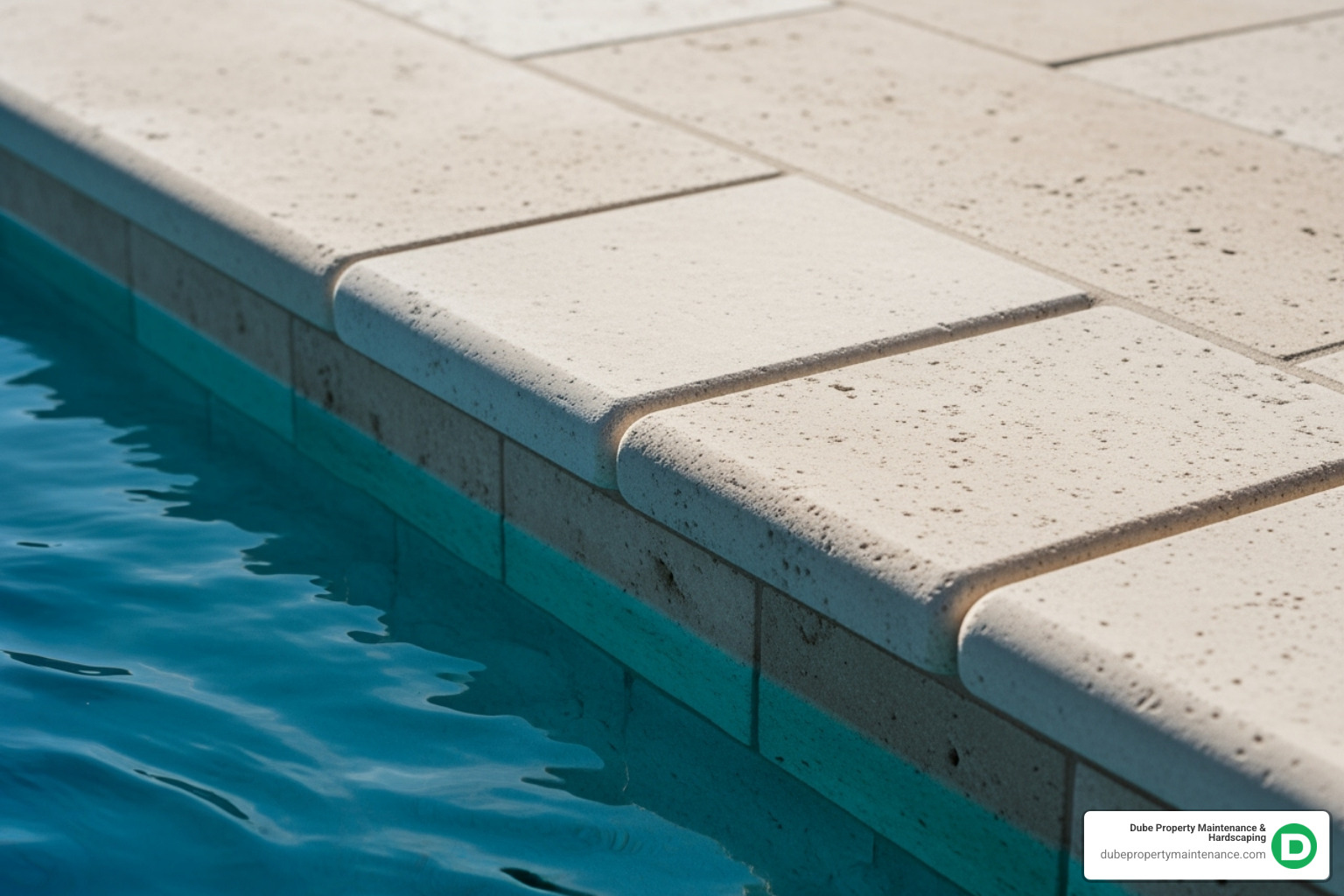
  • Coping Edge Styles:
    • Bullnose Edge: A classic, rounded edge for comfort and a soft look.
    • Square Edge: A clean, minimalist style popular for modern designs.
    • Rebated (Drop-Down) Edge: An L-shape that creates a thicker, more substantial appearance.
    • Eased Edge: A slightly softened square edge for a contemporary feel without sharp angles.
  • Color and Texture: Match your coping color to your pool’s interior and decking. Textured surfaces are essential for providing slip resistance and ensuring safety around wet areas. For design inspiration, explore our Swimming Pool Paving Ideas.

different coping edge profiles on a pool - Saltwater pool coping

Understanding Long-Term Cost-Effectiveness

Look beyond the initial price to understand the true cost of your coping over its lifespan.

  • Upfront Cost vs. Lifespan: Salt-resistant materials like granite or high-quality precast concrete may cost more upfront but save you money in the long run by avoiding premature repairs and replacement.
  • Installation and Repair Costs: Investing in a durable material from the start minimizes future repair costs from salt damage. Additionally, uniform materials like precast concrete can sometimes be quicker and less expensive to install than irregular natural stone.

On average, pool coping installation can range from $15 to $150+ per linear foot, depending on the material, pool complexity, and local labor rates. For more details on costs, see our resource on Information on pool deck paver costs.

Please note: any cost estimates are based on national averages and do not reflect pricing for Dube Property Maintenance & Hardscaping.

Frequently Asked Questions about Saltwater Pool Coping

Here are answers to the most common questions we receive about saltwater pool coping.

Can I use natural flagstone for my saltwater pool coping?

Yes, but with extreme caution. Flagstone is naturally porous and vulnerable to salt damage. Success depends on choosing a very dense variety, like some types of bluestone, and committing to diligent maintenance. Proper sealing with a high-quality penetrating sealer is absolutely non-negotiable to protect it.

How often do I need to seal my pool coping?

As a general rule, plan to reseal every 2 to 5 years. The exact frequency depends on the sealer quality, sun exposure, and pool use. The best test is to splash water on the coping: if it beads up, the sealer is working. If it soaks in, it’s time to reapply. Think of sealing as an insurance policy for your investment.

Is precast concrete a good alternative to natural stone?

Absolutely. For saltwater pools, high-quality precast concrete is an excellent choice and often outperforms natural stone. It is engineered for high strength and low absorption, making it highly resistant to salt damage. It also offers vast aesthetic possibilities, providing the look of natural stone with greater consistency, durability, and long-term value.

Conclusion

Choosing the right saltwater pool coping is one of the most important decisions for your pool’s longevity and beauty. It’s about protecting your investment from the relentless damage salt can cause.

The science is clear: density and low porosity are your best defense. Materials that don’t absorb much water can’t be damaged by expanding salt crystals. Durable options like granite, high-density precast concrete, and quality travertine have proven they can stand up to saltwater’s challenges.

However, even the best materials need your help. Proper sealing and regular maintenance—like rinsing with fresh water and keeping your water chemistry balanced—are essential.

At Dube Property Maintenance & Hardscaping, we’ve helped countless homeowners in Methuen and the surrounding areas steer these choices. We know which materials perform best in our New England climate, especially with the addition of salt. Your perfect coping depends on your style, budget, and maintenance preferences, and making an informed decision with an experienced team is what matters most.

Ready to create a pool area that’s both stunning and built to last? Explore our professional hardscaping services and let’s start planning your perfect outdoor oasis together.


Saltwater pool coping

Table Of Contents

Get Started Today!
Dube Property Maintenance
& Hardscaping
Dube Property Maintenance
160 Hampstead St., Methuen, MA 01844
Servicing Merrimack Valley & Southern NH
For 25+ years Dube Property Maintenance & Hardscaping has provided top-rated residential and commercial landscape design, installations, hardscaping, irrigation systems and commercial snow and ice management. Our hardscaping division proudly serves the Merrimack Valley, Middlesex and Essex County and Southern, NH regions, transforming outdoor spaces into stunning works of art.