Property Maintenance
& Hardscaping
Headquarters In
Methuen, MA

Holding It All Together: The World of Retention Walls

What is a Retaining Wall and Why Do You Need One?

retaining wall - retention walls

Retention walls are structures designed to hold back soil and create a stable, vertical face on a slope. They are essential for managing changes in ground elevation that soil cannot naturally support on its own.

Quick Definition:

  • Primary Purpose: Hold back soil on slopes to prevent erosion and create usable, level spaces.
  • How They Work: Counter lateral earth pressure (the sideways force of soil trying to move downhill).
  • Common Applications: Terracing sloped yards, preventing erosion, creating flat areas for patios or gardens, and supporting driveways or walkways.

If you’ve ever looked at your sloped yard and wondered how to create more usable outdoor space, a retaining wall might be the answer. As one homeowner described it, “Retaining walls keep landscape soil from eroding, and they also make attractive landscape features.”

The reality is simple: soil wants to move downhill, especially when wet. A properly built retaining wall resists that pressure, changing unusable slopes into functional spaces you can enjoy. In Massachusetts and New Hampshire, where properties often feature natural slopes, retention walls are crucial for protecting your property from erosion during heavy rains and snowmelt while adding structure and beauty.

The key to a successful retaining wall is understanding that it’s doing real work. Wet soil is dramatically heavier than dry soil, so proper design, drainage, and construction are critical to prevent failure.
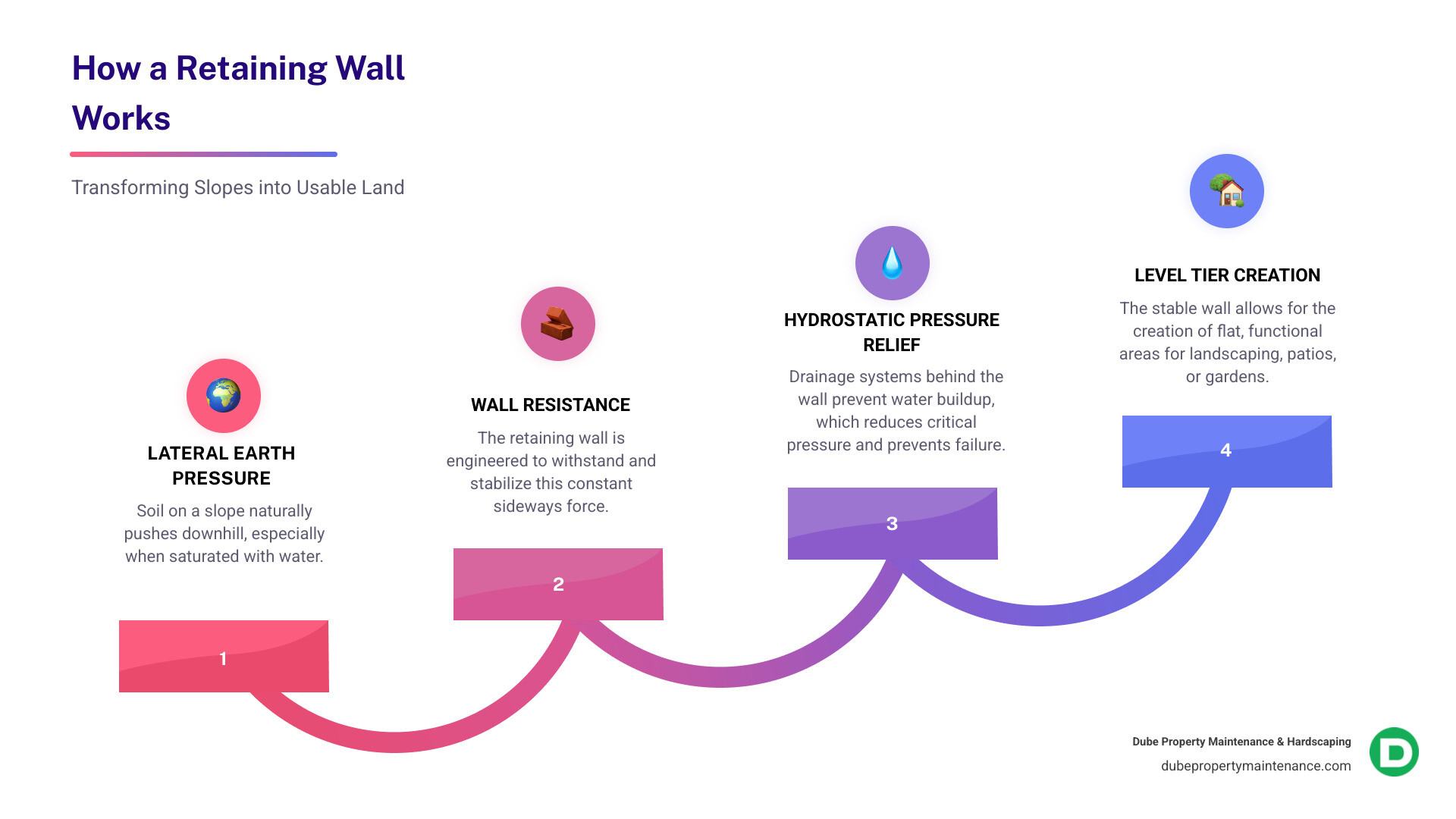
infographic showing a cross-section of a retaining wall on a slope, with arrows indicating lateral earth pressure from the soil pushing against the wall, drainage gravel behind the wall, and the creation of a level tier above the wall for usable space - retention walls infographic step-infographic-4-steps

The Core Benefits for Your Property

A well-designed retaining wall is a strategic investment that offers numerous advantages for homes in areas like Andover, MA, or Salem, NH. Key benefits include:

  • Increased Usable Space & Property Value: Walls create level tiers from unusable inclines, perfect for patios, gardens, or lawns. This expansion of functional space makes your property more versatile and valuable.
  • Erosion Control & Soil Stability: A retaining wall acts as a robust barrier against soil erosion caused by rain and snowmelt, protecting your foundation and landscape integrity.
  • Improved Aesthetic Appeal: These structures add definition, visual interest, and a clean, organized look to your yard, creating beautifully defined landscape beds or outdoor living areas.
  • Better Drainage: When built with proper drainage systems, walls manage water runoff effectively, preventing hydrostatic pressure and mitigating issues like soggy yards. For more ways to improve your outdoor living, explore our hardscaping services.

How Retaining Walls Lift Landscape Design

Retention walls are powerful design elements that blend engineering with artistic vision. They excel at creating focal points and adding architectural interest to your yard. For properties with varying elevations, terraced gardens are a beautiful and practical solution, creating a series of level planting beds that add texture and depth.

Walls also provide excellent opportunities for integrating with patios and walkways, forming natural edges, raised planting beds, or even the base for built-in seating around a fire pit. This seamless integration creates cohesive and inviting outdoor rooms.

Looking for inspiration? Check out our landscape retaining wall ideas and front yard retaining wall landscape ideas for examples of how we’ve transformed properties in Methuen, MA, and surrounding areas.

Understanding the Types and Materials of Retention Walls

Choosing the right type and material for your retention wall is crucial for its longevity, functionality, and aesthetic appeal. The decision depends on factors like wall height, soil conditions, and your desired look. We help clients in places like Lawrence, MA, and Pelham, NH, select the best solution for their needs.
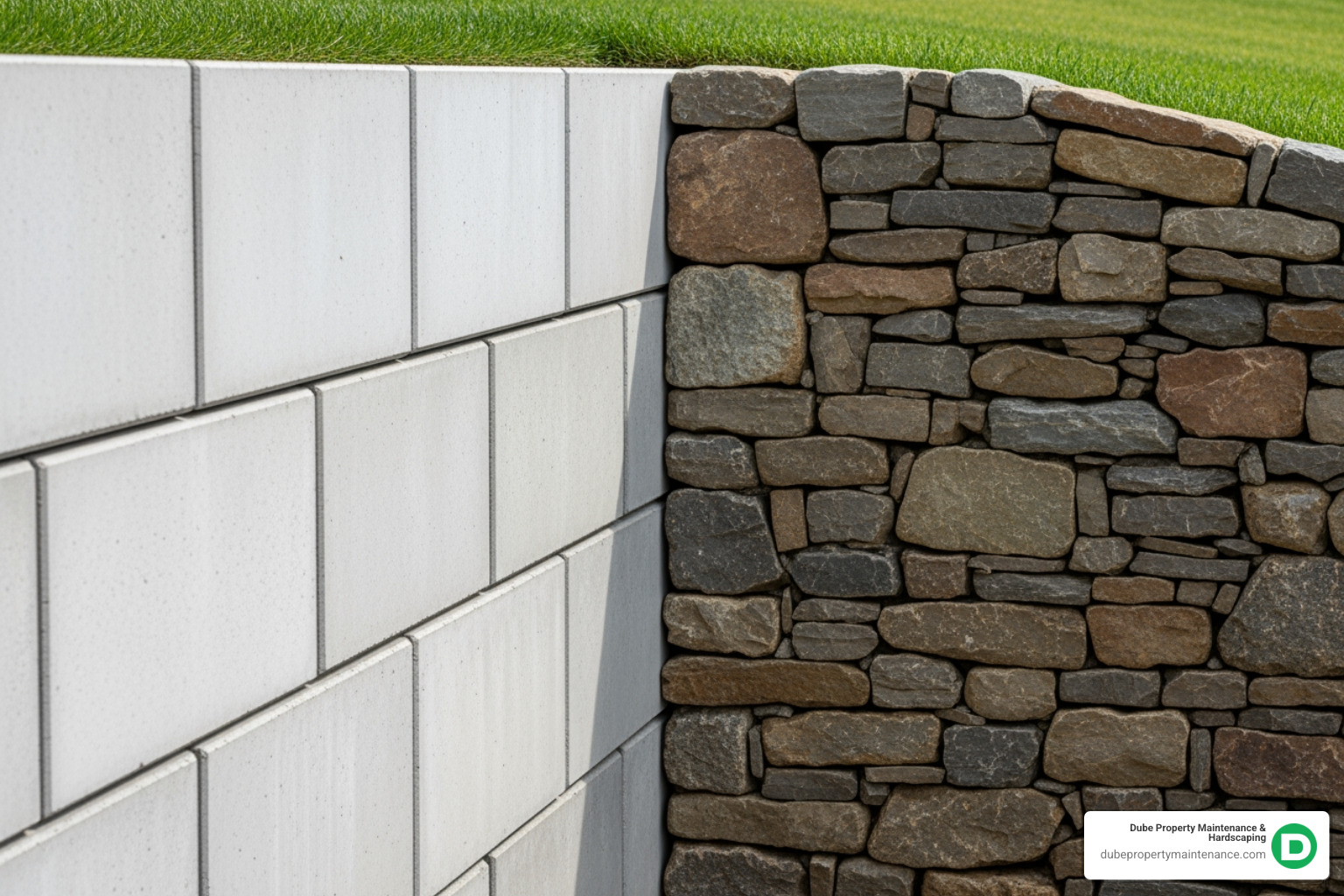
image of a sleek concrete block retaining wall next to a rustic natural stone wall to show material contrast - retention walls

Common Structural Types Explained

Retention walls come in several structural types, each designed for specific challenges. Understanding these is key to a successful project.

  1. Gravity Walls: Rely on their sheer mass and weight (from large blocks, stone, or gabions) to resist soil pressure. They are often thick at the base with a slight backward lean for stability.
  2. Cantilevered Walls: A common reinforced concrete design, these walls use an “L” or “T” shaped footing to convert horizontal soil pressure into vertical pressure on the footing, providing stability with a thinner wall stem.
  3. Sheet Piling Walls: Built by driving thin, interlocking sheets of steel or vinyl into the ground. They are ideal for soft soils and tight spaces, like waterfronts.
  4. Anchored Walls: These combine a wall face with anchors (cables or rods) driven deep into the soil or rock behind the wall. This provides extra support against high pressure.
  5. Mechanically Stabilized Earth (MSE) Walls: These use alternating layers of compacted soil and geosynthetic reinforcement (geogrids) to form a coherent, stable block, often faced with modular concrete panels.
  6. Soil Nailing: A technique to reinforce existing slopes by inserting steel bars (“nails”) into the ground and grouting them in place. This creates a stable soil mass that can be faced with concrete.

For a deeper dive into engineering principles, consult resources like the Geotechnical Manual.

The material you choose significantly impacts your wall’s appearance, durability, and cost. Here’s a comparison of popular options:

Material Lifespan (Years) Cost (Relative) Aesthetics Maintenance
Concrete Blocks 50-100+ Medium Versatile, various colors/textures, modern Low, occasional cleaning
Natural Stone 100+ High Timeless, rustic, neat, blends with nature Low, occasional cleaning, re-pointing mortar
Poured Concrete 50-100+ Medium-High Modern, sleek, can be stamped/stained Low, crack repair, sealing
Wood (Treated) 10-20 Low-Medium Rustic, natural, informal High, rot inspection, replacement of boards
Gabions 50-100+ Medium Industrial, natural, modern, permeable Low, occasional rock refill, wire inspection

Note: Lifespan and cost are estimates and can vary greatly depending on quality of materials, installation, and specific site conditions.

Concrete Blocks: A popular choice for their versatility, durability, and wide array of colors and textures. Learn more about interlocking retaining wall blocks.

Natural Stone: For a timeless and organic look, a stone retaining wall offers exceptional durability and a classic aesthetic that blends seamlessly with the landscape.

Poured Concrete: When maximum strength and a smooth, modern finish are desired, a poured concrete retaining wall is an excellent option, offering superior structural integrity.

Wood: Timber walls are suitable for lower-height applications and offer a rustic look. They are more economical initially but have a shorter lifespan than masonry.

Gabions: These wire cages filled with rocks offer a unique, permeable, and often eco-friendly solution, excellent for erosion control and providing a distinctive look.

Planning and Building Your Wall: From Permits to Paver Base

Building a retention wall is a significant project requiring meticulous planning and execution. We ensure every detail is considered for our clients in the varied terrains of Massachusetts and New Hampshire.
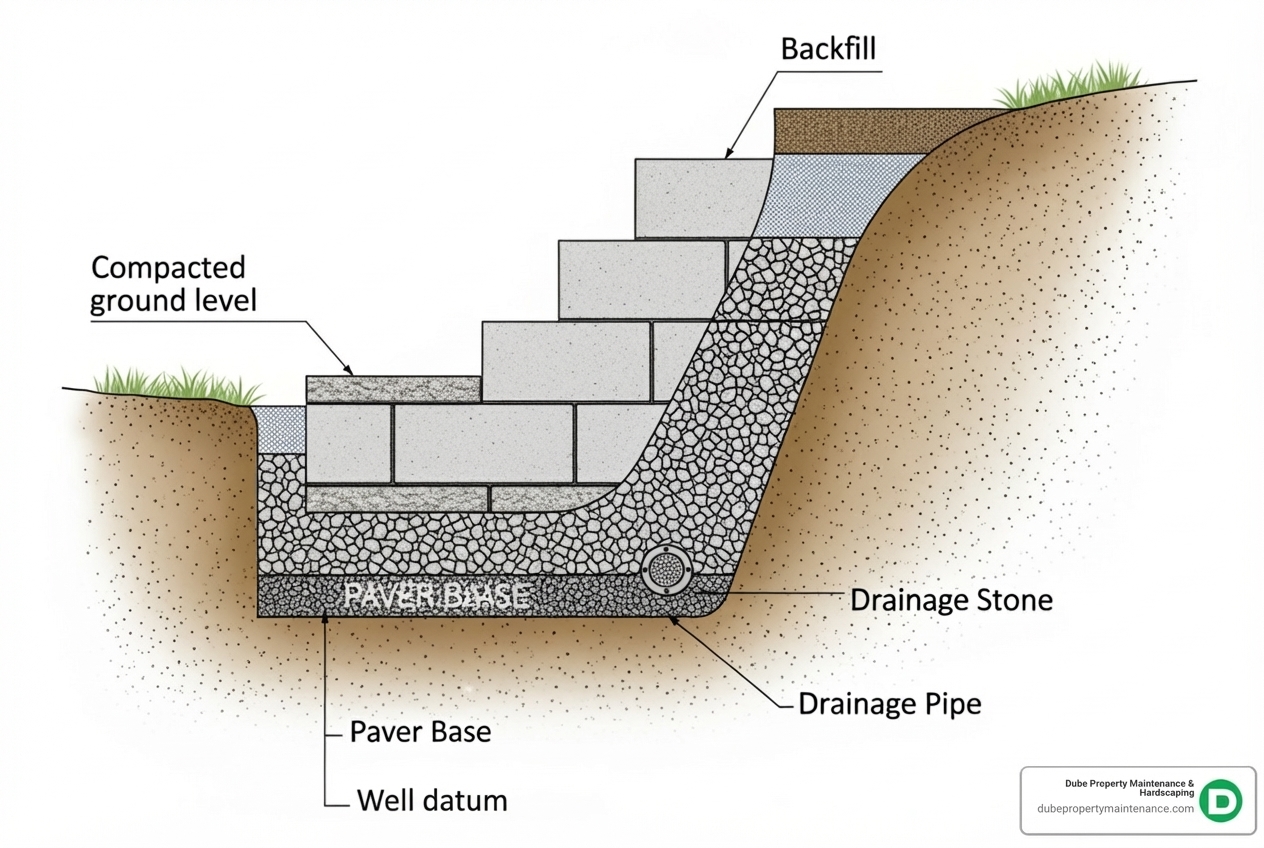
image showing the cross-section of a properly built block wall, including the trench, paver base, drainage stone, and backfill - retention walls

Key Factors to Consider Before Starting

Before digging, several critical factors must be addressed to ensure a safe and durable retention wall.

  1. Building Permits and Local Codes: This is paramount. In many MA and NH towns, walls over 4 feet high require permits and structural plans. Always check specific regulations in your town (e.g., Lowell, MA, or Windham, NH). For general guidance, see resources like Building Codes Illustrated: A Guide to Understanding the 2006 International Building Code.
  2. Soil Conditions: Soil type (e.g., water-retaining clay vs. sandy soil) significantly impacts the wall’s design and stability.
  3. Property Lines and Setbacks: Ensure your wall is within your property boundaries and adheres to local setback requirements to prevent legal disputes.
  4. Underground Utilities: Always call 811 before you dig to locate underground utility lines and prevent dangerous accidents.
  5. Surcharge Loads: Account for any additional weight behind the wall, such as a driveway, patio, or building. These “surcharges” increase pressure and must be part of the design.

A Step-by-Step Guide to Building a Low-Level Block Wall

While larger walls require professional installation, a low-level block wall (under 3 feet) can be a DIY project. Here’s a simplified guide:

  1. Plan and Mark: Layout the wall’s path with stakes and a string line.
  2. Dig the Trench: The trench should be twice as wide as a block and deep enough to bury half the first block plus 3 inches for a paver base.
  3. Create a Level Base: Fill the trench with 3 inches of paver base (crushed gravel) and compact it with a tamper. Use a long level to ensure the base is perfectly flat.
  4. Lay the First Course: Place the first course of blocks on the compacted base, ensuring each block is level. Half the height of this course should be below ground level.
  5. Stagger Subsequent Courses: Offset each new course from the one below, like brickwork. You may need to cut the first block of alternating courses in half.
  6. Backfill and Drainage: As you build, continuously backfill behind the wall with gravel, tamping it down in layers to eliminate air pockets.
  7. Install Capstones: Secure capstones to the top course with construction adhesive for a finished look, typically with a 1 to 1.5-inch overhang.

For more detailed instructions, refer to guides like how to build a landscape block retaining wall.

Planning for Your Retention Walls Project

Careful planning ensures efficiency and accuracy. Consider these practical aspects:

  • Calculating Materials: Purchase 10 percent more material than your estimate to account for cuts, breakage, or errors. A retaining wall block calculator can be a helpful tool.
  • Trench Dimensions: A trench should be twice as wide as a single block and deep enough to bury at least half the first course plus a 3-inch paver base.
  • Safety Factor Considerations: Professional design is invaluable here. Walls must have adequate safety factors (e.g., 1.5 against sliding/overturning, 2.0 for soil bearing capacity) to withstand forces over time, especially from saturated soil.

Ensuring Stability: Drainage, Maintenance, and Failure Prevention

A robust retention wall is a testament to proper engineering. Its long-term stability hinges on drainage, maintenance, and preventing common failures. For our projects in places like North Andover, MA, and Dracut, MA, we prioritize these elements to build walls that last.

The Critical Role of Proper Drainage

Proper drainage is the single most important factor for a retention wall’s longevity. Water accumulating behind a wall creates immense hydrostatic pressure, a leading cause of bulging, cracking, and collapse. Effective drainage solutions include:

  • Gravel Backfill: A layer of clean, coarse gravel behind the wall allows water to drain down quickly instead of saturating the soil.
  • Perforated Pipes: A retaining wall drainage pipe (or French drain) installed at the base collects water and directs it away from the wall.
  • Weep Holes: Small holes in the wall’s face that allow trapped water to escape.
  • Geotextile Fabric: This special geotextile fabric is used to separate soil from the gravel, preventing clogs while allowing water to pass through. Learn more about how to install landscape fabric behind retaining wall.
  • Surface Grading: Proper grading on the surface directs runoff away from the wall.

Without these measures, even the strongest wall is vulnerable to water pressure.

Lifespan, Maintenance, and Common Failure Modes of Retention Walls

A well-built retention wall can last 20 to 50 years or more, with materials like stone and concrete often exceeding this. Maintenance is generally low, involving regular inspections for distress, clearing drainage outlets, and managing nearby vegetation.

Recognizing the signs of failure early is crucial. If you see these issues, it’s time to call professionals for a block wall repair near me:

  • Leaning, Cracking, or Bulging: These are classic signs of excessive hydrostatic pressure from poor drainage or unaccounted-for surcharge loads.
  • Overturning: The wall rotates forward at its base, often due to insufficient mass (for gravity walls) or an inadequate footing to resist soil forces.
  • Sliding: The entire wall moves horizontally, caused by a lack of friction between the footing and the foundation soil.
  • Unstable Foundation: The wall settles unevenly because of poor soil compaction during construction or building on unsuitable ground.
  • Shoddy Construction or Age: Failure can also result from poor-quality materials, missing reinforcement (like geogrid), or the natural degradation of an old wall.

Prompt intervention is critical to prevent a small problem from becoming a dangerous collapse.

Frequently Asked Questions about Retaining Walls

We often get questions from homeowners in places like Tewksbury, MA, and Methuen, MA, about retention walls. Here are some common inquiries:

How high can I build a retaining wall without a permit?

This is a crucial question, as permit requirements vary significantly by town in Massachusetts and New Hampshire. Generally, a wall that is 3 to 4 feet in height (measured from the lowest grade) is the common limit before a building permit and professional engineering plans are required. However, some towns have lower thresholds. If the wall supports a driveway or structure, a permit may be needed regardless of height. We always recommend checking local building codes for your specific town (e.g., Wilmington, MA, or Salem, NH) before starting.

What is the best material for a retaining wall?

There isn’t a single “best” material; the ideal choice depends on your project’s specific needs:

  • Budget: Wood is often the most economical, while natural stone is a higher-end investment. Concrete blocks offer a mid-range balance.
  • Aesthetics: Choose between a rustic look (wood, natural stone) or a modern, structured appearance (poured concrete, concrete blocks).
  • Structural Needs: Taller walls or those under heavy loads require the strength of poured concrete or engineered block systems with reinforcement.
  • Maintenance: Masonry walls are low-maintenance, whereas wood requires more upkeep and has a shorter lifespan.

The best material is one that meets your aesthetic, budget, and structural needs. We can help you find the optimal solution for your custom retaining walls project.

How do you anchor a retaining wall?

Anchoring methods depend on the wall’s type, height, and the forces it must resist. Common techniques include:

  • Geogrid Reinforcement: For block walls, layers of high-strength polymer fabric are laid in the soil behind the wall, tying the face to a stable soil mass.
  • Tiebacks: Long steel rods or cables are installed through the wall and anchored deep into stable soil or rock behind it, providing powerful resistance against overturning.
  • Deadman Anchors: Used for timber walls, these are horizontal timbers buried in the slope and tied to the wall face, using the weight of the soil to provide an anchor.
  • Soil Nails: Steel bars are grouted into existing soil to create a reinforced mass that supports an excavation, which is then often faced with concrete.
  • Footing: For gravity and cantilevered walls, the large, heavy footing itself acts as the primary anchor against sliding and overturning.

The choice of anchoring method is a critical engineering decision to ensure long-term stability.

Transform Your Landscape with a Professional Retaining Wall

Investing in a professionally installed retention wall is one of the most impactful improvements for your property. These structures do more than hold back soil—they maximize usable space, prevent erosion, improve property value, and lift your landscape’s aesthetic appeal. From terraced gardens to robust support for slopes, the benefits are clear.

The complexities of soil mechanics, drainage, and local building codes mean that proper construction is paramount. Shortcuts lead to failure, but an expertly executed wall will stand strong for decades.

For expert design, installation, and repair of retention walls in Massachusetts and Southern New Hampshire, trust the professionals at Dube Property Maintenance & Hardscaping. We bring high-quality craftsmanship and a deep understanding of local conditions to every project, ensuring structural integrity and lasting beauty.

Ready to reclaim your sloped yard and create the outdoor living space of your dreams? Contact us for your retaining wall project today! Let us help you hold it all together, beautifully and reliably.

Table Of Contents

Get Started Today!
Dube Property Maintenance
& Hardscaping
Dube Property Maintenance
160 Hampstead St., Methuen, MA 01844
Servicing Merrimack Valley & Southern NH
For 25+ years Dube Property Maintenance & Hardscaping has provided top-rated residential and commercial landscape design, installations, hardscaping, irrigation systems and commercial snow and ice management. Our hardscaping division proudly serves the Merrimack Valley, Middlesex and Essex County and Southern, NH regions, transforming outdoor spaces into stunning works of art.