
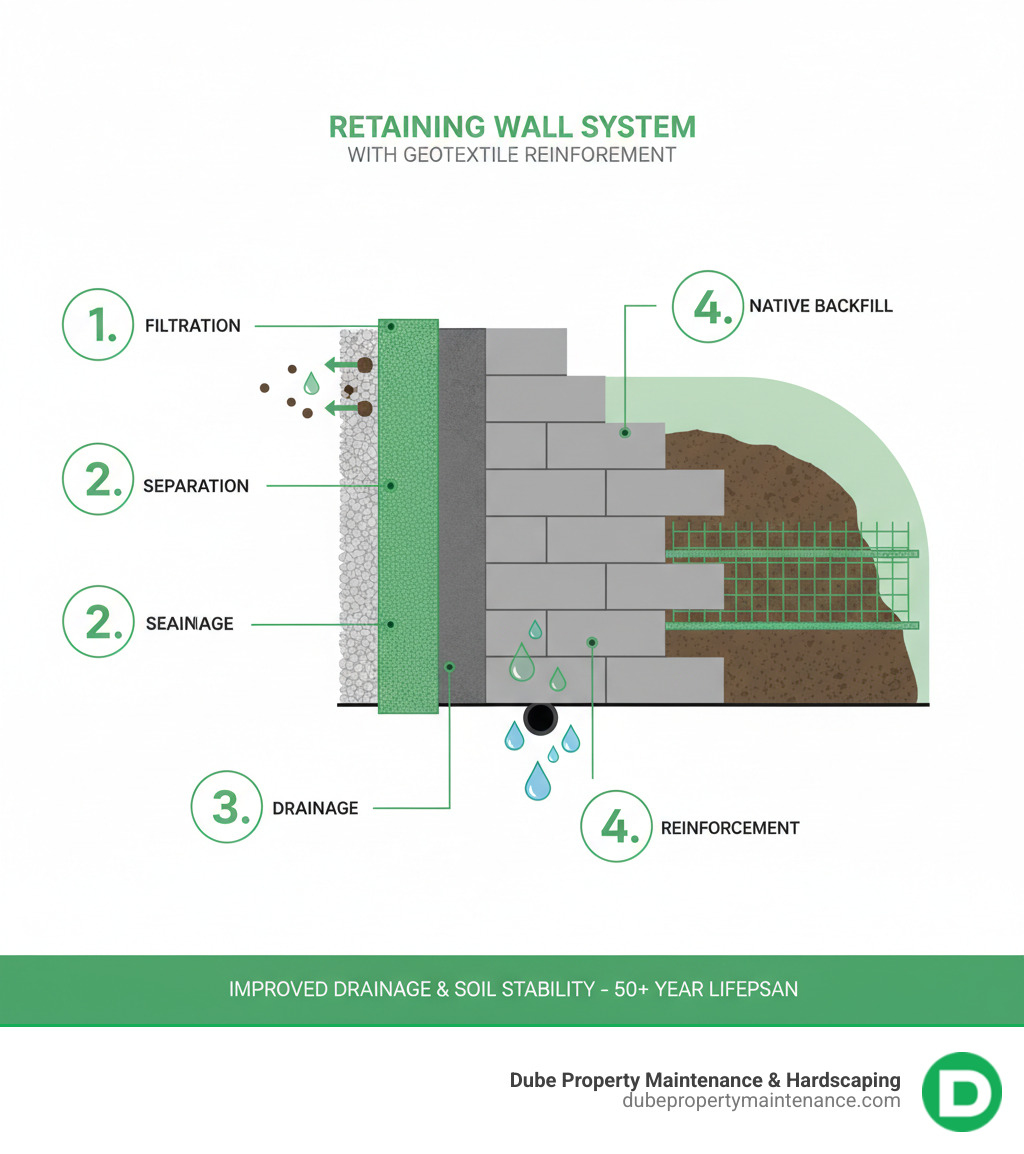
Retaining wall with geotextile reinforcement systems use specialized fabric to improve drainage, prevent soil migration, and extend wall life to 50+ years. Here’s what you need to know:
The Four Critical Functions of Geotextile in Retaining Walls:
When You Need Reinforcement:
Without proper geotextile fabric, drainage failure can cause walls to need major repairs within 5-10 years. Trapped water creates massive hydrostatic pressure—the primary cause of wall failure.
Think of geotextile fabric as the quiet engineer preventing the invisible enemy: water pressure. It’s the difference between a wall that cracks after a few harsh New England winters and one that protects your property for generations.
For homeowners in Methuen and surrounding areas, understanding these systems is key to making a smart landscape investment.
Simple retaining wall with geotextile reinforcement glossary:
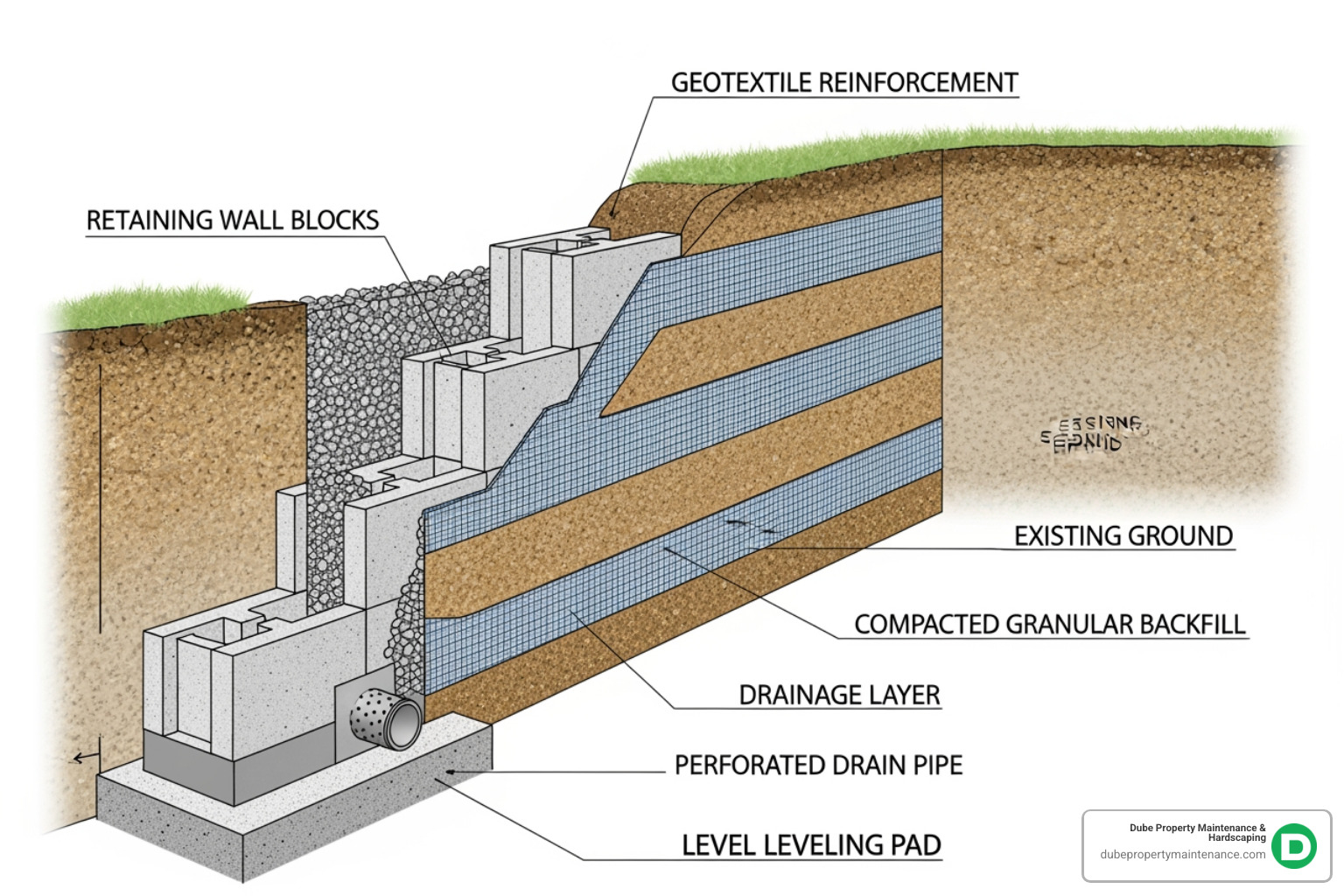
When building a retaining wall with geotextile reinforcement and geogrid, you’re creating a “reinforced soil mass,” turning the soil itself into part of the wall’s structure. This system works with the soil rather than against it.
Geosynthetic reinforcement is more cost-effective than conventional concrete walls, offering similar stability without the high material and labor costs. These systems are also flexible, handling ground shifts from New England’s freeze-thaw cycles without cracking. This flexibility also provides natural earthquake resistance. Unlike rigid concrete, reinforced soil systems absorb and distribute seismic energy.
Geotextile fabric is the brains of your drainage system, handling four critical jobs to ensure your wall’s longevity.
Filtration allows water to pass through the fabric’s pores while blocking soil particles. Without it, soil would clog the drainage gravel, leading to pressure buildup and wall failure.
The fabric also provides separation, creating a permanent barrier between your clean drainage aggregate and the native soil.
For drainage, the fabric, gravel, and a perforated pipe work together to channel water away, reducing hydrostatic pressure by up to 90% and preventing the primary cause of wall failure.
Non-woven fabric is best for retaining walls due to its high permeability and filtration. Look for non-woven, spun-bonded polypropylene with ~200 lb/in tensile strength and a permittivity of at least 0.05 sec⁻¹. Woven fabric is better for road stabilization, as its larger pores are less effective for drainage filtration.
Properly installed and protected from UV light, high-quality geotextile fabric can last 20-50+ years. For detailed specifications, check out this nonwoven fabric application sheet.
While geotextile fabric manages water, geogrid provides structural reinforcement for taller, stronger walls. This polymer grid extends into the soil, creating tensile strength that stabilizes the backfill into a reinforced soil mass.
As a basic guideline, the 3-4 feet rule applies: walls taller than this typically need geogrid reinforcement. The blocks’ weight alone isn’t enough to resist the increased lateral pressure of taller walls.
Height isn’t the only factor. Shorter walls may need geogrid with poor soils, slopes, or surcharges (like driveways or patios). Tiered walls also require geogrid.
Uniaxial geogrid, with high tensile strength in one direction, is used for most retaining walls, installed perpendicular to the wall face. Biaxial geogrid is more common for base stabilization under driveways.
Geogrid layers should extend back into the soil at least 0.8 times the wall height. For a six-foot wall, the geogrid should be about five feet long. This creates the larger mass needed to resist soil pressure.
For more information about how we design and install walls with the right reinforcement, visit our page on retaining wall services.
| Feature | Geotextile-Reinforced Wall | Geogrid-Reinforced Wall | Conventional Concrete Wall |
|---|---|---|---|
| Primary Function | Filtration, Separation, Drainage | Soil Reinforcement, Stability | Mass, Rigidity |
| Best For | All walls for drainage | Walls > 3-4 ft, slopes, loads | High-load, engineered projects |
| Flexibility | High | High | Low (Rigid) |
| Cost | Economical | Moderate | High |
| Installation | Easy, rapid | Moderate complexity | Skilled labor, heavy equipment |

The secret to a long-lasting retaining wall is proper site preparation. This phase is critical for ensuring your retaining wall with geotextile reinforcement withstands soil pressure and New England’s freeze-thaw cycles for 50+ years. Planning involves checking local regulations, locating utilities, planning drainage, and preparing the ground. Rushing this work leads to costly repairs.
Now the real work begins. Excavate a trench wide enough for the blocks plus a 12-18 inch drainage zone behind them (use 18 inches for clay soils). This zone will be filled with clean, angular stone.
In New England, trench depth must reach the frost line (around 36 inches in MA and NH) to prevent frost heave, which can lift and crack walls with shallow foundations.
The trench bottom (subgrade) must be firm, level, and compacted to at least 95% compaction to prevent uneven settlement and wall failure.
On top of the subgrade, add a 4-6 inch layer of compacted gravel for stability and drainage. A thin leveling pad of sand on top is critical for getting the first course of blocks perfectly level. Any error here will be magnified up the wall.
A solid foundation is the difference between a wall that lasts generations and one that needs rebuilding in five years. For comprehensive hardscaping solutions that include expert site preparation, explore our services at More info about hardscaping services.
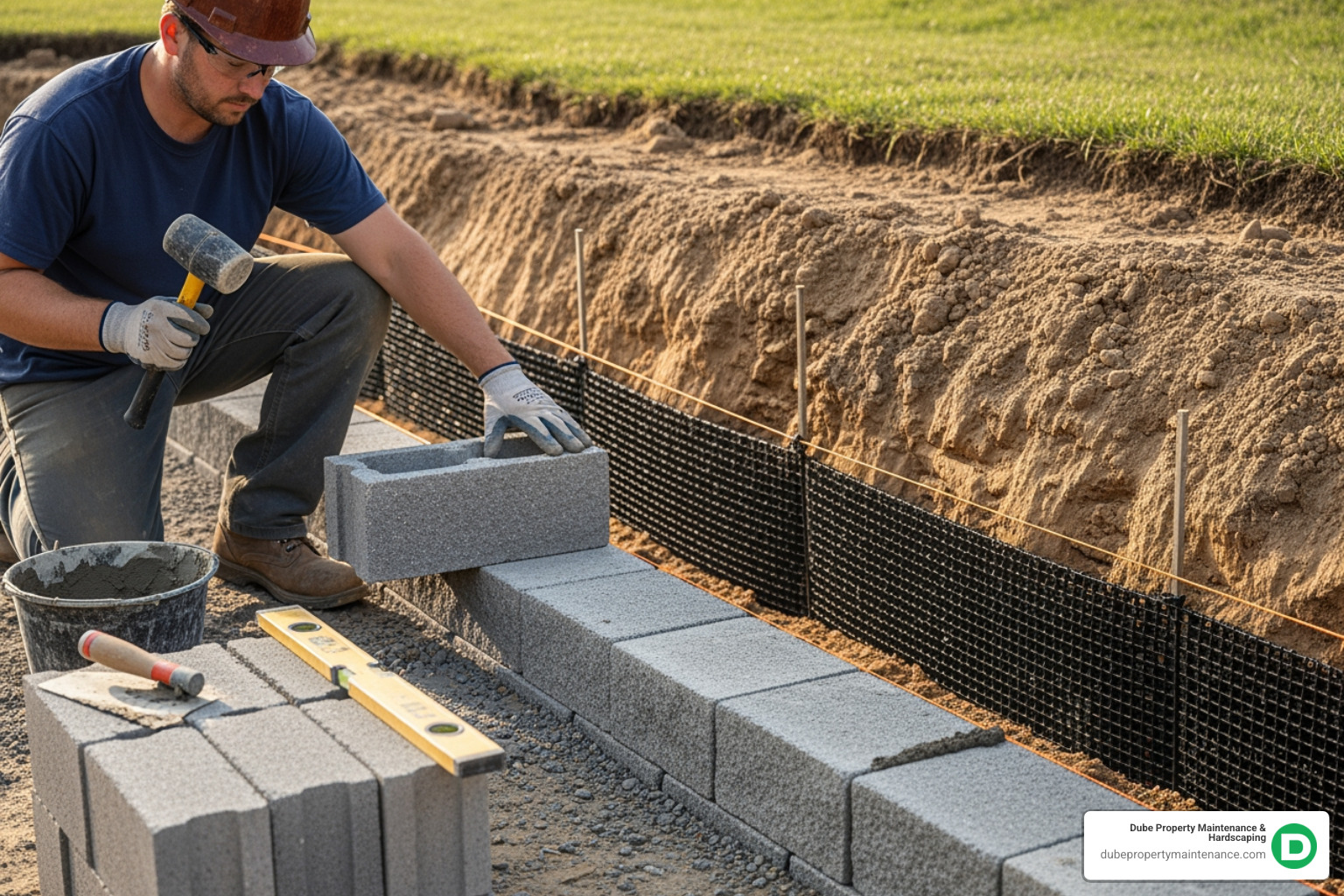
Building your retaining wall with geotextile reinforcement requires patience and precision. This process combines block-laying with geosynthetic technology to create a seamless system of drainage, filtration, and reinforcement. Each layer depends on the one below, so careful work is essential.
For detailed technical specifications, the SPECIFICATION FOR SUBGRADE STABILIZATION USING GEOSYNTHETIC REINFORCEMENTS provides comprehensive instructions.
The first course of blocks must be perfectly level. Place each block on the leveling pad, checking it front-to-back and side-to-side with a level. Use a rubber mallet for fine adjustments. An unlevel first course will compromise the entire wall.
After leveling the first course, install the non-woven geotextile fabric. Position it vertically against the back of the blocks, extending from the base to at least 6 inches above the final wall height. Keep the fabric smooth and overlap seams by 6-12 inches. Temporarily secure it to maintain its vertical position.
A proper drainage system is critical to combat water pressure. Lay a perforated drain pipe behind the first course, sloped at least 1% toward the drainage outlet.
Create a “drainage blanket” by surrounding the pipe with at least 6 inches of clean, 3/4-inch angular stone. Continue this 12-inch-thick (18 inches for clay) gravel zone up the back of the wall. Angular stone is essential for water flow. You can also add weep holes every 4-6 feet in the base course for visual confirmation of drainage.
Backfill behind the drainage gravel in 6 to 8-inch lifts, compacting each layer. Use only hand tampers within 3 feet of the wall to avoid damaging it. With each course, ensure the geotextile fabric remains vertical and smooth, separating the drainage gravel from the backfill soil.
For walls over 3-4 feet or those in challenging conditions, geogrid installation is essential. It creates a reinforced soil mass, making the soil part of the wall’s structure.

To ensure your retaining wall with geotextile reinforcement lasts 50+ years, follow best practices and avoid common mistakes. The details are what separate a long-lasting wall from one that fails within a decade.
Proper drainage is the single most important factor for a wall’s longevity.
In New England’s climate, these practices are essential. Our team at Dube Property Maintenance & Hardscaping has extensive experience building walls that withstand these conditions.
Here are answers to common questions we hear from homeowners in the Methuen area about geosynthetic reinforcement.
For a retaining wall with geotextile reinforcement, non-woven geotextile fabric is the best choice. It’s engineered for high permeability (water flow) and filtration (blocking soil). Look for spun-bonded polypropylene with these specs: a tensile strength around 200 lb/in, a permittivity rating of at least 0.05 sec⁻¹, and a weight of 3-4 oz. UV stabilization is a plus, but the fabric should always be completely buried to protect it from sunlight.
When properly installed and protected from UV light, high-quality geotextile fabric can last 20-50+ years, often outliving the wall itself. Longevity depends on fabric quality (not cheap landscape fabric), correct installation, and protection from sunlight. This small upfront investment provides decades of performance and reduces long-term maintenance costs.
Yes, but with significant limitations. Unreinforced walls, or gravity walls, rely solely on their own weight to hold back soil. They are generally limited to a height of 3-4 feet in ideal conditions (good soil, no slopes, no extra loads). However, ideal conditions are rare in New England. Even for short gravity walls, we always recommend using geotextile fabric for drainage, as water management is key to longevity. For walls over 3-4 feet or any wall in challenging conditions, geogrid reinforcement is essential. Proper reinforcement turns a short-term structure into a generational investment.
Understanding the science of a retaining wall with geotextile reinforcement is the first step. The combination of proper materials (geotextile, geogrid), excavation, and installation creates a wall that will last for generations.
A properly built wall offers improved durability, safety, and property value. Reinforced systems manage hydrostatic pressure, prevent erosion, and create stable outdoor spaces—all crucial for withstanding New England’s challenging climate.
While this guide provides a good overview, building a reinforced retaining wall is complex. It requires precision and experience, especially for projects involving walls over 4 feet, poor soil, steep slopes, or surcharges. These often require permits and professional engineering.
At Dube Property Maintenance & Hardscaping, we have mastered these systems in Massachusetts and New Hampshire. Our team understands local soil, frost depths, and building codes. We are your partners in creating high-quality, long-lasting outdoor spaces.
Don’t let water, soil pressure, or improper installation undermine your investment. When you’re ready to build a wall that truly stands the test of time, we’re here to help.
Contact us for your retaining wall project and let’s build something that lasts for generations.