

Retaining wall builders near me can transform your sloped yard from an erosion nightmare into a stunning terraced landscape that adds serious value to your property. But not all contractors are created equal, and choosing the wrong one can cost you thousands in repairs down the road.
Quick Guide to Finding Quality Retaining Wall Builders:
The stakes are high when it comes to retaining walls. A properly built stone wall can last 50 to 200 years, while a poorly constructed one might fail in just a few seasons. Most homeowners spend between $2,000 and $15,000 for professional installation, making it crucial to get it right the first time.
Local contractors typically offer up to 50% savings compared to national franchises, plus they understand your area’s soil conditions, weather patterns, and permit requirements. They’re also accountable to your community – a huge advantage when problems arise.
Retaining wall builders near me vocabulary:
– block wall builders near me
– gabion wall builders near me
– garden wall builders near me
When you’re searching for retaining wall builders near me, you want someone who’ll answer your call quickly, show up when promised, and build something that’ll still look great decades from now. After analyzing thousands of customer reviews and project outcomes, we’ve found that the best contractors consistently earn ratings of 4.3 stars or higher.
The cream-of-the-crop builders back it up with proper licensing and comprehensive insurance coverage that protects both you and their crew. They’ll show you a portfolio packed with local projects you can actually drive by and see for yourself. When it comes to pricing, there are no surprise “gotchas” – everything’s laid out clearly in writing before work begins.
What really sets top-tier retaining wall builders near me apart is their responsiveness. The best ones get back to you within 24-48 hours and offer free initial consultations where they’ll walk your property and explain your options without any pressure.
Here at Dube Property Maintenance & Hardscaping, we’ve been serving communities across Massachusetts and New Hampshire for years, from Andover and Billerica to Salem and Windham. We know that every slope is different, every soil type presents its own challenges, and every homeowner has their own vision for what their outdoor space should become.
Finding reliable retaining wall builders near me isn’t as simple as picking the first name that pops up online. We’ve developed a thorough vetting process that focuses on the stuff that actually matters when your wall is holding back tons of soil and water.
Licensing and certifications come first because they’re non-negotiable. In Massachusetts, many towns require permits for walls over 3-4 feet, and only properly licensed contractors can pull those permits.
Insurance coverage is where a lot of fly-by-night operators fall short. Top contractors carry both general liability and workers’ compensation insurance with adequate coverage limits.
Customer reviews reveal patterns you won’t find in marketing materials. We dig deep across multiple platforms, looking for consistent praise about quality, communication, and how contractors handle the inevitable hiccups that come up during construction.
Price transparency separates the professionals from the amateurs. Quality contractors provide detailed written estimates that break down materials, labor, permits, and potential extras.
When you’re weighing your options for retaining wall builders near me, you’ll likely encounter both local contractors and big national franchise operations. Local builders offer compelling advantages that can save you serious money and headaches.
Cost savings are substantial, often running 25-50% less than national franchises. Local contractors don’t have franchise fees, massive advertising budgets, or corporate overhead eating into their margins.
Community accountability is huge when you’re making a major investment in your property. Local builders live and work in your area – their reputation depends on satisfied customers who talk to their neighbors.
Permit and code expertise becomes critical when dealing with local building departments. Local contractors know exactly which municipalities require permits for 3-foot walls versus 4-foot walls and understand regional soil conditions that affect design.
Speed of service is where local builders really shine. Most can visit your site within 24-48 hours for consultations and often provide same-day service for urgent repairs.
When retaining wall builders near me start discussing your project, they’ll typically explain different wall types based on how they resist soil pressure. Understanding these basics helps you make smart decisions about what works best for your specific situation.
Gravity walls are the workhorses of the retaining wall world – they simply use their own weight to hold back soil. These walls work beautifully for heights up to 3-4 feet and pair perfectly with natural stone, concrete blocks, or timber. They’re often the most budget-friendly option since they don’t require complex construction techniques.
Cantilever walls get more sophisticated with their T-shaped concrete base that acts like a lever arm. This design lets them handle much greater soil loads while using less material than a gravity wall of the same height. They’re a go-to solution for walls between 4-10 feet tall.
Reinforced soil walls incorporate steel bars, mesh, or geogrid reinforcement to handle challenging conditions. They’re your best bet for taller walls or tricky soil situations where extra strength is essential.
Gabion walls bring something different with their wire mesh cages filled with stones. They offer unique visual appeal while providing excellent drainage. The flexibility of gabion construction makes them particularly valuable in areas prone to ground movement.

Choosing the right material for your retaining wall needs to look good, fit your budget, and handle whatever life throws at it.
Natural stone is the luxury option that never goes out of style. With a lifespan of 50-200 years, it’s practically an heirloom you’re building for future generations. Expect to invest $30-90 per square foot based on internet averages. The catch? It demands skilled installation.
Concrete blocks are the reliable middle ground that most homeowners love. They typically cost $20-50 per square foot according to industry data, offer consistent quality, and install relatively easily. They’re perfect when you need something functional that won’t break the bank.
Timber and wood materials win the affordability contest, usually running $10-40 per square foot based on market research. They bring warm, rustic charm that works beautifully in garden settings. However, they’re the high-maintenance option with a 10-20 year lifespan.
Steel and metal options represent the heavy-duty end of the spectrum, capable of handling extreme conditions. The industrial appearance and high cost – potentially up to $150 per square foot according to industry sources – make them primarily suited for commercial applications.
For deeper insights into block options, our comprehensive guide on Retaining Wall Blocks covers everything you need to know. It’s worth noting that material choice dramatically impacts long-term value – similar to how concrete versus hardwood flooring decisions affect your home’s lifetime costs.
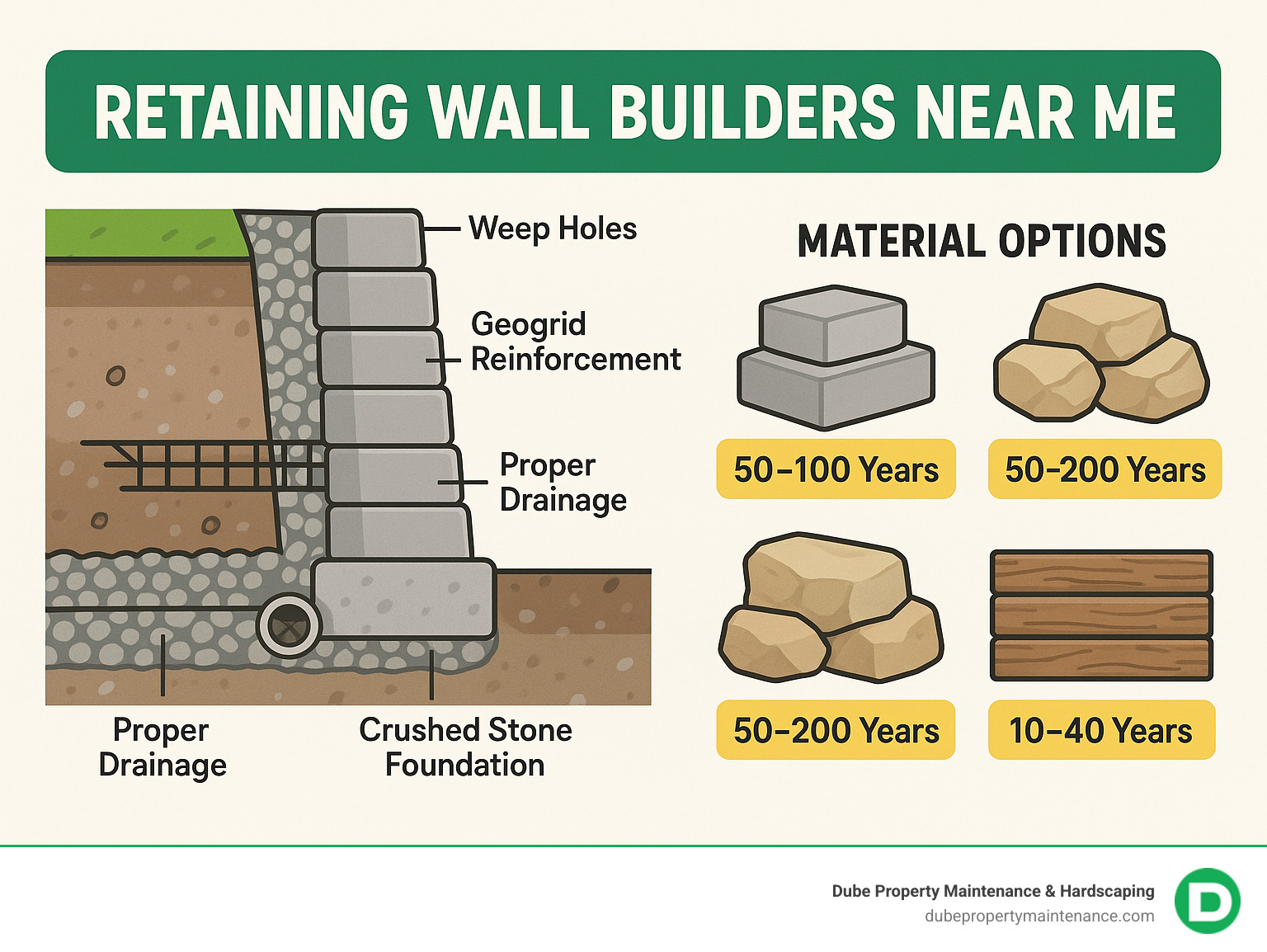
Here’s the truth that separates successful retaining walls from expensive failures: proper drainage isn’t optional – it’s everything. Even the strongest wall built with premium materials will fail spectacularly if water builds up behind it.
The foundation of good drainage starts with a crushed stone base that provides both stability and the first line of water management. Weep holes act like pressure release valves, typically spaced every 1200mm to let water escape before it becomes a problem. Behind the wall, gravel backfill using ¾” native stone creates a drainage highway that keeps water moving away from the structure.
Geotextile fabric plays the role of a selective bouncer – it lets water through while keeping soil particles from clogging up your drainage system. For properties with serious water challenges, French drain systems provide the heavy-duty solution.
Reinforcement requirements scale with your wall’s ambitions. Walls under 4 feet can usually get by with basic construction techniques. Once you hit the 4-6 foot range, geogrid reinforcement becomes your friend. Anything over 6 feet enters professional engineering territory.
The smart move? Invest in proper drainage from day one. Our Retaining Wall Drainage Pipe solutions ensure your wall performs beautifully for decades.
Note: All pricing mentioned represents average internet-based estimates and not actual costs for Dube Property Maintenance & Hardscaping services.
Let’s talk money – because nobody likes surprises when it comes to their wallet. When searching for retaining wall builders near me, you’ll find costs typically range from $10 to $150 per square foot installed. Most homeowners end up spending between $2,000 and $15,000 for a professionally built wall, though premium projects can reach $25,000 or more.
The wide price range reflects the huge variety in materials, site conditions, and project complexity. A simple timber wall for a small garden bed sits at the low end, while an engineered stone wall on a steep slope with challenging access hits the high end.
Material costs vary dramatically based on your choices. Timber and wood options start around $10-40 per square foot, making them budget-friendly for temporary solutions. Concrete blocks fall in the middle at $20-50 per square foot, offering good value for most applications. Natural stone commands premium pricing at $30-90 per square foot, while steel and metal walls can reach $45-150 per square foot for extreme engineering requirements.
Important note: These are average costs based on internet research and not actual pricing from Dube Property Maintenance & Hardscaping. Every project is unique, and we provide detailed estimates based on your specific needs.

Hidden costs can sneak up on you if you’re not prepared. Soil import and export often runs $20-50 per cubic yard. Demolition and debris removal from existing structures adds $500-2,000 to most projects. Utility conflicts are another budget buster, costing $200-1,500 or more. Premium finishes typically add 25-50% over standard options.
Permits and engineering aren’t optional expenses for many projects. Building permits typically cost $100-500, depending on your local municipality. Engineering drawings for walls over 4 feet run $500-1,500, and soil testing adds another $300-800.
Use our Retaining Wall Block Calculator to get a rough idea of material quantities before meeting with contractors.
Lifespan varies dramatically by material choice. Natural stone walls built properly can last 50-200 years with minimal maintenance. Concrete blocks offer excellent value with 50-100 year lifespans and low maintenance requirements. Timber walls cost less upfront but need replacement every 10-20 years. Gabion walls split the difference at 50-100 years with minimal upkeep needs.
| Material | Lifespan | Maintenance | Cost Range |
|---|---|---|---|
| Natural Stone | 50-200 years | Minimal | $30-90/sq ft |
| Concrete Block | 50-100 years | Low | $20-50/sq ft |
| Timber | 10-20 years | High | $10-40/sq ft |
| Gabion | 50-100 years | Minimal | $15-45/sq ft |
The return on investment makes retaining walls smart financial moves. Quality walls typically add 70-80% of their installation cost to property value, while solving practical problems like erosion control and creating usable outdoor space. Premium materials like natural stone often return 90-100% of investment, especially in upscale neighborhoods.
Beyond pure financial returns, retaining walls deliver lifestyle value that’s hard to quantify. Converting a steep, unusable slope into terraced garden space or preventing costly erosion damage provides benefits that extend far beyond the initial investment.
Getting the permits right from the start saves you headaches later. Most communities around Massachusetts have their own rules, but here’s the general pattern: walls over 4 feet typically need permits, while some towns like Billerica, Lexington, and Winchester drop that threshold to 3 feet. Experienced retaining wall builders near me handle the permit dance for you, since they know exactly what your local building department expects to see.
When permits become non-negotiable: walls supporting more than 3-4 feet of soil, anything requiring an engineer’s stamp, walls close to property lines, and all commercial projects.
For a deeper dive into typical requirements, this wall examples permit guide breaks down when permits are required and what documentation you’ll need.
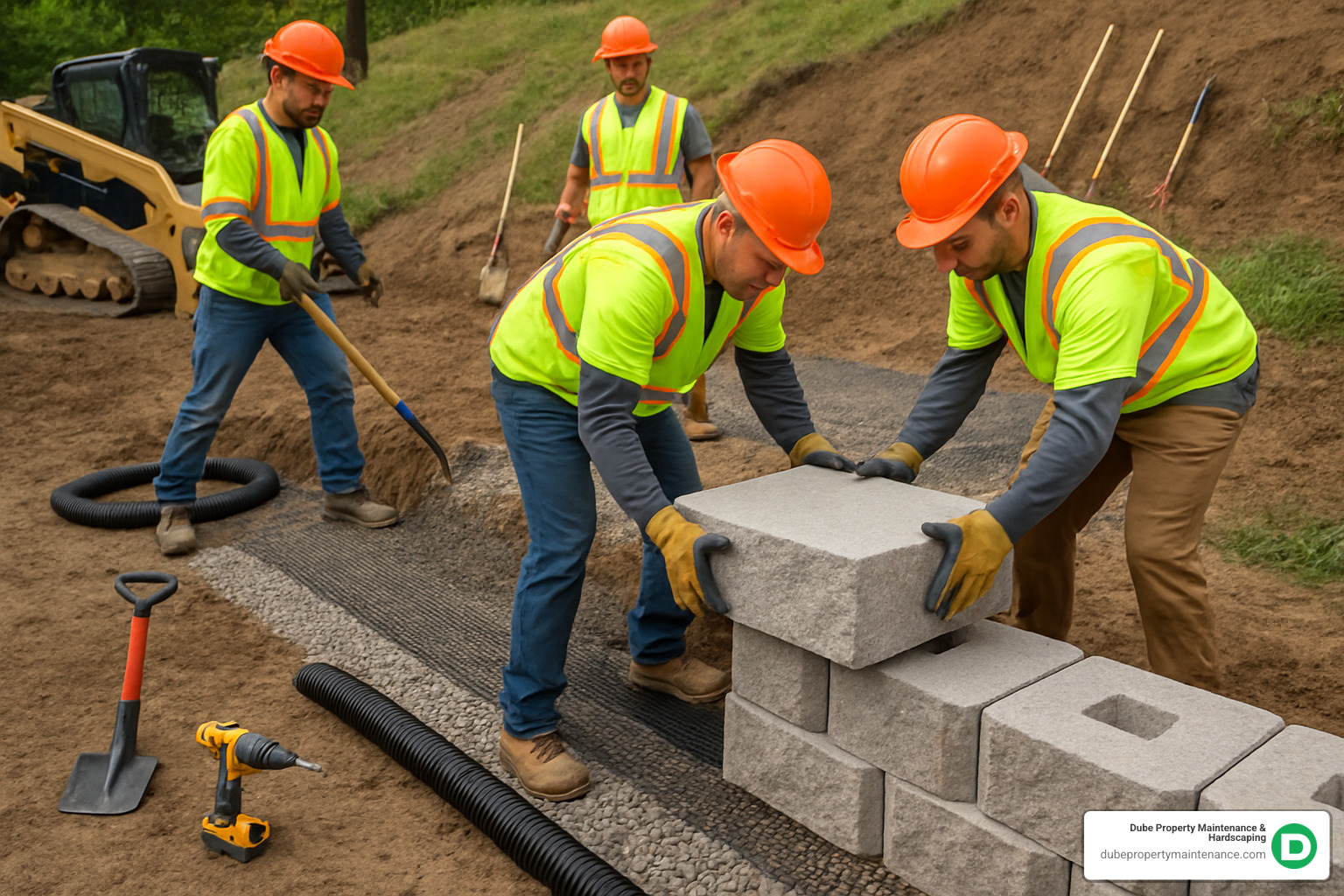
The construction process follows a logical sequence. Site survey and planning comes first – typically 1-2 days of soil analysis, utility marking, and final design tweaks. Excavation and foundation work takes another 1-2 days, with proper digging, crushed stone base installation (usually 4-8 inches deep), and compaction to 95% standard proctor.
The actual wall construction spans 2-5 days depending on size and complexity. First course installation and leveling sets the tone for everything that follows. Drainage system installation happens next – weep hole placement, gravel backfill, and geotextile fabric positioning. This single day of work determines whether your wall lasts 15 years or 50 years.
Finally, backfilling and finishing wraps up the project in 1-2 days with proper soil compaction, grade matching, landscaping touches, and thorough cleanup.

Timeline expectations vary with project scope: small walls under 4 feet and 50 linear feet typically take 3-5 days, medium walls running 4-6 feet high and 100 linear feet need 1-2 weeks, while large walls over 6 feet with complex designs can stretch 2-4 weeks.
Our comprehensive Building a Retaining Wall guide covers the technical details if you want to understand exactly what’s happening at each stage.
Smart design turns boring retaining walls into landscape stars that actually improve your property’s appeal and functionality. The secret is thinking beyond just “holding back dirt” to consider how the wall integrates with your overall outdoor space.
Tiered wall systems often work better than single tall walls, both practically and aesthetically. Instead of one imposing 8-foot wall, consider two 4-foot walls with planted terraces between them. This approach reduces engineering requirements, creates more interesting visual layers, and provides better drainage.
Integrated features transform functional walls into outdoor amenities. Built-in seating using wider cap stones creates gathering spots without additional furniture. Low-voltage LED lighting strips provide safety and ambiance for evening entertaining. Plantable pockets designed into the wall face allow cascading plants to soften the appearance naturally.
Aesthetic considerations matter more than you might think for property value. Matching materials to existing hardscaping creates visual continuity. Planning seasonal plant combinations keeps the area interesting year-round. Integrating with existing landscape features like patios, walkways, and garden beds creates a cohesive outdoor environment.
Catching problems early saves thousands in repair costs, but you need to know what warning signs actually matter.
Structural problems demand urgent response. Leaning or tilting more than 1 inch over the wall’s height indicates foundation failure. Bulging or bowing in middle sections suggests inadequate reinforcement. Cracking in mortar joints or block faces can signal settlement issues. Separation between wall sections often means the foundation is shifting.
Drainage failures show up in several ways. Standing water behind or around the wall indicates blocked drainage systems. Clogged weep holes create hydrostatic pressure that can destroy even strong walls. Soil erosion at the wall base suggests water is finding unintended paths.
Material deterioration varies by wall type but follows predictable patterns. Premature timber rot suggests moisture problems. Efflorescence (white staining) on concrete indicates water movement through the wall. Loose stones or shifting blocks mean the wall is losing structural integrity.
If you spot any of these red flags, contact professional retaining wall builders near me immediately. Early intervention often prevents complete wall failure and keeps repair costs manageable.
When homeowners start researching retaining wall builders near me, they often have similar concerns about costs, permits, and material longevity. Let’s tackle the most common questions we hear from clients in Massachusetts and New Hampshire.
Timber retaining walls offer the lowest upfront cost, typically running $10-40 per square foot installed based on internet research. However, “cheapest” and “best value” are two very different things when it comes to retaining walls.
Pressure-treated lumber works well for garden walls and temporary solutions, but it comes with significant drawbacks. Even the highest-quality treated timber requires regular maintenance – sealing every 2-3 years, replacing rotted boards, and dealing with insect damage. Most timber walls need complete replacement within 10-20 years.
Concrete blocks cost more initially at $20-50 per square foot, but they often provide better long-term value. When you factor in maintenance costs and replacement frequency, concrete typically wins the cost comparison over 20+ years.
Note: These are average costs based on internet data and not actual costs for Dube Property Maintenance & Hardscaping.
For budget-conscious homeowners, we often recommend modular concrete blocks as the sweet spot between affordability and durability.
Permit requirements vary significantly by municipality, and the “4-foot rule” isn’t universal across Massachusetts. Some communities require permits for walls over 3 feet, while others set the threshold at 4 feet.
In our service area, we see different requirements in neighboring towns. Bedford, Woburn, Reading, Stoneham, and Wilmington typically allow walls under 4 feet without permits, while Billerica, Lexington, and Winchester often require permits for walls over 3 feet.
But here’s the catch – even walls under the permit threshold must meet setback requirements and may need approval if they’re near property lines, utilities, or wetlands.
Smart approach: Always check with your local building department before breaking ground. Professional retaining wall builders near me handle these permit checks as part of their service.
The lifespan difference between concrete blocks and timber is dramatic – we’re talking about 50-100 years for concrete blocks versus 10-20 years for timber, even with proper maintenance.
Concrete blocks excel because they’re practically bulletproof. They handle freeze-thaw cycles without cracking, resist insect damage, and maintain their structural integrity for decades. The only maintenance they typically need is occasional cleaning and minor joint repairs.
Timber walls face constant challenges from moisture, insects, and temperature fluctuations. Even pressure-treated lumber eventually succumbs to rot, especially in our New England climate with wet springs and harsh winters.
The math is straightforward: if you’re planning to stay in your home for more than 15 years, concrete blocks almost always provide better value despite the higher upfront investment.
Choosing the right retaining wall builders near me might feel overwhelming at first, but taking time to research contractors properly will save you thousands of dollars and years of headaches down the road. Your retaining wall isn’t just about holding back soil – it’s an investment in your property’s beauty, functionality, and value.
The smart approach starts with getting multiple quotes from licensed, insured contractors who can show you their previous work. Don’t forget to check with your local building department about permit requirements, especially if your wall will be over 3-4 feet tall. Always budget for those sneaky extras like soil work, drainage improvements, and potential utility conflicts.
Material choice matters more than you might think. While timber walls cost less upfront, that concrete block wall that seems expensive today will likely outlast three timber replacements. Think about where you’ll be in 10, 20, or even 50 years – your future self will thank you for investing in proper drainage and quality materials now.
The average costs mentioned throughout this article are internet-based estimates and not actual costs for Dube Property Maintenance & Hardscaping. Real project costs depend on your specific site conditions, material preferences, local factors, and the complexity of your unique situation.
Local contractors consistently outperform national chains for retaining wall projects. We understand your soil, your weather, your local building codes, and we’re accountable to your community. When something needs attention five years from now, you’ll be able to find us right here in Methuen.
At Dube Property Maintenance & Hardscaping, we’ve helped hundreds of homeowners across Massachusetts and New Hampshire transform challenging slopes into beautiful, functional outdoor spaces. From that first site visit where we assess your drainage challenges to the final landscaping touches, we handle every detail with the care your property deserves.
Your sloped yard doesn’t have to be a constant source of erosion worries or wasted space. With proper planning, quality materials, and experienced installation, that troublesome slope can become your favorite outdoor feature – maybe even the neighborhood’s most admired landscape element.
Ready to see what’s possible for your property? Visit our Retaining Walls page to explore our services and get your free quote today. We’re here to answer your questions, walk your property, and show you exactly how we can solve your slope challenges while creating something beautiful that lasts for decades.
Contact Dube Property Maintenance & Hardscaping today and find why homeowners throughout the region trust us with their most important outdoor projects.
