
Retaining wall block adhesive is a specialized construction bonding agent designed to secure landscape blocks together for improved stability and longevity. For homeowners looking to build durable retaining walls, selecting the right adhesive is crucial.
Quick Answer: Best Retaining Wall Block Adhesives
| Adhesive | Best For | Temperature Range | Set Time |
|---|---|---|---|
| Loctite PL 500 | General use | 0°F to 100°F | 15 minutes |
| Liquid Nails LN-905 | Wet surfaces | 10°F+ | 30 minutes |
| SB-15 Rapid Set | Fast projects | 35°F to 110°F | 15 minutes |
| Gorilla Heavy Duty | Gap filling | 40°F+ | 30 minutes |
| DAP Touch ‘n Foam | Void filling | 40°F to 100°F | 10 minutes |
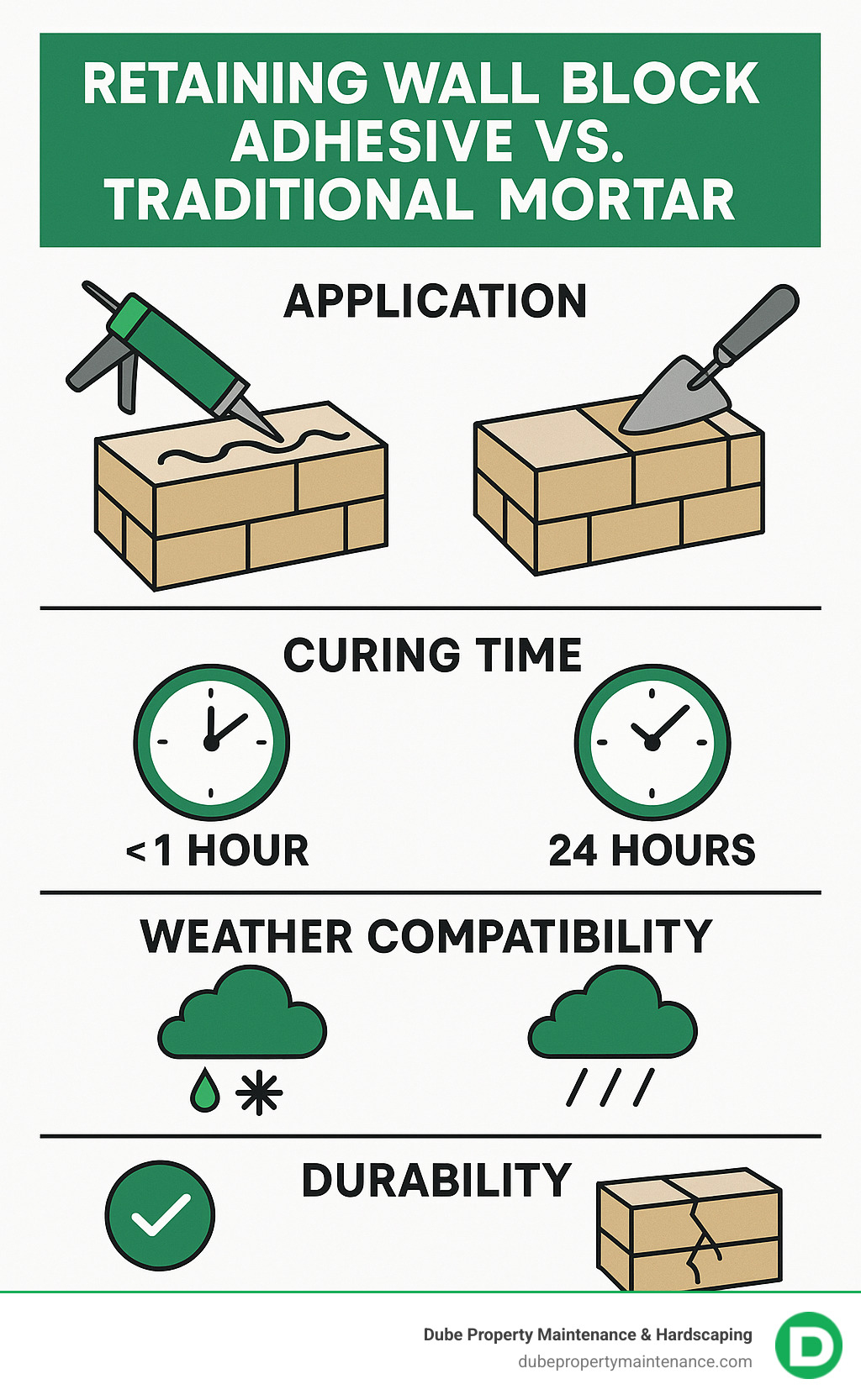
When building a retaining wall, the choice between traditional mortar and modern adhesives can significantly impact your project’s timeline and durability. Unlike mortar, which requires mixing and days to fully cure, retaining wall block adhesive offers a faster, easier solution that works even in challenging weather conditions.
These specialized adhesives create strong bonds between concrete blocks, natural stone, and other hardscape materials. They’re formulated to withstand the harsh outdoor elements that retaining walls face – from freezing winters in Methuen to summer heat, heavy rains, and the constant pressure of soil.
Whether you’re a DIY homeowner tackling a garden wall or a contractor building substantial landscape features, understanding which adhesive to choose and how to apply it properly will determine the structural integrity of your project for years to come.
Key Retaining wall block adhesive vocabulary:
In this comprehensive guide, we’ll walk you through everything you need to know about retaining wall block adhesives. You’ll learn how to plan your project effectively, understand the cost ranges (typically $7-$25 per tube, with project costs ranging from $50 for small garden walls to $300+ for larger installations based on internet data, not our pricing), find our top picks for different situations, and get professional tips that we’ve learned from years of experience across Massachusetts and New Hampshire.
By the end of this article, you’ll have the knowledge to select the right adhesive for your specific retaining wall project, whether you’re in the freezing winters of Haverhill or the variable conditions of Salem, NH.
Ever wonder what magical stuff keeps those beautiful landscape blocks from tumbling down after a harsh winter? That’s where retaining wall block adhesive comes in – a special kind of outdoor “super glue” that’s revolutionized how we build hardscapes here in New England.
These adhesives are primarily made from polyurethane compounds specifically engineered for outdoor use. Unlike the glue you might use for household crafts, these formulations are weather warriors, designed to stand strong through Massachusetts snowstorms and summer heat waves alike.
Most retaining wall block adhesives work through what’s called a moisture-cure process. It’s pretty fascinating chemistry – the adhesive actually uses humidity in the air to trigger a chemical reaction that creates an incredibly strong bond. This smart science is why we can install walls even when conditions aren’t perfect.
“The polyurethane technology in modern landscape adhesives creates bonds that can actually become stronger than the blocks themselves,” our senior hardscape technician often tells clients. “We’ve seen walls where the block itself fails before the adhesive joint does.”
What makes these adhesives so effective is their gap-filling ability – they can expand slightly to fill spaces between uneven blocks, creating a more complete bond. Their high shear strength resists the sideways pressure from soil that’s constantly pushing against your wall. Quality products perform in temperatures ranging from freezing (0°F) all the way up to scorching summer days (100°F+), and they laugh in the face of rain, snow, and ground moisture while resisting breakdown from years of sun exposure.
You’ll typically find two main types: pressure-activated adhesives that need firm compression between blocks, and gravity-based options that flow naturally to fill gaps. Your project needs and block types will determine which is best.
Many newer formulations offer low-VOC (Volatile Organic Compound) options, which are not only better for our environment but also safer for you and our installation team. This matters particularly in residential neighborhoods throughout our service area where air quality is a priority.
While your grandfather might have sworn by traditional mortar for masonry projects, there are compelling reasons why retaining wall block adhesive has become our go-to choice for modern hardscaping:
| Feature | Adhesive | Traditional Mortar |
|---|---|---|
| Mixing required | No – ready to use | Yes – requires precise water ratio |
| Set time | 15-45 minutes | 24-48 hours |
| Full cure time | 24 hours – 7 days | 7-28 days |
| Skill level | Beginner-friendly | Requires masonry experience |
| Weather limitations | Works in wet/cold conditions | Needs dry, above-freezing weather |
| Flexibility | Maintains some flexibility | Rigid, prone to cracking |
| Cleanup | Easy – often acetone-based | Difficult – requires scrubbing |
| Cost per sq ft | $0.50-$2.00 | $0.75-$3.50 |
“I’ve been building retaining walls for over 15 years, and the switch to adhesives has been a game-changer,” one of our project managers likes to say. “What used to take days now takes hours, and the walls hold up better in our New England freeze-thaw cycles.”
The beauty of these adhesives is their slight flexibility. Unlike rigid mortar that cracks when the ground shifts during freeze-thaw cycles (a big deal in places like Methuen and Salem), quality adhesives allow for tiny movements without failing. This resilience is crucial for long-term stability in our region.
Perhaps best of all, we can extend our building season well into the cooler months when mortar work would be impossible. That means we can complete your project in early spring or late fall when traditional methods would force you to wait for warmer weather. No wonder retaining wall block adhesive has become the professional’s choice for creating beautiful, lasting hardscapes throughout Massachusetts and New Hampshire.
Shopping for retaining wall block adhesive can feel overwhelming with so many options on the hardware store shelf. Before you grab just any tube, take a moment to consider these six crucial factors that’ll make or break your wall project:
Not sure how many blocks you’ll need? Our handy Retaining Wall Block Calculator can help you figure out your block count, which makes estimating your adhesive needs much easier.
When examining adhesive specifications, you might encounter technical terms like “ASTM D3498 compliance” or “shear modulus values” that seem like gibberish at first glance. These industry-specific measurements actually tell you a lot about performance under stress. For example, a higher “tensile modulus” rating (measured in MPa or psi) indicates better resistance to pulling forces. The International Masonry Institute provides excellent resources explaining these technical specifications in more detail.
Let’s talk dollars and cents for your retaining wall block adhesive project. Based on internet data (not our pricing at Dube Property Maintenance & Hardscaping), here’s what your wallet can expect:
Per Tube/Container:
The price range is pretty wide depending on quality and size. Economy options typically run $7-$12 for a basic 10 oz tube – perfect for small repairs or tiny garden walls. Mid-range options jump to $12-$18 for 10-28 oz tubes, while professional-grade products command $18-$25 for the larger 28 oz tubes or specialty formulations. If you’re looking at foam adhesives, expect to pay $10-$20 per 12 oz can.
Project Cost Estimates:
For a charming little garden wall about 10 feet long and 2 feet high, budget between $50-$150 just for the adhesive. A medium retaining wall (20 feet long, 3 feet high) typically requires $100-$300 worth of adhesive. If you’re tackling a substantial residential retaining wall spanning 40 feet and standing 4 feet tall, you’re looking at $200-$600 for adhesive alone.
These figures only cover the sticky stuff! Your total project investment will include blocks, crushed stone base, drainage materials, and potentially labor if you decide your back deserves a break.
Several factors can drive your adhesive costs up or down. Taller walls need more adhesive per linear foot since they face greater pressure. Irregular natural stone walls typically gobble up more adhesive than clean-lined manufactured blocks. Your application technique matters too – continuous beads use considerably more product than strategic spot bonding. And don’t forget that prices tend to run higher in urban areas like Burlington compared to more rural locations where overhead costs are lower.
When budgeting, I always recommend adding a 15% buffer for those “just in case” moments – because running out of adhesive with three blocks left to install is nobody’s idea of a fun Saturday afternoon!
Loctite PL 500 Landscape Block Adhesive has earned its place at the top of our list through years of reliable performance in the tough New England climate. As our team has found while installing walls from Methuen to Salem, this tan-colored powerhouse delivers consistent results when you need a dependable retaining wall block adhesive.
What makes the PL 500 stand out is its impressive temperature versatility. While some adhesives give up when the mercury drops, this formula works in temperatures as low as 0°F and up to 100°F – perfect for those tricky spring and fall projects when Massachusetts weather can’t make up its mind.
“I remember using PL 500 on a wall in North Andover last November when temperatures dipped unexpectedly,” shares one of our hardscape specialists. “Other adhesives would have failed, but the wall set beautifully and has weathered three winters without a single loose block.”
The efficiency factor can’t be overlooked either. With a quick 15-minute grab time, you won’t waste daylight waiting for blocks to set. Yet you still have enough working time to make adjustments if needed. A standard 10 oz cartridge covers about 30 linear feet with a 1/4″ bead, while the larger 28 oz size handles around 90 linear feet – making it perfect for projects of any size.
We particularly appreciate the tan color that blends seamlessly with most landscape blocks, creating a nearly invisible bond line. This natural-looking finish matters when you’re creating showcase retaining walls in upscale neighborhoods like Andover or Tewksbury.
The versatility of PL 500 extends beyond just retaining walls. Our crews have successfully used it for outdoor kitchens, fire pits, and even securing capstones on pillars. Its waterproof formula stands up to everything New England weather throws at it – from summer downpours to winter freeze-thaw cycles.
With an impressive 4.5-star rating from over 1,500 reviews, we’re clearly not alone in our appreciation. As one homeowner in Haverhill told us after completing a DIY garden wall: “Even after the wettest spring we’ve had in years, every block is exactly where I placed it. Worth every penny!”
For environmentally conscious homeowners, Loctite offers low-VOC formulations that maintain the same performance while reducing chemical emissions – something our clients in residential neighborhoods increasingly request.
If you’ve ever tried to build a retaining wall after a rainy day in New England, you know the frustration of working with damp materials. That’s where Liquid Nails LN-905 Landscape Block Adhesive truly shines. This remarkable adhesive has become a staple in our truck for those less-than-perfect weather days that are all too common around Methuen and Salem.
Liquid Nails LN-905 stands out from the crowd with its exceptional ability to bond to wet or even frozen surfaces – a game-changer when you’re racing against weather conditions or seasonal deadlines. While other adhesives demand bone-dry materials, this formula keeps your project moving forward despite Mother Nature’s challenges.
“Last October, we had a client in Haverhill who needed their retaining wall finished before winter set in,” shares one of our crew leaders. “A cold front moved in overnight, but the LN-905 still adhered perfectly to those nearly-frozen blocks. The wall has stood strong through two winters now.”
The 10 oz tube size makes this adhesive especially handy for smaller projects or repairs, though we often bring multiple tubes for larger installations. With a generous 30-minute open time, even DIY homeowners have plenty of wiggle room to adjust blocks for that perfect alignment – a luxury that faster-setting products don’t offer.
What many of our environmentally conscious clients particularly appreciate is the low-VOC formulation. This means significantly less odor during application and reduced environmental impact – important considerations when working in residential neighborhoods throughout our service area.
The adhesive’s impressive 4.3-star rating from over 1,000 reviews speaks to its reliability in real-world applications. We’ve found it performs exceptionally well in the challenging conditions common in Massachusetts and New Hampshire – from the humid summers to our notoriously unpredictable springs.
Despite its specialized wet-surface capabilities, Liquid Nails LN-905 doesn’t compromise on long-term durability. The bonds remain flexible enough to withstand our dramatic freeze-thaw cycles while maintaining the structural integrity your retaining wall needs for years of reliable service.
For DIYers tackling their first landscape project or professionals working in challenging conditions, this adhesive offers the perfect balance of forgiving application properties and professional-grade performance, all while keeping environmental impact to a minimum.
If you’re looking for a retaining wall block adhesive that can handle just about anything, Gorilla Heavy Duty Construction Adhesive might just become your new best friend. This powerhouse product has been winning over both weekend warriors and seasoned pros across Methuen and beyond with its impressive versatility and strength.
Key Features:
What really sets Gorilla’s adhesive apart is how it handles the reality of hardscaping projects. Unlike some specialty products that work with only one type of material, Gorilla Heavy Duty plays nicely with virtually everything you might incorporate into your landscape design. This means whether you’re building a pure stone wall or creating something that combines wood accents, metal features, and concrete blocks, you can stick with one reliable product.
“I love recommending Gorilla for clients who want those mixed-material modern designs,” shares one of our design specialists. “When someone in North Andover wants a retaining wall with integrated wood benches or metal accents, we know this adhesive can handle all those connections without keeping multiple products on hand.”
The gap-filling capability is a lifesaver when working with natural stone or irregular blocks that don’t fit together perfectly. The adhesive actually expands slightly to ensure complete contact with uneven surfaces. This creates stronger bonds and more stable structures – particularly important during our Massachusetts winters when freeze-thaw cycles put extra stress on outdoor structures.
Perhaps the most unique selling point is the clear formulation option. “For projects where the adhesive might peek through, like open-joint walls or decorative applications where aesthetics really matter, having an option that virtually disappears is a game-changer,” notes another team member.
Gorilla offers both 9 oz cartridges for larger projects and handy 7 oz squeeze tubes that are perfect for smaller repairs or touch-ups when you don’t want to break out the caulk gun. This flexibility makes it a staple in our service trucks year-round as we work throughout our service areas.
For innovative void-filling and specialized applications, DAP Touch ‘n Foam Landscape Exterior Filler Adhesive offers a unique approach to retaining wall block adhesive needs. This expanding foam formulation provides exceptional gap-filling capabilities while creating strong bonds between landscape materials.
Key Features:
What makes DAP Touch ‘n Foam particularly valuable is its ability to expand and fill irregular spaces between blocks, creating a more complete bond even with imperfect surfaces. This is especially beneficial when working with natural stone or reclaimed materials that may have irregular shapes and surfaces.
“The black color is genius for retaining walls,” explains our hardscape specialist. “It virtually disappears in the shadow lines between blocks, creating a more natural appearance than tan or white adhesives that might be visible in certain lighting conditions.”
The aerosol can format eliminates the need for a caulk gun, making it more accessible for DIY homeowners throughout our service areas in Massachusetts and New Hampshire. It’s particularly well-suited for smaller projects or touch-up repairs where bringing out a caulk gun might be overkill.
One satisfied customer from Haverhill shared: “I used this to repair a section of my retaining wall where a few blocks had shifted, and the foam expansion really helped lock everything back in place. The black color is completely invisible between my dark gray blocks.”
The product’s quick 10-minute tack time accelerates installation, though it’s important to note that full cure still takes 24 hours. This makes it ideal for projects where quick initial setting is valuable, such as securing capstones that might otherwise shift during the curing process.
When every minute counts on your retaining wall project, SB-15 Rapid Set Polyurethane Adhesive delivers speed without sacrificing strength. This premium retaining wall block adhesive has become the go-to solution for both our professional crews and time-conscious DIYers across Massachusetts and New Hampshire.
SB-15 stands out in the crowded adhesive market with its lightning-fast 15-minute set time—a game-changer when you’re racing against daylight or trying to complete a weekend project. This professional-grade formula creates bonds that are often stronger than the concrete blocks themselves, giving you confidence that your wall will stand the test of time.
“We used SB-15 on a challenging hillside project in North Andover last fall,” shares one of our senior hardscape technicians. “The homeowner needed the wall completed before a family gathering, and the rapid set time allowed us to build three courses in a single day without any shifting or slippage. Try that with regular adhesive or mortar!”
What makes this adhesive particularly valuable in our New England climate is its impressive temperature versatility. It performs beautifully in conditions ranging from a chilly 35°F to a sweltering 110°F—perfect for those unpredictable spring days in Methuen or late fall projects in Salem when temperatures can swing wildly.
Morning dew or recent rainfall won’t derail your project either. Unlike many competitors that require bone-dry surfaces, SB-15 maintains its grip even on slightly damp stone and pavers. This moisture tolerance extends your working window significantly, especially during our region’s notoriously humid summers.
The adhesive’s slight flexibility is another hidden advantage. While it creates rock-solid bonds, it allows for minimal movement during freeze-thaw cycles—a crucial feature for retaining walls in our harsh winters. This flexibility prevents the cracking and failure often seen with completely rigid bonding agents.
While SB-15 might carry a slightly higher price tag than basic options, our clients consistently tell us the time savings and peace of mind are well worth the investment. For professional landscapers, the faster completion times translate directly to labor savings. For DIYers, it means finishing that backyard change in a weekend instead of stretching it across multiple weekends.
When you’re building a substantial retaining wall that needs to withstand New England’s challenging weather conditions for decades to come, investing in a professional-grade adhesive like SB-15 Rapid Set makes perfect sense. Its combination of speed, strength, and versatility has made it a staple in our hardscaping toolkit for projects throughout our service area.
Getting the application technique right is just as crucial as choosing the right retaining wall block adhesive. As we’ve learned from years of building walls throughout Massachusetts and New Hampshire, proper application makes the difference between a wall that lasts decades and one that fails prematurely.
The foundation of a successful adhesive application starts with thorough preparation. Clean and prepare your surfaces by removing all dirt, dust, and loose material. This simple step is often rushed, but as our lead installer often says, “The five minutes you spend cleaning blocks can add years to your wall’s lifespan.” While some premium adhesives bond to damp surfaces, most perform best on clean, dry materials.
Before reaching for the adhesive tube, dry-fit your blocks to ensure everything aligns properly. This rehearsal helps identify any problematic areas before the adhesive starts setting. One of our Andover customers learned this the hard way: “Trying to remove blocks after the adhesive has started grabbing was incredibly frustrating. I wish I’d spent more time dry-fitting first.”
When you’re ready to begin, prepare your adhesive and tools properly. Cut the cartridge tip at a 45-degree angle to create a ¼” to ⅜” opening and pierce the inner seal if needed. Don’t overlook your caulk gun quality—professional-grade adhesives often require higher thrust-ratio guns (10:1 to 18:1) for smooth dispensing without hand fatigue.
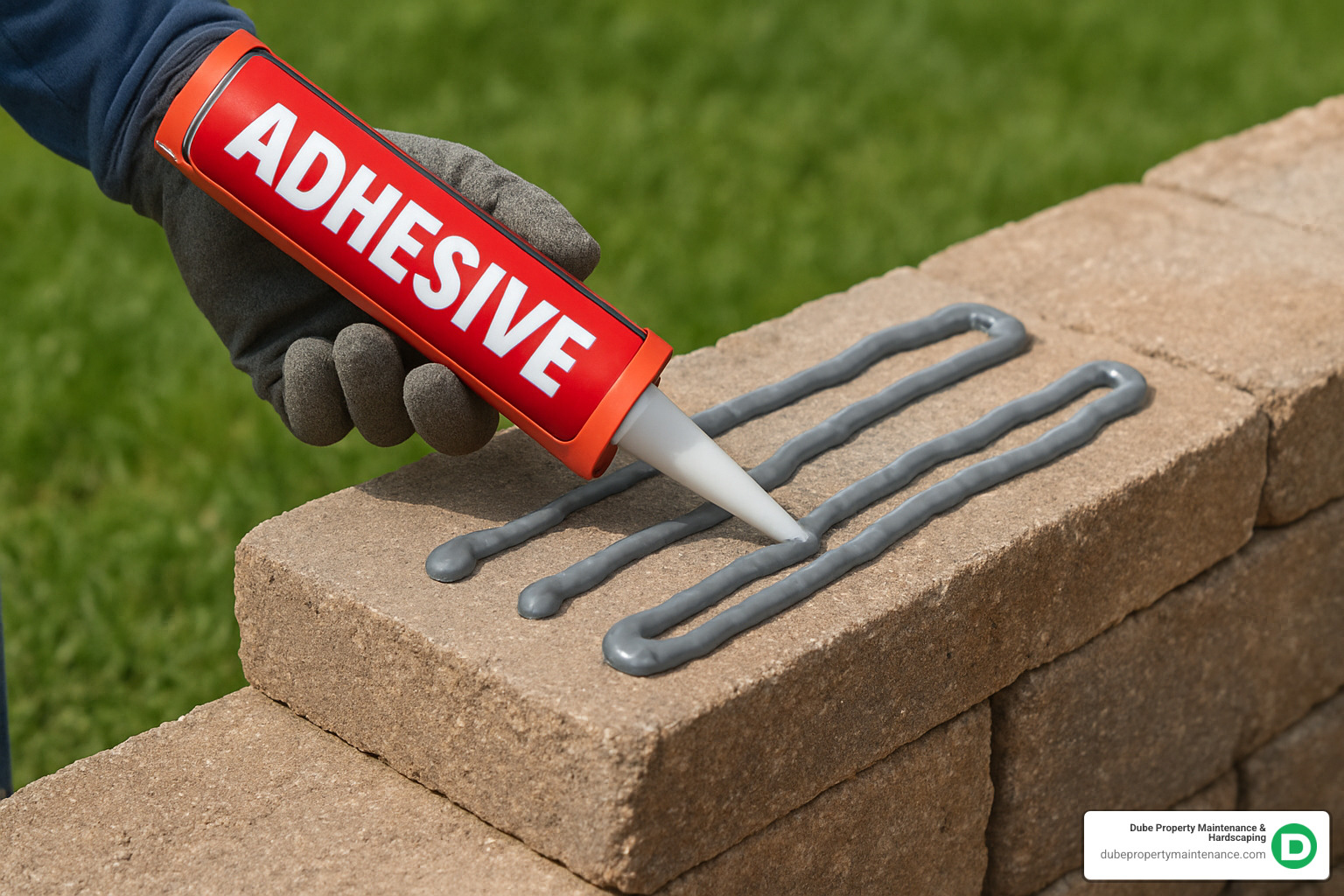
The pattern you use to apply the adhesive significantly impacts both bond strength and wall longevity. For most retaining walls, we recommend parallel lines running from front to back (not side to side), which allows moisture to escape downward. For larger blocks, an S-pattern provides excellent coverage while maintaining drainage paths. Whatever pattern you choose, avoid creating closed loops that could trap water inside your wall structure.
After applying the adhesive, press and secure the blocks within the product’s open time (typically 10-30 minutes). Apply firm, even pressure to ensure good contact. For capstones or top courses, you might need temporary shims or weights until the adhesive sets.
Patience pays off when it comes to curing. While most retaining wall block adhesives grab within minutes, full curing time typically takes 24 hours or longer. Resist the temptation to backfill or load the wall too soon—this is especially important for taller structures that will bear significant soil pressure.
For our New England customers dealing with cold weather installations, we recommend storing adhesive in a warm vehicle until needed, applying slightly thicker beads to account for slower curing, and extending minimum cure times by 50-100% before loading the wall. “In Methuen winters,” our project manager notes, “temperature adaptation is essential for successful installations.”
For comprehensive drainage solutions that work alongside your adhesive-bonded wall, check out our guide on retaining wall drainage pipe.
After building hundreds of retaining walls across Massachusetts and New Hampshire, we’ve seen virtually every adhesive application mistake possible. Learning from these common errors will save you time, money, and frustration.
Over-applying adhesive is a frequent rookie mistake. More isn’t better—excessive adhesive wastes product, creates messy squeeze-out, and can actually prevent proper block-to-block contact. Follow manufacturer guidelines for appropriate bead size.
Many DIYers inadvertently block drainage paths by applying adhesive in continuous loops or horizontal lines. This traps water inside the wall structure, leading to freeze-thaw damage that can destroy walls in just a few New England winters. Always orient your adhesive beads to allow moisture to escape downward.
Temperature limitations matter tremendously in our region. Each adhesive has specific temperature ranges for application and curing, and using a product outside its recommended range often results in weak bonds or complete failure. This is why we carry multiple adhesive types to accommodate seasonal changes.
Once the adhesive begins to set, moving blocks can break the forming bond. As one of our technicians puts it, “If you need to adjust after the adhesive grabs, it’s better to completely remove the block, clean off the old adhesive, and start fresh.”
Unless you’re using an adhesive specifically formulated for wet conditions, applying to dirty or wet surfaces significantly reduces bond strength. This is particularly challenging in spring when ground moisture is high—sometimes waiting for a drier day is the best approach.
Some homeowners try to save money by skipping adhesive on “hidden” courses, only applying it to visible top courses or capstones. This seriously compromises the wall’s structural integrity. While not every block necessarily needs adhesive, strategic use throughout the wall improves overall stability.
Finally, resist the temptation to use standard indoor construction adhesive for your outdoor project. These products aren’t formulated for the extreme conditions that landscape features endure in places like Haverhill or Salem. Always use products specifically designed for outdoor and landscape applications.
“We’ve been called to repair many DIY walls where these common mistakes led to premature failure,” notes our Dube Property Maintenance & Hardscaping project manager. “Taking the time to apply adhesive correctly is always less expensive than rebuilding a failed wall.”
When it comes to retaining wall block adhesive, timing is everything. There are actually two different timing factors you need to know about:
First, there’s the initial grab time – that magical moment when your blocks actually stay put without you holding them. Fast-setting formulas will give you this in just 10-15 minutes (perfect for those of us who aren’t blessed with patience). Standard formulas take around 20-45 minutes, while slower options might keep you waiting up to an hour.
But don’t be fooled – that initial set doesn’t mean the job is done. Full curing takes considerably longer. Most adhesives need at least 24 hours before they can handle any real pressure, and many don’t reach their maximum Hulk-like strength until 3-7 days later.
“We always tell our Methuen customers to wait at least a full day before backfilling against a new wall,” says our installation team leader. “It’s like waiting for concrete to dry – not the most exciting part of the project, but skipping this step is asking for trouble.”
New England weather loves to complicate things too. When temperatures drop below 50°F (a regular occurrence in our service area), your curing time might double. Interestingly, high humidity actually helps polyurethane adhesives cure faster, while hot, sunny days can make your adhesive set too quickly, giving you less working time to get those blocks perfectly positioned.
Absolutely! Retaining wall block adhesive is actually a DIY hero when it comes to fixing existing walls. We’ve seen countless successful repairs throughout Methuen, North Andover, and surrounding towns using the right adhesive.
Loose capstones are probably the most common repair we see. A quality adhesive can lock those wandering caps back in place with minimal fuss. For walls with minor bulging, you can often remove just the affected section, clean everything thoroughly, and rebond with fresh adhesive.
Some adhesives (especially the foam types we discussed earlier) work wonders for filling and stabilizing small cracks in concrete blocks. They can also reinforce areas that get extra pressure or water exposure, like corners or sections near downspouts.
The key to successful repairs is preparation. “Clean surfaces are happy surfaces,” as our repair specialist likes to say. Remove all traces of old, failed adhesive and make sure you’re working with clean, stable blocks. For repairs, we often recommend using slightly more adhesive than you would for new construction, as weathered surfaces can be more porous.
That said, not every wall can be saved with adhesive alone. If your wall is showing significant structural failure, leaning dramatically, or experiencing major movement, it’s time to call in professionals like our team at Dube. Some problems require partial or complete rebuilding for a safe, lasting solution.
Let’s be honest – removing fully cured retaining wall block adhesive isn’t anyone’s idea of a fun Saturday project. But sometimes it’s necessary, and there are effective approaches.
For visible excess adhesive, mechanical removal is your first line of attack. Grab a sharp chisel, putty knife, or utility knife and carefully work at the adhesive without damaging the block surface. A wire brush can help with the final cleanup once you’ve removed the bulk of the material.
Heat can be your secret weapon with polyurethane adhesives. A heat gun (the kind used for stripping paint) will soften the bond enough to make scraping much easier. Just be careful not to overheat your concrete blocks – they don’t appreciate it and can crack or spall if you get too aggressive with the heat.
For those last stubborn bits, solvents like mineral spirits or acetone can help, but always test in an inconspicuous spot first. Some blocks, especially those with specialized coatings or colors, might react poorly to strong solvents.
The toughest scenario is when you need to separate fully bonded blocks. “With today’s premium adhesives, sometimes the block will actually break before the adhesive bond fails,” explains our team leader. “That’s great when you want your wall to stay together, not so great when you’re trying to take it apart.” Careful work with a masonry chisel and hammer is your best approach, but be prepared for some casualties.
The wisest approach? “An ounce of prevention beats a pound of cure,” as my grandfather used to say. Using the right amount of adhesive in the first place and cleaning up any squeeze-out immediately while it’s still wet will save you hours of frustration later.
For major reconstruction needs in Methuen or anywhere in our service area, our team at Dube Property Maintenance & Hardscaping is always ready to help assess the situation and provide the most efficient solution.
Choosing the right retaining wall block adhesive isn’t just about completing your project—it’s about ensuring your wall stands strong through years of New England weather. From freezing winters in Methuen to coastal conditions in Newburyport, the adhesive you select plays a crucial role in your hardscape’s long-term success.
Throughout this guide, we’ve seen how each adhesive brings something special to the table. Loctite PL 500 offers that reliable all-around performance that works in nearly any condition. Liquid Nails LN-905 saves the day when you’re dealing with damp surfaces, while being gentler on the environment. Gorilla Heavy Duty fills those tricky gaps when blocks don’t quite meet perfectly. The innovative DAP Touch ‘n Foam hides itself away with that smart black coloration, and SB-15 Rapid Set gets you back to other projects faster with its quick-setting formula.
“I’ve seen walls fail after just one winter because someone chose the wrong adhesive or applied it incorrectly,” shares our senior hardscape specialist. “It’s heartbreaking when that happens, especially when it could have been prevented.”
For our environmentally conscious neighbors throughout Massachusetts and New Hampshire, the low-VOC options like Liquid Nails LN-905 offer peace of mind without sacrificing strength. These formulations protect both your family and our local ecosystem while still delivering the performance you need.
Remember though—even the best adhesive won’t save a poorly installed wall. Taking time with surface preparation, applying adhesive in patterns that allow proper drainage, and respecting cure times aren’t just suggestions—they’re essential steps that determine whether your wall lasts for seasons or generations.
At Dube Property Maintenance & Hardscaping, we’ve installed countless retaining walls across Methuen, North Andover, Haverhill, Salem and beyond. What we’ve learned is that success lies in the details. The extra few minutes spent cleaning block surfaces or the patience to let adhesive fully cure before backfilling pays enormous dividends in the long run.
Whether you’re tackling this project yourself or considering professional help, we’re always here to offer guidance based on our years of local experience. Every property has unique challenges, and we’re happy to help you steer them. For more comprehensive support with your retaining wall project, visit our retaining wall services page.
A well-built retaining wall doesn’t just hold back soil—it improves your outdoor living space and adds value to your property. By selecting the right retaining wall block adhesive and applying it with care, you’re making an investment that will continue to pay dividends with every passing season.
