
Sometimes your driveway whispers its troubles; other times it shouts with jagged gaps and broken chunks. The goal is to tell the difference between a quick fix and a full tear-out.
Cracks wider than 1/8 in. They let water, salt and ice reach the slab’s core. If you can slide a quarter into a crack, plan on replacement.
Spalling or pitting. New England freeze-thaw cycles turn a few flakes into widespread surface loss. Once spalling starts it rarely stops.
Sinking or uneven slabs. Shifting soil creates trip hazards and drainage problems that surface repairs can’t solve.
Standing water or bad pitch. Puddles speed up concrete deterioration and may push water toward your foundation.
Recurring freeze-thaw damage. Does the driveway look worse every spring? The slab is telling you it has reached the end of its service life.
Age also matters. After 30 years concrete becomes brittle; repeated patching usually costs more than starting fresh. Resurfacing averages $3–$10 per sq. ft. (internet data, not Dube pricing). If you’ll need a replacement soon anyway, skip the band-aids.
7 Signs You Need Driveway Replacement – Is it Time?
Because new concrete never matches the old, patchwork often looks worse than uniform wear. Heavy equipment used for partial repairs can crack “good” slabs next to the work area, and you’ll pay twice if the rest fails later. For driveways over three decades old, a full replacement is almost always the most economical—and best-looking—choice.
Cost to Remove and Replace Concrete Driveway
| Material | Lifespan | Initial Cost | Maintenance | Climate Performance |
|---|---|---|---|---|
| Concrete | 30–50 yrs | Moderate | Low | Excellent freeze-thaw resistance |
| Asphalt | 15–20 yrs | Lower | High | Requires regular sealing |
| Pavers | 25–50 yrs | Higher | Moderate | Good with proper base |
Concrete’s longer life and minimal upkeep routinely outweigh its slightly higher upfront price. At Dube Property Maintenance & Hardscaping we install both concrete and paver driveways and can walk you through the pros and cons of each option.
Paver Driveway Cost vs. Concrete
Replacing a driveway sounds daunting, but the work breaks down into four manageable phases. Most residential projects wrap up in about a week, with a few extra days for curing.
Essential tools: jackhammer, sledge, pry bar and (ideally) a skid steer. Suit up with eye, ear, respirator and foot protection. Start at an edge or existing crack, break the slab into sections about 3 ft. square, cut away any rebar or mesh, and load debris for disposal. For a typical driveway, demolition takes one long day.
A DIY Guide to Removing Your Driveway
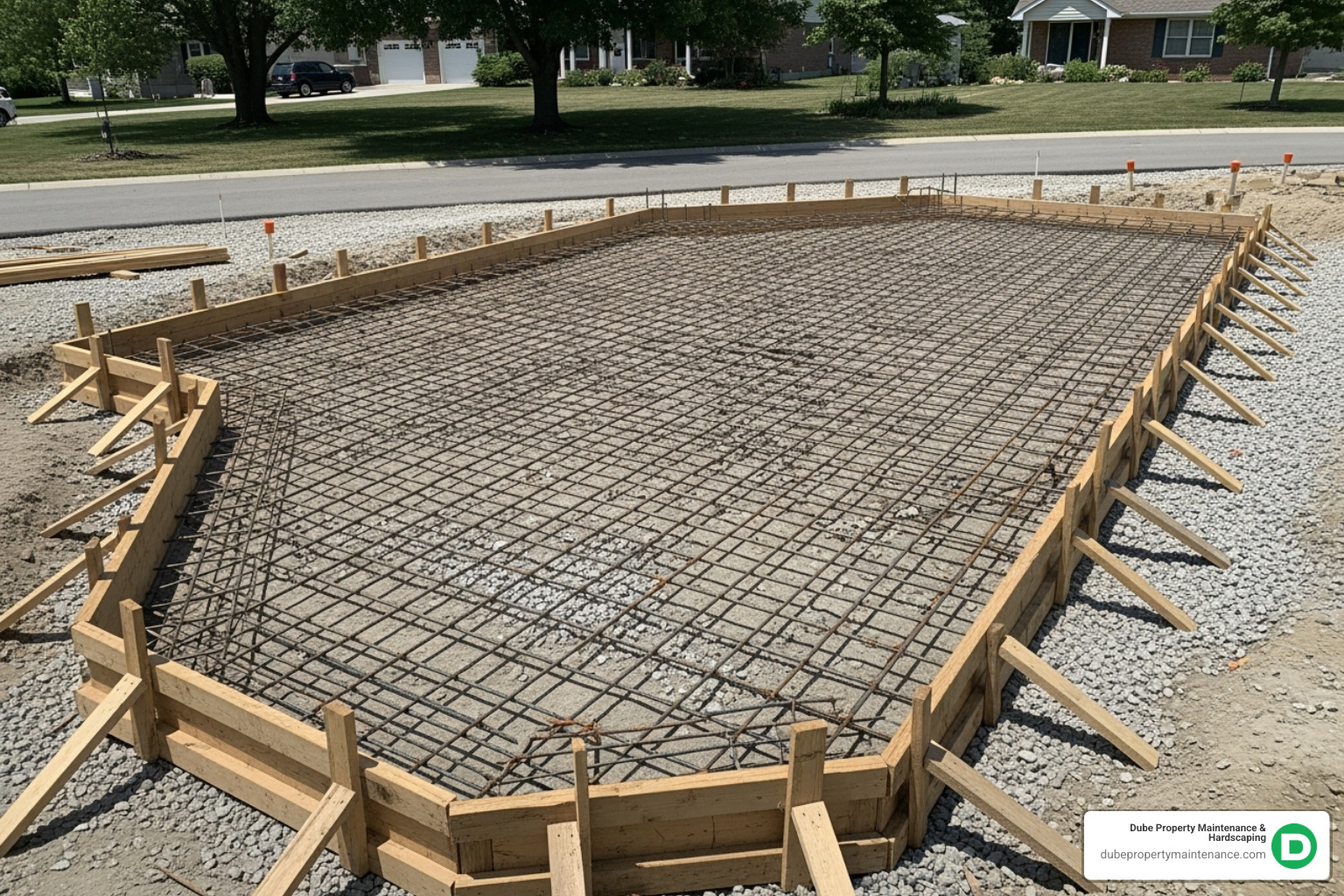
Keep the slab damp for the first few days. Light foot traffic is fine after 24–48 hours; hold off on vehicles for at least 5–7 days (longer in cold weather). Patience here equals decades of performance.
Disclaimer: The following figures are national averages found online and do not represent Dube Property Maintenance & Hardscaping pricing. Always request a written quote for local, accurate numbers.

Like a new car, your driveway has a base price plus optional upgrades. Size, thickness, access and finish determine where you land on the spectrum.
Removal – $1–$4 per sq. ft. (complex jobs up to $12+).
Plain gray install – $5–$15 per sq. ft. (high-end up to $45).
Stamped or colored – $8–$25 per sq. ft. (intricate designs up to $60).
Exposed aggregate – $7–$20 per sq. ft. (premium up to $50).
Combining removal and installation puts most projects between $6.50 and $25+ per sq. ft.; luxury jobs can exceed $60. For a 640 sq. ft. two-car driveway that’s roughly $4,160–$16,000, with elaborate designs reaching $38,400.
Cost to Remove and Replace Concrete Driveway Per Square Foot
Get at least three quotes, keep the design simple, schedule during a contractor’s off-season, tackle demolition yourself if you’re experienced, or team up with neighbors for volume discounts.
Watching how-to videos makes a pour look easy, but concrete is famously unforgiving.
Pros
Cons
Pros bring:
Dube Property Maintenance & Hardscaping handles the entire process—from permits to perfect broom finish—so you enjoy a driveway built to last.
The beauty of a new concrete driveway lies in its simplicity – it doesn’t ask for much, but what it does need makes all the difference in reaching that impressive 30-40 year lifespan.
Regular cleaning forms the foundation of good concrete care. A simple pressure wash or garden hose with mild detergent removes the everyday dirt, oil stains, and debris that can slowly penetrate and discolor your surface. Think of it as giving your driveway a regular shower – nothing fancy, just consistent care.
Sealing every 2-5 years acts like sunscreen for your concrete, protecting it from moisture penetration, salt damage, and stubborn stains. Professional sealing costs average $1-$2 per square foot (based on internet data, not Dube Property Maintenance & Hardscaping pricing), while DIY sealing materials run about $0.50-$0.75 per square foot. The investment pays for itself by preventing much costlier repairs down the road.
Prompt crack repair might be the most important maintenance task. Small cracks are like tiny invitations for water and ice to cause bigger problems. Catch them early with concrete crack filler or caulk, and you’ll avoid the headache of major repairs later. It’s much easier to spend 10 minutes fixing a hairline crack than dealing with a full section replacement.
For most homeowners, 4 inches of thickness hits the sweet spot between strength and cost-effectiveness. This standard depth easily handles your daily drivers – cars, SUVs, and light trucks – without breaking the bank during installation.
But if your driveway sees heavier action, thickness matters more. Properties that regularly welcome RVs, delivery trucks, or commercial vehicles need 5-6 inches with rebar reinforcement. Those concentrated loads from heavy vehicles can crack thinner concrete, turning your smooth driveway into an expensive repair project.
Your local building codes might have the final say on thickness requirements. Some municipalities set specific standards based on soil conditions and expected traffic loads in your area. When in doubt, a quick call to your local building department can save you from costly mistakes.
The extra inch or two of thickness costs more upfront, but it’s insurance against premature failure. Think of it as buying the right tool for the job – you want concrete that matches your actual usage, not just the minimum requirement.
Absolutely, and the impact goes beyond just dollars and cents. A fresh concrete driveway dramatically improves your home’s curb appeal, creating that positive first impression that matters so much in real estate.
The durability factor sets concrete apart from other driveway materials. When potential buyers see a well-maintained concrete driveway, they’re seeing decades of low-maintenance reliability ahead. No annual sealing like asphalt, no individual paver repairs, just solid performance year after year.
Buyers appreciate the practical benefits too. Concrete driveways are easier to shovel in winter, provide better traction than smooth surfaces, and won’t develop the ruts or soft spots that plague other materials. These everyday advantages translate into real value for busy homeowners.
While exact return on investment varies by location and market conditions, driveway replacement consistently ranks as a valuable home improvement. You’ll enjoy the benefits every day you live there, and when it’s time to sell, that professional appearance and known reliability give your property a competitive edge.
The investment in a quality concrete driveway pays dividends both in daily convenience and eventual resale value – making it one of those rare home improvements that truly serves you twice.
A new concrete driveway isn’t just a repair; it’s a decades-long upgrade in safety, value and appearance. By recognizing when replacement is wiser than patching, planning each phase and allowing proper cure time, you ensure results that withstand New England’s punishing climate.
If you’d rather skip the heavy lifting, the team at Dube Property Maintenance & Hardscaping is ready to help homeowners from Methuen to Exeter. We combine professional equipment, proven techniques and a commitment to quality that protects your investment for the long haul.
Ready to get started? Learn more about the Cost to Remove and Replace a Concrete Driveway and request your personalized quote today.
