
A paver driveway cost calculator typically estimates that paver driveways cost between $10 and $30 per square foot installed, with the average 2-car driveway (24′ x 24′) costing between $5,700 and $17,200 total.
For quick budgeting purposes:
| Driveway Size | Low-End Cost | High-End Cost |
|---|---|---|
| Small (12′ x 24′) | $2,900 | $8,600 |
| Standard (24′ x 24′) | $5,700 | $17,200 |
| Large (36′ x 24′) | $8,600 | $25,900 |
Note: These are average costs based on internet data, not actual costs from Dube Property Maintenance & Hardscaping.
Planning a new driveway can be overwhelming, especially when trying to budget accurately. With so many materials, sizes, and design options available, knowing where to start can be challenging.
The good news is that a paver driveway cost calculator simplifies this process by breaking down expenses into manageable components. Unlike a simple square footage estimate, a proper calculator factors in materials, labor, base preparation, and even accounts for waste.
Why use a calculator instead of a quick estimate? Because paver driveways involve multiple layers and materials:
Each element contributes to both the durability and the final cost of your driveway. By using a calculator, you’ll get a more accurate picture of your investment rather than an unpleasant surprise when quotes come in higher than expected.

Glossary for paver driveway cost calculator:
– cost to install paver driveway
– cost to seal driveway pavers
– paver driveway maintenance
A paver driveway cost calculator is your virtual budgeting buddy when planning that beautiful new driveway. These handy online tools take the guesswork out of estimating what you’ll actually spend on your project. Instead of rough ballpark figures, you’ll get a detailed breakdown that considers all the important elements of your specific situation.
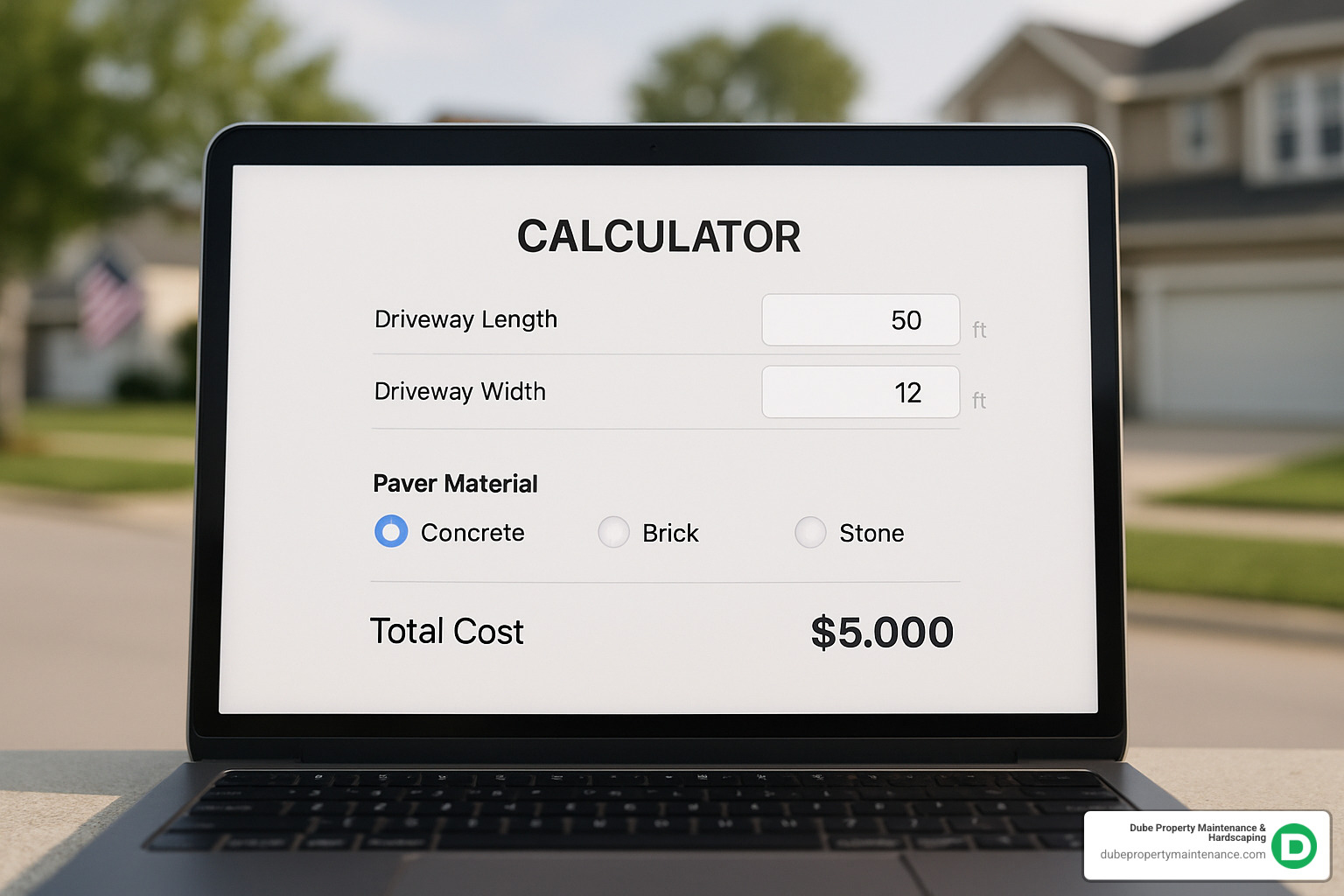
The best calculators make it simple – just enter your driveway dimensions, choose your preferred paver type, and sometimes add your location to account for regional price differences. Today’s calculators are designed to work beautifully on your smartphone too, so you can take measurements and input data while standing in your actual driveway space. This means your estimates are based on real measurements rather than hopeful guesses!
What makes a good calculator stand out is its attention to detail – options for square footage calculations, material selections (concrete, brick, or natural stone), pattern complexity adjustments, and even waste allowance percentages. Some even let you explore extras like decorative edging and lighting to complete your vision.
Need to check current material prices? The Home Depot Concrete and Masonry Materials section can give you a sense of what supplies might cost in your area.
Behind that simple interface, a good paver driveway cost calculator is doing some serious number-crunching based on industry standards. It’s not just counting pavers – it’s considering your entire driveway system from the ground up.
For the foundation, the calculator estimates how much gravel base you’ll need (typically 4-6 inches deep), the precise amount of bedding sand (usually 1 inch), and the appropriate amount of geotextile fabric to prevent weeds and provide stability. These materials form the hidden support system that makes your driveway last for decades.
When it comes to the pavers themselves, the calculator divides your total square footage by the size of each individual paver, then intelligently adds an overage percentage. This is where experience matters – straight patterns typically need about 10% extra material, while diagonal or herringbone patterns might require up to 20% more to account for all those angled cuts.
Think of it this way: for a standard two-car driveway measuring 24′ × 24′ (576 square feet) using classic 4″ × 8″ brick pavers, you’d need approximately 2,500 pavers as a baseline. Add that smart waste allowance, and you’re looking at ordering between 2,750-3,000 pavers total. This precision helps ensure you won’t run short halfway through the project or end up with stacks of unused materials.
After crunching your numbers, a comprehensive paver driveway cost calculator serves up several helpful results that paint a complete financial picture:
Your material shopping list appears first – the exact number of pavers needed, cubic yards of gravel, tons of sand, and other essentials. This alone can save you from expensive over-ordering or frustrating mid-project supply runs.
The cost breakdown is where things get really valuable. You’ll see itemized expenses for all materials, a separate labor estimate based on typical rates in your region, and a total project range showing both economy and premium options. This range reflects differences in material quality, pattern complexity, and potential site challenges.
Most calculators provide a printable or savable summary that becomes your roadmap when talking to contractors. Having this detailed breakdown makes comparing quotes much easier – you’ll quickly spot if someone is cutting corners on materials or padding their estimate.
While these calculators provide excellent estimates, they’re based on average internet data, not actual costs from Dube Property Maintenance & Hardscaping. For a truly personalized quote that accounts for your property’s unique characteristics, it’s always best to get a professional assessment.
When planning your paver driveway, several critical factors will significantly impact your budget beyond just the pavers themselves. Understanding these elements will help you use a paver driveway cost calculator more effectively.

You might be surprised to learn that site preparation costs often take a bigger bite out of your budget than you’d expect. Before a single paver is laid, you’ll need to consider excavation costs ranging from $3-$8 per square foot to remove existing surfaces and soil. Proper grading is essential for drainage and typically runs between $800-$3,000 for a standard driveway.
Speaking of water management, don’t overlook drainage solutions like French drains or dry wells if your property needs them. These can add $10-$30 per linear foot to your project. And before any work begins, check if you need permits in your area – these typically cost between $50-$250 depending on your location.
Every beautiful paver driveway needs proper edge restraints to prevent shifting and spreading over time. These borders, which can be plastic, metal, or concrete, generally cost $3-$15 per linear foot installed.
Living in Massachusetts or New Hampshire? Regional differences significantly impact costs. Labor rates in the Northeast may differ from national averages. A good paver driveway cost calculator should account for these regional variations by asking for your zip code.
The material you choose for your paver driveway dramatically affects your wallet. Concrete pavers offer the most budget-friendly starting point at $4-$8 per square foot for standard gray options. If you’re looking for a bit more character with colored or textured concrete pavers, prices climb to $8-$15, while premium finishes can reach $15-$20 per square foot.
Brick pavers bring classic charm at $5-$10 for standard clay brick, $10-$18 for that gorgeous antique or tumbled look, and $18-$25 for custom colors and sizes. For the ultimate in luxury and durability, natural stone pavers range from $10-$20 for limestone or sandstone, $15-$30 for granite or bluestone, and $25-$40 for exotic stone varieties.
Availability in your region can significantly impact these prices. Some materials might require special ordering or shipping, adding to your bottom line. Those beautiful color upgrades and special finishes you’ve been eyeing on Pinterest? They typically command premium prices too.
Want to explore your options in more detail? Visit our driveway pavers page for a closer look at the possibilities.
When you’re budgeting for your paver driveway, don’t forget that labor typically accounts for 35-50% of your total investment. A reliable paver driveway cost calculator will show labor estimates ranging from $6-$10 per square foot for standard installations, climbing to $10-$15 per square foot for those eye-catching complex patterns and designs.
Several factors can push your labor costs up or down. That beautiful herringbone pattern you’ve fallen in love with? It requires more cuts and time than a simple running bond. If your property has tricky access issues, crews will need more time to move materials, increasing costs.
Seasonal timing matters too – peak season installations (spring and summer) often come with premium pricing due to high demand. At Dube Property Maintenance & Hardscaping, we see this seasonal effect in our Massachusetts and New Hampshire service areas.
The experience level of your installation crew makes a significant difference in both quality and efficiency. Our trained teams can typically install around 100 square feet of pavers per day under standard conditions. However, this drops to about 50 square feet daily when dealing with intricate cuts and complex patterns.
While these figures represent average costs based on internet data, they’re not actual costs for Dube Property Maintenance and Hardscaping. Your specific project may vary based on site conditions, design choices, and current material availability.
When planning your driveway project, looking beyond just the initial price tag can save you thousands in the long run. While a paver driveway cost calculator helps you understand upfront expenses, the true value emerges when you consider the big picture.
I’ve seen many homeowners initially hesitate at paver pricing, only to thank themselves years later when their neighbor’s concrete driveway is cracking while theirs still looks fantastic!
| Feature | Paver Driveway | Concrete Driveway | Asphalt Driveway |
|---|---|---|---|
| Initial cost per sq ft | $10-$30 | $8-$12 | $7-$13 |
| Average lifespan | 25-75 years | 20-30 years | 15-20 years |
| Maintenance needs | Low (joint sand, occasional sealing) | Medium (crack repair, sealing) | High (regular sealing, resurfacing) |
| Repair difficulty | Easy (replace individual pavers) | Difficult (patch or replace sections) | Moderate (patch and seal) |
| Winter durability | Excellent (flexible joints) | Poor (prone to cracking) | Good (somewhat flexible) |
| Curb appeal | High | Medium | Low |
| Environmental impact | Good (permeable options available) | Poor (impermeable) | Poor (petroleum-based) |
Those higher upfront costs for pavers often translate to significant savings over time. Think of it as buying quality boots instead of cheap ones – you might pay more initially, but you’ll replace the cheap ones multiple times while the quality pair keeps serving you year after year.
The numbers tell a compelling story when it comes to long-term value – something a basic paver driveway cost calculator might not fully capture.
Your paver driveway could last 25-75 years with proper installation and maintenance, dramatically outlasting concrete (20-30 years) and especially asphalt (15-20 years). This extended lifespan becomes particularly valuable in our New England climate, where freeze-thaw cycles wreak havoc on solid surfaces.
The impact on your property value is equally impressive. Paver driveways typically return about 69% of your investment when selling your home, compared to just 40-50% for concrete and an even lower 30-40% for asphalt.
Here in Massachusetts and New Hampshire, we’ve seen how pavers hold up beautifully through harsh winters. Their ability to flex slightly during freeze-thaw cycles prevents the cracking that plagues concrete driveways in our region. This resilience means fewer headaches and repairs for you as a homeowner.
When comparing the results from a paver driveway cost calculator to concrete estimates, the price difference is noticeable but doesn’t tell the whole story:
The average paver driveway runs $10-$30 per square foot installed, while concrete typically costs $8-$12 per square foot. That initial premium for pavers, however, is offset by significant differences in ongoing costs.
Concrete driveways demand more frequent attention – crack sealing as problems develop and complete resealing every 2-3 years. When damage occurs, repairs often involve cutting out and replacing entire sections at $10-$25 per square foot.
Paver driveways, by contrast, need joint sand refreshed every 3-5 years and sealing every 3-4 years. When damage happens – whether from tree roots, settling, or accidents – repairs are remarkably simple. We can lift the affected pavers, fix the underlying issue, and replace them without visible patches or seams. These repairs typically cost just $2-$5 per paver plus labor.
Perhaps most compelling is the replacement timeline. Your concrete driveway will likely need complete replacement after 20-30 years, while a properly installed paver driveway might never need full replacement – just occasional maintenance and perhaps individual paver replacements.
For a deeper dive into how these options compare financially, check out our detailed paver driveway cost vs concrete page.
Using a paver driveway cost calculator effectively isn’t rocket science, but it does require some careful measuring and a bit of homework about your specific project. Let’s walk through how to get the most accurate estimate possible without breaking a sweat.

Grab your measuring tape and head outside! For a simple rectangular driveway, just measure the length and width in feet, then multiply these numbers together. Voilà – you’ve got your square footage.
If your driveway has a more creative shape (we see you, curved driveway enthusiasts!), break it down into simpler shapes like rectangles and triangles. Calculate each section separately, then add them all together.
A little insider tip from our team at Dube Property Maintenance: Add an extra foot or two to your width measurements if you want some breathing room when getting in and out of your vehicle. Those few extra inches make a world of difference when you’re juggling groceries or helping kids out of car seats!
Your local soil and weather conditions play a huge role in determining how thick your driveway base should be:
Here in New England, where freeze-thaw cycles are a fact of life, we typically recommend at least a 6″ base. If you’re blessed with sandy soil in a milder climate, you might get away with a 4″ base. For areas with drainage issues (you know who you are if your yard turns into a mini-lake after rain), consider going up to 8″ with additional drainage solutions.
Not sure about your soil type? A soil test can provide definitive answers. Yes, it’s an extra expense ($300-$1,000), but it’s far cheaper than dealing with a failing driveway a few years down the road.
Now comes the fun part – putting your numbers to work in a paver driveway cost calculator:
First, most calculators will ask for your zip code. This isn’t just nosy – it helps provide regionally adjusted pricing since labor and material costs vary significantly across the country.
Next, input your driveway dimensions and select your preferred paver type. Are you leaning toward classic brick, versatile concrete, or luxurious natural stone? Each has its own price point and aesthetic appeal.
Don’t forget to specify your desired base thickness based on your soil conditions and select a waste percentage. For straight patterns, 10% extra material is typically sufficient, but if you’re going for something more intricate like a herringbone pattern, bump that up to 15-20%.
Finally, consider any extras you might want – edging, lighting, or special drainage features. These improve both function and beauty but will add to your bottom line.
When your paver driveway cost calculator generates an estimate, take some time to review the breakdown. A good calculator will show you not just the total cost but also material quantities, labor hours, and individual cost components.
Print or save this estimate – it’s gold when you start talking to contractors. It gives you a baseline for comparing quotes and helps ensure you’re not being overcharged (or underquoted, which can lead to surprise costs later).
If the estimate makes your eyes water, don’t panic! Try adjusting some variables like paver type or reducing some optional features. You can always add those path lights or border accents in a future project.
The next step is to request quotes from professionals. While calculators are helpful tools, nothing beats having an experienced contractor like our team at Dube Property Maintenance & Hardscaping visit your property and provide a personalized assessment.
Professional quotes should generally align with your calculator results, though some variation is normal due to site-specific challenges that calculators can’t account for.
For more detailed information about the installation process and professional services, check out our cost to install paver driveway page where we break down exactly what goes into creating your dream driveway.
Beyond the basic calculations from a paver driveway cost calculator, several upgrades and additional features can improve your driveway’s functionality, appearance, and value. Understanding these options helps you budget more accurately and prioritize features that matter most to you.
Popular upgrades and their approximate costs:
Driveway extensions and modifications:
If you’re looking to widen an existing driveway with pavers, costs typically range from $12-$35 per square foot, which includes:
– Matching to existing driveway
– Creating proper transitions
– Ensuring consistent drainage
For detailed information about widening projects, visit our cost to widen driveway with pavers page.
Many homeowners consider DIY installation to save on costs. A paver driveway cost calculator might show significant savings when you remove professional labor, but there are important factors to consider:
Potential DIY savings:
– Labor costs represent 35-50% of total project cost
– DIY installation typically saves about 50% compared to hiring professionals
DIY considerations:
– Equipment rental: Plate compactor ($75-$100/day), wet saw ($50-$75/day), excavator ($300-$400/day)
– Time commitment: A professional team might complete your driveway in 3-5 days; DIY could take 2-3 weekends or more
– Physical demands: Paver installation involves heavy lifting and repetitive bending
– Skill requirements: Proper grading and base preparation require technical knowledge
Quality and warranty considerations:
– Professional installation often includes warranties (typically 2-5 years)
– Improper installation can lead to settling, shifting, and drainage issues
– Mistakes can be costly to correct
For those interested in DIY installation, we recommend reviewing our how to install a paver driveway guide to understand the process fully before deciding.
If you decide to hire professionals after using a paver driveway cost calculator, use this checklist to ensure you select a qualified contractor:
At Dube Property Maintenance & Hardscaping, we welcome these verification steps and are happy to provide references from our many satisfied customers throughout Massachusetts and New Hampshire.
When you’re using a paver driveway cost calculator, you’ll notice it adds a certain percentage for waste. This isn’t just the calculator being cautious—it’s actually essential for a successful installation.
For straight patterns, plan to order about 10% extra pavers. If you’re going with diagonal patterns (which require more cuts), bump that up to 15%. And for those beautiful but complex circular designs or intricate patterns? You’ll want to have at least 20% extra materials on hand.
These extra pavers aren’t just for show—they serve several important purposes. They account for the inevitable cuts you’ll need to make around edges and obstacles, any breakage that happens during installation (it happens to even the pros!), and they provide you with matching pavers for future repairs. There’s nothing worse than needing to replace a damaged paver years later and finding that particular style has been discontinued.
Pro tip: Before placing your order, ask your supplier about their return policy. Some companies will happily take back unopened pallets, while others might charge restocking fees or have a strict no-returns policy. Knowing this in advance can help you plan more effectively.
Yes, you absolutely can install pavers over an existing concrete driveway—and it might save you some money on excavation costs! However, before you get too excited about this option, there are some important things to consider.
First, your existing concrete needs to be in good structural condition. Small surface cracks are usually fine, but if your driveway has major cracks, significant settling, or drainage issues, those problems will eventually transfer to your new pavers.
You’ll also need to use special thin overlay pavers (typically about 1″ thick) for this application. Standard pavers are too thick for overlay projects and would create excessive height differences.
Speaking of height—your finished driveway will be higher than the original. This could affect your garage entrance, create a step where none existed before, or change how water flows across your property. A good contractor will address these transition areas with special edge treatments.
From a cost perspective, an overlay installation typically adds $2-$6 per square foot to standard installation costs. If your concrete needs repairs first, that’s another $10-$20 per square foot. Most standard paver driveway cost calculators don’t account for overlay installations, so make sure to discuss this specifically with your contractor if you’re considering this approach.
While a paver driveway cost calculator focuses primarily on getting your driveway installed, understanding the ongoing maintenance costs helps you budget for the long term.
Your beautiful paver driveway will need some regular care to keep it looking its best. Plan for professional sealing every 3-4 years, which typically costs between $1.50-$3.25 per square foot. Joint sand replacement runs about $0.50-$1.00 per square foot every 3-5 years, and occasional pressure washing (around $0.40-$0.80 per square foot) keeps everything looking fresh.
For repairs, individual paver replacement costs about $5-$15 per paver including labor. Edge restraint repairs might run $10-$20 per linear foot if they become damaged, and releveling small areas that have settled costs approximately $10-$25 per square foot.
A good rule of thumb is to budget about 1-2% of your initial installation cost for annual maintenance. This might seem like an extra expense, but it’s actually an investment that significantly extends your driveway’s lifespan and maintains its curb appeal.
Your maintenance calendar should look something like this: monthly visual inspections and debris removal, quarterly weed removal from joints (if needed), annual thorough cleaning and inspection, and resealing with joint sand refreshing every 3-4 years.
The beauty of paver driveways is that with proper care, they can last for decades—some even outlast their homes! By staying on top of these simple maintenance tasks, you’ll maximize your investment and minimize the need for more extensive repairs down the road.
Using a paver driveway cost calculator gives you a solid starting point for your project budget, but these estimates reflect internet averages, not specific quotes from Dube Property Maintenance & Hardscaping. Your actual costs will depend on your unique property conditions, material choices, and design preferences.
When you invest in a paver driveway, you’re not just getting a place to park—you’re making a smart long-term decision that pays off in multiple ways. Improved curb appeal creates that wow factor when friends and family visit. The increased property value (with up to 69% ROI) makes financial sense too. You’ll also enjoy reduced long-term maintenance compared to concrete or asphalt alternatives, along with exceptional durability that can last 25-75 years. Perhaps best of all is the design flexibility that allows your driveway to complement your home’s unique character.
As you move forward with your planning, we recommend using the calculator as just the first step in your journey. Consider the full lifecycle cost of your driveway—not just what you’ll pay upfront, but what you’ll save over decades of ownership. Take time to explore different paver materials and patterns to find the perfect match for your home’s style. And most importantly, get a professional site assessment for the most accurate quote possible.
Here at Dube Property Maintenance & Hardscaping, we’ve installed beautiful paver driveways throughout Massachusetts and New Hampshire for years. Our experienced team loves helping homeowners steer material choices, design options, and budget considerations to create driveways that improve properties for decades.
Ready to transform your home’s entrance? Visit our cost to install paver driveway page to request a personalized quote custom to your specific needs and property conditions.
We firmly believe that quality installation is an investment that pays you back through years of reduced maintenance and repairs. Our team is ready to help you make that investment wisely, creating a driveway that welcomes you home every day with beauty and durability that stands the test of time.