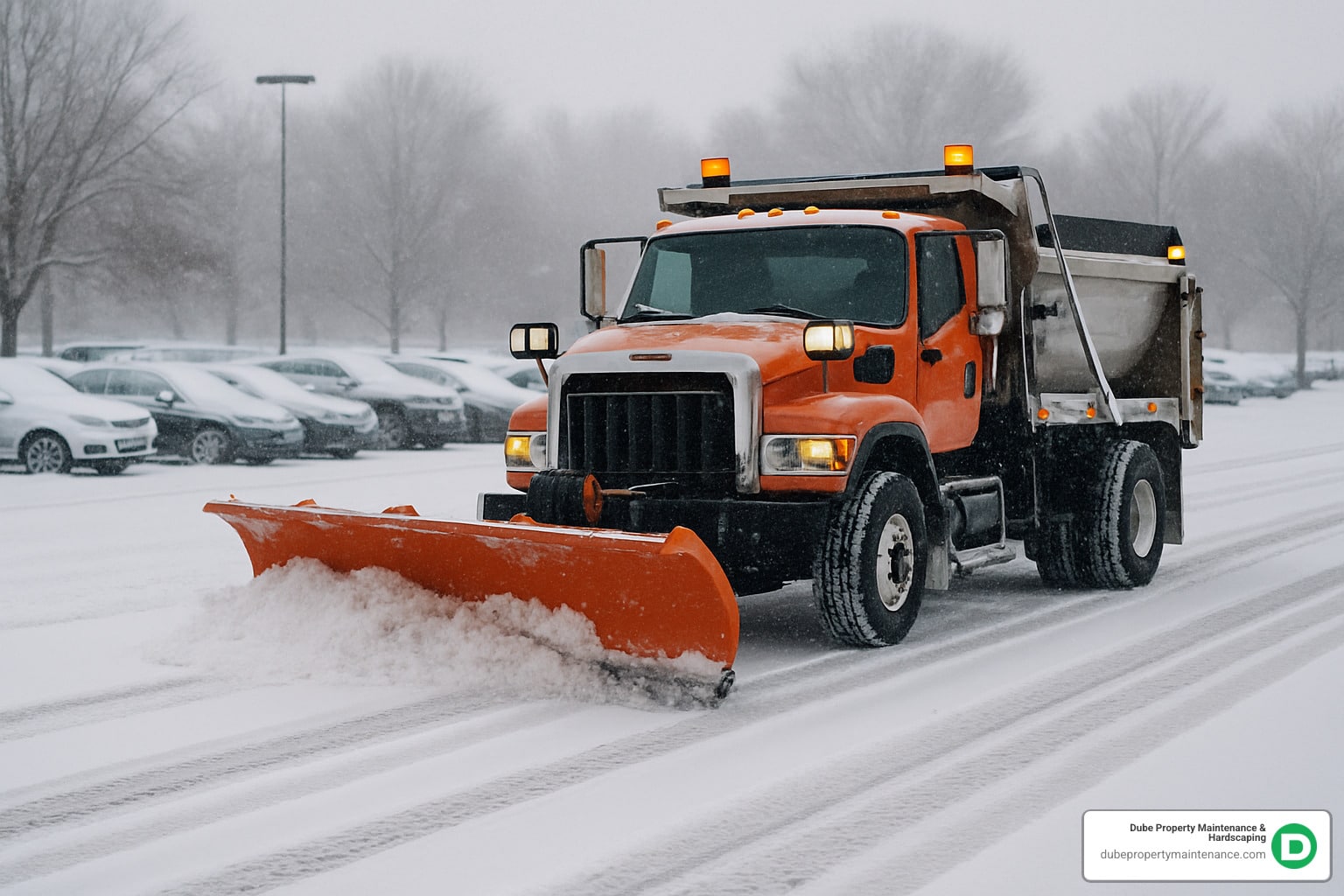

Parking lot snow removal is the process of clearing accumulated snow and ice from commercial, residential, or municipal parking areas to maintain safety, accessibility, and prevent property damage.
Quick Guide to Parking Lot Snow Removal:
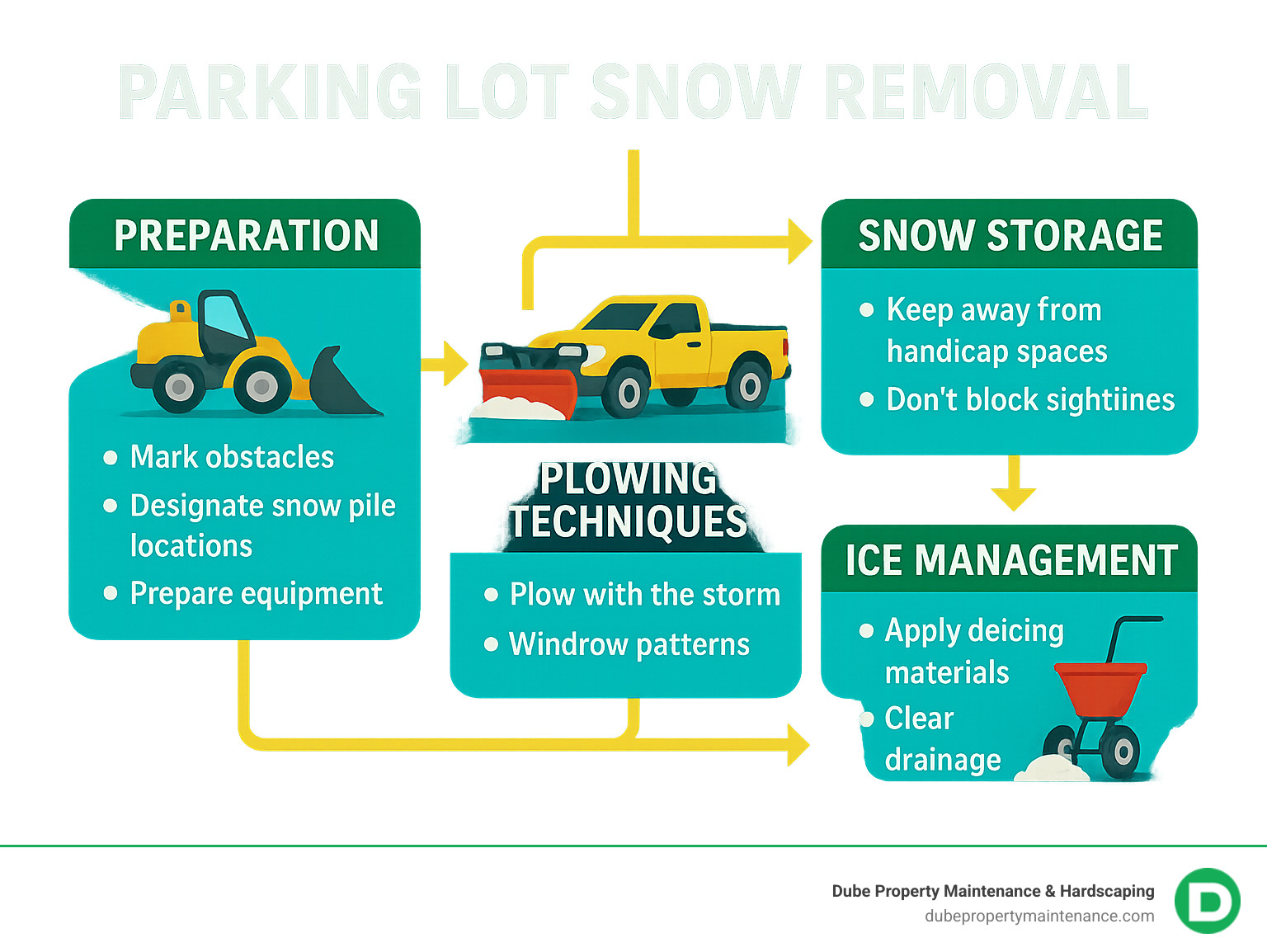
* Before snow: Mark obstacles, designate snow pile locations, prepare equipment
* During light snowfall: Plow with the storm in windrow patterns (angle plowing with wings is 30% more efficient)
* For ice prevention: Apply anti-icing treatments before storms (uses 75% less material than reactive deicing)
* After plowing: Clear drainage areas, apply deicing materials based on surface temperature
* Snow storage: Keep away from handicap spaces, don’t block sightlines, avoid piling on drains
Every winter, business owners and property managers face the same daunting challenge: how to efficiently clear snow from parking lots without disrupting operations, endangering visitors, or damaging pavement. It’s not just about aesthetics—it’s about safety and liability.
The stakes are high. Consider this sobering statistic: 90% of walkway injuries happen with less than 1 inch of snow. That thin white blanket separating customers from your business isn’t just an inconvenience—it’s a potential lawsuit waiting to happen.
Beyond safety concerns, snow and ice that remain on parking surfaces eventually seep into cracks and crevices, accelerating pavement deterioration. What begins as a winter weather event can quickly become a costly spring repair bill.
Effective parking lot snow removal isn’t about brute force or waiting until the storm passes. The most successful approaches combine proactive planning, efficient execution, and strategic ice management—all while considering environmental impact and legal requirements.
Parking lot snow removal terms simplified:
– commercial sidewalk snow plow
– commercial snow removal contract
– snow blowing services near me
When winter storms blanket Massachusetts and New Hampshire, every snowflake that lands on your parking lot starts a countdown. The longer that snow sits, the bigger the risks become—to your visitors, your property, and your bottom line.
“You wouldn’t believe how little snow it takes to create a hazard,” says our operations manager at Dube Property Maintenance & Hardscaping. “Just that thin layer can transform a perfectly good walkway into a skating rink.”
This isn’t just our opinion—the numbers tell the story. Studies show that 90% of slip-and-fall accidents on walkways happen with less than 1 inch of snow. That’s right—not during blizzards, but during those “minor” snowfalls many businesses think they can wait out.
These accidents go far beyond a bruised hip or wounded pride. The average slip-and-fall claim runs between $30,000-$50,000, and courts increasingly expect businesses to demonstrate “reasonable care” through proactive snow management. Even when you hire contractors, your business can still bear liability if someone gets hurt.
That innocent-looking snow is quietly damaging your pavement. Every time moisture seeps into tiny asphalt cracks and freezes, it expands—pushing your pavement apart in a process experts call “frost heaving.”
As the Minnesota Pollution Control Agency notes in their Winter Parking Lot and Sidewalk Maintenance Manual, “Snow and ice left on asphalt accelerate fracturing by allowing water infiltration into surface cracks.”
Regular parking lot snow removal isn’t just about today’s safety—it’s about avoiding thousands in premature resurfacing costs down the road. The pavement you save could be your own.
Your parking lot makes a powerful first impression. When customers pull up to a snow-covered lot, many simply turn around. Retail studies show that snow-covered parking areas can reduce foot traffic by up to 30%, even when businesses remain open.
Beyond lost sales, snow-clogged lots create a cascade of problems:
– Employees struggle to arrive safely and on time
– Delivery services delay or cancel crucial shipments
– Emergency vehicles face potentially life-threatening access challenges
In today’s competitive business environment, can you afford to let snow decide whether customers choose you or your competitors?
The Americans with Disabilities Act isn’t suspended when snow falls. Businesses must maintain accessible routes—including parking lots and sidewalks—throughout winter. Snow and ice barriers that block wheelchair users or create hazards for those with mobility impairments can constitute serious ADA violations.
These violations come with serious consequences: federal complaints, investigations, civil penalties up to $75,000 for first violations, and potentially years of court-supervised remediation efforts.
For businesses in Methuen and throughout our service area, parking lot snow removal isn’t just about convenience—it’s about ensuring everyone can access your business safely, regardless of physical ability.
Timely snow removal isn’t just a winter chore—it’s a critical business decision that protects your customers, your property, and your legal standing. When the forecast calls for snow, having a plan isn’t just nice to have—it’s essential.
The secret to effective parking lot snow removal isn’t just showing up with a plow after a blizzard. It’s about thoughtful preparation and smart execution. At Dube Property Maintenance & Hardscaping, we’ve learned that winter success begins months before the temperature drops.
Think of winter preparation like setting up a chess board before the game starts. You need to know where all the pieces are and plan your strategy accordingly.
Start by mapping your obstacles. Those innocent-looking curbs, speed bumps, and fire hydrants become dangerous hidden hazards under a blanket of snow. We create detailed property maps for every client, noting everything from manhole covers to light poles.
“I’ve seen new plow operators hit everything from shopping cart corrals to buried parking blocks,” says our operations manager. “A good map saves thousands in repair costs for everyone involved.”
Next, install reflective markers at key points around your property. These bright sentinels serve as guides when everything looks like a winter wonderland. Our fleet manager swears by them: “Those reflective stakes are like runway lights for plow operators in a snowstorm. They’re the difference between clearing your lot and accidentally taking out a row of shrubs.”
Designating snow pile locations might seem obvious, but it requires strategic thinking. The perfect spot receives good sun exposure to encourage melting but doesn’t block visibility, handicap spaces, or drainage structures. We work with property managers to identify optimal storage areas that respect both their needs and neighboring property boundaries.
Finally, document everything in a comprehensive snow response plan. This should include trigger depths for service activation, priority clearing areas, and any special instructions unique to your property. Having this plan in place prevents confusion when time is critical.

When snowflakes start falling, timing and technique make all the difference. The professionals at Dube Property Maintenance & Hardscaping follow a proven workflow that maximizes efficiency and minimizes property damage.
We believe in plowing with the storm rather than waiting for it to end. When snow reaches 2-3 inches, our teams mobilize. This prevents that dreaded compaction and ice bonding that makes removal ten times harder. It’s like washing dishes right after dinner instead of letting them sit overnight—much easier in the long run.
Our crews always clear sidewalks first. This might seem counterintuitive, but it allows us to push that snow away from buildings along with the parking lot snow in one smooth operation. Working from buildings outward creates a cleaner final result with less hand-work needed.
For areas directly adjacent to structures, we use a technique called backdragging. Our operators approach the building with the plow raised, then lower it and pull snow away from the structure before pushing it to storage areas. This prevents snow from piling against your foundation where it can cause moisture problems.
For open areas, we start with a center pass down the middle of the lot, then work outward in parallel paths. We use windrow patterns with angled plows to create long ridges of snow that can be efficiently pushed to the edges. One veteran operator told me, “Plowing a lot is like mowing a lawn—you need a pattern that prevents going over the same spot twice.”
Whenever possible, we time our plowing during low-traffic hours. This isn’t always feasible during major storms, but early morning and late evening operations allow our teams to work more quickly and thoroughly without navigating around moving vehicles.
Where you put the snow matters just as much as how you remove it. Poor pile placement creates hazards when melting begins and can lead to property damage and drainage nightmares.
Mind the load limits when creating snow piles, especially on liftd structures like parking garages. Snow is surprisingly heavy—a cubic yard can weigh over 400 pounds when wet and compacted. We’ve seen structural damage occur when piles grow too large in the wrong locations.
Savvy property managers use sun exposure strategically by positioning piles in southern-facing areas that receive maximum sunlight. This accelerates natural melting and reduces the need for mechanical removal later in the season.
Always maintain drainage access by keeping snow away from catch basins and natural waterways. When drainage paths are blocked, melting snow has nowhere to go except back onto your cleared surfaces, creating dangerous refreeze conditions.
Smart contracts include haul-off triggers that determine when piles become too large and require removal to off-site locations. Our operations director notes, “The most common mistake we see is businesses running out of snow storage space mid-winter. That’s when emergency hauling becomes necessary—and expensive.”
Be sure to respect boundaries with neighboring properties. Pushing snow onto adjacent lots without permission isn’t just poor etiquette—it’s often illegal under local ordinances. Many municipalities have specific regulations about snow placement that can result in fines if violated.
By planning ahead for snow storage, you’ll avoid the mid-winter scramble that leaves many property managers literally out in the cold. At Dube Property Maintenance & Hardscaping, we believe preparation is the foundation of exceptional parking lot snow removal service.
The right tools make all the difference in parking lot snow removal efficiency. From basic plows to sophisticated GPS-guided systems, equipment selection should match your property’s specific needs.
Research shows that equipment selection dramatically impacts clearing efficiency. Did you know that angle plowing with wings clears about 30% more per pass than wingless plowing? It’s also 50% more efficient than a standard, rubber-edged pusher. That’s the difference between finishing by noon or working until sunset!
At Dube Property Maintenance & Hardscaping, we’ve invested in versatile equipment suited to different property types. For large, open lots, we rely on heavy-duty plow trucks with wing attachments, front-end loaders for high-volume snow moving, and push boxes for efficient clearing of long runs.
When it comes to tight spaces and precision work, we bring in the specialists: skid steers with specialized snow attachments, smaller vehicles with V-plows, and walk-behind snow blowers for sidewalks and narrow passages. One of our contractors swears by his “jeep with V-plow” approach for navigating tight lots with remarkable agility.
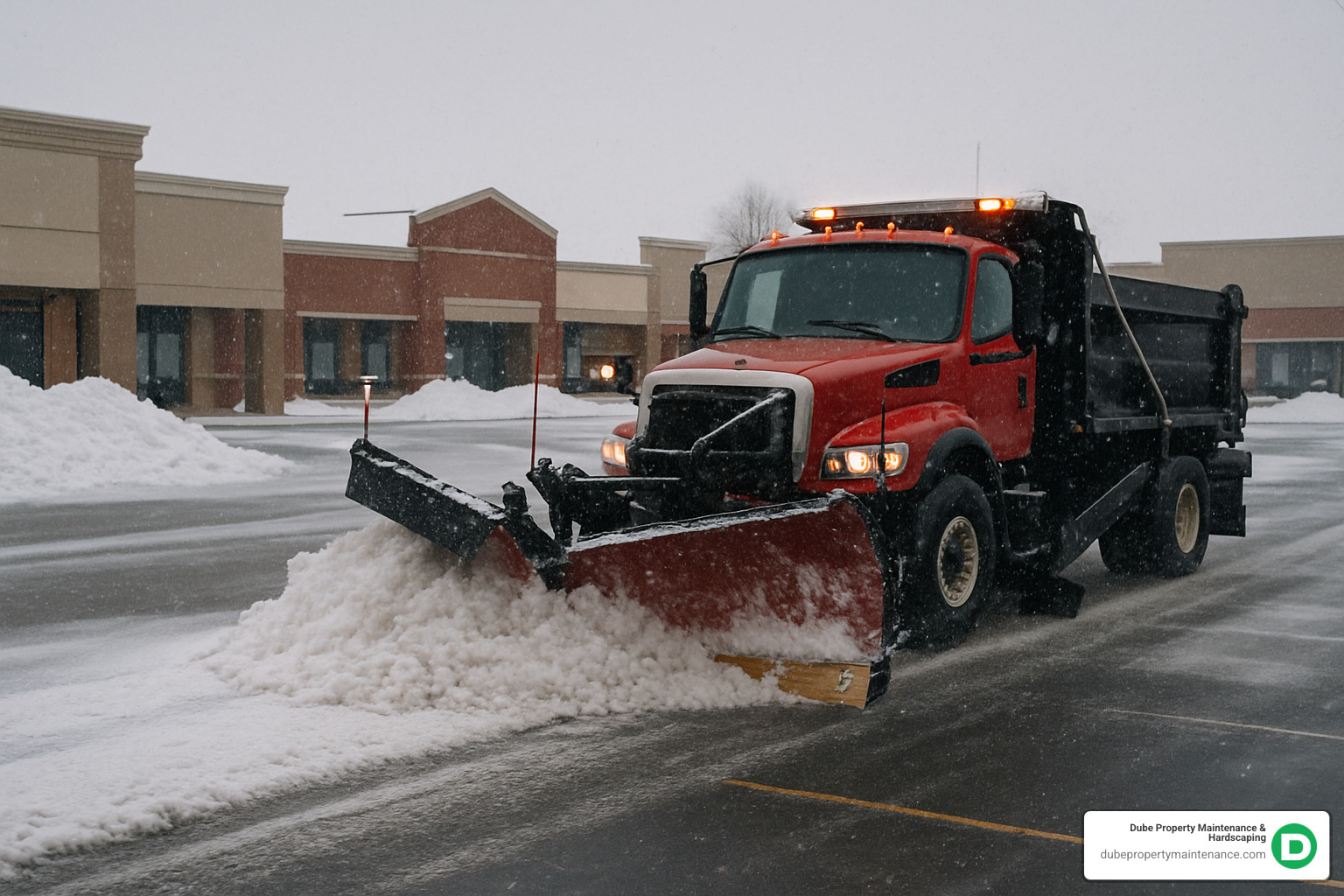
Equipment selection isn’t just about size—it’s about matching the right tool to specific challenges. “We’ve found that a smaller vehicle with the right attachment can sometimes outperform larger equipment in certain settings,” explains our fleet manager. “It’s about maneuverability and technique, not just raw power.”
Before winter even begins, we put our equipment through rigorous maintenance checks, and continue these inspections throughout the season. This includes hydraulic system inspections, cutting edge replacements, engine and transmission servicing, and electrical system testing. Nothing derails a snow removal operation faster than equipment failure during a storm!
For more detailed information on the equipment we use, visit our guide on Commercial Snow Removal Equipment: What You Need to Know.
Modern parking lot snow removal has gone high-tech, with digital tools that improve accuracy, efficiency, and communication. Gone are the days of eyeballing measurements and hoping for the best!
Property measurement platforms like Go iLawn have transformed how we prepare for winter. We can precisely measure parking lot square footage, identify and document obstacles, calculate exact material needs for deicing, and create color-coded service maps for our crews. This level of precision means we arrive prepared with exactly what we need—no wasted materials or trips back to the yard.
Want to see how digital measurement can transform your snow management planning? Get Your FREE 14-Day Trial of Go iLawn.
Weather monitoring systems have also become essential tools in our arsenal. With hyperlocal forecasts for specific properties, automatic alerts for changing conditions, and historical data to improve future planning, we’re never caught off guard by Mother Nature’s surprises.
Perhaps most impressive is how GPS and telematics help our team track real-time equipment location, document exact service times and locations, optimize routes between multiple properties, and verify service completion for billing accuracy. This transparency builds trust with our clients while maximizing our efficiency.
“Digital tools have revolutionized how we prepare for and respond to winter weather,” says our operations coordinator. “What used to take hours of manual measurement and guesswork can now be done with precision in minutes.”
The combination of the right equipment and cutting-edge technology allows us to provide faster, more reliable parking lot snow removal services throughout Massachusetts and New Hampshire, keeping your business accessible and safe all winter long.
Clearing snow is only half the battle in the war against winter—managing ice is where the real safety challenge begins. But there’s a delicate balance between keeping surfaces safe and protecting our environment.
Remember when everyone waited until after a storm to throw down salt? Those days are gone for good reason. Research has revealed something remarkable: anti-icing (treating surfaces before snow falls) is dramatically more efficient than traditional reactive methods.
“When we apply materials before a storm, we use about 75% less product than when we’re fighting ice that’s already bonded to the pavement,” explains our operations manager at Dube Property Maintenance & Hardscaping. “It’s not just better for the environment—it saves our clients money too.”
The numbers don’t lie. Anti-icing typically costs about one-tenth what reactive deicing does when you factor in labor, materials, and reduced slip-and-fall incidents.
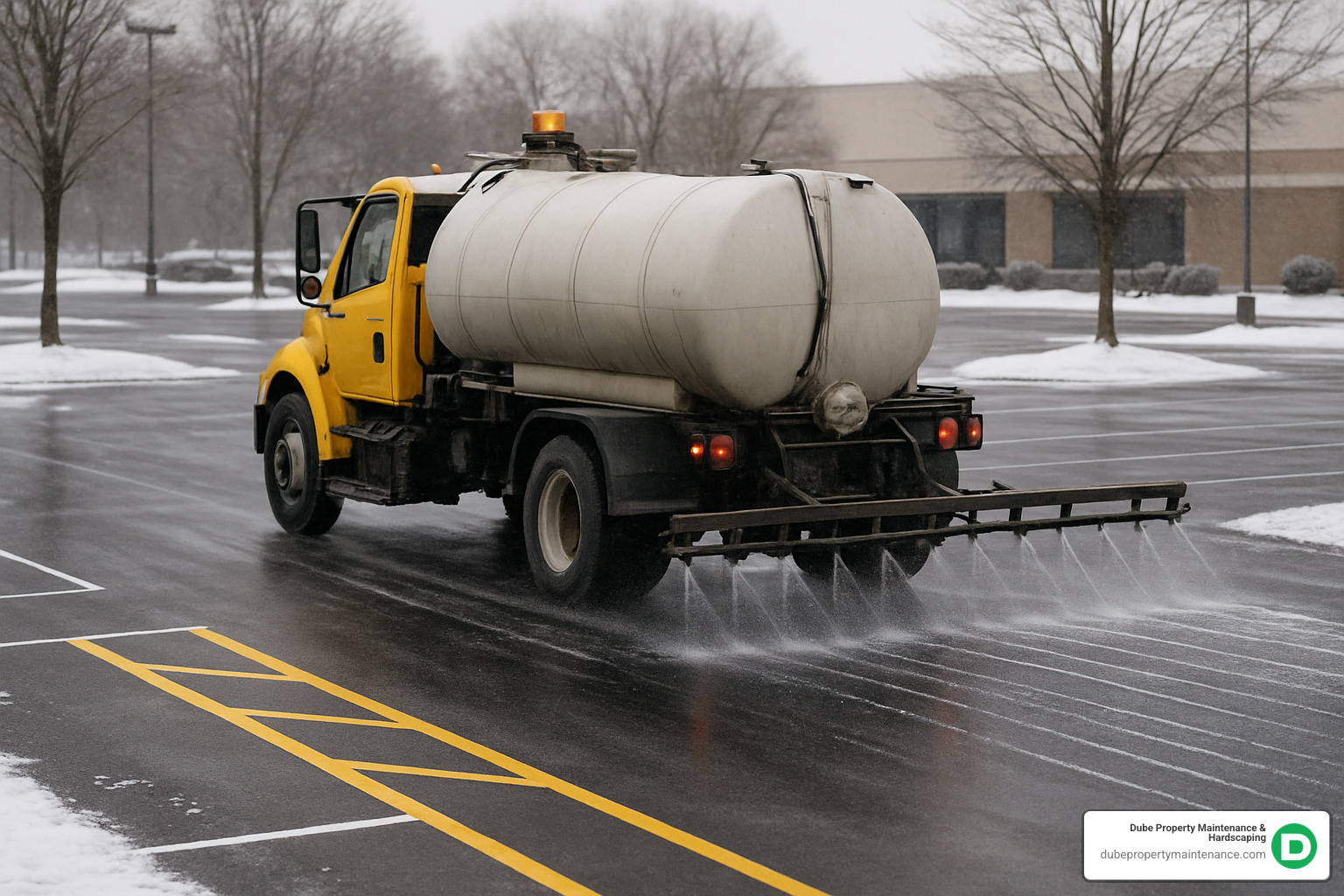
Our comprehensive approach to ice management follows a proven four-step strategy:
First, we apply anti-icing treatments 24-48 hours before expected snowfall. These liquid brine solutions prevent ice from bonding to the pavement in the first place—like putting a non-stick spray on your pan before cooking. We focus these applications on high-traffic areas and critical zones like entrances and walkways.
Second, we prioritize thorough mechanical removal before applying any deicing materials. “Every inch of snow we plow away is snow we don’t have to melt with chemicals,” our team leader often says. This simple approach reduces chemical usage by up to 60%.
Third, we select materials based on actual surface temperature, not just air temperature. This matters tremendously:
– When it’s above 32°F, standard rock salt works perfectly
– Between 15-32°F, we switch to treated salt or calcium chloride
– Below 15°F, specialized blends like calcium magnesium acetate become necessary
Finally, we use calibrated equipment for precision application. Gone are the days of “more is better.” Our spreaders are carefully calibrated to apply just the right amount of material, and we pre-wet solid materials to improve their adhesion and activation while reducing waste.
“The temperature of the pavement, not the air, determines what will work,” explains our ice management specialist. “Using the wrong material is like trying to cut wood with a hammer—expensive and ineffective.”
Our approach aligns with industry best practices outlined in Strategies and Technologies to Keep Parking Lots and Sidewalks Clear of Snow and Ice.
Traditional deicing has a dark side that too few companies acknowledge. Excess salt and chemicals don’t just disappear—they wash into waterways, damage vegetation, and accelerate corrosion of vehicles and infrastructure.
At Dube Property Maintenance & Hardscaping, we’ve made Eco-Friendly Snow Management a core part of our approach. Our environmental commitment includes:
We’ve invested in calibrated equipment that prevents over-application, sometimes reducing salt usage by 30% compared to traditional spreaders. Our team is trained to apply materials only where needed—not broadcasting salt across entire lots when targeted treatment will do.
When conditions allow, we incorporate alternative deicers with lower environmental impacts. These specialized products cost more upfront but cause less damage to landscapes and infrastructure over time.
Proper material storage is non-negotiable at our facilities. All deicing materials are stored under cover on impermeable surfaces to prevent runoff contamination—a requirement of the Minnesota Pollution Control Agency (MPCA) guidelines that we’ve voluntarily adopted.
Our team undergoes annual environmental training to stay current on best practices. “Understanding the ‘why’ behind our methods makes all the difference,” shares our training coordinator. “When our team knows the environmental impact of their work, they take more care with application rates.”
One of our commercial property managers put it best: “We used to think being environmentally responsible meant higher costs. Working with Dube has shown us that precision ice management actually saves money while protecting our property and the environment.”
Let’s talk money and legal stuff—the part of parking lot snow removal that might not be as exciting as watching a plow clear a fresh blanket of snow, but it’s just as important for your business.
When it comes to snow removal costs, there’s a wide spectrum of pricing that depends on several factors: the size of your lot, how quickly you need it cleared, your location, and Mother Nature’s mood that winter.
Here’s what you might expect to pay (and remember, these are average costs based on internet data and not actual costs for Dube Property Maintenance and Hardscaping):
| Service Type | Low Range | Average | High Range |
|---|---|---|---|
| Plow Truck Hourly Rate | $95 | $150-200 | $300-600 |
| Hand Shoveling Hourly Rate | $38 | $65-75 | $120-225 |
| Salt Application (per bag) | $30 | $45-60 | $90-180 |
| Seasonal Contract (small lot) | $3,000 | $5,000-8,000 | $15,000-24,000 |
Why such big ranges? Well, clearing a suburban office park in Methuen is quite different from maintaining a busy shopping center during a Nor’easter. The high-end prices can easily be three times the average depending on your property’s complexity and your service expectations.
When it comes to how you’ll pay, you’ve got options:
Per-push pricing is like paying per visit—you’re charged each time the plows come out. It’s great if you only want to pay when it snows, but your monthly budget might look like a roller coaster ride during snowy winters.
Seasonal contracts are the “all-you-can-plow” buffet of snow removal. You pay one fixed price regardless of whether we get three inches or three feet of snow all season. Your accounting department will love the predictability, even if some winters end up lighter than expected.
Zero-tolerance contracts are the premium option—we’re there continuously ensuring not a single snowflake stays on your pavement. It’s perfect for medical facilities or high-end retailers but comes with a price tag to match the service level.
Hourly rates simply bill for the time spent clearing your property. While transparent, this model doesn’t necessarily encourage efficiency and can make budgeting tricky.
Want to dive deeper into contract options? Check out our guide to Commercial Snow Removal Contract considerations.
The legal side of parking lot snow removal isn’t just fine print—it’s protection for your business and your customers.
Most contracts include hold-harmless clauses that spell out who’s responsible when someone slips and falls. Even with the best snow removal service, understanding where liability falls is crucial. This is why we at Dube Property Maintenance & Hardscaping are sticklers for documentation.
“When it comes to slip-and-fall claims, the photos and service logs we maintain have saved our clients countless headaches,” shares our operations manager. “It’s hard to argue with time-stamped photos showing a freshly cleared lot.”
Local regulations also play a big role. Many towns in Massachusetts and New Hampshire have specific ordinances about:
– How quickly you must clear snow after it stops falling
– Where you can (and definitely cannot) pile snow
– Who’s responsible for sidewalk clearing
– Restrictions on salt and chemical usage
Clear communication is your best friend during winter operations. We establish protocols with each client including:
– Who to contact for emergency clearing
– How service completions will be documented and shared
– 24/7 contact information for both parties
Massachusetts and New Hampshire courts apply “reasonable care” standards to property owners. This doesn’t mean you need to keep your lot perfectly clear during an active blizzard, but it does mean you need to act reasonably promptly once the storm passes.
Q: What is zero-tolerance snow removal?
A: Think of zero-tolerance as the “white glove” service of snow removal. Instead of waiting until the snow reaches a certain depth, our crews continuously clear throughout the storm. This premium approach keeps your surface clear at all times—ideal for hospitals, emergency services, and high-traffic retail locations where any snow accumulation presents safety risks.
Q: How early should I book a snow removal contractor?
A: The early bird gets the plow! By September or early October, the most reliable contractors (like us!) are already filling their winter schedules. Wait until the first forecast of snow, and you might find yourself with limited options or paying premium rates for last-minute service.
Q: Who is liable for slips and falls after snow clearing?
A: This depends on your contract terms and local laws, but generally, property owners retain ultimate responsibility even when hiring contractors. That said, contractors may share liability if negligence can be proven. This is why we document everything—date-stamped photos, detailed logs, and clear communication records protect everyone involved.
Q: Can I just have snow piled anywhere on my property?
A: If only it were that simple! Snow pile placement requires strategic thinking. Improper placement can block visibility, impede handicap access, cover drainage systems, or create hazardous runoff patterns. We carefully select pile locations that comply with local ordinances while minimizing disruption to your operations.
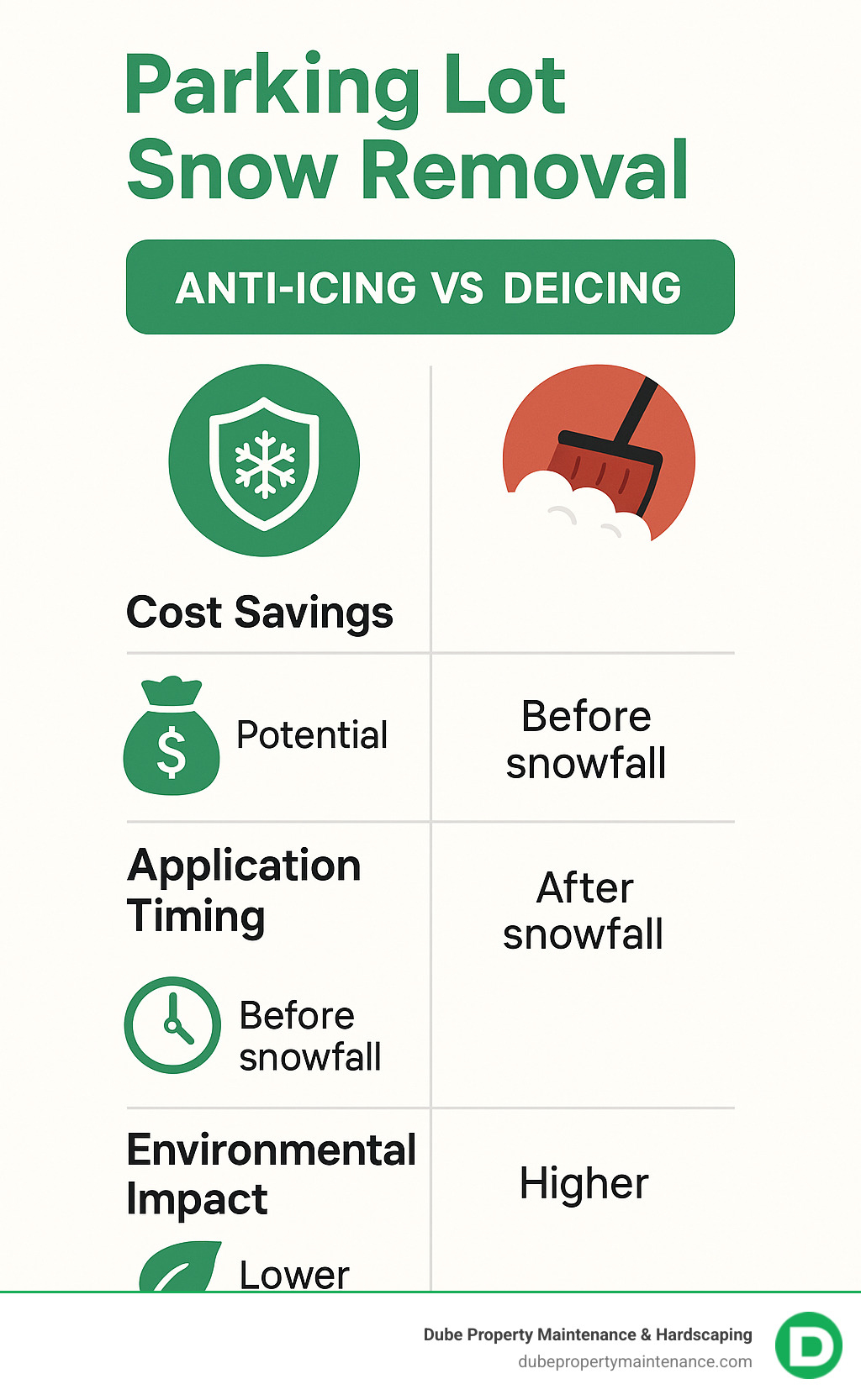
Q: What’s the difference between anti-icing and deicing?
A: Think of anti-icing as prevention and deicing as treatment. Anti-icing happens before snow falls, preventing ice from bonding to the pavement in the first place. Deicing breaks that bond after snow and ice have already accumulated. Anti-icing is typically more cost-effective and environmentally friendly, requiring up to 75% less material than reactive deicing.
Effective parking lot snow removal isn’t just about pushing snow—it’s about creating safe, accessible environments that protect your property, people, and business reputation all winter long. At Dube Property Maintenance & Hardscaping, we’ve learned this through years of serving commercial clients throughout Massachusetts and New Hampshire.
The most successful winter maintenance programs we’ve implemented share five key characteristics that you can adopt too:
Proactive planning makes all the difference. The businesses that thrive during winter storms are those that prepare long before the first snowflake falls. Site mapping, obstacle marking, and designating snow storage areas in advance saves time, money, and headaches when storms hit.
A safety-first approach should guide all your decisions. We’ve found that prioritizing pedestrian walkways, main entrances, and emergency access points dramatically reduces slip-and-fall incidents. 90% of walkway injuries happen with less than 1 inch of snow—it doesn’t take much to create hazards.
Documentation rigor might seem tedious, but it’s your best protection. Our most prepared clients maintain detailed records of all services performed, conditions encountered, and communications exchanged. These records have proven invaluable when addressing questions or, unfortunately, defending against liability claims.
Environmental consciousness isn’t just good for the planet—it’s good business. Using calibrated equipment, targeted applications, and temperature-appropriate materials minimizes environmental impact while often reducing your overall costs. Being a good steward of the environment builds goodwill with customers too.
Clear communication prevents most problems before they start. Establishing expectations and response protocols in advance ensures everyone knows what to expect when winter weather strikes.
We strongly recommend scheduling a preseason walkthrough with your snow removal provider. This brief investment of time allows us to address property-specific concerns and establish clear service expectations before they’re needed. Walking your property together helps identify potential problem areas and opportunities to improve service efficiency.
For more information about our commercial snow management services throughout the Merrimack Valley and beyond, visit our Commercial Snow Management page or contact us directly to discuss your specific needs.
When winter arrives in New England, the difference between struggling through storms and maintaining business continuity often comes down to preparation and partnership. With the right approach to parking lot snow removal, you can keep your business accessible, your liability exposure minimal, and your property protected—no matter what winter brings.