
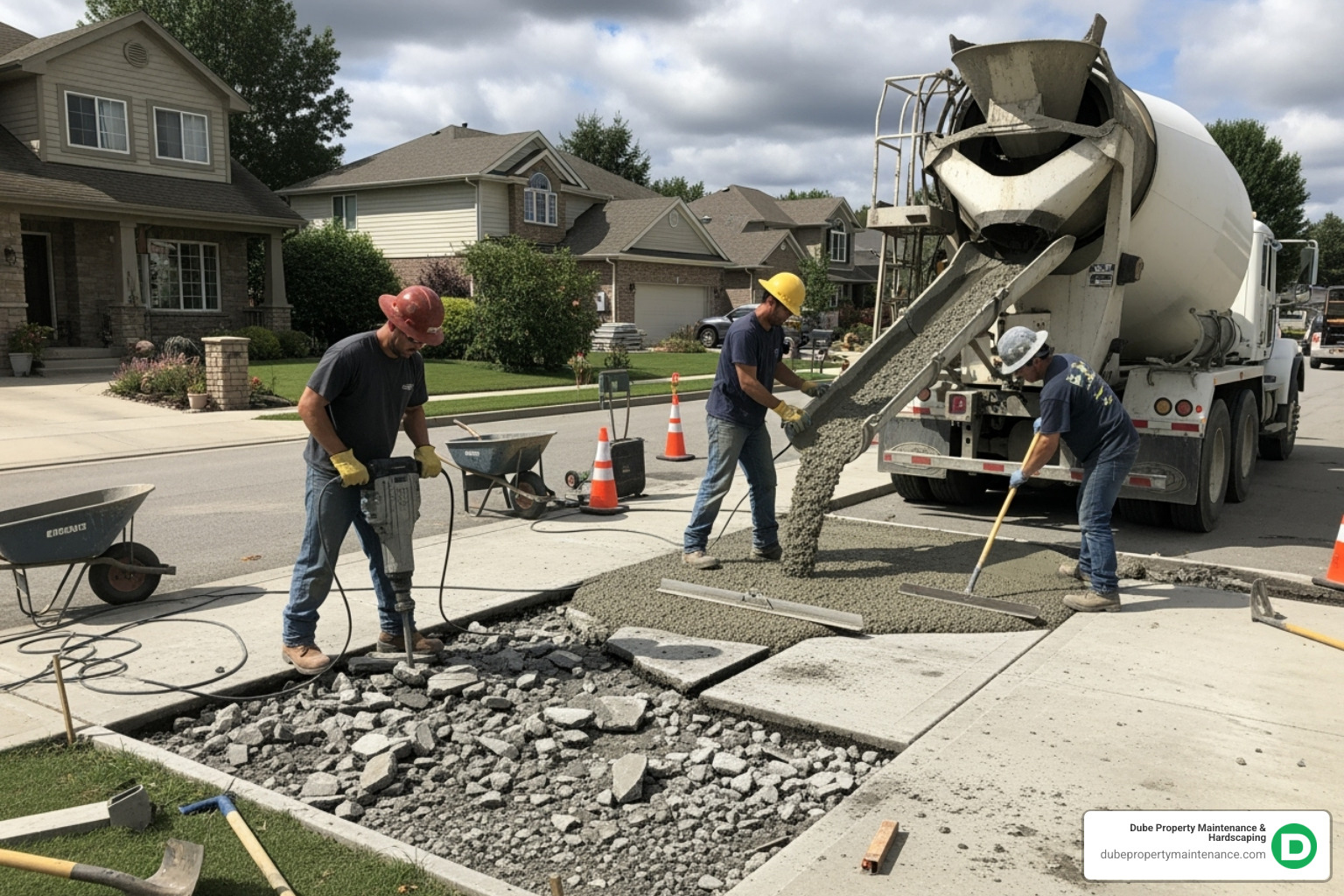
When your driveway shows significant signs of distress, replacement is a smart investment. A cracked, settling, or crumbling driveway isn’t just an eyesore—it’s a safety hazard that can hurt your property value. A new concrete driveway boosts curb appeal, improves safety, and offers long-term durability of 30+ years.
How to replace concrete driveway involves a multi-step process:
This guide walks you through the entire replacement, from deciding if it’s necessary to maintaining your new driveway for maximum lifespan. Understanding the process helps you make informed decisions and know what to expect from your contractor.
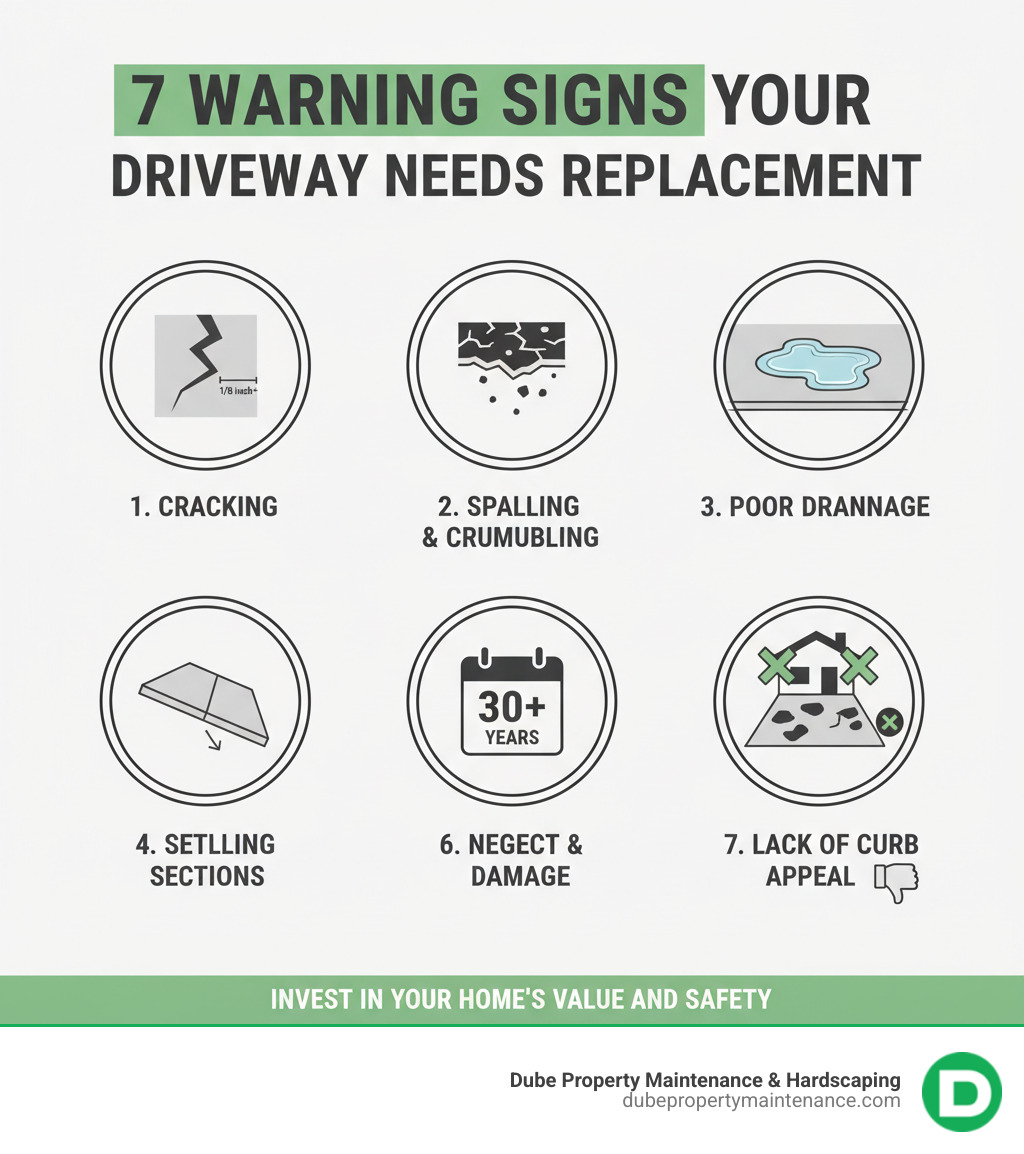
How to replace concrete driveway further reading:
Before deciding on a full replacement, it’s important to determine if a simpler solution might work. Let’s explore when to replace versus when you can repair or resurface.
While minor issues can be fixed, some problems indicate that repairs would be a temporary fix. In these cases, a full replacement is the smarter long-term investment.
For more insights, see 7 Signs You Need Driveway Replacement – Is it Time? and get More info about Concrete Driveway Replacement.
Not every problem requires a full replacement. If your driveway’s issues are mostly cosmetic, you have less expensive options.
However, resurfacing only works on a stable foundation. Applying a new layer over badly cracked or settled concrete is a waste of money, as the new surface will quickly fail. As experts warn, pouring new concrete over bad concrete creates new problems.
For a deeper dive, read our guide: Should I Repair, Resurface, or Replace My Concrete Driveway?
Note: Dube Property Maintenance & Hardscaping specializes in full concrete driveway replacement and installation. For minor repairs or resurfacing, consult a qualified professional to determine if these options are suitable for your situation.
Once you’ve decided on a full replacement, understanding the process is key. This is a significant project requiring specialized equipment and expertise, but when done correctly, it results in a driveway that lasts for decades.
Before our crew arrives, a little preparation ensures everything runs smoothly.

This is the loud, messy, but satisfying phase where the old driveway is removed to make way for the new.

Our crew uses heavy-duty jackhammers, concrete saws, and equipment like skid-steers to break the old slab into manageable pieces. We work carefully to avoid damaging adjacent structures or underground utilities.
Hauling away the debris is a major part of the job. Concrete is extremely heavy, and a standard driveway can require multiple dump truck loads to remove. We manage this entire process, ensuring all debris is disposed of responsibly, often at recycling facilities. We work efficiently to minimize noise and disruption.
Learn more in our Concrete Driveway Removal Guide 2025.
The longevity of your new driveway depends heavily on what’s underneath it. Proper subgrade preparation is a step we never rush.
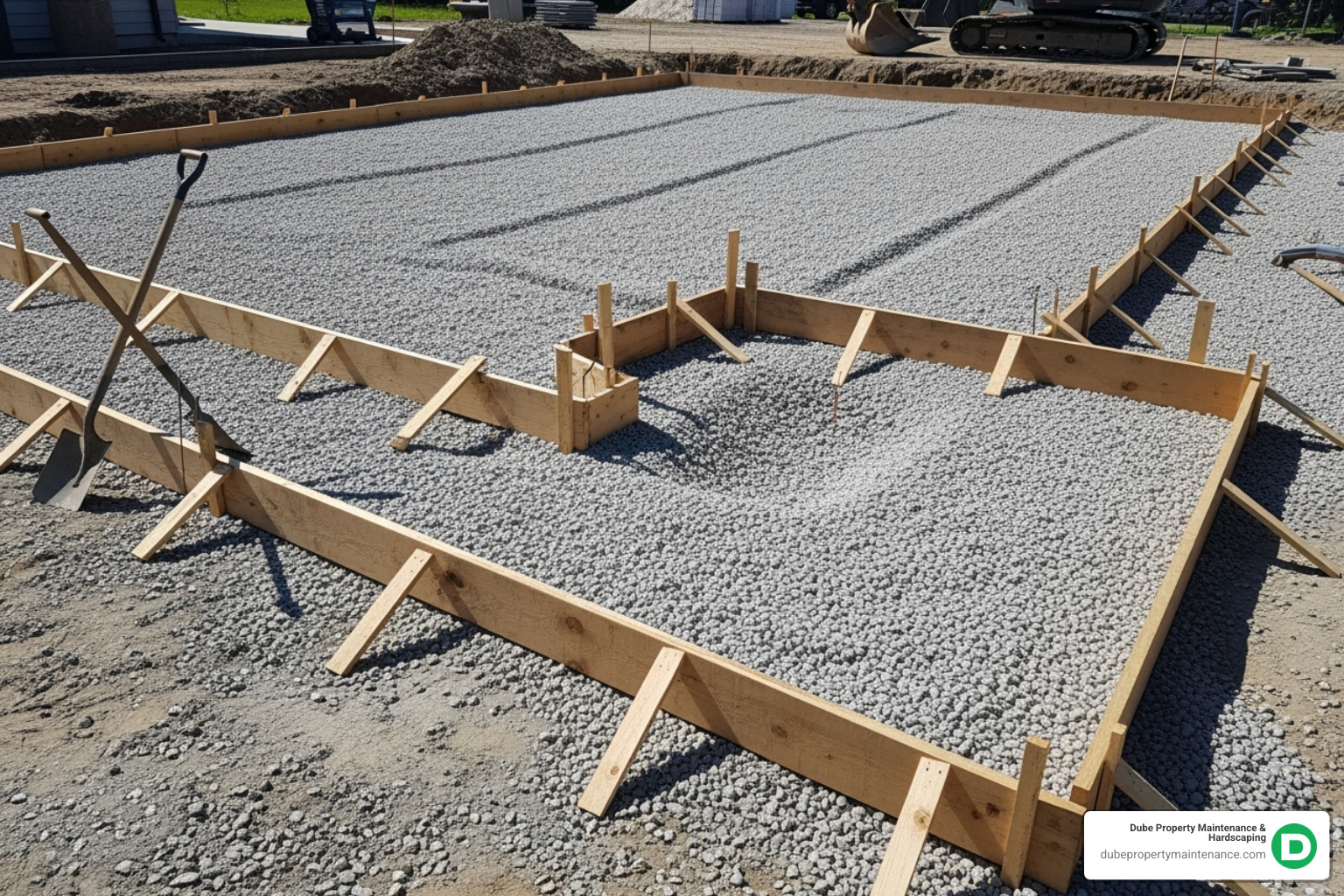
First, we grade the soil to ensure proper drainage, creating a slope of at least 1/4 inch per foot to direct water away from your home. Then, we use plate compactors to create a dense, stable base that won’t settle over time.
Next, we add and compact a 4-inch layer of gravel. This base improves stability and drainage, preventing water from pooling beneath the concrete. With the base prepared, we set wooden form boards to define the driveway’s perimeter and final elevation.
Finally, we install steel reinforcement (rebar or wire mesh) inside the forms. This adds tensile strength, helping the concrete resist cracking from temperature changes and heavy loads. We use rebar “chairs” to hold the rebar in the middle of the slab, ensuring it’s properly embedded.
This is when your new driveway takes shape as liquid concrete transforms into a solid, durable surface.

A ready-mix truck delivers fresh concrete, which our crew guides into the forms. We then screed the concrete to level it and use floats to create a smooth, workable surface.
For traction, we typically apply a broom finish by dragging a special broom across the surface. If you’ve chosen stamped concrete, this is when we press patterns into the surface to mimic stone or brick. Next, we cut control joints—shallow grooves that give the concrete a predetermined place to crack neatly as it expands and contracts.
The final and most critical phase is curing. This is a chemical reaction, not just drying. To ensure the concrete gains maximum strength, we may apply a curing compound to slow water evaporation. Patience is key: you can walk on the surface in 24-48 hours, but you must wait a minimum of 5-7 days before driving on it. Driving on it too soon can cause permanent damage.
For more details, see A Simple Guide To Driveway Concrete Replacement.
A new concrete driveway is a significant investment, so understanding the costs and how to hire the right professional is crucial for a successful project.
The final price for how to replace concrete driveway depends on several factors specific to your project:
Here’s a general comparison of different materials:
| Material Type | Average Cost (per sq ft) | Average 600 sq ft Driveway Replacement Cost | Typical Lifespan | Maintenance Needs (General) |
|---|---|---|---|---|
| Concrete | $6 – $20 | $2,400 – $9,000 | 30-40+ years | Low (cleaning, occasional sealing) |
| Asphalt | $3 – $25 | $750 – $4,000 | 15-20 years | Moderate (resealing every 2-3 years, crack filling) |
| Gravel | $1 – $3 (installation) | $750 – $1,125 | Indefinite | High (leveling, topping off, weed control) |
| Pavers | $10 – $70 | $6,000 – $42,000 | 30-40+ years | Moderate (joint sand, occasional cleaning, re-leveling) |
Note: The “Average Cost (per sq ft)” for gravel refers to installation, while “Average 600 sq ft Driveway Replacement Cost” is based on material tonnage and installation.
For more detailed cost information, explore Cost data from Angi and our guide on the Cost to Remove and Replace Concrete Driveway.
Note: All pricing referenced in this article is based on average internet data and not actual costs for Dube Property Maintenance & Hardscaping. Average costs for concrete driveway replacement can range widely, from $4,000 to $12,000 or more, depending on size, site conditions, and finish options, with the high end being at least 3x the average pricing.
The quality of your contractor is as important as the quality of the concrete. A skilled professional ensures a long-lasting result.

For more guidance, see expert advice from Angi. If you’re in our service area, our Concrete Driveways Near Me page can help.
Congratulations on your new driveway! A little ongoing care will protect your investment and ensure it serves you faithfully for decades.

Proper maintenance starts immediately after installation and continues throughout the life of your driveway.
With proper care, your concrete driveway should easily last 30-40 years or more. This exceptional lifespan makes concrete a smart, cost-effective choice. A little preventive maintenance goes a long way in protecting your investment.
Learn more about protecting your investment on our page about Replacing a Driveway.
Homeowners often have similar questions about how to replace concrete driveway. Here are answers to the most common concerns.
The physical work of demolition, preparation, and pouring typically takes a professional team 2-4 days, depending on the project’s size and complexity. However, the concrete needs to cure. You must wait at least 5-7 days before driving on it. Therefore, you should plan for your driveway to be out of commission for a total of 7-11 days.
While technically possible, we strongly advise against it. If your old driveway is cracked or settling, those problems will transfer to the new layer, causing it to fail quickly. This is because the underlying issue—a poor foundation—has not been fixed. For a long-lasting result, the old driveway must be completely removed and the subgrade properly prepared. Learn more about this common question to understand why shortcuts don’t work.
Spring and fall are the ideal seasons for concrete work. Moderate temperatures, between 50°F and 80°F, are perfect for the concrete curing process. Extreme heat can cause concrete to dry too quickly and crack, while freezing temperatures can cause internal damage that weakens the slab. While an experienced contractor can pour in summer or winter with special precautions, spring and fall offer the best natural conditions for a durable finish.
Replacing a cracked or crumbling driveway is a smart investment in your home’s safety, curb appeal, and long-term value. A professionally installed concrete driveway eliminates hazards, withstands New England weather, and can last 30-40 years with minimal care.
While understanding how to replace concrete driveway is helpful, the execution requires professional skill, specialized equipment, and experience. From proper subgrade compaction to expert finishing, every step is crucial for a long-lasting result. Cutting corners leads to premature failure.
At Dube Property Maintenance & Hardscaping, we provide high-quality concrete driveway installations that stand the test of time. We serve homeowners throughout Methuen, MA, and surrounding communities like Andover, Haverhill, and Salem, NH. Our experienced team manages every detail of your project, ensuring a smooth process and a beautiful, durable result.
Ready to transform your home’s exterior? Get a detailed estimate for your concrete driveway replacement today! Let’s build something that lasts.
