
A geotextile fabric retaining wall uses a synthetic, permeable fabric to improve drainage, prevent soil mixing, and increase structural stability. Placed behind the wall, it separates soil layers while letting water pass through, preventing the buildup of hydrostatic pressure that causes most wall failures.
Key functions of geotextile fabric in retaining walls:
While most people focus on the blocks or stones, the secret to a wall that lasts is what goes behind it. Geotextile fabric is engineered to solve the number one cause of retaining wall failure: water buildup. Without it, even the strongest wall can bow, crack, or collapse.
Properly installed geotextile drainage fabrics can last 50+ years. Made from synthetic polypropylene or polyester, they resist decay, chemicals, and environmental factors. For homeowners in Methuen and surrounding areas, where freeze-thaw cycles and heavy rain are common, this fabric is critical. It protects your investment by managing the water that would otherwise destroy your wall from the inside out.
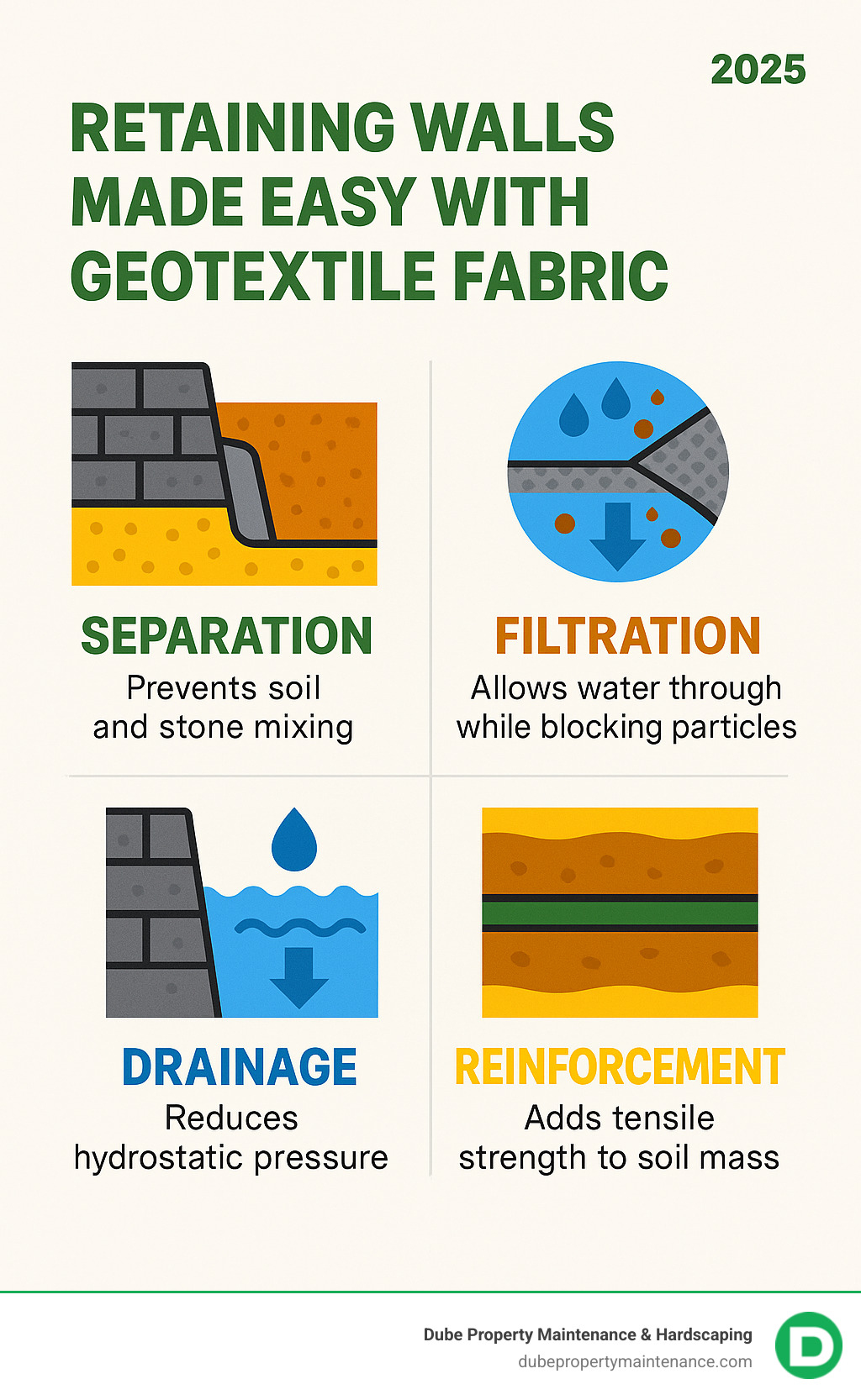
Quick geotextile fabric retaining wall definitions:
When planning a retaining wall, you’ll encounter \”geosynthetics\”—a family of materials designed to improve soil performance. The two most important for a geotextile fabric retaining wall are geotextiles and geogrids. While they may look similar, they serve different purposes, and knowing which you need is key to a long-lasting wall.
Geotextiles are permeable fabrics made from synthetic materials like polypropylene or polyester, often with a soft, felt-like texture. Their primary role is to let water pass through while keeping soil particles in place. This makes them ideal for:
For most residential projects, geotextiles are the workhorse behind the scenes. They are especially crucial in New England’s climate, where freeze-thaw cycles can damage poorly drained walls. For more insights on how different materials work, see our guide on stone retaining walls.
Geogrids are a different tool, made from high-density polyethylene or polypropylene in a lattice or grid structure. While geotextiles manage water, geogrids provide strength and reinforcement. Think of them as rebar for soil.
Their open grid structure interlocks with soil particles, creating a reinforced soil mass. This provides incredible pull-out resistance and soil confinement, preventing backfill from shifting. Geogrids are essential for taller walls (over 3-4 feet) or walls supporting heavy loads, providing the muscle to stand up to significant earth pressures. You can view an enlarged diagram of geogrid use to see how they work.
Here’s the practical takeaway:
For most residential retaining walls under 4 feet, a quality non-woven geotextile is sufficient. For taller walls, poor soil, or heavy loads, geogrids become necessary. Often, the best approach is to use both: geotextile for water management and geogrid for reinforcement, creating a robust wall that will last for decades.
A retaining wall is only as strong as what’s behind it. Geotextile fabric is your wall’s best friend, preventing premature failure from water buildup and soil movement. Building a geotextile fabric retaining wall is like properly insulating a house—it’s a critical step for long-term reliability.
This engineered fabric performs several critical jobs at once:
Investing in a geotextile fabric retaining wall provides compounding benefits:
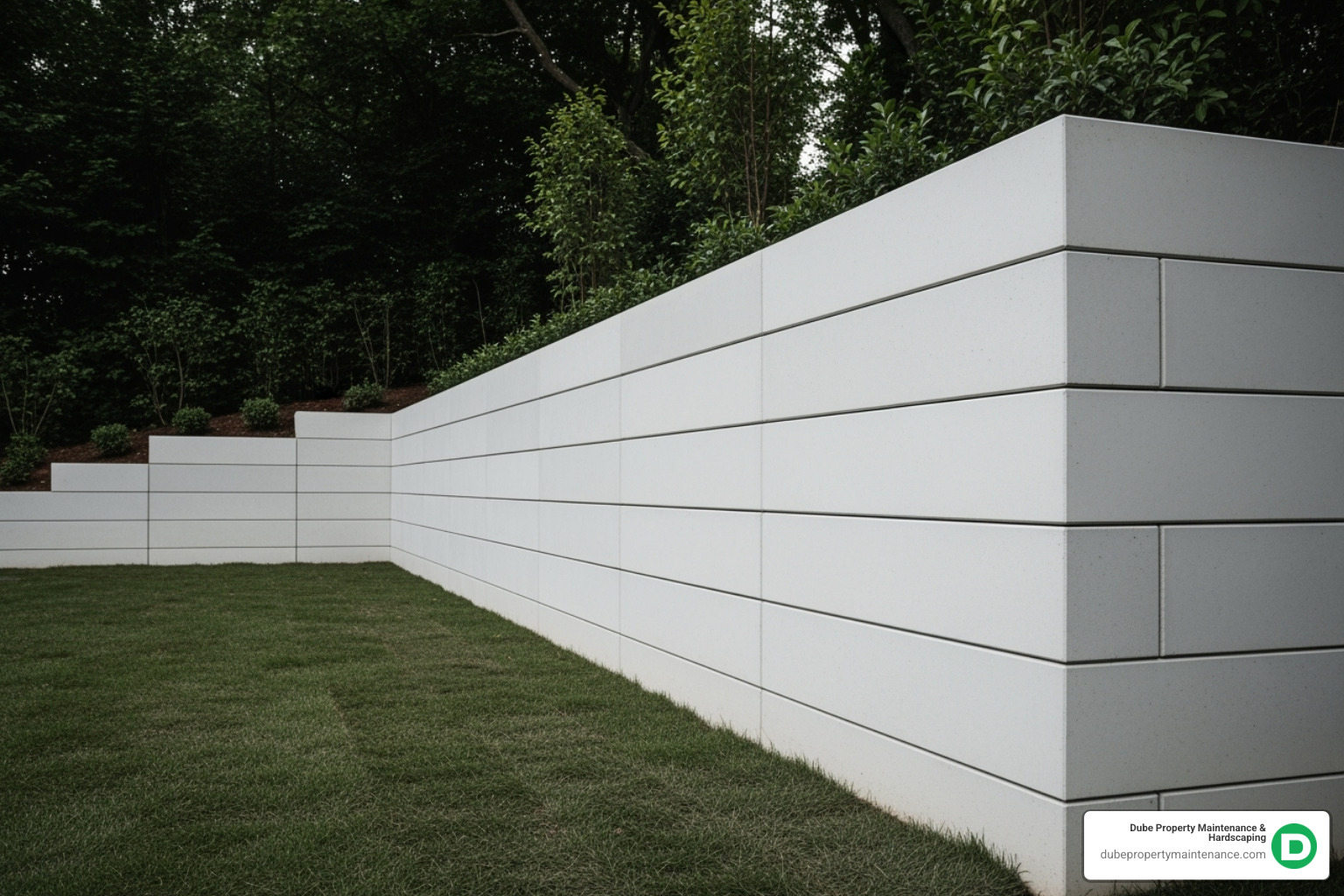
Using geotextile fabric is a best practice that ensures your retaining wall performs effectively for decades. For more on the construction process, explore our guide on building a retaining wall.
Choosing the right geotextile for your geotextile fabric retaining wall is critical. The material must match your project’s needs, such as soil type, wall height, and water flow. A small garden wall has different requirements than a large block retaining wall holding back a slope.
You’ll encounter two main types: woven and non-woven. For retaining walls, non-woven geotextile fabric is almost always the correct choice. Its felt-like structure has high permeability, allowing water to flow through easily while filtering out soil particles—perfect for drainage.
Woven fabrics have high tensile strength but low permeability, making them better for ground stabilization under heavy loads (like driveways) rather than for drainage behind a wall.
| Feature | Woven Geotextiles | Non-Woven Geotextiles |
|---|---|---|
| Strength | High tensile strength | Moderate to high tensile strength, excellent puncture resistance |
| Permeability | Low permeability (water flows over) | High permeability (water flows through) |
| Primary Use | Ground stabilization under heavy loads, separation | Filtration, drainage, separation (behind retaining walls) |
| Cost | Generally more expensive | More cost-effective for drainage applications |
Geotextile fabrics are sold by weight, measured in ounces per square yard. While heavier is often stronger, the goal is to balance strength with water flow.
Key technical specs to look for are tensile strength (at least 200 lbs/in), permittivity (at least 0.05 sec^-1 for good drainage), and UV stabilization if the fabric will be exposed to sunlight during installation. You can view a nonwoven fabric application sheet for more details.
Do not substitute landscape fabric for drainage fabric. Drainage fabric (geotextile) is engineered for construction, designed to handle water pressure and last for decades. Landscape fabric is a thin weed barrier meant for garden beds. Using it behind a retaining wall will lead to rapid failure, as it cannot provide the necessary drainage and separation.
Proper installation is as important as choosing the right material. A high-quality geotextile won’t work if installed incorrectly. The goal is to create a complete drainage system that integrates seamlessly with the wall structure. The following steps outline the professional technique.

This guide uses the \”burrito wrap\” method to encapsulate the drainage stone.
Following these steps ensures your geotextile fabric retaining wall will last. For more tips, see our guide on how to install landscape fabric behind retaining wall.
While geotextile fabric is a game-changer, it’s only as effective as the design and installation. A successful geotextile fabric retaining wall requires understanding soil conditions, proper engineering, and awareness of potential limitations.
Several factors are critical for a wall that will stand for decades:
While we recommend fabric for nearly any retaining wall, it is non-negotiable in these situations:
Here are answers to the most common questions we receive about building a geotextile fabric retaining wall in the Methuen area.
For basic drainage, the fabric should cover the entire drainage zone, extending from the base up the back of the wall. When used for reinforcement, it must extend much further into the backfill to act as an anchor. A common rule is an embedment length of at least 70% of the wall’s height, with a minimum of 3 feet for smaller walls. Skimping on this distance compromises the wall’s stability.
No. This is a critical mistake. Plastic sheeting is impermeable and traps water, creating a \”water balloon\” effect behind your wall. This leads to immense hydrostatic pressure and will cause the wall to fail. Geotextile fabric is specifically engineered to be permeable, allowing water to drain freely while retaining soil. Using plastic guarantees failure and costly repairs.
While not always structurally critical for very small walls (under 2 feet), we still highly recommend it. The fabric prevents fine soil from washing through and staining the face of your wall, keeping it looking clean. It also ensures your drainage stone doesn’t clog over time, extending the wall’s life and appearance. For the small additional cost, it’s a step that provides significant long-term value.
When you’re planning a retaining wall project, it’s easy to focus on the visible elements – the beautiful stone blocks, the perfect curves, the way it will transform your landscape. But as we’ve finded together, the real magic happens behind the scenes with geotextile fabric retaining wall construction.
Think of it this way: you wouldn’t build a house without proper insulation, and you shouldn’t build a retaining wall without proper drainage and soil separation. The geotextile fabric is your wall’s insurance policy against the forces that destroy most retaining walls – water buildup, soil migration, and structural instability.
The benefits we’ve explored aren’t just theoretical. When you invest in a geotextile fabric retaining wall, you’re getting superior stability that prevents the hydrostatic pressure and soil movement that cause wall failure. You’re securing exceptional longevity – we’re talking about a 50+ year lifespan when properly installed. Most importantly, you’re making a cost-effective choice that saves you from expensive repairs and complete rebuilds down the road.
Here in Methuen and the surrounding communities, we see the effects of New England weather on hardscaping projects every day. The freeze-thaw cycles, heavy spring rains, and clay soils common in our area make proper drainage absolutely critical. That’s why we never cut corners on materials or installation techniques.
At Dube Property Maintenance & Hardscaping, we understand that every component matters – from the base preparation to the final cap stone, and especially the geotextile fabric working quietly behind the scenes. Our professional team has the experience to select the right fabric specifications for your specific soil conditions and wall height, then install it with the precision that ensures decades of reliable performance.
We serve residential and commercial clients throughout Methuen, MA, and extend our expertise to Andover, Billerica, Lowell, North Andover, Salem, NH, Windham, NH, and many other communities in our region. Whether you’re planning a small garden wall or a major commercial hardscaping project, we bring the same commitment to quality and attention to detail.
Don’t leave something as important as your retaining wall’s longevity to chance. Partner with professionals who understand that the difference between a wall that lasts 10 years and one that lasts 50 years often comes down to what you can’t see. Contact us for your retaining wall project today, and let’s build something that will stand strong and beautiful for generations to come.

