
Think of geotextile fabric behind retaining wall as the quiet engineer that keeps everything working. Made from polypropylene or polyester, it performs four critical jobs:
Dube Property Maintenance & Hardscaping relies on these benefits to deliver walls that last decades.
| Fabric Type | Permeability | Tensile Strength | Primary Function | Best Use Case |
|---|---|---|---|---|
| Non-woven | High | Moderate | Filtration & Drainage | Behind retaining walls |
| Woven | Low | Very High | Reinforcement | Roads / load-bearing |
| Geogrid | Variable | Extremely High | Soil Reinforcement | Walls 4 ft+ |
| Landscape Fabric | Low | Low | Weed Control | Garden beds |
For retaining walls, choose non-woven fabric with roughly 200 lb/in tensile strength, permittivity ≥ 0.05 sec⁻¹, UV stabilization (70 % strength after 500 h), and a 3-4 oz weight.
A small investment in fabric yields decades of peace of mind.
Proper prep separates a 50-year wall from a 5-year headache. Before the first shovel:
For tall walls or tricky soils, bring in a pro who understands building a retaining wall in New England.
Tools: shovel or mini-excavator, utility knife, 4-ft level, tamper/plate compactor, safety glasses, gloves, tape & string line.
Materials: non-woven fabric (length × height + 20 %), 6–12 in landscape staples, retaining wall blocks, 3/4-in angular gravel (+20 %), 4-in perforated pipe with sock, leveling sand.
That platform is what your wall—and its drainage fabric—will rely on.
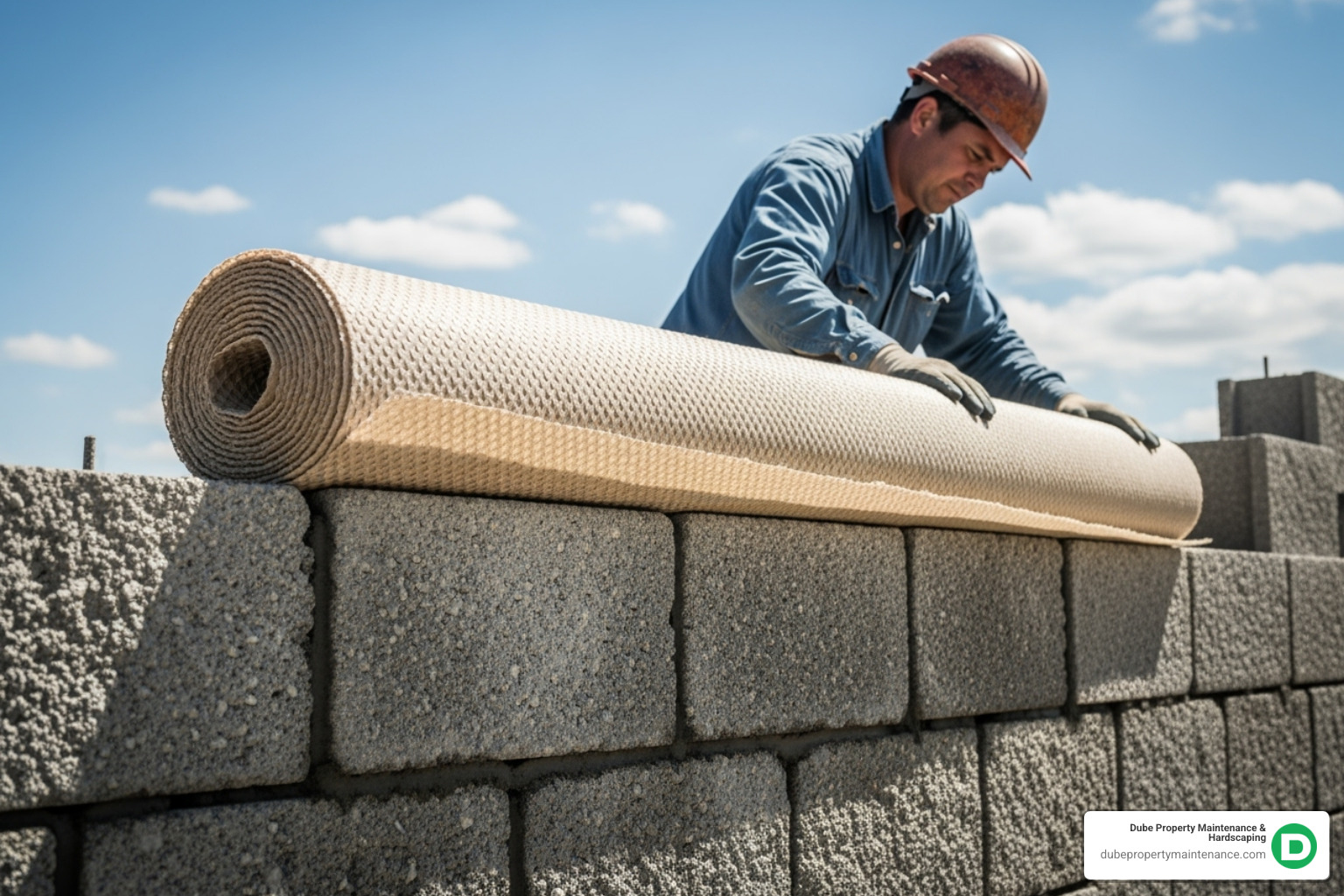
Follow these five concise steps; skip one and you invite failure.
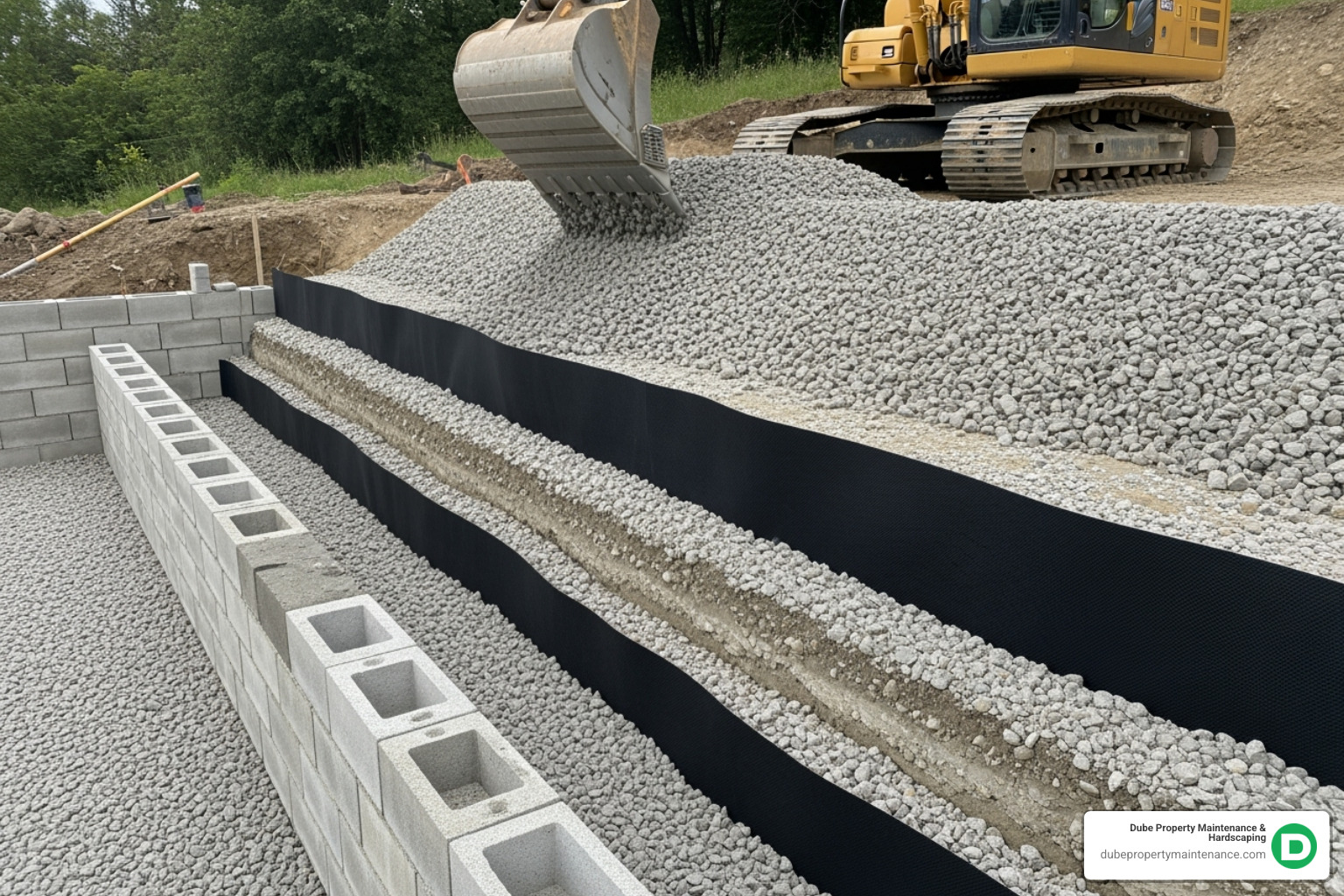
Need more detail? Download full geotex install guide here.
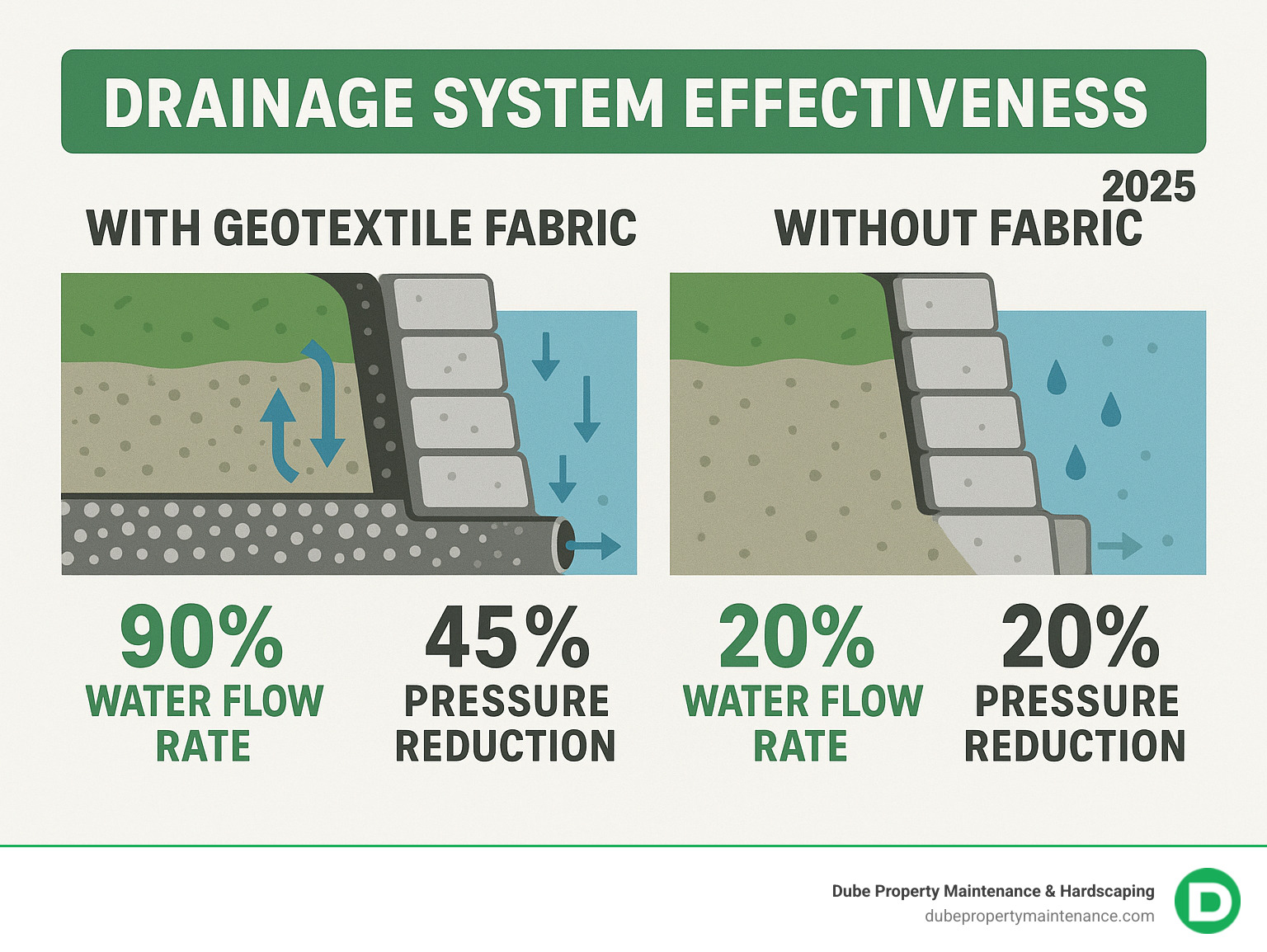
Water weighs 62.4 lb/ft³. Two feet of trapped water behind a 4-ft wall equals 500 lb of sideways force per linear foot—enough to topple walls without drainage.
A complete system = fabric + clean gravel + drain pipe + outlet.
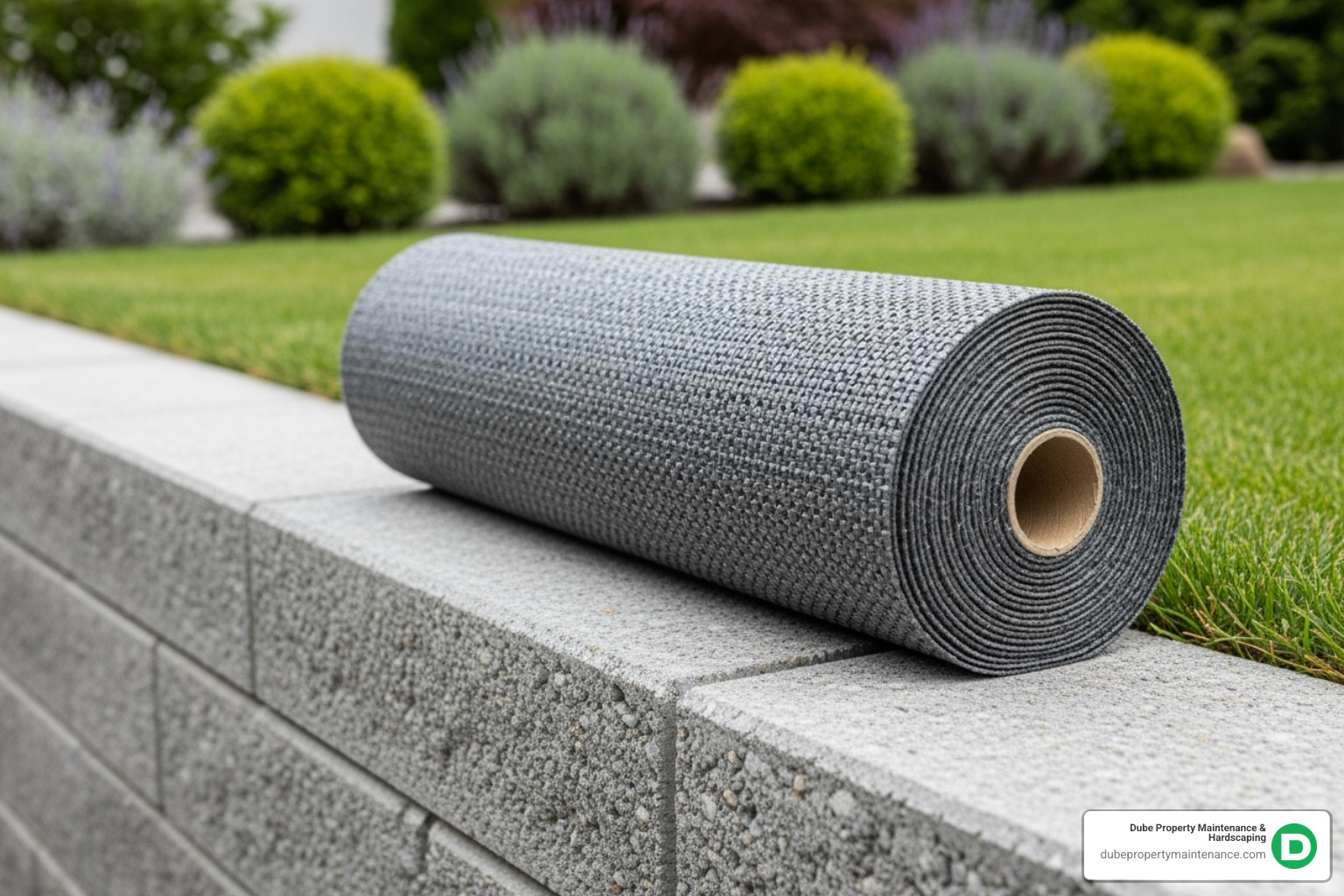
Pick a non-woven fabric with:
Review the detailed specs in the nonwoven fabric application sheet.
Most failures stem from three avoidable errors.
Landscape fabric is for weeds, not walls. Its tight weave blocks water, clogs quickly, and tears under load. Always choose drainage-rated, non-woven geotextile.
Fabric must extend from footing to above the gravel, seams overlapped 6-12 in, and be pinned in place. Short, loose, or poorly overlapped fabric lets soil contaminate the drain field.
Avoid these missteps and you’ll avoid 90 % of the repairs we see across Massachusetts and New Hampshire.
Geotextile fabric behind retaining wall is absolutely the correct placement for drainage and filtration – this is where the magic happens. The fabric should stand vertically against the back of your wall, extending from the base all the way up to above your final gravel height.
Think of it this way: the fabric behind the wall is like a bouncer at a club – it lets the water through but keeps the troublemaking soil particles out of your drainage system. Without this barrier, fine soil particles will gradually wash into your gravel backfill and turn your drainage system into concrete.
You can also place fabric under the base for stabilization and to separate your leveling pad materials from the sub-base soil, but this is really just a bonus feature. The fabric behind the wall is doing the heavy lifting when it comes to preventing drainage failure.
Non-woven, spun-bonded polypropylene fabric is your best friend for retaining wall applications. This type offers excellent water flow (high permeability) while acting like a super-fine strainer that catches soil particles before they can clog your drainage stone.
The key is understanding what you’re not looking for. Woven geotextiles are designed for reinforcement, not filtration – they’re like using a chain-link fence when you need a coffee filter. And please, avoid standard landscape fabric at all costs! That stuff is designed for weed control in flower beds and has terrible drainage characteristics.
Look for fabric with a permittivity rating of at least 0.05 sec^-1 and a tensile strength of 200+ pounds per inch. The 3-4 oz weight range hits the sweet spot for most retaining wall projects.
High-quality drainage fabric is built to outlast most of us – we’re talking 20-50+ years when properly installed and protected. Premium fabrics from established manufacturers can easily last half a century when they’re covered with at least 3 inches of gravel to shield them from UV exposure.
The lifespan really depends on a few key factors: quality of the fabric material you choose, proper installation techniques (no shortcuts!), protection from UV light (burial is key), and your local soil chemistry and environmental conditions.
At Dube Property Maintenance & Hardscaping, we’ve seen walls with properly installed fabric still performing perfectly after decades, while walls without fabric often need major repairs within 5-10 years. That’s the difference between building it right the first time and dealing with expensive failures down the road.
The bottom line? Quality fabric properly installed is essentially a lifetime investment that pays for itself many times over by preventing costly drainage failures.
Installing geotextile fabric behind retaining wall structures isn’t just a good idea – it’s the difference between a wall that lasts 10 years and one that protects your property for 50 years or more. This simple synthetic barrier prevents the silent killer of retaining walls: water pressure buildup that can crack, shift, or topple even the most expertly built structures.
Think of it this way: you wouldn’t build a house without a foundation, and you shouldn’t build a retaining wall without proper drainage fabric. The upfront investment in quality materials and correct installation techniques pays for itself many times over through prevented failures, reduced maintenance costs, and extended lifespan.
The process really comes down to following proven steps: choose non-woven fabric with proper drainage specifications, position it vertically behind your wall from base to top, overlap seams generously, secure everything properly, and backfill with clean gravel instead of soil. Miss any of these steps, and you’re essentially building a water trap instead of a drainage system.
A properly installed block retaining wall with geotextile fabric represents a lasting investment in your property’s value and functionality. We’ve seen countless DIY projects and professional installations over the years, and the ones that follow these principles consistently outperform those that cut corners.
For walls over 4 feet tall, complex soil conditions, or situations where you simply want the peace of mind that comes with professional expertise, working with experienced contractors makes sense. At Dube Property Maintenance & Hardscaping, we’ve installed hundreds of retaining walls throughout Massachusetts and New Hampshire, and we’ve learned that proper fabric installation is what separates successful projects from costly failures.
Whether you tackle this as a weekend DIY project or work with professional hardscaping services, the fundamentals remain the same. Quality materials, attention to detail, and respect for proper drainage principles will reward you with a retaining wall that stands strong through decades of New England weather.
Your retaining wall is only as reliable as its drainage system – and geotextile fabric behind retaining wall installations ensures that system never fails. When you see your wall standing straight and strong years from now, you’ll know you made the right choice to do it properly from the start.
