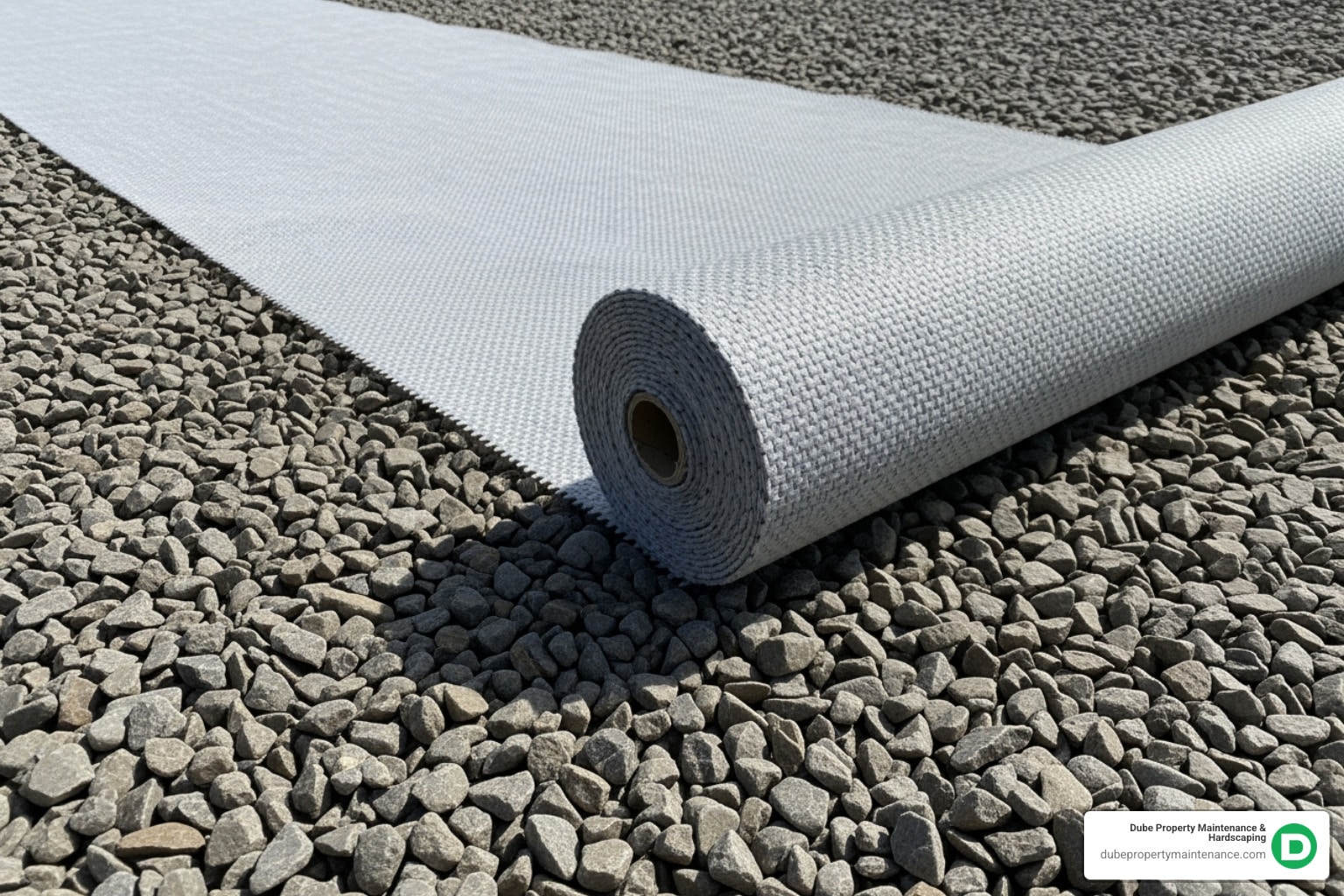

Geo fabric cloth is a permeable textile material used in construction and landscaping to stabilize soil, control weeds, and improve drainage. These engineered fabrics, typically made from polypropylene, serve five primary functions: separation, filtration, reinforcement, drainage, and protection.
Quick Guide to Geo Fabric Cloth:
| Type | Best For | Weight Range |
|---|---|---|
| Non-Woven | Drainage, filtration, weed control | 2oz – 16oz |
| Woven | Soil stabilization, driveways, roads | 4oz – 8oz (specified by tensile strength) |
| Monofilament | High-flow drainage, filtration | Varies by application |
Common Applications:
Before geotextiles became widely available, builders struggled with a common problem: expensive gravel sinking into soft subsoil, creating what was described as “100 lbs of mud.” This led to costly repairs. Today, geotextiles offer reliable solutions for preventing soil mixing, controlling erosion, and extending the life of hardscaping projects.
For property owners in Methuen, MA, facing harsh winters and drainage challenges, understanding geotextiles leads to smarter choices for long-lasting outdoor spaces. Whether for a new driveway, French drain, or retaining wall, the right geo fabric cloth is an invisible foundation that protects your investment for decades.
Geo fabric cloth vocabulary:
Most geotextiles are made from polypropylene, a tough synthetic material resistant to moisture and chemicals, designed to last for decades underground. The fabric’s performance depends on its construction. The two main types, woven and non-woven, are engineered for different jobs, and choosing the correct one is critical for a project’s long-term success.

Woven geotextiles are created by interlacing strips of polypropylene film or monofilament threads on industrial looms. The result is a material with exceptional tensile strength, allowing it to handle significant pulling and stretching forces without tearing.
Woven fabrics are the workhorses when you need raw strength. Their tight weave creates a relatively impermeable barrier, though water can still pass through at a controlled rate. But drainage isn’t their main job. These fabrics excel at keeping different soil layers from mixing and spreading heavy loads across weak ground so your driveway doesn’t turn into a muddy disaster after one winter.
Woven geo fabric cloth is used when a project demands strength. For driveways and roads, it creates a stable foundation that prevents gravel from sinking into subsoil. Its high tensile strength (often 200 lbs or more for commercial grades) is essential for reinforcing unstable ground or distributing structural weight, providing decades of stabilization for roads and paver installations.
Within the woven category, you’ll find two main types. Slit-film wovens use flat polypropylene tapes, while monofilament versions use individual extruded threads. Monofilament fabrics offer better dimensional stability and slightly higher water flow compared to slit-film, giving you a bit more flexibility when your project needs both strength and some filtration capability.
While woven fabrics provide strength, non-woven geotextiles are filtration and drainage specialists. Instead of being woven, they are made through a needle-punching process that tangles polypropylene fibers into a thick, felt-like material. This gives it a soft, fuzzy feel compared to the smooth, plastic texture of woven fabric.
This construction creates countless tiny pathways for water to flow freely while trapping soil particles, much like a coffee filter for the ground. This makes non-woven geo fabric cloth essential for any project where water management is the priority.
We install non-woven fabrics in French drains more than anywhere else. Wrapped around drainage gravel, they keep soil from washing into the stone and clogging the system. In garden beds, they work beautifully under mulch for weed control—blocking sunlight to prevent weed growth while still letting water, air, and nutrients reach your plants’ roots. They also excel at separating different soil layers and providing cushioning protection under pond liners to prevent punctures from rocks.
Non-woven fabrics come in different weights measured in ounces per square yard. A lightweight 2oz fabric offers maximum water flow but won’t hold up to heavy foot traffic. A mid-weight 4oz or 6oz strikes a nice balance for most residential landscaping. Heavy-duty 8oz or heavier fabrics provide serious durability and puncture resistance for demanding applications, though water flows through them slightly slower. We stock options ranging from 2oz up to 16oz depending on what your project demands.
Picking the right geo fabric cloth requires matching the fabric’s capabilities to your project’s specific needs. When we’re evaluating options, several key specifications guide our decision.
Tensile strength tells you how much pulling force the fabric can withstand before tearing, measured in pounds. This matters most for stabilization work—if you’re building a driveway or reinforcing a slope, you need fabric that won’t fail under load. Woven fabrics typically shine here, with commercial grades offering 200 lbs or more of tensile strength.
Permeability measures how quickly water passes through the fabric, expressed in gallons per minute per square foot. High permeability is critical for drainage applications where you want water moving freely. Non-woven fabrics excel in this department, with their porous structure allowing rapid water flow while filtering out soil particles.
Weight serves as a quick indicator of a non-woven fabric’s overall toughness. Our most common weights are 2oz, 4oz, and 8oz per square yard, though specialized applications might call for fabrics up to 32oz. Heavier generally means stronger and more puncture-resistant, but it also means slightly reduced water flow.
Roll sizes vary widely to accommodate different project scales. You might find small 3×50 foot rolls perfect for a garden bed project, or massive commercial rolls measuring 5.3 feet by 330 feet covering 1,750 square feet for larger installations.
Here’s how woven and non-woven fabrics stack up against each other:
| Property | Woven Geotextiles | Non-Woven Geotextiles |
|---|---|---|
| Strength | High—excellent for reinforcement and stabilization | Moderate to high—good puncture resistance and cushioning |
| Permeability | Low to moderate—primarily for separation | High—excellent for filtration and drainage |
| Texture | Smooth, plastic-like with visible weave pattern | Soft, felt-like with random fiber network |
| Best Use | Driveways, roads, heavy load support, soil separation | French drains, weed control, erosion control, cushioning |
The goal is always finding the fabric that does exactly what your project needs without paying for features you won’t use. If you’re standing in the aisle at the store scratching your head, give us a call. We’ve installed enough geotextile over the years to know which fabric will work best for your specific situation.
While common in landscaping, geo fabric cloth is also a critical component in major infrastructure. From highways to water treatment facilities, geotextiles work behind the scenes to keep everything stable and functional. They solve long-standing engineering challenges by preventing soil layers from mixing, filtering water without clogging, and providing stability that ensures infrastructure lasts for generations.

A common issue with new gravel driveways is the rapid formation of ruts and dips. This is the problem geo fabric cloth solves, and it’s why Massachusetts DOT specifications now require these fabrics for subgrade stabilization.
The issue is simple physics. When you place clean, expensive gravel directly onto soft subsoil, those two layers want to become one muddy mess. Your aggregate slowly sinks into the softer ground below, especially under the weight of vehicles. What started as a crisp, stable surface becomes uneven, rutted, and structurally compromised.
This is where the separation function of geotextiles becomes invaluable. A woven fabric placed between your sub-base soils and granular layers creates a firm barrier that keeps everything in its place. The aggregate stays clean and effective at distributing weight, while the subsoil stays where it belongs. The result is a driveway or road surface that resists rutting, maintains its shape, and can last decades longer than one built without this crucial layer.
For heavy-duty applications like driveways that see regular vehicle traffic, woven geotextiles with high tensile strength ratings are the professional choice. These fabrics can handle significant loads without tearing or stretching, making them perfect for extending pavement life. Products like Woven Geotextile for Driveway Stabilization are specifically engineered for this kind of long-term performance, offering the commercial-grade strength needed to prevent those disappointing ruts and dips.
Poor drainage can lead to flooded basements, waterlogged lawns, and failing retaining walls. For drainage systems that last, non-woven geo fabric cloth is essential.
Think about how a French drain works. You dig a trench, fill it with gravel, and install a perforated pipe to carry water away. Simple enough. But here’s the catch: without a protective filter fabric, soil particles will gradually wash into that gravel, filling the spaces between stones and eventually clogging the whole system. What should be an open drainage channel becomes a compacted, useless mess.
Non-woven geotextiles solve this problem beautifully. Their felt-like structure allows water to permeate freely while preventing soil erosion and blocking fine particles from migrating into your drainage system. The fabric essentially acts as a sophisticated filter, letting the water through while keeping the dirt out. This means your drainage system stays clear and functional for decades, not just seasons.
We use non-woven fabrics to complement drainage systems in several critical applications. In French drains, they’re wrapped around the gravel to maintain clear pathways for water flow—our guide on Filter Fabric for French Drain covers this in detail. Behind retaining walls, these fabrics allow water to drain through while holding back soil, preventing dangerous hydrostatic pressure buildup that could cause the wall to fail. You can learn more in our Filter Fabric Retaining Wall Guide and our articles on Geotextile Fabric Retaining Wall and Geotextile Fabric Behind Retaining Wall. In larger environmental projects, these same fabrics handle landfill leachate collection, filtering contaminants from water in waste management systems.
The bottom line? Proper filtration isn’t optional—it’s what separates drainage systems that work from expensive failures that need to be dug up and rebuilt.
Sometimes the most important work happens where no one can see it. In wastewater treatment lagoons, retention ponds, decorative water features, and landfills, geomembrane liners create a waterproof barrier that prevents contamination and leakage. These liners are incredibly effective, but they have one vulnerability: they can be punctured by sharp rocks or coarse aggregate used in construction.
A single puncture in a pond liner or landfill membrane can lead to significant environmental problems and costly repairs. This is where geo fabric cloth steps in as a protective cushion. Placed directly under or above the geomembrane, the fabric acts as a buffer layer that absorbs and distributes stress from any sharp objects. It’s like putting a protective pad between your expensive liner and anything that might damage it.
This protective function might seem simple, but its impact is profound. In ponds and lagoons, it means your water feature stays leak-free for years. In landfills, it helps prevent contamination of groundwater—a critical environmental safeguard. The fabric essentially adds an insurance layer that dramatically reduces puncture risk, ensuring these containment systems maintain their integrity over the long term.
It’s one more example of how these unassuming fabrics contribute to both practical construction needs and environmental protection. Whether stabilizing a highway, keeping a drainage system flowing, or protecting sensitive liners, geotextiles are working quietly to make our infrastructure more reliable and our environment safer.
Choosing the right geo fabric cloth is key to successful landscaping and hardscaping. These fabrics work beneath the surface to ensure garden beds, driveways, and retaining walls look great and last for years. Let’s explore the best options for common home and garden projects.

Non-woven geotextiles are an excellent solution for weed control and drainage in garden beds. For projects like French drains, garden beds, or areas under mulch where you need water to flow freely while keeping weeds in check, a mid-weight non-woven fabric is your best friend. We typically recommend fabrics in the 4oz or 6oz range. This weight hits the sweet spot between durability and water flow. A 4oz non-woven fabric, for example, is particularly popular for French drains because it balances toughness with excellent permeability.
The benefits are hard to beat. The porous, felt-like structure allows water, air, and nutrients to reach your plants’ roots, preventing that soggy, waterlogged soil that nobody wants. At the same time, it blocks sunlight from reaching weed seeds below, stopping most weeds before they even start. While no fabric is completely weed-proof—some determined weeds might find a way through or sprout on top of your mulch—it dramatically reduces the time you’ll spend weeding and eliminates the need for harsh herbicides. Plus, it keeps your topsoil, mulch, or decorative gravel nicely separated from the subsoil underneath, maintaining that crisp, clean look you’re after.
A solid choice for these applications is Mid-weight Non-Woven Fabric for Landscaping, which delivers reliable performance for most residential projects.
The secret to a driveway or pathway that remains smooth and stable for years is a properly installed geo fabric cloth underneath. It’s the key difference between a surface that lasts for decades and one that fails within a few seasons.
When you’re stabilizing under gravel, pavers, or any aggregate surface that will see vehicle traffic or heavy foot traffic, you need serious strength. Heavy-duty woven geotextiles are typically our go-to recommendation here. Their superior tensile strength effectively spreads loads and prevents your expensive aggregate from mixing with the softer subgrade below. Alternatively, a thick non-woven fabric—like an 8oz option—can also provide excellent stabilization and separation, especially for lighter-duty applications like garden pathways.
Installation matters just as much as fabric choice. Start by preparing your ground properly: grade and compact the subgrade, and remove any large rocks, roots, or debris that could puncture the fabric. When you unroll your chosen geotextile, make sure it lies flat and taut, without wrinkles that could create weak spots. Overlap adjacent rolls by at least 6 to 12 inches (or follow the manufacturer’s specific recommendations) to create a continuous barrier that prevents soil from sneaking through the seams.
Secure everything with landscape staples every few feet along seams and edges to keep the fabric in place while you work. Finally, cover the fabric immediately with your gravel or paver base material—this protects it from UV damage and keeps it where it belongs.
Follow these steps, and you’ll create a stable, long-lasting foundation that minimizes maintenance headaches and maximizes your outdoor enjoyment.
Retaining walls are hardworking structures that manage soil and water on slopes, and controlling erosion is essential for protecting property. Geo fabric cloth plays a crucial role in both scenarios.
When you’re stabilizing soil on slopes, providing filtration behind retaining walls, or preventing erosion in vulnerable areas, a heavy-weight non-woven geotextile is often your best bet. We typically recommend 8oz and heavier fabrics for these demanding applications. The robust, felt-like texture provides excellent puncture resistance and cushioning, while the high permeability ensures water can pass through freely—exactly what you need behind a retaining wall or under erosion control materials.
The benefits are significant. On slopes, the fabric helps bind soil together, preventing it from washing away during heavy rains or windstorms. This is particularly effective under rip-rap or other rock armoring on shorelines, where that 8oz weight (or heavier) provides the durability these harsh conditions demand. You can find robust options like Heavy-duty Non-Woven Fabric for Erosion Control that stand up to these challenges.
Behind retaining walls, the fabric prevents dangerous hydrostatic pressure by allowing water to drain away instead of building up against the wall. This simple function can prevent serious structural damage and extends the life of your investment. This complements our work in retaining wall installations and ensures structures like geotextile bag retaining walls perform as designed for years to come.
By separating the backfill from native soil, the fabric also ensures that the drainage layer behind your wall stays free-flowing and effective. This is a critical step whether you’re learning how to install landscape fabric behind a retaining wall or working with a geotextile fabric retaining wall. Even for dry stack walls, proper fabric installation matters—check out our guide on geotextile fabric behind retaining wall or explore whether you need filter fabric for dry stack retaining wall projects.
Here are answers to common questions about using geo fabric cloth effectively.
No, plastic sheeting is not a suitable substitute. Plastic is impermeable, trapping water and suffocating soil, which leads to a waterlogged mess that harms plants and compromises drainage. In contrast, geotextiles are permeable, allowing water and air to pass through while filtering soil. This is essential for healthy soil, proper drainage, and preventing pressure buildup behind retaining walls. Using plastic will likely cause project failure and require redoing the work.
The lifespan of geo fabric cloth depends on the fabric type, weight, and sun exposure. High-quality polypropylene geotextiles are very durable and can last over 50 years when properly installed and buried, protecting them from UV degradation. Direct sunlight is the primary cause of degradation, so it’s crucial to cover the fabric promptly after installation. While most fabrics have UV stabilizers, this protection is only temporary. Heavier fabrics (8oz and up) are generally more robust and puncture-resistant, contributing to a longer lifespan. When installed correctly, geotextiles will outlast most other project components.
Finding geo fabric cloth is easier than you might think. Online retailers like Amazon offer an extensive selection of geotextile fabrics from various manufacturers, with options ranging from lightweight 2oz garden fabric to heavy-duty 16oz commercial-grade material. You’ll find products in different roll sizes to match your project scale, and customer reviews can help you gauge real-world performance.
Big-box home improvement stores like Home Depot and Lowe’s typically stock basic landscape fabric options. Their selection tends to focus on lighter-weight non-woven varieties suitable for garden beds, weed control, and light landscaping projects. While convenient for smaller jobs, you might not find the heavy-duty options needed for driveways or retaining walls.
For larger projects or when you need specific technical specifications, specialty landscaping and construction supply companies are your best bet. These suppliers carry professional-grade materials, can provide detailed spec sheets, and often have knowledgeable staff who can help you select the right product for your application. Our team at Dube Property Maintenance & Hardscaping can also point you in the right direction for professional-grade materials and help you understand exactly what specifications your project requires.
When shopping, always consider your project’s specific needs for tensile strength, permeability, and durability. Don’t hesitate to ask for technical specifications – a few minutes of research upfront can save you from headaches and do-overs down the road.
As we’ve covered, understanding the difference between woven and non-woven fabrics is key to the success of your outdoor projects. Whether building a driveway that won’t rut or a French drain that keeps your basement dry, the correct geo fabric cloth is essential.
Think back to that old construction problem we mentioned: “50 lbs of stone plus 50 lbs of mud equals 100 lbs of mud.” That’s exactly what happens when you skip the geotextile or choose the wrong type. But when you understand how these fabrics provide separation, filtration, reinforcement, drainage, and protection, you’re already miles ahead in creating outdoor spaces that stand the test of time.
The key is matching the fabric to your specific needs. Woven geotextiles bring the muscle—they’re your go-to for stabilizing driveways and distributing heavy loads. Non-woven geo fabric cloth offers the finesse—allowing water to flow freely while keeping soil and debris exactly where they belong. Neither is “better” than the other; they’re simply designed for different jobs.
For property owners in Methuen, MA, and the Merrimack Valley, these choices are critical. New England’s freeze-thaw cycles, heavy rains, and nor’easters put immense stress on outdoor structures. Using the right materials from the start means fewer repairs and more years of enjoying your investment.
At Dube Property Maintenance & Hardscaping, we’ve seen how proper material selection transforms projects from temporary fixes into permanent solutions. Our team doesn’t just install beautiful patios, walkways, retaining walls, and driveway pavers—we build them on foundations that actually work. That means choosing the right geo fabric cloth for each unique situation, preparing the ground properly, and installing everything according to industry best practices.
The most beautiful paver patio or the most neat outdoor kitchen is only as good as what’s underneath it. Those hidden layers—the ones nobody sees once the project is finished—are what separate a job that lasts five years from one that lasts fifty.
Ready to build something that lasts? Whether you’re planning a major hardscaping project or tackling drainage issues that have been plaguing your property, we’re here to help. Contact us for your next hardscaping project and let’s create an outdoor space you’ll enjoy for decades to come.