
First impressions count in business, and your driveway is often the first thing customers see. A well-designed commercial driveway doesn’t just look good—it speaks volumes about your attention to detail and commitment to quality.
When we talk about Driveway Installation for commercial properties, we’re talking about an investment that directly impacts your curb appeal, traffic flow, and operational efficiency. That cracked, potholed entrance? It’s silently turning away potential customers before they even park.
“I’ve seen businesses transform their entire image just by upgrading their driveway,” says John from our team. “It’s like putting on a fresh suit before an important meeting—people notice.”
Driveway Installation for commercial properties is a different animal compared to residential projects. Your business driveway needs to handle heavy delivery trucks, accommodate high traffic volumes, and maintain its appearance through years of use. Plus, it needs to be built with scalability in mind as your business grows.
Here’s what you should know about commercial driveway materials:
| Material | Average Cost Per Sq. Ft. | Typical Lifespan | Best For |
|---|---|---|---|
| Asphalt | $7-$39 | 15-20 years | High traffic, cost-efficiency |
| Concrete | $4-$45 | 30-40+ years | Durability, customization |
| Gravel | $1.25-$5.40 | 5-10 years (with maintenance) | Budget constraints, temporary solutions |
| Pavers | $10-$70 | 25-50+ years | Aesthetic appeal, permeability |
Note: These figures represent average costs based on internet data, not actual pricing from Dube Property Maintenance and Hardscaping.
The foundation of your driveway is where quality truly matters. As our project manager often says, “Nothing beats a properly engineered foundation when it comes to commercial driveway longevity. The sub-base preparation is where most installation failures begin.”
Unlike your home driveway, a commercial entrance requires careful planning and consideration of:
Permits and code compliance – Commercial properties face stricter regulations, including ADA requirements and load ratings that residential properties don’t.
Thorough site assessment – We’ll check everything from soil composition to drainage patterns before breaking ground.
Commercial-grade materials – Your business driveway needs materials specifically formulated to handle commercial traffic loads.
Professional base preparation – The invisible layers beneath your driveway are actually the most important part of the installation.
Specialized equipment – Commercial projects require industrial-grade machinery for proper installation and finishing.
A properly installed commercial driveway isn’t just a convenience—it’s a smart business decision that reduces maintenance headaches and improves your property value. Whether you’re developing a new site or upgrading an existing one, your driveway sets the tone for how customers perceive your entire operation.
Looking for more information about specific Driveway Installation options? Check out these helpful resources:
– Cost to remove and replace concrete driveway
– How to install a paver driveway
– Stone driveway
Getting your commercial Driveway Installation right starts long before the first shovel hits the dirt. Commercial projects face a maze of regulations that can make your head spin—but don’t worry, we’ll walk through this together.
When planning your commercial driveway, commercial standards are significantly stricter than residential ones. Your business driveway needs to handle everything from customer cars to heavy delivery trucks.
Most local codes specify that commercial driveways must be 12-24 feet wide depending on your traffic needs. They’ll need proper load ratings to support those weekly deliveries without cracking. And don’t forget about ADA compliance—those 1:12 slope ratios (about 8.33%) aren’t just suggestions, they’re requirements to ensure everyone can access your business safely.
The rules around curb cuts and setbacks might seem like small details, but they can cause major headaches if overlooked. We’ve seen many business owners surprised by these requirements.
“I can’t tell you how many clients come to us after their project has stalled because of permit issues,” says our team at Dube Property Maintenance & Hardscaping. “What looks straightforward on paper can get complicated fast when dealing with commercial regulations.”
For most commercial Driveway Installation projects, you’ll need multiple permits and inspections. Think of them as checkpoints to ensure everything’s being done right:
Your zoning permit confirms your plans match local land use regulations. The construction permit details your materials and specifications. If you’re connecting to a public road, you’ll need a separate curb cut permit. Projects over a certain size typically require stormwater management permits. And finally, you’ll need that all-important final inspection to verify everything meets code.
Whether your business is in Methuen, MA, Salem, NH, or anywhere in our service area, we handle all this paperwork for you. It’s one less thing for you to worry about.
Before finalizing any commercial driveway design, we conduct a thorough site evaluation. This isn’t just a quick walkthrough—it’s a comprehensive assessment that prevents costly surprises later.
Good soil testing tells us everything we need to know about what’s beneath your future driveway. We measure the California Bearing Ratio (CBR) to determine how much weight your subgrade can support. We check moisture content to plan for proper drainage and prevent frost heave issues in our harsh New England winters. And we analyze soil composition to identify any problematic areas that might need special attention.
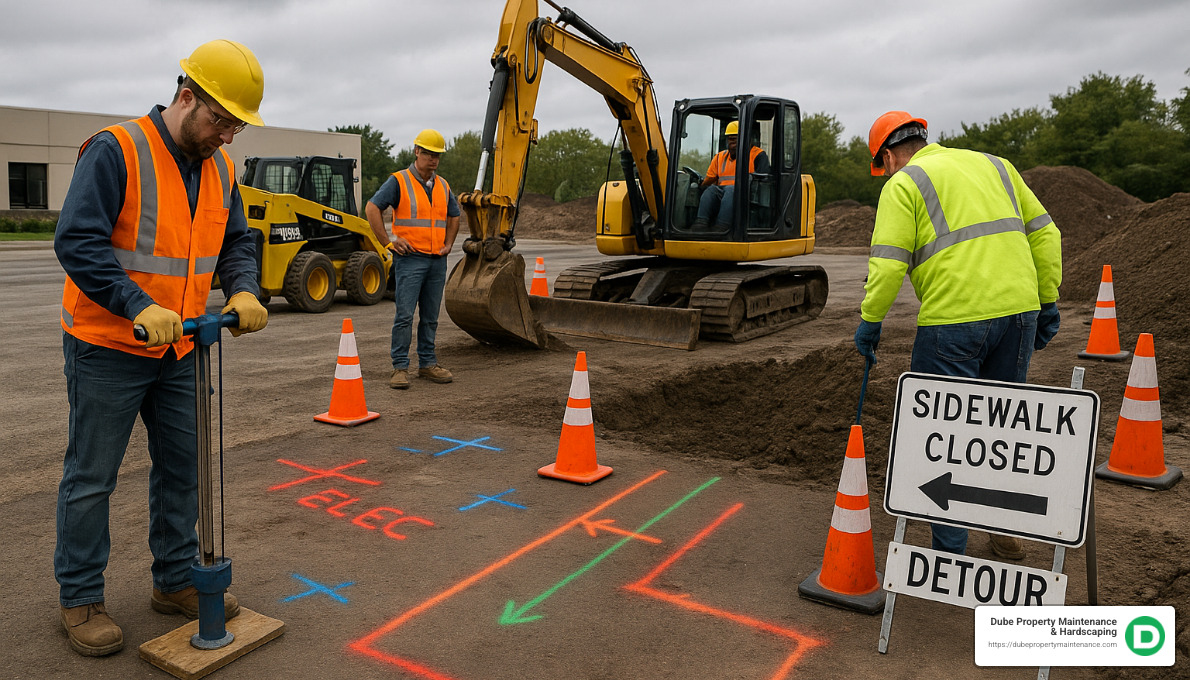
The last thing anyone wants is to accidentally hit a gas line or water pipe during excavation. That’s why we always coordinate with 811 “Call Before You Dig” to mark all underground utilities. This includes water and sewer lines, gas pipes, electrical conduits, communication cables, and drainage systems. Safety first, always.
A commercial driveway isn’t just a path—it’s a critical part of your business operations. We analyze peak hour capacity to ensure your driveway can handle your busiest times. We consider vehicle turning radius so even your largest delivery trucks can steer easily. We plan adequate stacking space so vehicles can queue without backing up onto public roads. And we ensure proper sight lines for safe entry and exit.
Environmental considerations have become increasingly important in commercial Driveway Installation, and for good reason—proper planning protects both your property and the surrounding environment.
Most municipalities now have strict stormwater regulations for commercial properties. Your driveway needs to limit runoff volume, filter out pollutants before water reaches local streams, and control peak flow to prevent downstream flooding during those heavy New England downpours.
If stormwater management is a concern for your property (and it probably is), permeable solutions offer some fantastic benefits.
Permeable pavers allow water to filter between individual units, creating an attractive surface that’s also environmentally friendly. Pervious concrete uses larger aggregate with minimal fine particles to create pathways for water. Porous asphalt is specially formulated to let water pass through rather than run off. And gravel systems with proper stabilization provide both permeability and a stable driving surface.
The beauty of these systems is they often reduce or eliminate the need for separate retention basins, potentially saving you valuable property space and money.
Beyond basic stormwater management, many commercial projects must consider EPA guidelines, potential LEED credits (if you’re pursuing green building certification), local watershed protection requirements, and restrictions on salt and chemicals if you’re near water sources.
“The trend toward permeable solutions isn’t just about compliance—it makes financial sense too,” our hardscaping team often explains. “Many clients find that the initial investment pays for itself through reduced infrastructure needs and potential tax incentives.”
At Dube Property Maintenance & Hardscaping, we help you steer all these requirements while designing a driveway that looks great, functions perfectly, and meets every code requirement. From Methuen to Salem and all points between, we know the local regulations and how to satisfy them without unnecessary delays or expenses.
More info about permeable solutions
Picking the right material for your commercial Driveway Installation isn’t just about looks—it’s a strategic decision that affects your bottom line for decades to come. Let’s walk through your options with an eye toward what really matters for busy commercial properties.
There’s a reason you see asphalt everywhere in the commercial world—it offers that sweet spot of affordability and functionality that businesses love.
When you choose asphalt for your business driveway, you’re getting a surface that’s ready for action almost immediately—typically within 24-48 hours after installation. This minimizes downtime, which is music to any business owner’s ears. The dark surface hides those inevitable oil drips and tire marks, keeping your property looking professional without constant cleaning.
The flipside? Asphalt won’t last forever. With a typical lifespan of 15-20 years, it’s more of a medium-term investment. You’ll need to budget for regular sealcoating every few years to protect your investment, and extremely hot summer days can sometimes leave the surface a bit soft.
Average Cost: $7-$39 per square foot for commercial applications. The higher end reflects specialized mixes and thicker applications designed for heavy truck traffic. These are average costs based on internet data and not actual costs for Dube Property Maintenance and Hardscaping.
If longevity tops your priority list, concrete deserves serious consideration. A well-installed commercial concrete driveway can serve your business for 30-40+ years with minimal maintenance—that’s essentially the lifetime of your building!
Concrete brings best versatility to the table. Want to match your company colors? We can add integral color. Looking for texture to prevent slips? We can broom finish or stamp patterns into the surface. These customization options let your driveway become part of your brand identity.
The main drawbacks? You’ll need patience during installation, as concrete requires up to 7 days before allowing light traffic and a full 30 days before heavy trucks can safely use it. Winter weather can also be tough on concrete if not properly installed and maintained.
Average Cost: $4-$45 per square foot, with decorative finishes and heavy-duty commercial applications at the higher end. These are average costs based on internet data and not actual costs for Dube Property Maintenance and Hardscaping.
For businesses where first impressions really matter—like high-end retail, restaurants, or corporate headquarters—interlocking pavers deliver best curb appeal with surprising practical benefits.
The modular nature of pavers creates a uniquely serviceable surface. If a section gets damaged or stained, we can replace just those affected units without disrupting the entire driveway. This targeted repair capability often saves money over the long term.
Many of our commercial clients are surprised to learn that quality pavers actually have incredible compressive strength—up to 8,000 PSI—making them suitable even for areas with heavy vehicle traffic. And since there’s no curing time, your driveway is ready for immediate use after installation.
Average Cost: $10-$70 per square foot, depending on the paver style, pattern complexity, and base requirements. These are average costs based on internet data and not actual costs for Dube Property Maintenance and Hardscaping.
While less common as a primary commercial driveway material, gravel provides an affordable solution for secondary access points, overflow parking, or businesses with tight budget constraints.
Gravel driveways offer excellent drainage and easy maintenance—simply add more stone as needed. They’re also easy to reconfigure if your business needs change, making them ideal for growing businesses that might redesign their space in the near future.
The challenges? Gravel surfaces generate dust, require more frequent maintenance, and can be tricky to plow during New England winters. Many commercial zoning codes also limit gravel use for primary access points.
Average Cost: $1.25-$5.40 per square foot, with stabilization systems and premium gravel types at the higher end. These are average costs based on internet data and not actual costs for Dube Property Maintenance and Hardscaping.
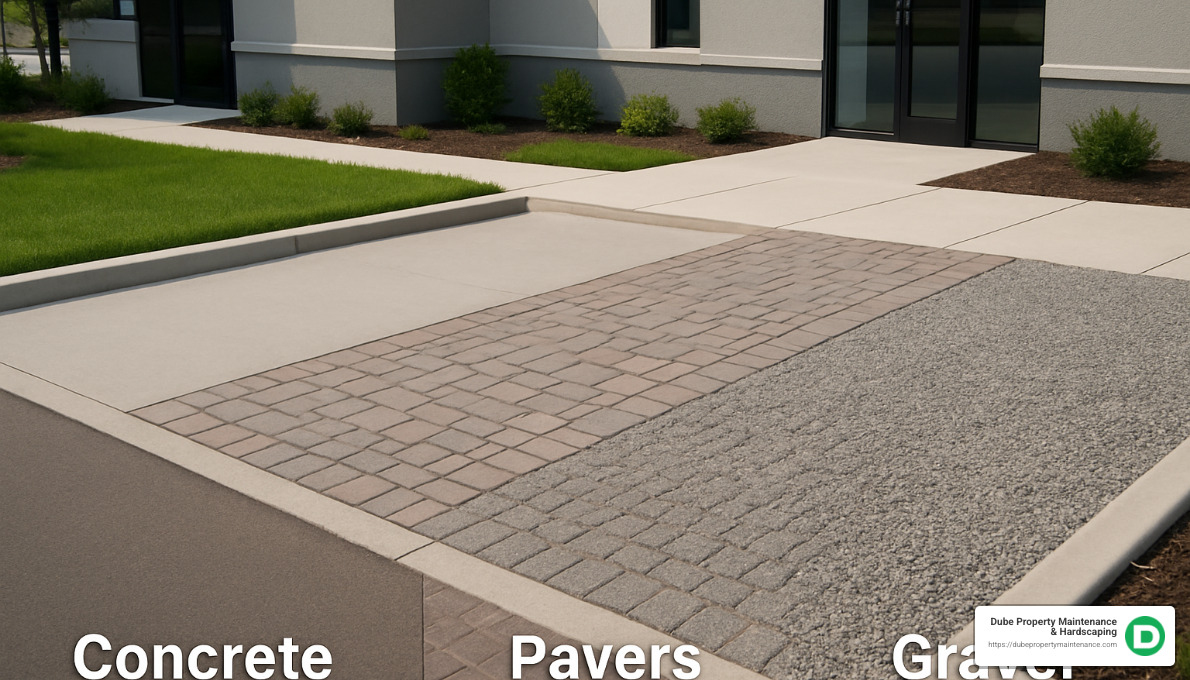
When we sit down with commercial clients to discuss their Driveway Installation project, we often find ourselves weighing several key factors that impact the business’s daily operations.
From a practical standpoint, installation speed can be critical. Gravel installations can be completed in just 1-2 days, with asphalt close behind at 2-3 days. Pavers typically require 3-7 days, while concrete needs 7-14 days including curing time before you’re back to business as usual.
Budget constraints naturally push many businesses toward gravel or asphalt for their lower upfront costs, while those focused on creating a premium impression might invest in concrete or pavers despite the higher initial investment.
When it comes to handling our harsh New England freeze-thaw cycles, pavers typically perform best, followed by asphalt. Concrete, despite its many benefits, can be more susceptible to winter damage if not properly installed and maintained.
“We always remind our commercial clients that the right material depends entirely on their specific operation,” says our team at Dube Property Maintenance & Hardscaping. “A warehouse shipping facility has completely different needs than a boutique retail store or restaurant.”
Commercial properties often need more than standard residential materials. That’s why we offer specialized formulations designed specifically for demanding business environments:
For asphalt driveways, our polymer-modified mixes incorporate rubber or plastic to increase flexibility and durability. These specialized blends resist rutting from heavy vehicles and stand up to the constant turning of delivery trucks. For properties with sustainability goals, we also offer warm-mix asphalt options that require less energy during production.
Our commercial concrete installations use high-strength 6-bag mixes that achieve 4,000+ PSI—significantly stronger than residential standards. For busy businesses that can’t afford extended downtime, we can specify high-early-strength formulations that allow faster reopening.
The paver systems we install for commercial clients aren’t your typical residential products. We use 8,000 PSI-rated units specifically engineered for vehicular applications. For properties with stormwater management requirements, our permeable interlocking concrete paver systems allow water infiltration while maintaining exceptional strength for heavy vehicles.
Beneath the surface, we incorporate advanced base systems like geo-cell structures that distribute weight more effectively, reducing the likelihood of settling or failure under heavy commercial traffic.
More info about permeable solutions
At Dube Property Maintenance & Hardscaping, we help commercial property owners throughout Northeastern Massachusetts and Southern New Hampshire steer these material choices. We consider not just your immediate budget, but your long-term maintenance plans, traffic patterns, and business growth projections to recommend the perfect solution for your specific situation.
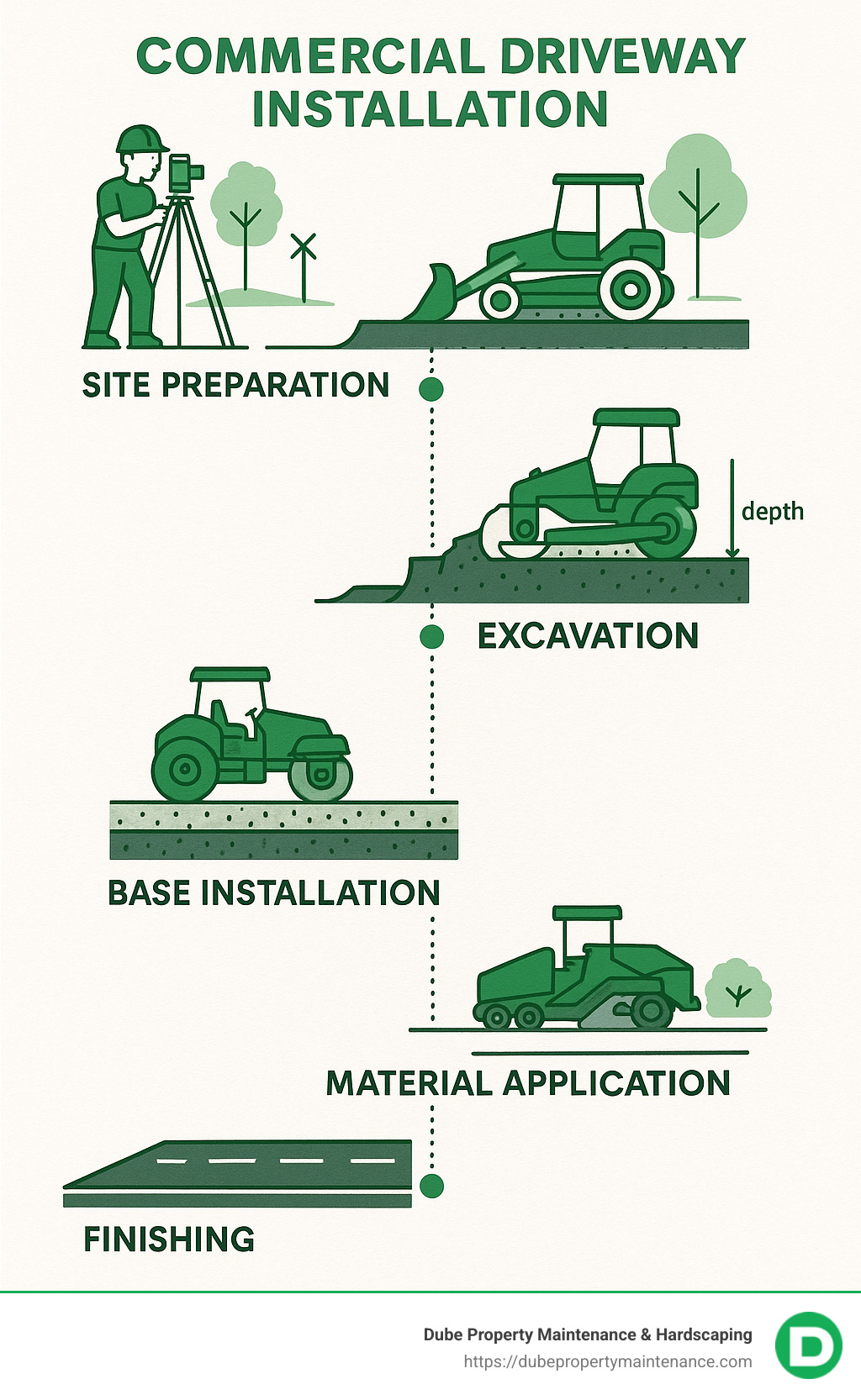
The driveway installation process for commercial properties isn’t just about pouring asphalt or laying concrete—it’s a carefully orchestrated sequence of steps that ensures your investment will stand the test of time. At Dube Property Maintenance & Hardscaping, we’ve refined this process through years of experience serving businesses throughout Northeastern Massachusetts and Southern New Hampshire.
Before the first shovel hits the ground, proper preparation sets the stage for success. Our team arrives with a well-organized plan that minimizes disruption to your business operations.
We begin by establishing a clear safety perimeter with barriers and signage to protect both workers and visitors. Equipment staging follows, with excavators, compactors, and material delivery areas strategically positioned for maximum efficiency.
For businesses that need to maintain operations during construction, we implement comprehensive traffic management plans. “One of our retail clients in Methuen was worried about losing customers during their driveway renovation,” recalls our project manager. “We developed a phased approach that kept half their lot open at all times—they actually saw increased foot traffic as people came to watch the change!”
Before excavation begins, we conduct a final utility verification and establish precise surveying points to guide the entire project. This attention to detail at the outset prevents costly mistakes and delays later.
The foundation of a successful commercial driveway installation begins with thorough excavation. For commercial properties, we typically dig 12-18 inches deep—significantly deeper than residential projects to accommodate the heavier loads of delivery trucks and high traffic volumes.
Our team carefully removes existing surfaces, hauling away old pavement for proper recycling. During this phase, we identify any problem areas in the subgrade, such as soft spots or unsuitable soils that could compromise the finished driveway. These areas receive special attention, with remediation that might include soil replacement or specialized stabilization techniques.
Throughout excavation, we maintain rough grading to establish initial slope and contours, setting the stage for proper drainage—a critical aspect of driveway longevity.
If the excavation is the foundation of your driveway, the base layer is its backbone. This critical component determines how your driveway will perform for decades to come.
We begin by installing geotextile fabric across the excavated area. This specialized material prevents the mixing of subgrade and base materials while allowing water to pass through—essentially creating a stable platform for everything that follows.
Next comes the placement of 6-12 inches of crushed stone. For commercial applications, we never skimp on base depth, as this is where many contractors cut corners. The base material is carefully graded to create proper drainage slopes (typically 1-2% minimum) to prevent water pooling.
“The compaction process is where the magic happens,” explains our installation team leader. “Each layer must be compacted separately, with moisture content carefully controlled for optimal density.” We make multiple passes with vibratory compactors, achieving 95%+ density—the industry gold standard for commercial applications.
After compaction, we perform fine grading with laser-guided precision to ensure the surface meets exact specifications before moving to the next phase.
The visible portion of your commercial driveway requires specialized techniques depending on your chosen material:
For asphalt installations, we begin with a tack coat to ensure proper bonding between layers. The base course follows—typically 2-3 inches of larger aggregate mix—which is thoroughly compacted while the material is hot. The surface course adds another 1.5-2 inches of finer aggregate mix, followed by final compaction with multiple roller passes to achieve proper density.
Concrete installations start with careful formwork and reinforcement placement. We pour 6-8 inches of high-strength concrete (4,000+ PSI), followed by expert screeding and floating to create a smooth, even surface. Strategic control joints are cut to manage inevitable cracking, and proper curing techniques ensure the concrete reaches its full strength potential.
For paver installations, we begin with sturdy edge restraints to contain the pavers. A precisely screeded 1-inch bedding layer provides the perfect setting bed, followed by meticulous paver placement according to the specified pattern. Custom cuts ensure perfect fits around edges and obstacles. The installation is completed with vibration to seat the pavers and joint sand application to lock everything in place.

The final steps transform your commercial driveway from a mere surface into a functional business asset. We add professional striping and markings for parking spaces, directional arrows, and ADA designations. Appropriate signage, curbing, and wheel stops are installed to protect landscaping and structures while guiding traffic flow.
Drainage features are completed and connected to stormwater systems, ensuring compliance with local regulations. Finally, we conduct thorough site cleanup and restoration, removing all equipment and restoring adjacent areas to pristine condition.
Proper site preparation is the unsung hero of durable commercial driveways. Our comprehensive approach ensures no detail is overlooked:
Grading and drainage planning begins with establishing a minimum 1-2% slope away from structures. We identify and address potential water collection points, plan connections to existing drainage systems, and ensure ADA-compliant transitions at entrances. For wider driveways, we often incorporate crown or cross-slope designs for optimal water management.
Geotextile selection and installation is custom to your specific soil conditions. We use appropriate fabric weight, overlap seams by at least 12 inches, and extend fabric up the sides of excavation to create a complete separation layer. Before proceeding, we carefully inspect for tears or damage that could compromise performance.
Base material specifications are never compromised. We use 3/4-inch crushed stone conforming to ASTM D2940 standards—never rounded gravel, which doesn’t compact properly. The material must be clean and free of organic matter, with minimum depths of 6-12 inches for commercial applications. Areas with poor subgrade receive additional base depth for extra stability.
Compaction requirements follow industry best practices. “The most common mistake we see is inadequate base compaction,” notes our installation team. “You simply cannot achieve proper density with a single pass or by compacting thick layers all at once.” We compact in 3-4 inch lifts using vibratory plate compactors with minimum 5,000 pounds of force, making at least three passes in different directions. Moisture content is carefully monitored to achieve optimal compaction density of 95%+ of maximum.
The final paving and finishing stages transform the prepared base into a functional commercial driveway that will serve your business for years to come:
For asphalt installations, our first lift (base course) consists of 3 inches of larger aggregate mix, typically using 3/4-inch stone for stability. We compact this layer with a minimum of 3 passes using a 10-ton roller while the material maintains its optimal temperature range of 220-290°F. The second lift (wearing course) adds 2 inches of finer aggregate mix with 3/8-inch stone for a smoother finish. Final compaction includes multiple directional passes to achieve the ideal 92-96% density. Edge treatment includes careful tamping and finishing of exposed edges for improved durability.
Concrete installations use a minimum 4,000 PSI mix with 4-5% air entrainment—critical for freeze-thaw durability in New England’s harsh winters. We pour at 6-8 inches thick for standard commercial traffic, reinforced with either a #4 rebar grid or 6×6 W2.9xW2.9 welded wire mesh for structural integrity. Control joints are cut to 1/4 depth at carefully calculated intervals to manage cracking. Surface finishing typically includes a broom finish for traction, though we offer specialized decorative options for businesses looking to make a statement.
Paver installation begins with a precise 1-inch bedding course of concrete sand, screeded to exact grade. Pavers are placed following the specified pattern with consistent 1/8-inch spacing. Edge cutting is performed with masonry saws for precise fits, while sturdy edge restraints made of plastic, metal, or concrete contain the installation. We use rubber-pad vibratory compactors to set pavers without damaging their surface, followed by polymeric sand application swept and compacted into joints for a locked-in, weed-resistant finish.
Final markings and features include thermoplastic line striping for longevity (lasting 3-5 years compared to paint’s 1-2 years), ADA-compliant markings for accessible spaces, directional arrows guiding traffic flow, stop bars indicating required stopping points, and professional signage installation for regulatory and informational purposes.
actual asphalt laying procedure
At Dube Property Maintenance & Hardscaping, we understand that many businesses can’t simply shut down during driveway renovation. That’s why we implement phased traffic control plans that allow your operations to continue while portions of your driveway are being upgraded. This approach has helped countless businesses throughout Methuen, MA and surrounding communities maintain customer access throughout the renovation process.

When investing in a commercial driveway installation, understanding the complete picture of costs over time helps you make smarter decisions for your business. It’s not just about what you pay upfront—it’s about value that lasts for decades.
Commercial driveways represent a significant investment, with costs varying dramatically based on materials, site conditions, and specific requirements of your business property.
“Many business owners experience sticker shock when they see initial quotes,” shares our team at Dube Property Maintenance & Hardscaping. “But when you consider that your driveway is essentially the red carpet for your business, the investment makes sense.”
For commercial properties, expect these price ranges (these figures represent average costs based on internet data and not actual costs for Dube Property Maintenance and Hardscaping):
For perspective, a typical 5,000 square foot commercial driveway could cost anywhere from $6,250 for a basic gravel installation to $350,000 for premium pavers with extensive preparation work. That’s quite a range! But making this decision based solely on upfront costs often leads to regrets down the road.
The true value of your driveway investment becomes clearer when you consider how long it will serve your business:
Asphalt driveways typically last 15-20 years with proper maintenance. They’re the workhorses of commercial properties—reliable but not eternal.
Concrete installations offer impressive longevity of 30-40+ years, especially in moderate climates. They’re the marathon runners of driveway materials.
Paver driveways can serve your business for 25-50+ years with occasional maintenance, offering both beauty and staying power.
Gravel solutions generally require significant replenishment every 5-10 years, making them better for secondary or temporary commercial applications.
These lifespans assume proper installation by experienced professionals and regular maintenance. A heavily-used delivery entrance will naturally wear faster than a customer-only parking area.
Each driveway material has its own maintenance rhythm that directly impacts its lifespan and your bottom line:
For asphalt driveways, plan on sealcoating every 2-3 years ($0.25-$0.50 per square foot) to prevent oxidation and water damage. Crack sealing ($1-$3 per linear foot) should be handled promptly when cracks appear. Most commercial asphalt driveways need complete resurfacing every 8-12 years ($2-$6 per square foot).
Concrete maintenance is less frequent but still necessary. Apply sealer every 3-5 years ($0.20-$0.40 per square foot) and repair joints and cracks as they develop. Unlike asphalt, concrete typically doesn’t need complete resurfacing, though uneven sections might require grinding ($2-$5 per square foot).
Paver driveways require joint sand replenishment every 3-5 years ($0.50-$1.00 per square foot) and occasional power washing to maintain their appearance. The beauty of pavers is that individual damaged units can be replaced without disturbing the entire surface.
Gravel driveways demand the most frequent attention, with regrading needed 1-2 times annually and new material added every 2-3 years. Dust control and weed management are also ongoing concerns.
“We’ve seen businesses try to save money by skipping maintenance, only to end up replacing their entire driveway years earlier than necessary,” notes our maintenance team. “Regular care is always more affordable than premature replacement.”
How Much Does It Cost to Install a Driveway?
Latest research on national averages
Commercial driveway installation costs can vary significantly based on several key factors that might not be immediately obvious:
Site conditions often drive unexpected costs. Removing existing pavement ($1-$5 per square foot), proper grading ($2-$8 per square foot), and addressing poor soil conditions ($10-$30 per square foot of affected area) can significantly impact your budget. Limited access for equipment can also increase labor costs by 10-30%.
Drainage solutions are non-negotiable for commercial properties. Installing catch basins ($1,500-$5,000 each), trench drains ($100-$300 per linear foot), or connecting to storm sewers ($1,000-$10,000 depending on distance) adds to the initial investment but prevents costly water damage later.
Material specifications for commercial use typically exceed residential standards. Deeper bases for heavy vehicles ($1-$3 per square foot), thicker surface courses ($1-$4 per square foot), and reinforcement materials ($1-$3 per square foot) all contribute to higher upfront costs but longer service life.
Regional factors also play a significant role. Installing driveways in urban areas typically costs 10-30% more than in rural locations. In New England, winter installations may carry a 15-25% premium due to heating requirements and slower work conditions.
“Every commercial property has its own unique challenges,” explains our estimating team. “What might seem like a straightforward job can become complex once we evaluate soil conditions, drainage needs, and traffic patterns. That’s why we always conduct thorough site assessments before providing estimates.”
With proper care, your commercial driveway can serve your business for decades. Here’s how to protect your investment:
Follow a proactive maintenance calendar rather than reacting to problems. Quarterly inspections help catch minor issues before they become major repairs. In New England, scheduling pre-winter maintenance and spring assessments is particularly important due to freeze-thaw cycles.
Don’t skip recommended maintenance intervals. Sealcoating asphalt every 2-3 years might seem like an unnecessary expense, but it dramatically extends pavement life by preventing oxidation and water penetration. Similarly, maintaining paver joints or concrete seals preserves structural integrity.
Manage operational impacts on your driveway. Designate specific routes for heavy delivery vehicles to distribute wear more evenly. Implement protocols for quickly cleaning up automotive fluid spills, which can degrade asphalt. During winter, use rubber-tipped snowplow blades and salt alternatives when possible to minimize surface damage.
Address small problems immediately. That tiny crack or slight depression might not seem urgent, but it can rapidly worsen, especially after water gets underneath the surface. Early intervention is always less expensive than waiting until complete failure occurs.
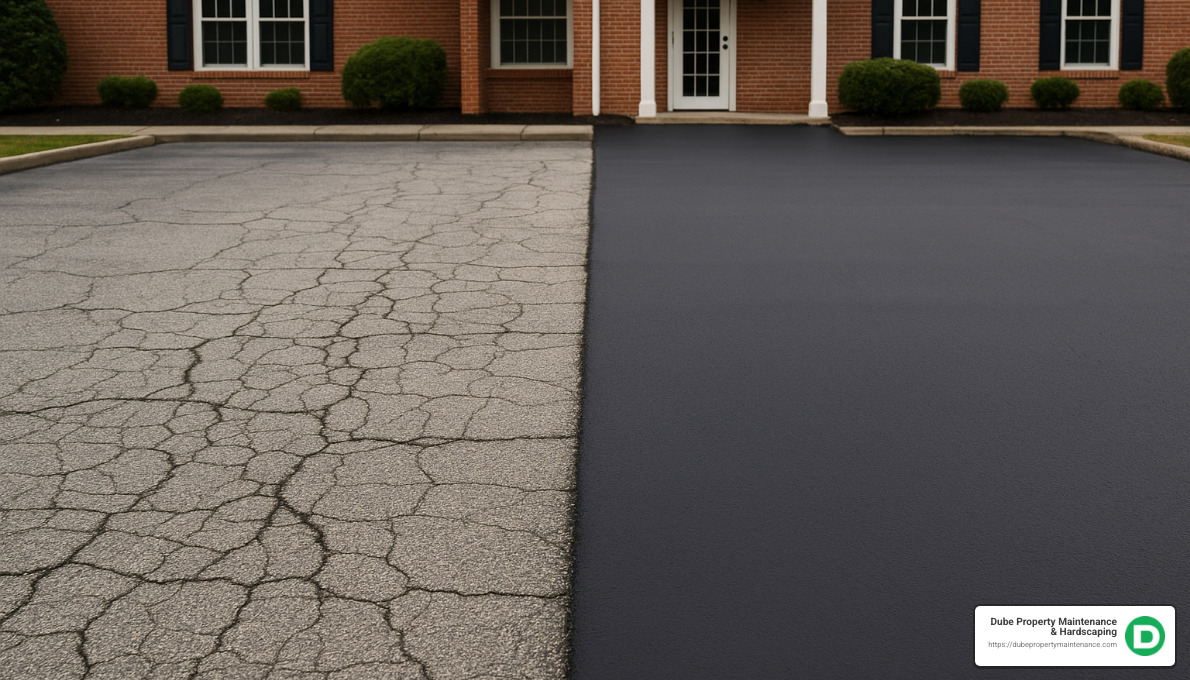
“We’ve maintained commercial driveways throughout Northeastern Massachusetts and Southern New Hampshire for decades, and the difference between properties that follow maintenance plans versus those that don’t is striking,” shares our team. “Some of our clients have driveways performing beautifully after 20+ years, while others have had to completely replace surfaces in half that time due to neglected maintenance.”
At Dube Property Maintenance & Hardscaping, we provide customized maintenance programs that help our commercial clients maximize their driveway investments. From routine inspections to seasonal care and timely repairs, we help ensure your driveway continues to make a positive impression on customers while supporting your daily operations.
One of the most common questions we hear from business owners is about wait times after a new driveway installation. The truth is, patience pays off when it comes to allowing your new commercial driveway to properly set before subjecting it to heavy loads.
With asphalt driveways, you’re looking at a relatively quick return to service. Light vehicles can typically use the driveway within 24-48 hours, depending on temperature. For delivery trucks, we recommend waiting 3-5 days. If you’re expecting heavy commercial vehicles weighing over 20,000 pounds, it’s best to wait 7-14 days.
“What many property owners don’t realize is that asphalt continues to cure and harden for up to 6-12 months,” explains our installation team. “While you can drive on it relatively quickly, we strongly advise against parking heavy vehicles in one spot during that first month. Those stationary loads can create permanent depressions that are difficult to repair.”
Concrete driveways require significantly more patience. Light vehicles should stay off for at least 7 days, delivery trucks should wait 14-21 days, and heavy commercial vehicles need the full 28-day cure period.
“Concrete is a bit deceptive,” notes our concrete specialists. “It reaches about 70% of its strength after a week, which makes people think it’s ready for anything. But that final 30% makes all the difference for durability. Rushing the process is one of the most common reasons we see premature concrete failure.”
Paver driveways offer a distinct advantage here – they’re ready for all vehicles immediately after completion. This immediate usability makes pavers particularly attractive for busy commercial sites that simply can’t afford downtime.
New England winters can be brutal on commercial properties. While heated driveways aren’t necessary for every business, they’re becoming an increasingly popular option for good reason.
You might want to consider a heated driveway installation if your business cannot tolerate any snow or ice accumulation, you have steep slopes that become treacherous in winter conditions, you’re looking to eliminate ongoing snow removal costs and liability concerns, or your entrance areas are critical for customer safety.
“Heated driveways typically cost $12-$25 per square foot to install,” our team explains. “Yes, that’s a significant upfront investment, but many of our commercial clients find it pays for itself over time. When you factor in the elimination of snow removal services, reduced slip-and-fall liability, and improved customer access during storms, the math often makes sense.”
For heating options, you can choose between electric resistance cables (lower installation cost but higher operating expense) or hydronic systems (higher installation cost but more efficient operation). Many of our clients opt for zoned heating that targets only critical areas like main entrances, ADA access points, and steep sections rather than entire parking areas.
For most commercial properties throughout Methuen and our service area, a strategic approach to heated sections often provides the best return on investment.
Absolutely! We understand that most businesses simply can’t shut down operations for a complete driveway installation. That’s why we’ve developed specialized phasing strategies that allow commercial properties to remain operational throughout the construction process.
“Business continuity isn’t just important – it’s essential,” explains our project management team. “We’ve refined our approach over years of commercial installations to minimize disruption while still delivering excellent results.”
Our phased approach typically includes strategic section planning that divides your project into logical segments allowing continued access. We create temporary access routes during construction and often schedule off-hours work for the most disruptive activities. We can deploy larger crews and extended hours for critical phases, and we always provide clear communication with signage and updates for your staff and customers.
Several factors influence how smoothly a phased construction can proceed. Multiple access points make phasing easier, larger areas provide more flexibility, and some materials allow faster section completion than others. Weather conditions can also affect phasing options, especially in our New England climate.
“I remember a retail center in Methuen where we completed their driveway installation in three phases over two weekends,” shares our team leader. “They maintained normal business hours with minimal disruption, and their customers barely noticed the work was happening. That’s always our goal.”

Commercial driveway installation isn’t just another construction project—it’s a critical investment that shapes how customers, employees, and partners experience your business from the moment they arrive. Throughout this guide, we’ve walked through the journey from initial planning to finished surface, highlighting the unique considerations that commercial properties face.
The success of your commercial driveway project depends on several fundamental principles. First, proper planning prevents problems. We’ve seen too many projects go sideways because of inadequate site assessment or overlooking permit requirements. Taking the time to evaluate drainage, soil conditions, and traffic patterns pays dividends for decades.
Quality installation matters tremendously. The difference between a driveway that lasts 10 years versus 30 years often comes down to what’s happening beneath the surface—proper base preparation, compaction, and material application techniques that most people never see.
When it comes to materials, material selection should match usage. A distribution center with constant heavy truck traffic has very different needs than a boutique retail location focused on customer impressions. Your material choice should reflect not just your budget but your specific operational requirements.
Smart property owners budget for the full lifecycle, not just installation costs. A premium installation might cost more upfront but could save tens of thousands in maintenance and early replacement costs over time. Consider the total cost of ownership when making your decision.
Finally, maintenance extends investment value. Even the best installation requires ongoing care. Regular sealcoating, prompt crack repair, and seasonal maintenance dramatically extend your driveway’s lifespan and preserve your property’s professional appearance.
At Dube Property Maintenance & Hardscaping, we’ve built our reputation by treating each commercial driveway installation with the care and attention it deserves. Our clients throughout Northeastern Massachusetts and Southern New Hampshire appreciate our comprehensive approach that removes the stress from complex projects.
We provide true end-to-end project management, handling everything from initial concept development through final inspection. Our team offers genuine material expertise, helping you steer the pros and cons of each option for your specific situation. We take care of regulatory navigation, managing all permitting and compliance requirements so you don’t have to become an expert in local codes.
Our quality installation processes follow industry best practices developed over years of experience, using premium materials that stand the test of time. And we offer ongoing maintenance services to protect your investment for decades to come.
“We see ourselves as partners in your property’s success, not just contractors,” explains our team. “When your driveway looks great and performs perfectly year after year, that’s when we know we’ve done our job right.”
Changing your commercial property with a professional driveway installation starts with a simple conversation. Here’s how to begin:
First, schedule a free on-site consultation where our team will evaluate your property’s unique characteristics, discuss your operational needs, and provide expert recommendations custom to your situation.
Next, review your custom proposal with detailed material options, timeline expectations, and complete project specifications—no surprises or hidden costs.
Then, experience stress-free installation as our professional team handles every aspect of your project, from securing permits through final cleanup and walkthrough.
Finally, enjoy the peace of mind that comes with industry-leading warranties that protect your investment with comprehensive material and workmanship guarantees.
“The driveway is often the first physical interaction customers have with your business,” our design team often reminds clients. “Make it count with a professional installation that reflects your commitment to quality.”
More info about our driveway paver solutions
Contact Dube Property Maintenance & Hardscaping today to find how our commercial driveway installation services can improve your property’s functionality, safety, and curb appeal for decades to come. From Methuen to Andover, Lawrence to Haverhill, we’re ready to bring your vision to life with the craftsmanship and care your business deserves.
