
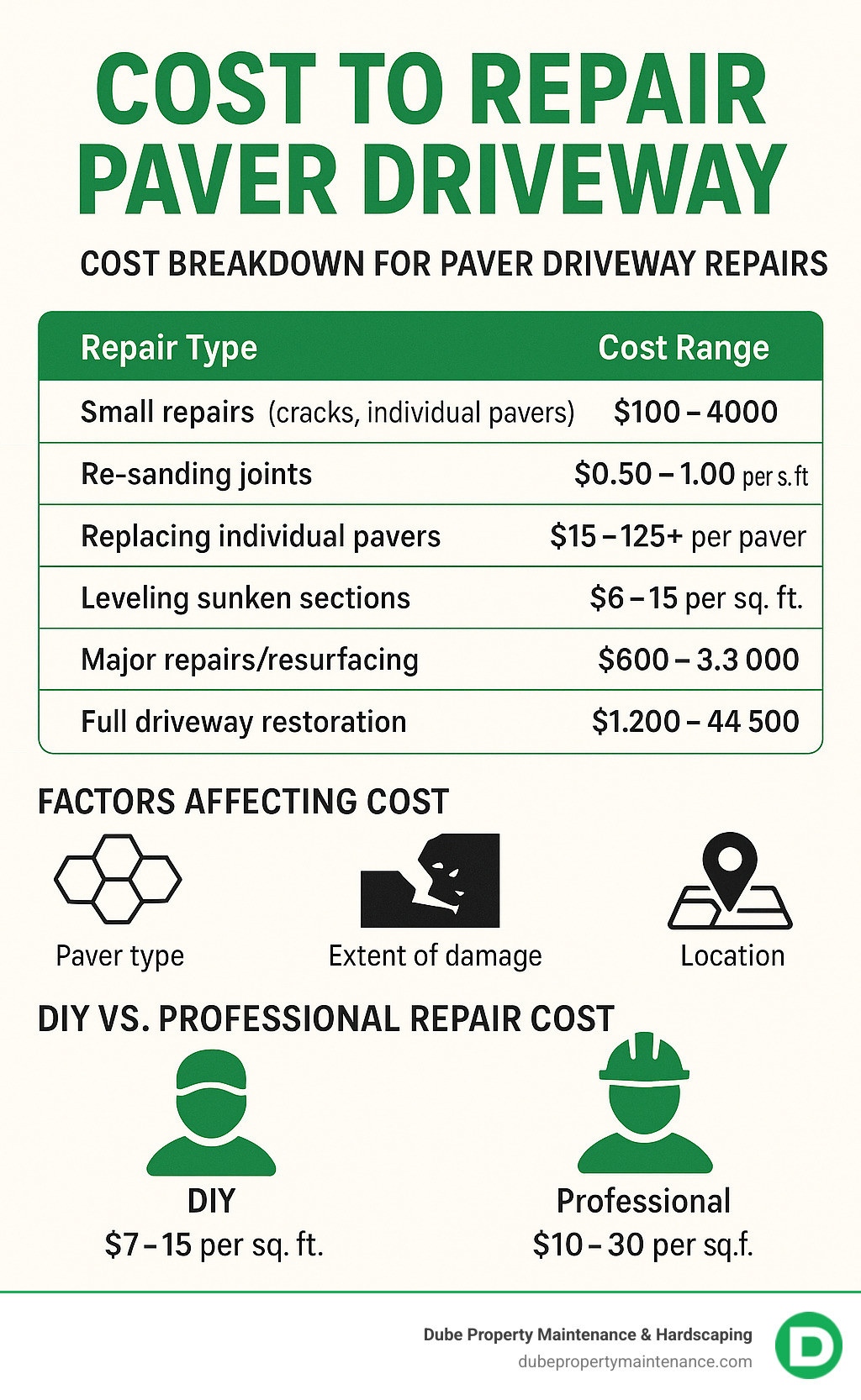
The cost to repair paver driveway projects typically ranges from $7 to $30 per square foot, with most homeowners spending between $726 and $2,485 for average repairs. For a standard 100-square-foot repair area, expect to pay around $1,599 nationally.
| Repair Type | Cost Range |
|---|---|
| Small repairs (cracks, individual pavers) | $100 – $400 |
| Re-sanding joints | $0.50 – $1.00 per sq ft |
| Replacing individual pavers | $15 – $125+ per paver |
| Leveling sunken sections | $6 – $15 per sq ft |
| Major repairs/resurfacing | $600 – $3,000 |
| Full driveway restoration | $1,200 – $4,500 |
Note: These are average costs based on internet data and not actual costs for Dube Property Maintenance and Hardscaping. Your specific project may vary based on local conditions.
Standing at the edge of your property, you’re faced with an important decision that impacts both your home’s curb appeal and your wallet. Those shifted pavers and widening joints in your once-pristine driveway aren’t just an eyesore – they can become safety hazards and lead to more extensive damage if left unaddressed.
Unlike concrete driveways that typically require complete replacement when damaged, paver driveways offer a unique advantage: they can often be repaired section by section, saving you significant money while extending the lifespan of your investment.
For instance, on a recent local project, replacing a handful of damaged pavers after a truck scrape cost only a few hundred dollars—far less than the thousands that would have been spent replacing an entire concrete slab.
The repair costs vary widely based on several factors: the type of pavers you have (concrete, brick, or natural stone), the extent of the damage, your location, and whether you tackle it yourself or hire a professional.
In New England’s freeze-thaw climate, addressing repairs promptly is especially important. What starts as a minor unevenness in winter can quickly become a major repair project by spring.
Cost to repair paver driveway terms to learn:
– paver driveway maintenance
– cost to seal driveway pavers
– cost to widen driveway with pavers
Ever wondered why one neighbor paid $500 for their paver repairs while another shelled out $3,000? Let me walk you through what really influences the cost to repair paver driveway projects in our New England climate.
Your repair bill starts with the basics: size matters. Fixing a small section near your garage will naturally cost less than addressing half your driveway. Though there’s a silver lining – larger projects often come with a slight discount per square foot since the crew is already on site with all their equipment.
The material of your pavers plays a huge role too. Those concrete pavers? They’re the budget-friendly option at $7-$15 per square foot for repairs. Brick pavers step things up to $10-$20, while those gorgeous natural stone pavers can reach $15-$30+ per square foot when repairs are needed.
How severe is your damage? There’s a world of difference between resanding a few joints (a relatively minor fix) and addressing a driveway that’s sinking in multiple areas due to base failure (a major undertaking).
Here in Methuen and surrounding communities, skilled paver specialists typically charge between $50-$110 per hour. This reflects the expertise needed to ensure your repairs last through our challenging New England seasons.
Speaking of our climate – those freeze-thaw cycles we experience require deeper excavation and more robust base preparation than southern states. This necessity can add 10-20% to your repair costs, but it’s essential for longevity.
If drainage issues caused your paver problems in the first place, fixing the underlying cause might add $1,000-$3,000 for French drains or catch basins. It’s an investment that prevents future headaches.
| Repair Category | Minor Repair Budget | Major Repair Budget |
|---|---|---|
| Small area (≤100 sq ft) | $300 – $900 | $900 – $3,000 |
| Medium area (101-300 sq ft) | $700 – $2,100 | $2,100 – $9,000 |
| Large area (301-500 sq ft) | $2,100 – $4,500 | $4,500 – $15,000 |
| Full driveway (500+ sq ft) | $3,500 – $7,500 | $7,500 – $30,000+ |
Note: These are average costs based on internet data and not actual costs for Dube Property Maintenance and Hardscaping.
When budgeting for repairs, the material of your pavers significantly impacts your costs. Concrete pavers are typically the most affordable to repair at $7-$20 per square foot, while brick pavers range from $10-$30 per square foot. If you have premium cobblestone or natural stone pavers, expect repair costs between $15-$70 per square foot.
Living in the Boston metro area comes with its perks – beautiful seasons, rich history, and unfortunately, slightly higher repair costs. Here in Methuen, Andover, and surrounding communities, paver repair costs typically run 10-20% above the national average due to higher labor rates and our deeper frost line requirements.
For a more personalized estimate, use our Paver Driveway Cost Calculator.
When comparing repair costs across different driveway materials, looking beyond just the immediate price tag reveals the true value:
| Driveway Type | Repair Cost Range | Typical Lifespan | Maintenance Frequency |
|---|---|---|---|
| Pavers | $7-$30 per sq ft | 25-75+ years | Every 3-5 years |
| Concrete | $3-$8 per sq ft | 25-50 years | Every 2-3 years |
| Asphalt | $2-$5 per sq ft | 15-30 years | Every 3-5 years |
| Gravel | $1-$3 per sq ft | 5-10 years | 1-2 times annually |
While paver repairs might seem pricier upfront, they offer tremendous advantages in our New England climate. Unlike concrete that often requires complete replacement when damaged, pavers allow for modular repairs – you can fix just the problem areas, saving significantly over time.
For a deeper dive into these comparisons, check out our detailed guide on Paver Driveway Cost vs Concrete.
Your paver driveway tells a story – of winters endured, summer barbecues hosted, and years of faithful service. When that story includes a few rough chapters of damage, understanding your repair options helps restore both function and beauty. Let’s walk through the most common repairs your driveway might need and what you can expect to pay.
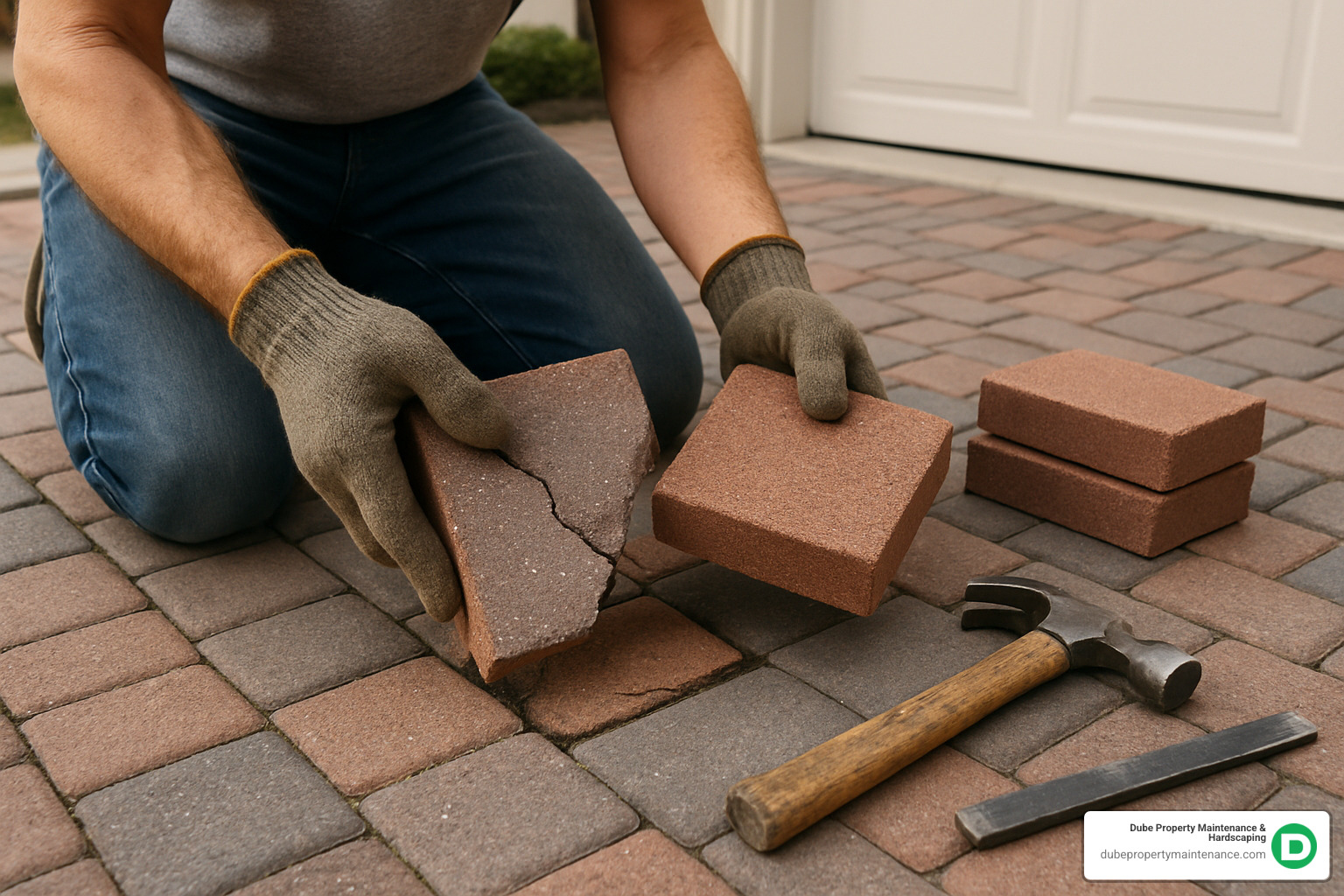
When winter’s freeze-thaw cycles crack your pavers or that accidental oil spill won’t come clean, individual paver replacement offers a targeted solution that won’t break the bank.
Cost range: $15-$125+ per paver
The beauty of paver driveways is their modular nature – you can replace just what’s damaged. A concrete paver might cost just $15-$40 to replace, while premium natural stone could run $50-$125+ each. The complexity grows when matching older, weathered pavers where colors have subtly changed over time.
If you’re handy, paver extractor tools ($30-$75) make DIY replacement possible, though achieving that seamless look often requires a professional’s touch, especially with intricate patterns like herringbone.
Nothing says “trip hazard” quite like a sunken section of pavers creating an unexpected dip in your driveway. These depressions not only look unsightly but can collect water and create bigger problems over time.
Cost range: $6-$15 per square foot
The process is methodical: carefully removing existing pavers, building up and compacting the base material, re-leveling fresh bedding sand, reinstalling the pavers, and finishing with new joint sand. For a typical 50-square-foot sunken area, expect to invest $300-$750 for professional restoration.
For tips on preventing future settling issues, check out our comprehensive Paver Driveway Maintenance guide.

Those tiny spaces between your pavers might seem insignificant, but they’re actually crucial to your driveway’s performance. When joint sand washes away, it invites weeds, ants, and eventual paver shifting.
Cost range:
* Basic joint sand: $0.50-$1 per square foot
* Polymeric sand: $0.75-$2 per square foot
* Sealing: $1.35-$2.50 per square foot
Polymeric sand has revolutionized paver maintenance. Unlike regular sand, it hardens when wet, creating a firm barrier against weeds and insects while still allowing for the slight movement pavers need during freeze-thaw cycles. For a typical 500-square-foot driveway, budget $375-$1,000 for professional re-sanding with quality polymeric sand.
The finishing touch of sealer not only improves your pavers’ color but creates an additional protective barrier against stains, fading, and joint erosion. Plan on resealing every 3-5 years to maintain optimal protection.
Water is both essential for life and potentially devastating for your paver driveway. Poor drainage leads to some of the most serious and costly paver problems we see in Massachusetts and New Hampshire.
Cost range: $10-$30 per square foot for major drainage fixes
When water can’t escape, it finds ways to cause trouble – especially when it freezes beneath your pavers and pushes them upward (known as “heaving”). Solving these issues often requires a multi-faceted approach:
Installing French drains ($1,500-$5,000) creates underground pathways for water to escape, while strategically placed catch basins ($500-$1,500 each) collect surface water before it becomes problematic. For severe cases, converting problem areas to permeable pavers ($15-$30 per square foot) allows water to filter through rather than pool on the surface.
Note: These are average costs based on internet data and not actual costs for Dube Property Maintenance and Hardscaping. Your specific project may vary based on local conditions.
That moment of truth has arrived – you’re staring at your damaged paver driveway, calculator in hand, wondering whether to patch things up or start fresh. It’s a common dilemma, and the answer isn’t always straightforward. Let’s walk through how to make this decision with confidence.
Your wallet will thank you for choosing repairs when certain conditions align:
The “25% rule” is your first checkpoint. If less than a quarter of your driveway shows damage, repairs typically make more financial sense. Think of it like a car – you wouldn’t replace the entire vehicle for a dent in one door.
Age matters tremendously. Driveways under 15 years old usually have solid foundation layers that are worth preserving. For example, a recent 12-year-old driveway we repaired saved the homeowner more than $4,000 compared with a complete replacement.
When issues are primarily cosmetic or superficial – like staining, minor settling, or a handful of cracked pavers – targeted repairs are your friend. These surface-level problems rarely justify starting from scratch.
Timeline constraints might also push you toward repairs. Most repair jobs wrap up in 1-3 days, while full replacements can disrupt your property for 1-2 weeks or more. If you’re hosting a graduation party next weekend, this timeline difference matters!
The budget factor is often decisive. For perspective, repairing 100 square feet of a 500-square-foot driveway might cost $1,000-$3,000, compared to $5,000-$15,000 for complete replacement. That’s potentially 80% savings for addressing the same problem areas.
For comparison with other materials, our guide on the Cost to Remove and Replace Concrete Driveway provides helpful context.
Sometimes starting fresh is the smarter long-term investment:
When damage exceeds 40% of your driveway, the economies of scale begin to favor replacement. The labor to repair numerous sections often approaches or exceeds replacement costs.
Recurring issues are a red flag. If you’re dealing with the same problems year after year (like that one section that keeps sinking), it signals deeper structural issues that patch jobs won’t solve.
Older installations often lack proper base preparation by today’s standards. Pavers installed 20+ years ago in Massachusetts typically have inadequate base depth for our increasingly volatile freeze-thaw cycles. Modern installations dig deeper and use better materials.
The design update factor shouldn’t be overlooked. If you cringe every time you pull into your driveway because you hate the outdated pattern or faded color, repairs won’t address that dissatisfaction.
Severe drainage problems almost always require complete reconstruction. Water is the enemy of any hardscape, and proper management requires correct grading and base preparation from the ground up.
Upgrading to permeable pavers is another scenario where replacement makes sense. These eco-friendly systems require specialized base construction that can’t be retrofitted to traditional installations.
Just last fall, a homeowner in Methuen made the tough but smart choice for full replacement after calculating that repairing 60% of their 20-year-old driveway would cost nearly 80% of starting fresh. The bonus? They gained an updated design and solved their drainage issues in one project.
For more insights on the replacement process, our guide to Replacing Driveway walks you through what to expect.

That stack of pavers in your garage might be tempting you to tackle repairs yourself. Before you dive in, let’s honestly weigh the DIY approach against hiring professionals for your paver driveway repairs.
The DIY route typically saves you about 30-50% on paper, but those savings come with some significant trade-offs. Equipment rentals alone can add up quickly—expect to pay $75-$150 per day for essentials like a plate compactor. And that weekend project? It might stretch into multiple weekends as DIY repairs typically take 2-3 times longer than professional work.
Here’s how the comparison breaks down:
| Aspect | DIY | Professional |
|---|---|---|
| Cost Savings | 30-50% | None |
| Equipment Rental | $75-$150/day | Included |
| Time Investment | 2-3x longer | Minimal |
| Quality Assurance | Variable | Guaranteed |
| Warranty | None | 1-3 years typical |
| Risk of Injury | Moderate | None to homeowner |
| Long-term Performance | Variable | Consistent |
If you’re still set on tackling smaller repairs yourself, preparation is key. You’ll need a paver extractor tool ($30-$75) to safely remove existing pavers without damage. Don’t forget to budget for a plate compactor rental ($75-$125 daily)—skipping proper compaction is the number one reason DIY repairs fail prematurely.
Other essentials include a rubber mallet ($15-$30), level ($10-$30), and several bags of polymeric sand ($25-$40 per 50-lb bag). For bedding, you’ll need mason sand ($3-$6 per bag), and don’t forget landscape fabric ($20-$50) to prevent weed growth.
Your safety matters too, so invest in proper gloves, eye protection, and knee pads ($50-$100 total). All told, even a modest 50-square-foot repair will require $200-$400 in materials and rentals, plus 8-16 hours of your weekend.
For more guidance on tackling paver projects, check out our comprehensive Driveway Pavers guide.
When you watch professionals at work, the difference becomes clear immediately. That laser grading equipment they’re using ensures proper drainage slopes (ideally ¼ inch per foot)—something nearly impossible to achieve with DIY tools. Their commercial-grade compactors achieve 95%+ compaction rates, significantly reducing future settling issues.
Material expertise is another professional advantage. When matching older pavers, professionals know exactly which manufacturer and color blend to order—something that could take days of research for a DIYer.
Professionals also install proper edge restraints—a critical component many DIYers overlook. These hidden heroes prevent the lateral spreading that causes pavers to loosen over time.
Perhaps most valuable is the peace of mind that comes with professional work. Most reputable companies (including Dube Property Maintenance & Hardscaping) offer 1-3 year workmanship warranties, plus they carry comprehensive liability insurance and workers’ compensation—protecting you from potential risks.
The time efficiency alone can be worth the investment. What might consume your entire weekend (or several) is often completed by professionals in a single day, with superior results.
Ready to explore professional repair options? You can Get Free Quotes for repairs or contact Dube Property Maintenance & Hardscaping directly for a personalized assessment of your driveway’s needs.
When you invest in repairing your paver driveway, you’re probably wondering how long that investment will last. The good news is that properly repaired paver driveways have impressive longevity – typically 25-75+ years with the right care.
Your specific timeline depends on several key factors. Professional repairs with proper base preparation will naturally outlast quick fixes. The material choice makes a significant difference too – concrete pavers typically serve you well for 25-50 years, while clay brick pavers can last an impressive 35-100 years. Natural stone takes the durability crown at 50-100+ years when properly maintained.
Our New England climate presents unique challenges. Those freeze-thaw cycles we experience each year make proper drainage and adequate base depth absolutely crucial for preventing premature deterioration.
Regular maintenance plays a huge role too. Simple routines like cleaning, re-sanding joints, and applying a fresh sealer every 3-5 years can add decades to your driveway’s life.
The permit question often causes confusion for homeowners planning repairs. The short answer? It depends on the scope of your project.
For minor repairs like replacing a few damaged pavers, refreshing joint sand, or applying sealer, you typically won’t need permits in most Massachusetts communities. These surface-level improvements generally fly under the radar of building departments.
However, major repairs that affect more than 100 square feet or alter your property’s drainage patterns often do require permits throughout Massachusetts and New Hampshire. This is especially true in communities with strict stormwater management regulations.
If you’re planning driveway expansions or relocations, you’ll almost certainly need permits, and you’ll need to comply with local setback requirements that dictate how close your driveway can be to property lines.
Permit costs typically range from $50-$250 depending on your municipality and project scope. At Dube Property Maintenance & Hardscaping, we’ve steerd the permitting maze countless times and can handle this potentially frustrating process for our clients across all our service areas.
Everyone loves saving money without cutting corners on quality. Here are some insider tips to reduce your cost to repair paver driveway projects while maintaining excellent results:
Bundle multiple repairs whenever possible. When we fix several issues during a single visit, you’ll save on mobilization costs, equipment fees, and labor time.
Speaking of timing, scheduling during off-peak seasons (late fall and early spring) often means better contractor availability and sometimes more competitive rates. The demand for hardscaping services skyrockets in summer, so planning ahead can really pay off.
Perhaps the most important money-saving tip: address problems early. That small area of settling or those missing joint sand particles might seem minor, but they can quickly escalate into major structural issues. Small repairs now prevent big expenses later.
Always get multiple quotes (3-5 is ideal) to ensure you’re getting competitive pricing, but be cautious about unusually low bids – they often indicate corners being cut or inexperienced contractors who might create more problems than they solve.
Regular maintenance is another smart investment. Cleaning, re-sanding, and sealing every 3-5 years might seem like an extra expense, but this routine care prevents the costlier repairs that come with neglect.

Navigating the cost to repair paver driveway projects doesn’t have to be overwhelming. Think of these repairs as an investment that protects both your home’s curb appeal and your wallet. While costs typically range from $7 to $30 per square foot, addressing issues promptly is almost always more economical than waiting until minor problems escalate into major headaches.
For those of us in New England, paver driveways offer a distinct advantage over solid concrete or asphalt surfaces. When winter frost heaves or summer rains cause damage, you can fix just the affected areas rather than replacing the entire driveway. This “modular” nature not only saves money but is also better for the environment by reducing waste.
I’ve seen countless homeowners breathe a sigh of relief when they learn that their beautiful but damaged driveway doesn’t need a complete overhaul. Sometimes, it’s just a matter of replacing a few pavers or addressing drainage issues to restore both function and beauty.
At Dube Property Maintenance & Hardscaping, we’ve been helping homeowners throughout Methuen, Andover, North Andover, and surrounding communities in Massachusetts and New Hampshire restore their paver driveways for years. Our approach isn’t just about fixing what you can see – we dig deeper to address underlying causes, ensuring repairs that truly last.
Whether you’re dealing with a few sunken pavers after a harsh winter, widespread settling from poor initial installation, or drainage issues causing repeated damage, quality repairs now will protect your property value and prevent more costly fixes down the road.
The driveway is more than just a place to park – it’s the first thing you and your guests see when arriving home. A well-maintained paver driveway improves your property’s appearance while providing a safe, stable surface for decades to come.
For those considering a fresh start rather than repairs, our guide on the Cost to Install Paver Driveway provides detailed information about new installations. Or simply reach out for a personalized assessment of your specific situation – sometimes a professional eye can spot simple solutions you might have overlooked.
In our challenging New England climate, today’s small cosmetic issue can quickly become tomorrow’s structural problem. Addressing repairs promptly not only saves money but also extends the life of your investment, keeping your home’s entrance beautiful and functional for decades to come.
