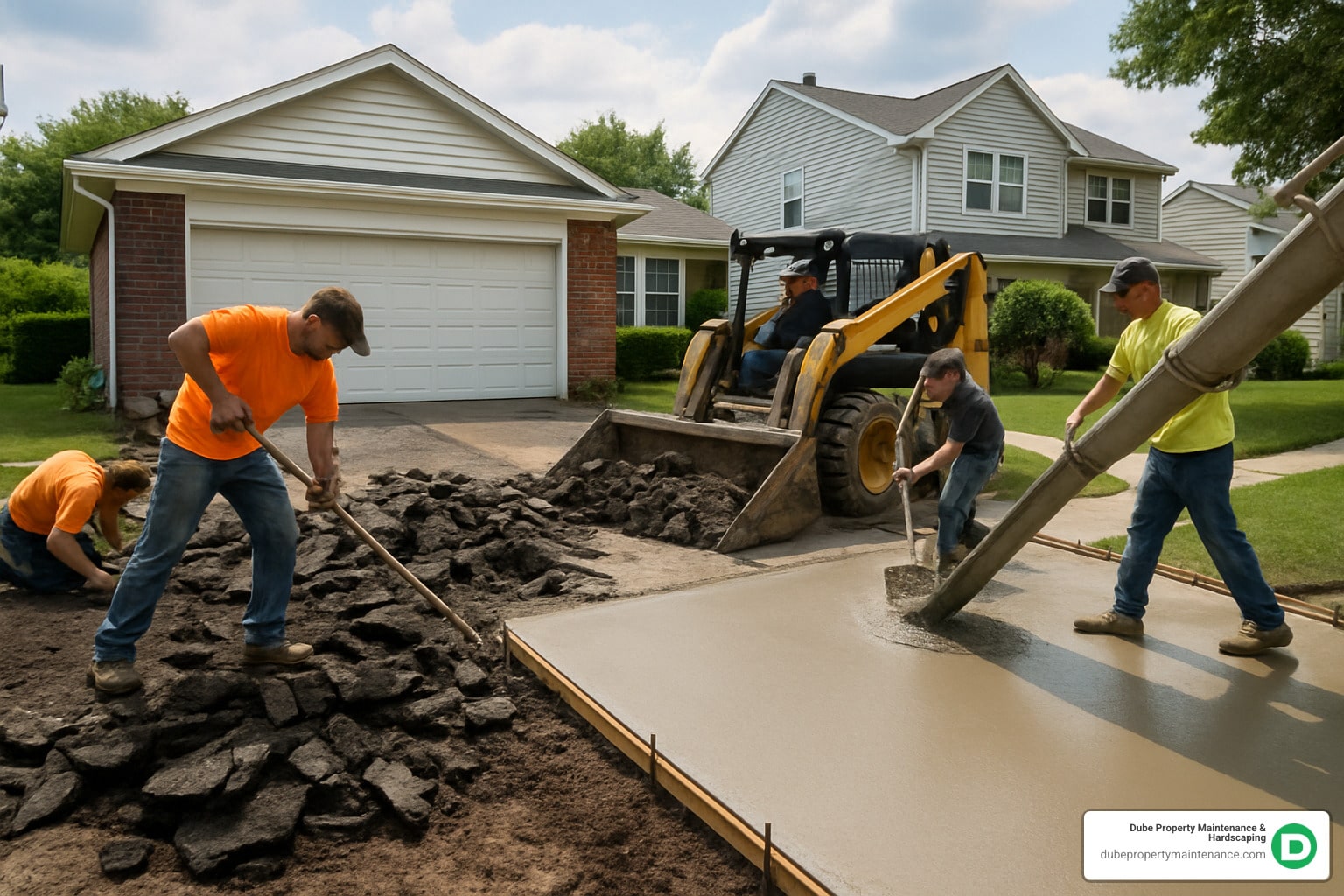

The cost to remove asphalt driveway and replace with concrete typically ranges from $4,200 to $10,200 for a standard 400-square-foot driveway. Here’s what you need to know:
Total Cost Breakdown:
Key Factors Affecting Price:
Note: These are average costs based on internet data and not actual costs for Dube Property Maintenance and Hardscaping.
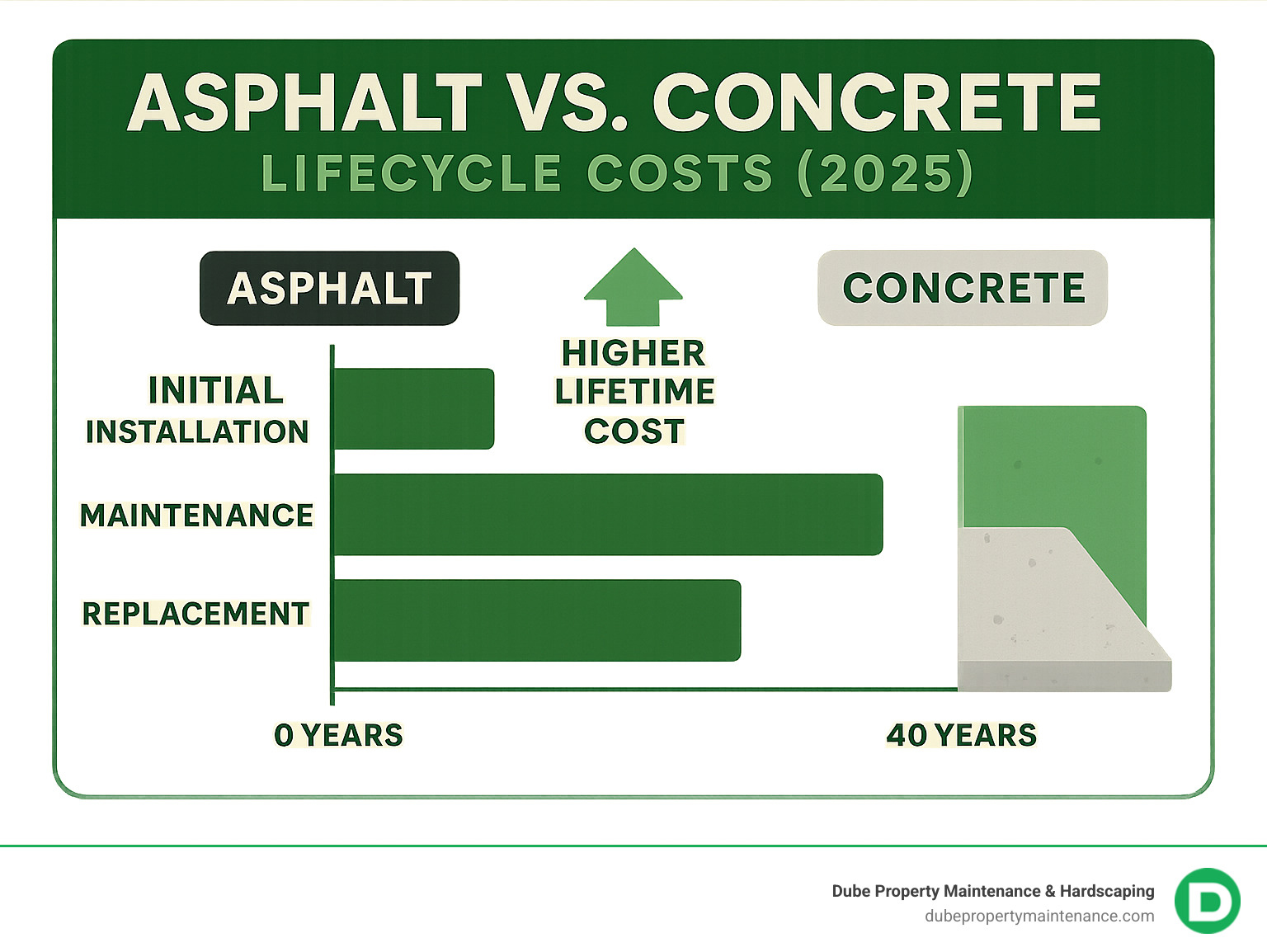
Making the switch from asphalt to concrete isn’t just about upfront costs. It’s about long-term value. While concrete costs more initially, it can last up to 40 years compared to asphalt’s 20-year lifespan. For homeowners in Methuen and surrounding areas, this decision impacts both your wallet and your property’s curb appeal for decades.
The process involves more than just ripping out old pavement. You’re looking at utility marking, proper disposal, base preparation, and concrete curing time. Each step affects your final bill.
Most homeowners are surprised by the hidden costs – things like drainage upgrades, landscaping repairs, and seasonal timing. Understanding these factors upfront helps you budget properly and avoid sticker shock.
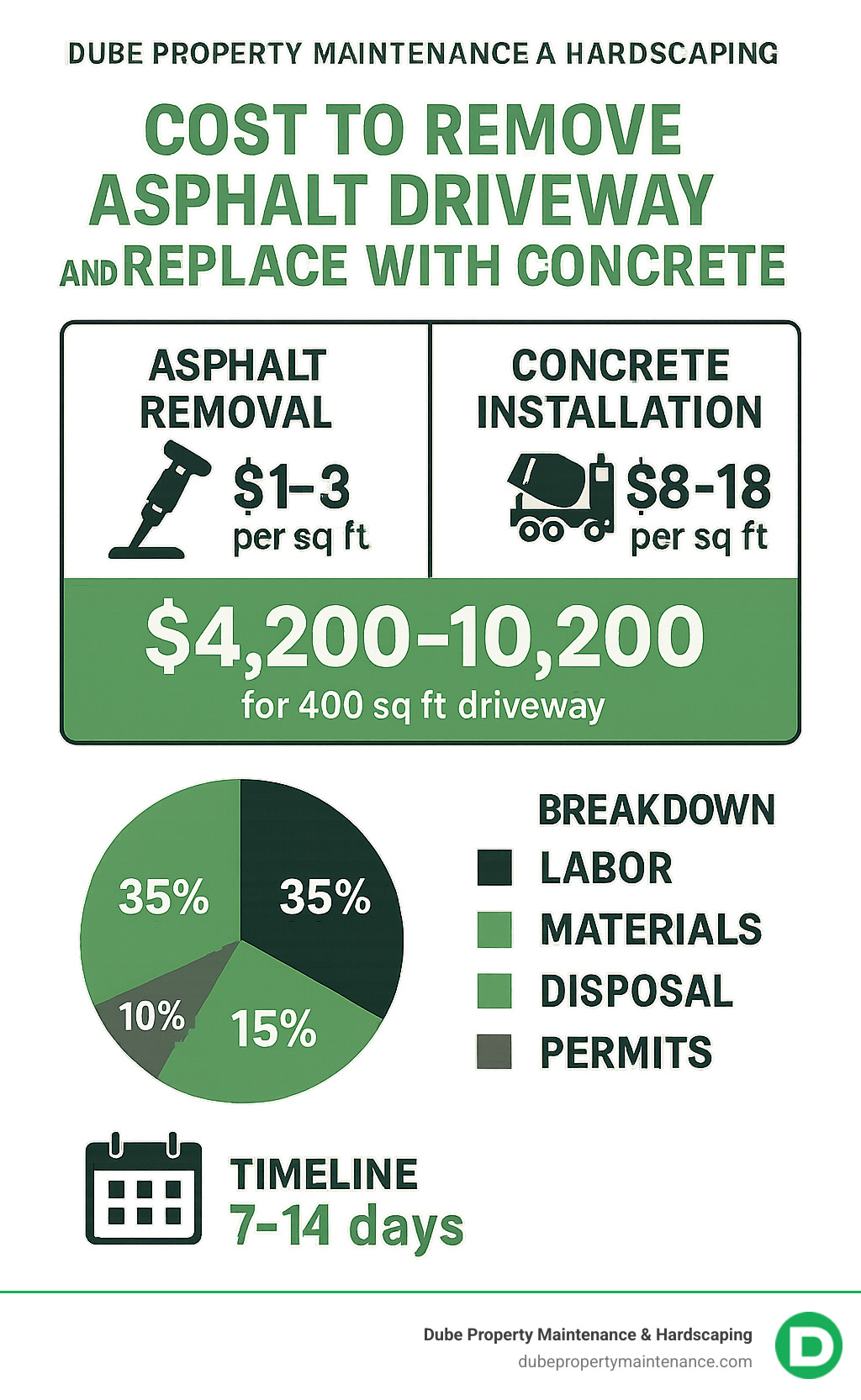
When we break down the cost to remove asphalt driveway and replace with concrete, we’re looking at several distinct components that together create your total investment. Labor accounts for up to 40% of the total project cost, with contractors charging between $16 to $38 per hour depending on your location and the complexity of the work.
The materials portion includes everything from the concrete mix to reinforcing steel, while disposal costs vary significantly based on local dump fees and recycling options. Permits, though often overlooked, can range from $50 to $200 depending on your municipality’s requirements.
Here’s how the costs typically break down:
| Cost Component | Percentage of Total | Price Range |
|---|---|---|
| Labor | 40% | $16-$38/hour |
| Materials | 35% | $8-$18/sq ft |
| Disposal | 15% | $1-$3/sq ft |
| Permits | 10% | $50-$200 |
Note: These are average costs based on internet data and not actual costs for Dube Property Maintenance and Hardscaping.
The beauty of economies of scale comes into play with larger driveways. While a 200-square-foot driveway might cost $15-$20 per square foot total, a 600-square-foot driveway often drops to $10-$15 per square foot due to more efficient equipment use and material ordering.
Using a standard 400-square-foot two-car driveway as our baseline, national averages show homeowners spending between $4,200 and $10,200 for complete asphalt removal and concrete replacement. This wide range reflects the significant variables in regional labor costs, material availability, and local regulations.
DIY enthusiasts might save $1,000-$3,000 by handling the demolition themselves, but professional installation of concrete is highly recommended. The concrete curing process requires precise timing and technique – drive too early and you’ll crack your investment, wait too long without proper curing and you’ll compromise strength.
Professional concrete installation ensures proper mix ratios, reinforcement placement, and curing schedules. Most concrete reaches sufficient strength for foot traffic in 7 days and vehicle traffic in 28 days, though weather conditions can extend these timelines.
Here in New England, we typically see costs running 10-15% higher than national averages due to higher labor rates and stricter environmental regulations. Urban areas like Boston or Cambridge can push costs even higher, while rural locations in New Hampshire might offer some savings.
The climate impact is real – our freeze-thaw cycles require thicker concrete pours (typically 4-6 inches versus 4 inches in warmer climates) and better drainage systems. This adds $1-$2 per square foot to the base cost but prevents costly cracking and heaving issues down the road.
Disposal fees vary dramatically by region. Some areas charge $30-$50 per ton for asphalt disposal, while others offer free recycling programs. In Massachusetts, many municipalities have acceptd asphalt recycling, which can reduce your disposal costs significantly.
The size of your driveway is the most obvious cost driver, but thickness matters just as much. Standard residential asphalt is typically 3-4 inches thick, while commercial applications might be 5-6 inches. Thicker asphalt means more material to remove and higher disposal costs.
Your existing sub-base condition can be a pleasant surprise or an expensive shock. If the gravel base is well-compacted and properly graded, you might reuse it and save $1-$2 per square foot. However, if it’s contaminated with asphalt chunks or poorly drained, complete replacement becomes necessary.
Site accessibility plays a huge role in equipment costs. A driveway with easy access for excavators and concrete trucks keeps costs down. Tight spaces, steep grades, or overhead obstructions require smaller equipment and more hand labor, potentially doubling labor costs.
Grading and drainage upgrades often become necessary during replacement. Poor drainage destroys concrete faster than almost anything else, so addressing these issues upfront saves money long-term. Expect to add $400-$2,400 for drainage improvements if needed.
More info about driveway installation
Equipment rental for DIY projects includes jackhammers ($75-$125/day), concrete saws ($30-$50/day plus blade wear), and skid steers ($150-$350/day). Professional contractors have this equipment and the expertise to use it efficiently.
Haul-off tonnage calculations matter because disposal fees are typically charged by weight. A 400-square-foot driveway with 4-inch thick asphalt weighs approximately 8-10 tons. At $30-$50 per ton disposal fees, you’re looking at $240-$500 just for getting rid of the old material.
Permit costs vary widely by municipality. Some towns require only a $50 building permit, while others mandate engineering reviews, environmental assessments, and stormwater management plans that can push permit costs to $200 or more.
Recycling credits can offset some disposal costs. Many asphalt recycling facilities pay $5-$15 per ton for clean asphalt, effectively reducing your disposal costs or even generating a small credit.
Tree roots are the sneaky budget-buster we see most often. Mature trees can send roots under driveways, and removing these roots properly requires careful excavation and sometimes tree service consultation. Budget an extra $500-$1,500 if large trees are nearby.
Utility relocation happens more often than you’d think. Gas lines, electrical conduits, and water services sometimes run closer to the surface than expected. While utility marking is free through 811, actual relocation can cost $1,000-$3,000 depending on the utility type.
Gutter tie-ins and drainage connections often need updating when you change driveway elevation or slope. This might require extending downspouts, adjusting catch basins, or installing new drainage pipes. Plan for $300-$800 in additional drainage work.
Landscaping repairs around the driveway edges are almost inevitable. Equipment operation and material delivery can damage adjacent lawn, plantings, or hardscaping. Budget 10-15% of your project cost for landscaping restoration.
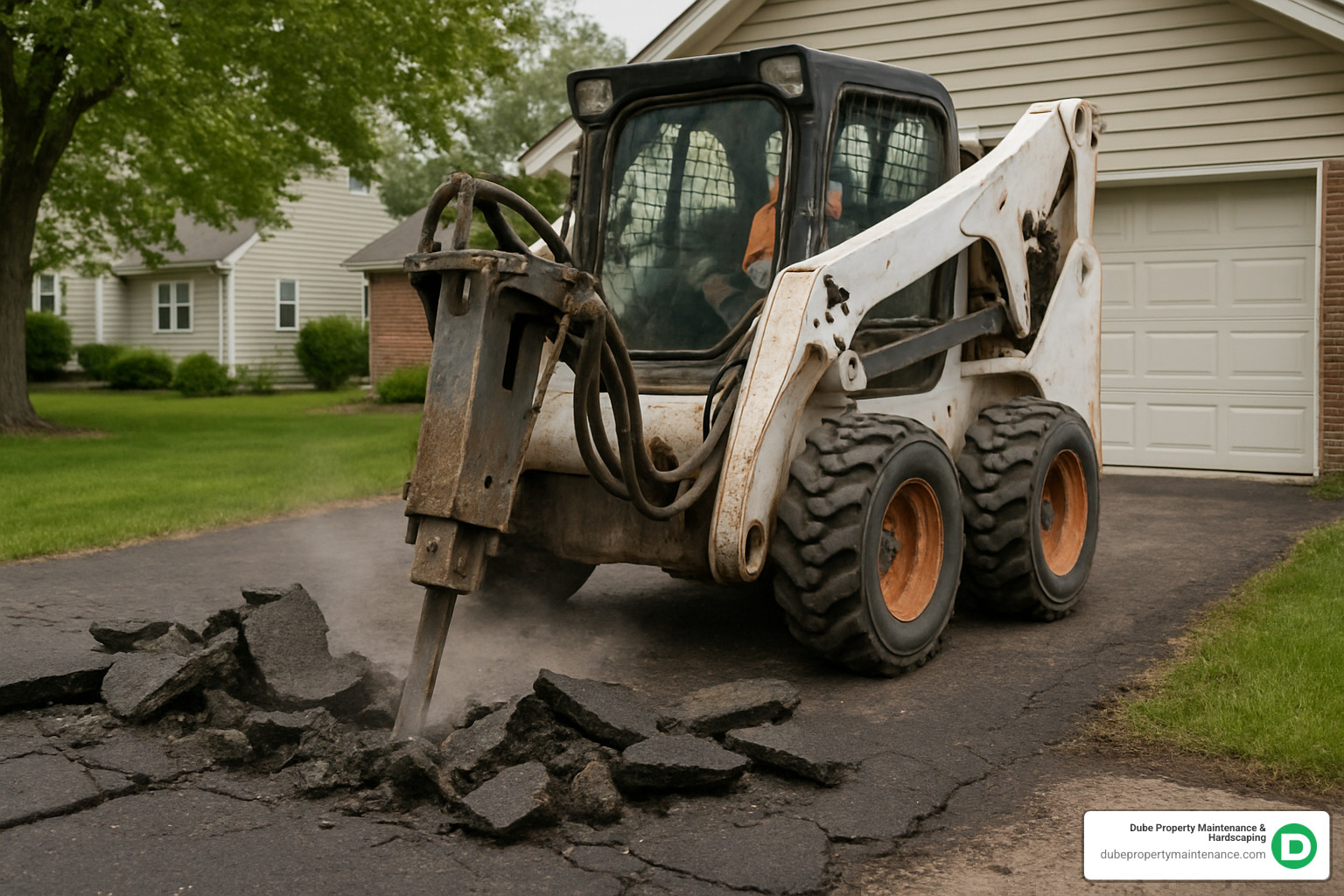
The process begins with utility marking through 811 – this free service must be completed at least 72 hours before any digging begins. Professional contractors handle this automatically, but DIY enthusiasts need to make the call themselves.
Demolition tools vary by project size. Hand tools like jackhammers and circular saws work for small areas, but excavators with breaker attachments make quick work of full driveways. Most residential projects take 1-2 days for complete asphalt removal.
Base compaction is critical and often overlooked by DIY attempts. The existing gravel base needs testing and often recompaction with a plate compactor or vibratory roller. This step determines the longevity of your new concrete.
Steel reinforcement isn’t always required but is highly recommended for driveways. Rebar or wire mesh adds $0.50-$1.00 per square foot but significantly reduces cracking risk. We typically recommend 3/4-inch rebar on 18-inch centers for residential driveways.
The concrete pour itself is surprisingly quick – usually completed in one day for typical residential driveways. However, finishing work including edging, jointing, and texturing can add another day to the timeline.
Curing is the longest part of the process. Initial set happens in 24-48 hours, but full strength takes 28 days. Most contractors allow light foot traffic after 7 days and vehicle traffic after 14 days, though optimal strength requires the full month.
Total project timeline runs 7-14 days from start to finish, with weather being the biggest variable. Rain delays concrete pours, and extreme temperatures require special admixtures or curing procedures.
More info about cost to pave a driveway
Demo labor is where motivated homeowners can save the most money. Renting a jackhammer for $75-$125 per day and breaking up asphalt yourself can save $1,000-$2,000 in labor costs. Just remember to wear proper safety equipment and take frequent breaks.
Debris sorting can reduce disposal costs if you separate asphalt from concrete and other materials. Clean asphalt often has recycling value, while mixed debris costs more to dispose of.
Sealing joints later is another DIY-friendly task. Concrete expansion joints need sealing 6-12 months after installation, and doing this yourself saves $200-$400 in contractor costs.
Rentable tools for DIY participation:
Sub-grade testing ensures your base can support the concrete load. Professional contractors test soil compaction and make adjustments before pouring. This prevents settling and cracking issues that plague DIY installations.
PSI mix design matters more than most homeowners realize. Residential driveways typically use 3,000-4,000 PSI concrete, but local climate and soil conditions might require adjustments. Professional contractors know local requirements and order appropriate mixes.
Control-joint spacing prevents random cracking by creating planned weak points. Joints should be spaced no more than 10 feet apart and cut to 1/4 the slab thickness within 24 hours of pouring.
Inspection schedules vary by municipality but typically include base inspection before concrete pour and final inspection after curing. Professional contractors coordinate these inspections and ensure compliance with local codes.
Bulk contractor quotes can save 10-20% when you coordinate with neighbors for multiple driveways. Contractors appreciate the efficiency of working in one area and often pass savings along to customers.
Off-season scheduling in late fall or early spring can reduce labor costs by 15-25%. Contractors have more availability and are often willing to negotiate better rates during slower periods.
Recycling old asphalt can generate $5-$15 per ton in credits while reducing disposal costs. Many contractors have relationships with recycling facilities and can arrange pickup directly from your site.
Retaining the existing gravel base saves $1-$2 per square foot if it’s in good condition. Professional evaluation is worth the cost to determine if your base can be reused.
Neighbor group discounts work when multiple properties need work simultaneously. We’ve seen savings of $500-$1,500 per driveway when coordinating 3-4 projects in the same neighborhood.
Property value increases of 5-10% are common with driveway replacement, especially when switching from deteriorated asphalt to new concrete. The exact increase depends on your local market and the condition of your previous driveway.
On average, it costs between $500-$5,000 for demolition services, with most homeowners spending in the $1,000-$3,000 range for typical residential driveways.
Cost to Remove and Replace Concrete Driveway Per Square Foot
The 40-year lifespan of concrete versus asphalt’s 20-year lifespan creates significant long-term value. While asphalt requires resealing every 3-5 years at $0.18-$0.95 per square foot, concrete needs resealing only every 5-10 years.
Lower heat island effect makes concrete more comfortable in summer and can reduce cooling costs for adjacent buildings. Light-colored concrete reflects more heat than dark asphalt, creating a more pleasant environment.
Insurance companies sometimes offer discounts for concrete driveways due to their fire resistance and durability. While not universal, these savings can add up over the decades.
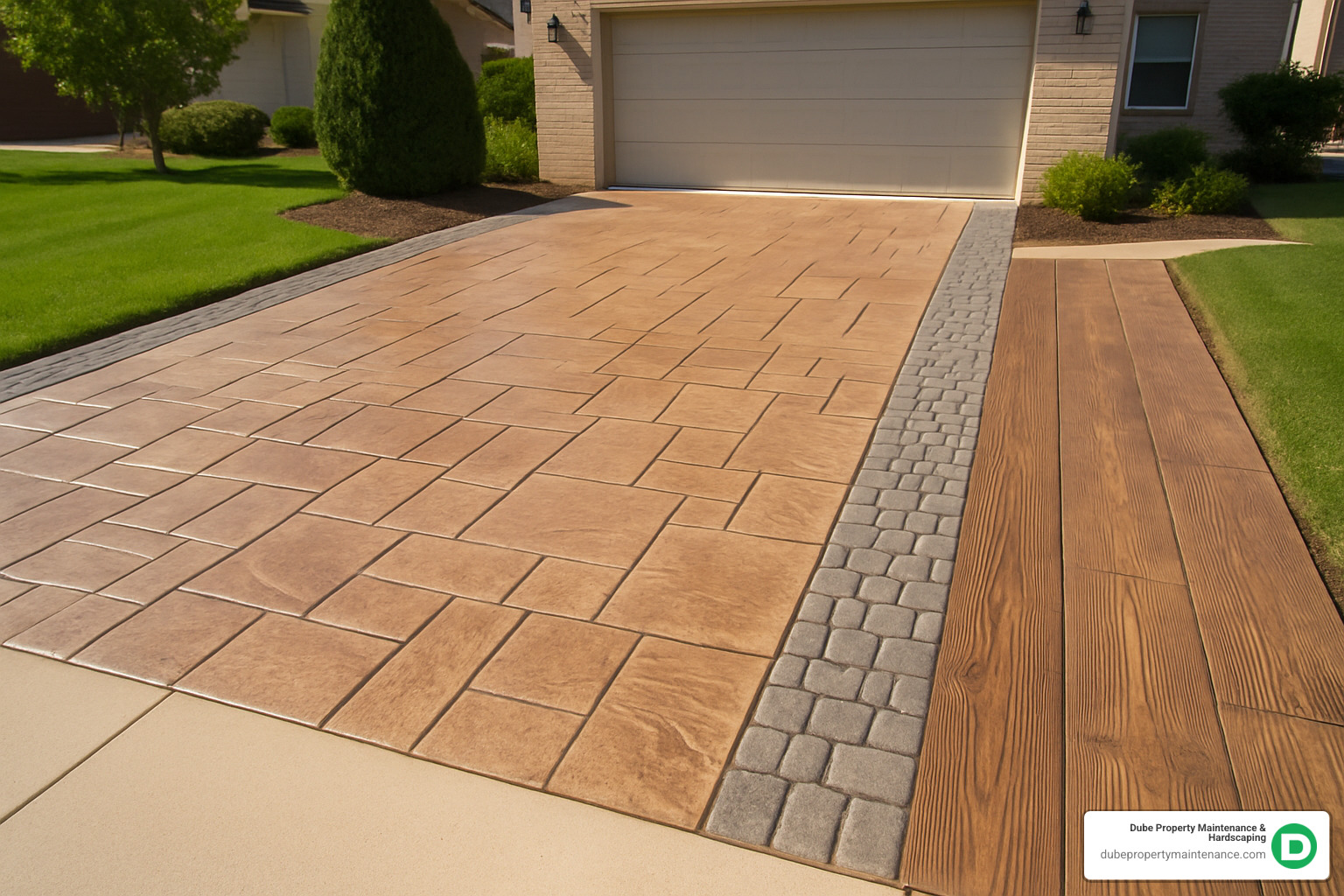
Decorative stamping adds $2-$8 per square foot to your base concrete cost but creates the appearance of brick, stone, or tile. Popular patterns include ashlar slate, cobblestone, and wood plank designs.
Exposed aggregate finishes cost $1-$3 per square foot extra but provide excellent traction and visual interest. This technique exposes decorative stones in the concrete surface for a natural, textured appearance.
Radiant heat mats can be installed during concrete pouring for $10-$15 per square foot. While expensive upfront, heated driveways eliminate snow removal costs and ice hazards in our New England winters.
Lighting sleeves installed during concrete work cost only $2-$5 per linear foot but allow future lighting installation without cutting into the finished surface. This forward-thinking approach saves money if you later want driveway lighting.
You can walk on new concrete after 7 days, but we recommend waiting 14 days for vehicle traffic and 28 days for heavy vehicles. Weather affects these timelines – hot weather accelerates curing while cold weather slows it down.
High humidity can extend curing times, while low humidity might require additional water curing to prevent surface cracking. Professional contractors monitor weather conditions and adjust curing procedures accordingly.
Most Massachusetts municipalities require permits for driveway replacement, especially if you’re changing the size, location, or drainage patterns. Local bylaws vary significantly between towns.
Setback rules often require driveways to be certain distances from property lines, wells, or septic systems. These requirements can affect your design and add to costs if modifications are needed.
Stormwater regulations are increasingly common and might require detention systems or permeable surfaces. These requirements can add $1,000-$5,000 to your project but are mandatory in many areas.
Fee ranges typically run $50-$200 for residential driveway permits, though complex projects requiring engineering review can cost more.
Base inspection by a professional can determine if your existing gravel is suitable for reuse. Well-compacted, properly graded gravel can save $1-$2 per square foot in material and labor costs.
Compaction testing ensures the base can support concrete loads without settling. This simple test can prevent expensive cracking and repair issues later.
Savings of $1-$2 per square foot might seem small, but on a 400-square-foot driveway, that’s $400-$800 in your pocket. The environmental benefit of reusing materials is an added bonus.
However, contaminated bases with asphalt chunks, organic matter, or poor drainage must be replaced regardless of cost savings. Cutting corners on the base always leads to premature concrete failure.
Understanding the cost to remove asphalt driveway and replace with concrete requires looking beyond the initial price tag to long-term value. While the upfront investment of $4,200-$10,200 for a typical 400-square-foot driveway might seem substantial, the 40-year lifespan and minimal maintenance requirements make concrete an excellent long-term investment.
The wide cost range reflects the many variables that affect your specific project – from site conditions and regional labor rates to upgrade choices and seasonal timing. Working with experienced professionals like our team at Dube Property Maintenance & Hardscaping ensures you understand all costs upfront and avoid expensive surprises.
We’ve seen too many DIY disasters and cut-rate contractor jobs that end up costing more than professional installation from the start. Our experience serving homeowners throughout Methuen, North Andover, Haverhill, and surrounding communities has taught us that quality installation pays dividends for decades.
The key to success is thorough planning, realistic budgeting, and choosing contractors who understand local conditions and regulations. Whether you’re looking to boost curb appeal, increase property value, or simply eliminate the hassle of asphalt maintenance, concrete replacement offers lasting benefits that justify the investment.
Ready to explore your options? Contact us for a comprehensive evaluation of your driveway replacement needs and a detailed cost estimate custom to your specific situation.
More info about replacing driveway