
When homeowners dream about upgrading their property with an neat paver driveway, the first question is almost always about price. The cost to paver driveway typically ranges from $6,000 to $18,000 for a standard installation, with most homeowners investing around $12,000 for a two-car driveway. But these numbers only tell part of the story.
If you’re browsing online for pricing information, you’ve probably noticed quite a range. That’s because paver driveways aren’t just about laying pretty stones in a pattern. The true cost encompasses proper excavation, drainage solutions, expert labor, and quality materials that will stand up to Methuen’s challenging New England weather.
On average, you can expect to pay between $10 and $30 per square foot for a professionally installed paver driveway. This price varies significantly based on size – small driveways under 1,000 square feet might cost between $9,000 and $14,000, while medium projects between 1,001-2,000 square feet typically run $15,000 to $25,000. For larger driveways exceeding 2,000 square feet, budget between $25,000 and $50,000+, though bulk material discounts might help offset some costs on bigger projects.
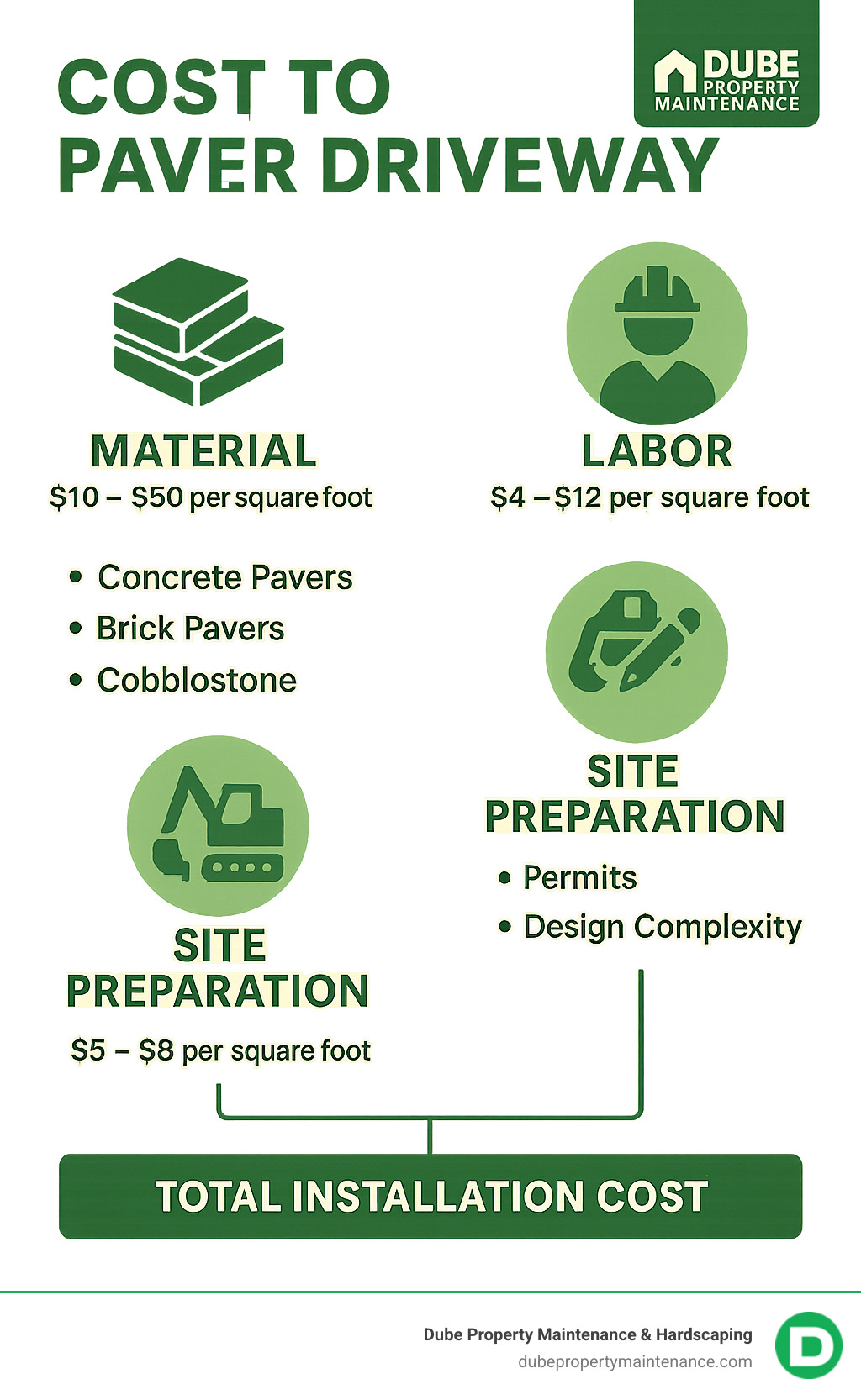
Your material choice dramatically impacts the bottom line. Concrete pavers are often the most budget-friendly at $10 to $25 per square foot, while brick pavers range from $10 to $45 per square foot. For a truly premium look, cobblestone commands $18 to $50 per square foot. If environmental concerns are a priority, permeable pavers that allow water drainage run between $10 and $70 per square foot.
What makes paver driveways worth considering despite potentially higher upfront costs? Unlike poured concrete or asphalt, properly installed pavers can last 25-50 years, offer easier repairs (just replace individual damaged units rather than entire sections), and add substantial value to your property – studies show a possible ROI of 50-75%. For Methuen homeowners dealing with freeze-thaw cycles, pavers also offer superior durability when properly installed.
For more specific information, you might want to explore these related topics:
– cost to install paver driveway
– cost to pave a driveway
Understanding the true cost to paver driveway isn’t just about number-crunching – it’s about making informed decisions for one of your home’s most visible features. Many homeowners are surprised to learn that the beautiful pavers you see represent only about 30-40% of the total project cost. The rest goes toward proper base preparation, drainage solutions, and expert installation.
Transparency in pricing helps you avoid that pit-in-your-stomach feeling when unexpected costs appear mid-project. When you understand what factors influence pricing, you can have more productive conversations with contractors and make smarter decisions about where to invest and where to economize.
Perhaps most importantly, accurate pricing information gives you genuine budget confidence. Rather than starting a project with foggy expectations, you can plan appropriately, set aside reasonable contingency funds (pros recommend 10-15%), and make informed decisions about materials and design options that balance your aesthetic vision with financial reality.
As Devin Brunke of Arcadia Design Group notes, “When we can’t unload the pavers close to the installation site, they must be brought in by hand in wheelbarrows. When that’s a long way, it drives higher costs. That also takes a much longer time and we need more laborers to move product as it’s needed. All that must be factored into the cost of a job.”
These “hidden” factors – site access, material handling, proper drainage engineering – often separate a bargain price from a realistic one. With Methuen’s seasonal challenges, cutting corners on installation today almost always leads to costly repairs tomorrow. A comprehensive pricing guide helps you understand not just what you’ll pay, but what you’re truly paying for.
Looking to upgrade your driveway in 2025? Let’s talk numbers. The cost to paver driveway this year typically falls between $6,000 and $18,000 for most homeowners. If you’re planning a standard two-car driveway (about 20 feet long by 24 feet wide), expect to land around the national average of $12,000.
Breaking this down to square footage, you’re looking at approximately $10 to $30 per square foot for a complete installation. This covers everything from the materials themselves to labor costs, proper site preparation, and basic design elements.
Please note that these figures represent average costs based on internet data and not actual costs for Dube Property Maintenance and Hardscaping. Your specific project may vary significantly based on multiple factors.
As one contractor colorfully put it, “When you look at a pile of pavers, it’s not that impressive. But man, the difference they can make when a skilled installer turns them into art.” This change isn’t cheap, but the boost to your property’s curb appeal and value can be remarkable.
| Cost Level | Total Project Cost | Square Footage | Features Included |
|---|---|---|---|
| Economy | $6,000-$10,000 | 600 sq ft | Basic concrete pavers, simple pattern, minimal site prep |
| Mid-Range | $10,000-$18,000 | 600-800 sq ft | Higher-quality pavers, standard patterns, average site prep |
| Premium | $18,000-$50,000+ | 800+ sq ft | Premium materials, complex patterns, extensive site work, additional features |
Where you live significantly impacts your cost to paver driveway. The price tag varies widely across different regions due to local labor rates, material availability, and climate considerations.
Here in the Northeast (including Methuen, MA), expect to pay between $12-$35 per square foot. Our region tends to have higher installation costs because our skilled tradespeople command better wages, our frost lines run deeper (requiring more extensive base preparation), our installation season is shorter (creating higher demand during warm months), and our freeze-thaw cycles demand more complex drainage solutions.
If you have friends on the West Coast/Bay Area, they’re likely paying even more—around $15-$40 per square foot. The Bay Area consistently ranks among the priciest regions for paver installation, driven by premium labor rates, higher material transportation costs, and stricter permitting requirements.
Meanwhile, folks in the Midwest enjoy more affordable rates at $8-$25 per square foot, thanks to lower labor costs, better material availability, and often less stringent permitting processes.
Homeowners in the South typically get the best deals, with prices ranging from $7-$22 per square foot. The year-round installation season, lower labor rates, and reduced base requirements in frost-free areas all contribute to more budget-friendly projects.
According to the Bureau of Labor Statistics, masonry workers in the Northeast earn approximately 15-20% more than the national average, which directly impacts your bottom line. For more detailed regional cost information, check out the Driveway Paver Cost Breakdown.
The size of your driveway project plays a major role in determining the overall cost to paver driveway. Let’s break down what you might expect to pay based on project scale:
Small Driveways (≤1,000 sq ft) typically run between $9,000-$14,000. These single-car width driveways (usually 10-12 feet wide) might extend up to 80-100 feet in length. While smaller in square footage, they often have a higher per-square-foot cost because contractors still need to cover fixed mobilization expenses. For example, an 800 sq ft installation in New England might cost approximately $11,000.
Medium Driveways (1,001-2,000 sq ft) represent the most common residential size, with prices ranging from $15,000-$25,000. These two-car width driveways (20-24 feet) with varying lengths make up the average installation. A standard 24′ x 40′ two-car driveway (960 sq ft) typically costs between $16,000-$22,000.
Large Driveways (>2,000 sq ft) jump significantly to $25,000-$50,000+. These may accommodate three cars side-by-side or feature circular designs with extensive square footage. A 4,500 sq ft driveway for a larger estate could easily reach $35,000-$50,000 or more.

Interestingly, larger installations sometimes benefit from economies of scale. As one contractor noted, “Cost becomes more competitive for larger driveways because contractors can buy materials in bulk and optimize crew mobilization.” However, this advantage may disappear if your design includes complex features like curves, circles, or multiple elevations.
When homeowners first consider installing a paver driveway, they’re often surprised to learn that the beautiful stones they’ve been admiring represent only a fraction of the total investment. The cost to paver driveway involves numerous hidden factors that explain why quotes can vary dramatically between contractors—and why cutting corners often leads to expensive repairs down the road.
Behind every stunning paver driveway lies a foundation that you’ll never see but will absolutely determine how long your investment lasts. Base preparation typically runs $4-$8 per square foot and includes excavation that goes 8-14 inches deep in frost-prone areas like Methuen, MA. This isn’t arbitrary—our harsh New England winters demand proper depth to prevent frost heave from destroying your driveway during the first freeze-thaw cycle.
The invisible layers matter most: geotextile fabric to prevent weed growth and improve stability, 6-12 inches of properly compacted crushed stone base, and 1-3 inches of bedding sand to create the perfect foundation for your pavers. As one of our clients recently remarked after watching our crew carefully prepare their site, “I had no idea there was so much work below the surface!”
Labor represents about half of your total project cost, typically running $5-$10 per square foot. This isn’t just paying someone to lay stones—it’s compensating skilled craftspeople who understand proper excavation techniques, precise grading for drainage, and expert installation methods that ensure your driveway will look beautiful for decades rather than months.
Site challenges can quickly impact your budget. Limited access adds $2-$4 per square foot when equipment can’t easily reach your installation area. Slopes and drainage issues might require engineering solutions that add $3-$8 per square foot. Clay soils, which are common in parts of Methuen, require additional compaction and sometimes soil amendments to prevent future settling.
Don’t forget about the paperwork! Permits typically cost $50-$250+ depending on your municipality. Regulations vary significantly across towns, with some requiring impervious surface calculations or multiple inspections throughout the installation process.
Removing existing materials is another significant expense: concrete removal runs $550-$1,800 for a typical driveway, while asphalt removal costs $400-$1,200. Disposal fees vary based on material and local regulations, often adding hundreds to your project total.
As Devin Brunke wisely points out, “People are attracted to amoeba shapes, which are not an efficient use of space. Rectilinear designs always work better with pavers so there’s less cutting and fitting.” This simple design choice can significantly impact your bottom line.
For more detailed information about proper base preparation, visit our base for pavers page.
The site preparation phase often delivers the biggest sticker shock when homeowners review quotes for their cost to paver driveway. Though it represents 30-40% of your total project cost, this critical work becomes completely invisible once your beautiful pavers are installed.
Your property’s soil type dramatically impacts preparation costs and methods. Clay soils require extensive compaction (minimum 95%) and often need additional drainage solutions to prevent water pooling. Sandy soils might seem ideal, but they frequently need stabilization to prevent future settling. Rocky terrain can significantly increase excavation costs as large stones must be removed to create a stable base.
Equipment requirements add another layer of expense. A typical installation requires an excavator or backhoe ($200-$400 daily rental), plate compactor ($75-$170 daily rental), and often a skid steer ($250-$500 daily rental). Professional companies like ours maintain this equipment, but the costs of ownership, maintenance, and transportation to your site are factored into your project price.
The New England weather creates unique challenges for driveway installations in Methuen and surrounding areas. Frozen ground in winter may require specialized equipment or simply force delays until conditions improve. Heavy rain can create muddy conditions that prevent proper compaction, while spring thaw often reveals drainage issues that must be addressed before installation can proceed.

As one of our veteran installers often tells clients, “What happens below the surface determines whether your driveway lasts 5 years or 25 years. We can’t cut corners on base preparation in New England because the freeze-thaw cycle will expose any weaknesses.” This wisdom explains why proper site preparation, though expensive, remains the best investment you can make in your project.
Labor and crew mobilization typically account for about half of the total cost to paver driveway, making it the largest single factor in your project budget. Understanding these costs helps explain why quotes can vary so dramatically between contractors.
A professional paver installation typically requires a crew of 3-5 skilled workers, each with specialized roles. You’ll need an excavator operator who can precisely grade your site, base preparation specialists who understand proper compaction techniques, and experienced paver installers who can create tight, level patterns that will remain stable for decades.
According to Bureau of Labor Statistics data, experienced hardscape installers earn $25-$45 per hour, while entry-level laborers make $15-$25 per hour. The crew foreman or project manager who oversees quality control and ensures the installation meets specifications typically commands $35-$60 per hour. These wages reflect the skilled nature of proper hardscaping work.
Before a single paver is laid, significant mobilization costs are incurred. Equipment transportation runs $150-$500 depending on distance and machinery requirements. Material delivery costs $100-$300 per truckload, and proper setup and staging requires time and space at the beginning of each workday. These “invisible” costs explain why even small projects have minimum price thresholds.
Timing can significantly impact your labor costs. Weekend work often commands a 25-50% premium as crews give up personal time. Rush jobs that require expedited scheduling may increase labor costs by 15-30%. And during peak season (spring/summer), demand typically drives higher rates across the industry.
At Dube Property Maintenance & Hardscaping, we maintain a full-time professional crew rather than relying on day laborers. While this approach might not always yield the lowest bid, it ensures consistent quality and accountability throughout your project. As one client recently told us, “The difference in installation quality was immediately apparent when I compared my neighbor’s bargain driveway to mine after just one winter.”
Navigating local codes and permitting requirements is an often-overlooked aspect of calculating the cost to paver driveway. In Methuen, MA and surrounding communities, these regulations can significantly impact both your timeline and budget.
Most municipalities require driveway permits costing $50-$250, depending on your location. These permits often include impervious surface calculations that may limit the total paved area allowed on your property—a particularly important consideration if you’re planning to expand your current driveway. Setback requirements typically mandate 5-10 feet of clearance from property lines, while drainage plans may be required for larger installations to ensure proper stormwater management.
Methuen has specific considerations that homeowners should be aware of. If your property contains or is near wetlands, Conservation Commission approval may be required before work can begin—a process that can add weeks to your timeline. The town typically requires inspections at key stages, including after excavation and after base installation, to ensure compliance with building codes. And if your property is in a historical district, you may face additional design restrictions that impact material and pattern choices.
These requirements often create hidden compliance costs that surprise homeowners. Complex sites may need professional engineering plans costing $500-$2,000. Properties with runoff concerns could require specialized drainage solutions ranging from $1,000-$5,000 or more. And if your initial submissions require revisions or resubmissions, your project could be delayed by weeks while you wait for approvals.
As local hardscaping experts who’ve completed hundreds of projects in Methuen and surrounding communities, we’re intimately familiar with the specific requirements in each town. This knowledge helps us steer the permitting process efficiently, avoiding costly delays and compliance issues that often arise when working with contractors unfamiliar with local regulations.
“The permit process was something I never considered when budgeting for my driveway,” one recent client told us. “Having a contractor who knew exactly what was needed and handled all the paperwork saved me weeks of frustration and probably thousands in potential rework.”
When planning your new driveway, material selection might just be the most exciting—and budget-impacting—decision you’ll make. The cost to paver driveway varies dramatically depending on the materials you choose and the design complexity you desire.
Concrete pavers represent the most popular choice for many homeowners, typically costing between $10-$25 per square foot installed. These versatile options offer excellent durability (25-50 years with proper care) and come in countless colors and styles. While they may fade slightly over time, their value proposition is hard to beat for most residential applications.
Brick pavers bring a timeless, classic aesthetic to your property at $10-$45 per square foot installed. Their natural clay composition means colors remain vibrant for decades, though your color palette is somewhat limited compared to concrete options. In New England’s freeze-thaw cycles, quality installation becomes especially important to prevent cracking.
“I’ve had customers initially balk at brick pricing,” shares one contractor, “but when they understand these pavers might outlive their mortgage, the perspective shifts completely.”
For the ultimate in prestige and longevity, cobblestone pavers ($18-$50 per square foot) deliver best character. These natural stone options can last an astonishing 75-100 years when properly installed. The irregular surface and limited color range make them less practical for some applications, but nothing matches their distinctive old-world charm.
Environmentally conscious homeowners are increasingly considering permeable pavers, which range from $10-$70 per square foot installed. While they require more maintenance and specialized installation, they significantly reduce runoff and may qualify for local environmental incentives.

Don’t forget to factor in edging materials (typically $5-$15 per linear foot for concrete curbing) and pattern waste—complex designs often require 10-20% additional material to account for cuts and fitting. As one homeowner told us, “We initially chose the cheapest concrete pavers but upgraded after seeing samples in person. The difference in appearance was worth the extra $2,000 for our project.”
For a helpful starting point in calculating your specific project costs, the Homewyse cost calculator provides customizable estimates based on your location and project parameters.
Beyond basic pricing, understanding the performance characteristics of different paver materials helps justify their cost differences and determine the best value for your specific situation.
Concrete pavers offer the best overall value for most homes with their impressive 8,000+ PSI compression strength. While you can expect some color fading over 5-10 years, their extensive texture options and reasonable price point make them the go-to choice for budget-conscious homeowners who still want durability and style flexibility.
Brick pavers command a premium price, but many homeowners find the investment worthwhile. With compression strength between 8,000-12,000 PSI and excellent color retention (since the color runs throughout the material), brick pavers are particularly well-suited for traditional homes where authentic materials improve architectural character.
Natural stone pavers represent the luxury end of the spectrum. Their compression strength varies widely (7,000-20,000+ PSI depending on stone type), but their best uniqueness and prestige make them worth the investment for certain high-end applications. As one contractor wisely noted, “Don’t just look at the initial price tag. Consider how the material will perform over decades in New England’s challenging climate. The most expensive option isn’t always necessary, but the cheapest rarely delivers the best long-term value.”
For modern designs, porcelain pavers have gained popularity with their exceptional 10,000+ PSI strength and virtually fade-proof coloration. Though relatively new to the residential market, their consistent appearance and impressive performance characteristics justify their premium pricing for contemporary homes.
The growing interest in sustainable landscaping has brought eco-friendly paving options into the mainstream conversation about the cost to paver driveway. While these options typically command a price premium, they offer significant environmental benefits that many homeowners find compelling.
Permeable paver systems add approximately $2-$10 per square foot over traditional pavers, but their environmental impact is substantial—reducing stormwater runoff by 70-100% in most applications. The specialized installation requires a different base preparation with larger aggregate stones that create water storage capacity beneath your driveway. Annual cleaning is recommended to maintain optimal permeability.
“Permeable pavers aren’t just environmentally responsible—they’re practical in New England,” explains a local contractor. “They help manage snowmelt and reduce ice formation by allowing water to drain rather than pool on the surface.”
Grass pavers offer another eco-friendly option at $10-$20 per square foot installed. These systems blend hardscape functionality with landscape aesthetics, reducing the heat island effect while allowing natural water infiltration. They’re particularly well-suited for overflow parking areas, fire lanes, or low-traffic sections of larger driveways.
Some manufacturers now offer pavers made from recycled materials, though pricing varies widely based on source materials and regional availability. While these options divert waste from landfills, it’s important to carefully evaluate their durability and performance characteristics before committing.

The financial equation for eco-friendly options may improve through various incentive programs. Some municipalities offer stormwater credits or reduced fees for permeable installations, while commercial properties may earn valuable LEED points. Before finalizing your paver selection, check with local environmental agencies about potential rebate programs that could offset the higher initial investment.
For more information about permeable paver options and their environmental benefits, Belgard permeable pavers offers an excellent resource.
The pattern you choose for your paver installation can impact your bottom line just as much as your material selection—something many homeowners don’t fully appreciate until they’re comparing quotes. The cost to paver driveway increases significantly with design complexity due to the additional labor hours required.
A simple running bond pattern (like a standard brick wall) represents the baseline labor cost for installation. Move to a herringbone pattern, and you’re looking at a 15-25% labor premium due to the additional cutting and alignment precision required. Circular features dramatically increase complexity, adding 25-40% to labor costs as installers must carefully cut each piece to maintain the radius while ensuring structural integrity.
Custom inlays or decorative borders might be the perfect finishing touch for your dream driveway, but they come at a price—typically adding 20-35% to labor costs. Each transition between materials or patterns requires precise cutting and additional time.
Material waste is another hidden cost of complex designs. While a simple pattern might generate minimal waste, intricate designs typically require 10-20% additional material to account for the necessary cuts. As one experienced installer candidly shared, “A simple pattern might allow us to install 100 square feet per day, while an intricate design with lots of cuts might reduce that to 50 square feet per day. That directly impacts your labor costs.”
If you’re looking to maximize value, consider these design efficiency tips:
Rectilinear designs with straight lines and 90-degree angles minimize cutting requirements and waste.
Standard paver sizes work more efficiently together than custom or mixed sizes.
Border designs using full pavers reduce the need for precision cuts.
Consistent patterns install more quickly than random arrangements that require constant decision-making.
Sometimes the most neat solution is using premium materials in a simple pattern rather than basic materials in a complex arrangement. This approach often creates more visual impact while keeping labor costs manageable.
When homeowners research the cost to paver driveway, many consider the DIY route to save money. While this approach can reduce upfront expenses, it comes with significant trade-offs that deserve careful consideration.
DIY paver installation typically costs between $3–$8 per square foot for materials alone, compared to $7–$15 per square foot for professional installation. But these numbers only tell part of the story. DIY projects require equipment rental (typically $300–$800 for a weekend), including excavators, plate compactors, and wet saws. More importantly, they demand a substantial time investment—often 40–80 hours for an average driveway.
“The biggest mistake homeowners make is underestimating the physical demands and technical knowledge required,” explains a veteran installer. “What professionals can accomplish in days often takes DIYers weeks, with results that may not stand the test of time.”
When evaluating long-term value, consider that properly installed paver driveways last 25–50 years, compared to 15–20 years for asphalt and 20–30 years for concrete. This durability translates to a significant return on investment, with homeowners typically recouping 50–75% of the cost in added property value.

Beyond longevity, paver driveways offer practical advantages when repairs become necessary. Rather than replacing entire sections, individual pavers can be removed and replaced—a significant benefit over the years of ownership.
For more information about our professional driveway installation services, visit our Driveway Installation page.
Despite the advantages of professional installation, there are scenarios where tackling a paver project yourself makes sense when considering the cost to paver driveway. DIY can be appropriate for simple rectangular layouts with minimal cutting, especially for smaller projects under 400 square feet.
Properties with an existing gravel base in good condition offer a significant head start, eliminating much of the excavation work. Homeowners with construction or landscaping experience will find the learning curve less steep, and those with flexible timelines can work at their own pace without pressure.
Success hinges on thorough research and proper equipment. At minimum, you’ll need access to excavation equipment, a plate compactor with at least 5,000 pounds of force, a wet saw for cutting pavers, and leveling tools. Physical stamina is essential—remember that individual pavers typically weigh 10–15 pounds each, and you’ll be handling thousands of them.
One successful DIYer shared, “I saved about $3,000 by installing my own 400 square foot patio, but it took me three full weekends of work. The key was spending twice as much time on the base preparation as on the actual paver installation.”
If you decide to go the DIY route, we recommend purchasing 10–15% extra materials to account for cutting waste and potential future repairs. This small additional investment provides valuable peace of mind and prevents color-matching issues if you need replacement pavers years later.
Professional installation offers significant advantages when evaluating the cost to paver driveway, particularly for complex projects or when long-term performance is your priority.
Experienced contractors bring technical expertise that’s difficult to replicate as a weekend warrior. They calculate proper base depth based on your specific soil type and local climate conditions. They engineer precise slopes (ideally ¼” per foot) to ensure optimal drainage away from your home’s foundation. Their compaction techniques prevent future settling, and they use professional-grade equipment that delivers consistent results.
The efficiency advantage can’t be overstated. What might take a homeowner several weekends or even months to complete, professional crews can accomplish in just 3–7 days. They have established supply chains ensuring material availability and quality, specialized equipment for handling heavy materials safely, and the experience to monitor and adapt to weather conditions for optimal installation.
Risk reduction represents another compelling reason to hire professionals. Reputable companies carry liability insurance protecting against property damage and typically offer workmanship warranties ranging from 1–5 years. They handle permitting and code compliance, preventing potential legal issues, and their established relationships with local inspectors facilitate the approval process.
As one Methuen homeowner explained, “After watching my neighbor struggle with their DIY paver project for weeks, I decided to hire professionals. The difference in quality was immediately apparent, and five years later, their driveway has settled unevenly while mine looks practically new.”
At Dube Property Maintenance & Hardscaping, our crews average over 10 years of hardscaping experience, ensuring your project benefits from established techniques and proven solutions specific to New England’s unique climate challenges.
When calculating the true cost to paver driveway, don’t overlook ongoing maintenance expenses over the installation’s lifetime. While properly maintained paver driveways can last decades, they do require periodic attention to maintain their beauty and functionality.
A typical maintenance schedule includes annual pressure washing ($100–$300 if professionally done), regular weed control (2–4 times annually, either DIY or $50–$150 per professional service), joint sand replenishment every 3–5 years ($200–$500), and sealer application on the same schedule ($200–$400).
When compared to alternatives, paver maintenance costs remain competitive. Paver driveways average $300–$600 in annual maintenance, while asphalt driveways run $200–$400 annually plus approximately $300 for sealcoating every three years. Concrete driveways may cost less annually ($100–$300) but often require expensive crack repairs, especially in freeze-thaw climates like New England.

The modular nature of pavers offers significant long-term value. “The beauty of pavers is their modular nature,” explains one contractor. “If a tree root causes a section to heave or a chemical spill damages a few units, we can remove and replace just those affected pavers without disturbing the entire driveway.”
Pavers also resist staining when properly sealed, maintain their appearance for decades, and handle freeze-thaw cycles better than solid surfaces. For homeowners in Methuen and surrounding areas, we recommend applying a quality penetrating sealer after installation and reapplying every 3–5 years. This simple maintenance step significantly extends paver life and improves appearance, particularly during New England’s harsh winters.
When you’re researching the cost to paver driveway, those handy online calculators can be tempting tools to quickly get a number. While they do provide helpful starting points for your budget planning, they come with some significant limitations worth understanding.
Most online calculators use national averages that might not reflect what we see on the ground here in Methuen and the surrounding areas. New England’s unique soil conditions, labor markets, and material availability can create quite different pricing scenarios than what generic calculators suggest. You’ll typically see a margin of error around 15-20% for simple rectangular driveways, but that jumps to 25-30% or even higher when dealing with complex designs or challenging terrain.
“Online calculators are a starting point, not an endpoint,” as one of our contractors often tells customers. “They’re useful for initial budgeting, but only an on-site evaluation can account for the specific challenges of your property.”
To get more value from these tools, always input your specific zip code when that option is available, and consider adding a 10-20% contingency for unexpected conditions. Better yet, gather material quotes from local suppliers and request multiple professional estimates to compare. The most accurate picture will always come from an on-site consultation where a professional can evaluate your specific conditions and requirements.
When weighing the cost to paver driveway against other materials, the longevity factor becomes crucial to understanding the true value of your investment. The durability advantage of pavers often justifies their higher initial price tag when you look at the bigger picture.
Paver driveways typically last 25-50 years with proper installation and maintenance, significantly outlasting concrete driveways (20-30 years before significant cracking) and asphalt driveways (15-20 years before major deterioration). This extended lifespan means you might replace an asphalt driveway twice during the lifetime of a single paver installation.
Pavers particularly shine in our New England climate where freeze-thaw cycles wreak havoc on solid surfaces. The interlocking system allows for slight movement without cracking, unlike concrete which tends to develop unsightly cracks after a few harsh winters. When a concrete driveway cracks, the entire section often needs replacement, while with pavers, you can simply replace individual units—a much more cost-effective repair approach.
“The initial cost difference between pavers and concrete narrows significantly when you factor in lifespan,” one of our industry veterans points out. “A concrete driveway might need complete replacement after 25 years, while a paver driveway might only need minor repairs and maintenance during the same period.”
The historical evidence speaks volumes too—many European streets paved centuries ago still function today, and modern high-stress applications like airports and ports rely on pavers for their exceptional durability under extreme conditions.
Many homeowners ask us about overlay options as a way to reduce the cost to paver driveway installation. It’s a reasonable question—if you already have a concrete driveway, why not use it as a base? While this approach is technically possible using thin pavers (typically 1″ thick), it comes with important considerations that might affect your long-term satisfaction.
For an overlay to work, your existing concrete must be structurally sound with only minor cracking. Significant cracks, settling, or drainage issues in the current driveway will eventually transfer to your new paver surface. The existing slope must also provide adequate runoff, as proper drainage becomes even more critical with an overlay installation.
From a cost perspective, you might save approximately 25-35% compared to a full installation, primarily by eliminating excavation and base preparation costs. The installation time is typically 30-40% less as well. However, these savings come with potential trade-offs.
“If your concrete is in reasonably good condition with minor cracking, an overlay can be a cost-effective solution,” explains one of our hardscaping professionals. “However, if there are significant structural issues or drainage problems, removing the concrete and starting fresh will provide better long-term value.”
Overlays typically have a shorter lifespan (15-25 years versus 25-50 for full installations), and many contractors offer reduced warranty coverage for this application. You’ll also need to consider the height implications—an overlay raises your driveway level by 1-3 inches, which may require transitions at your garage entrance and street connection.
Before deciding on this approach, we strongly recommend having a qualified professional assess your existing concrete. The condition of your current driveway and your long-term expectations will determine whether the initial savings justify the potential compromises.
The cost to paver driveway journey we’ve taken together reveals both the investment required and the lasting value these beautiful hardscapes deliver. Throughout this guide, we’ve finded that while paver driveways aren’t inexpensive, they offer compelling long-term benefits that often justify their upfront costs.
Your specific project cost will depend on numerous factors that we’ve explored together. Size plays a major role, with small single-car driveways typically running $9,000-$14,000, while expansive multi-car installations can reach $25,000-$50,000 or more. The materials you choose create another significant variable—basic concrete pavers start around $10-$25 per square foot installed, while premium natural stone options can command $15-$60 per square foot.
Don’t underestimate the impact of your property’s unique characteristics either. The condition of your soil, necessary drainage solutions, and removal of existing materials all influence your bottom line. And of course, design complexity matters tremendously—those beautiful herringbone patterns and circular features you’ve admired will add 15-40% to your labor costs compared to simpler layouts.
Here in Methuen and throughout New England, our freeze-thaw cycles demand particularly careful installation techniques. While you might find lower quotes from contractors willing to skimp on proper base preparation, these shortcuts often lead to settling, shifting, and premature failure—especially in our challenging climate.
When evaluating proposals, we’ve learned that the lowest bid rarely delivers the best value. Instead, look for contractors who provide detailed, transparent quotes that account for proper materials and installation techniques. Ask to see examples of their work that have withstood several New England winters, as this provides the truest testament to quality.
At Dube Property Maintenance & Hardscaping, we understand that a paver driveway represents a significant investment in your property. Our approach focuses on delivering lasting value through proper installation techniques, quality materials, and attention to the specific challenges posed by our local climate and soil conditions. We believe in transparent pricing that accounts for all necessary components of a properly installed paver driveway.
Your home deserves a driveway that not only improves its curb appeal today but continues performing beautifully for decades to come. For a personalized consultation about the cost to install paver driveway for your specific property, we invite you to contact us to discuss your project needs and vision.
