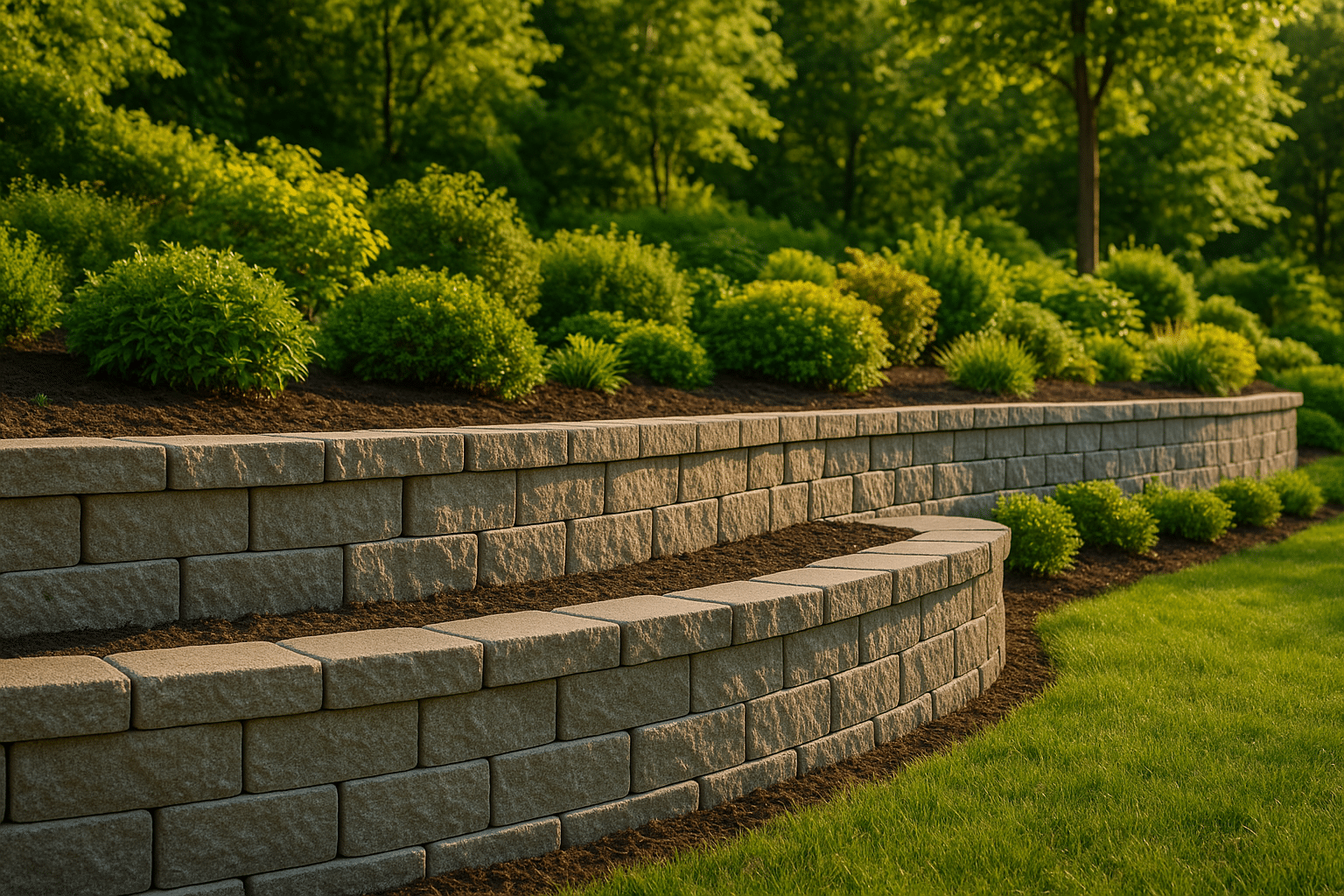

Concrete retaining wall blocks are durable precast units designed to hold back soil and create level areas in sloped landscapes. They combine structural strength with aesthetic appeal, making them ideal for both residential and commercial projects.
Quick Guide to Concrete Retaining Wall Block Types:
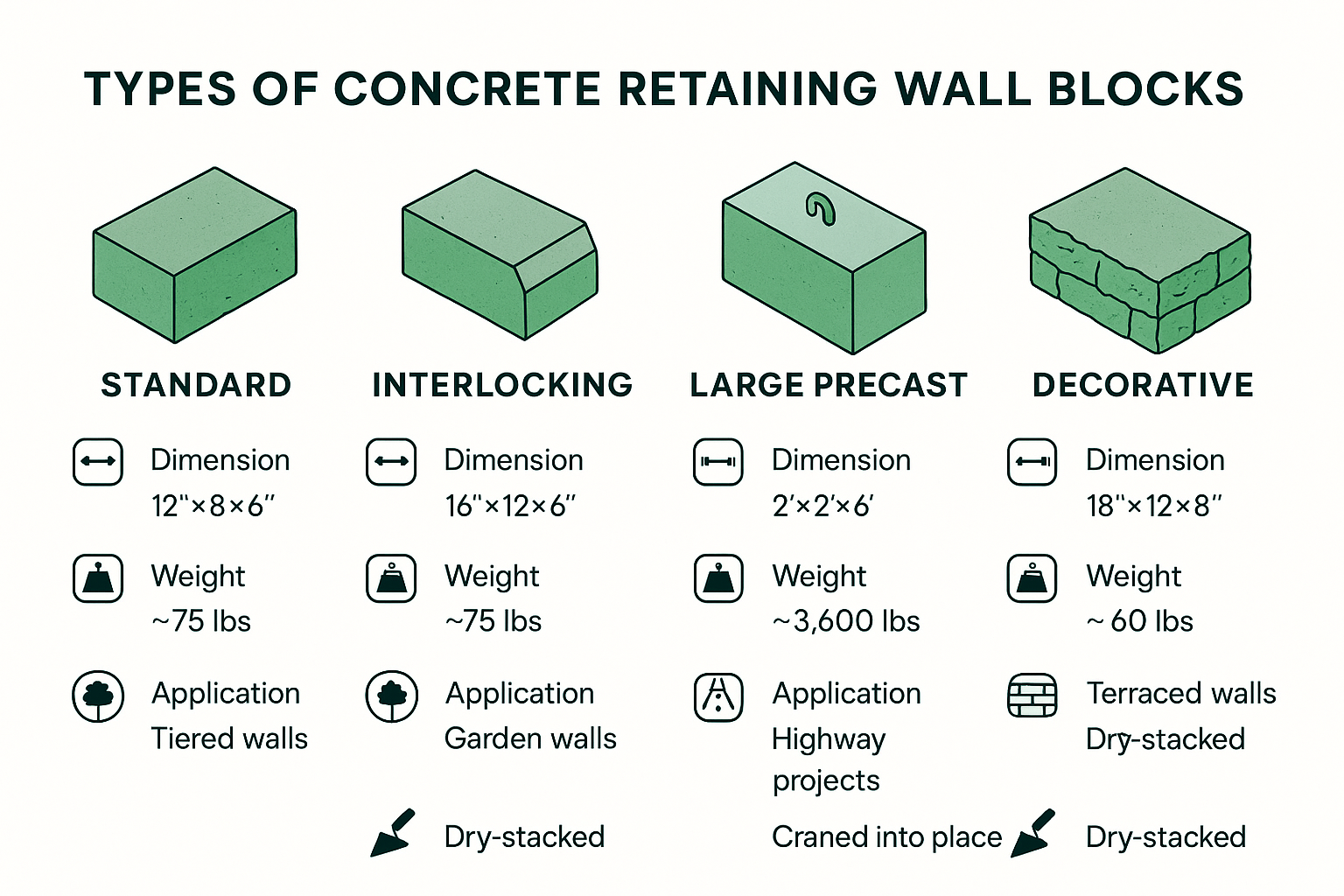
| Type | Size Range | Weight Range | Best For |
|---|---|---|---|
| Standard Blocks | 2’x2’x4′ | 2,200 lbs | General retaining walls |
| Half Blocks | 2’x2’x2′ | 1,100 lbs | Corners and ends |
| Large Precast | 2’x2’x6′ to 3’x3’x6′ | 3,600-7,200 lbs | Heavy-duty applications |
| Decorative | Various | 20-80 lbs | Visible landscape features |
| Interlocking | Various | 30-150 lbs | DIY projects, stability |
When choosing between different concrete retaining wall options, consider your specific needs. Are you looking to create a simple garden terrace, or do you need to stabilize a steep slope? The right block depends on your project’s scale, aesthetic goals, and structural requirements.
As beautiful as they are functional, concrete retaining wall blocks serve dual purposes: they provide critical structural support while enhancing your landscape’s visual appeal. Modern systems offer various styles, from natural stone appearances to sleek, contemporary designs.
The beauty of concrete blocks lies in their versatility. Whether you’re building a small garden wall or tackling a major slope stabilization project, there’s a concrete block solution engineered for your specific needs.
Retaining walls built with quality concrete blocks can last for decades with minimal maintenance, making them a sound investment for property owners looking for long-term solutions to erosion and landscaping challenges.
When you look at a beautifully terraced garden or a neatly contained hillside, you’re seeing concrete retaining wall blocks at work. These hardworking landscape elements might not get all the glory, but they’re the backbone of many stunning outdoor changes we create here in Massachusetts and New Hampshire.
Concrete retaining wall blocks are much more than just heavy pieces of concrete. They’re carefully engineered solutions that solve real problems for homeowners and businesses dealing with sloped properties. Think of them as the silent guardians of your landscape – holding back soil, preventing erosion, and creating usable space where there once was an unusable hillside.
Unlike poured concrete walls that require extensive formwork, reinforcement, and curing time, precast concrete retaining wall blocks offer immediate structural integrity. They can be installed much more efficiently, saving you time and often money on your landscape project.

The magic of these blocks lies in how they perform multiple functions simultaneously. They stabilize soil on sloped areas, preventing that gradual creep that can damage structures over time. During heavy New England downpours, they control erosion by keeping soil in place. They provide crucial structural support, creating level areas for patios, gardens, or play spaces. They can establish clear boundaries between different landscape zones, and they even help manage water runoff away from your home’s foundation.
“Concrete retaining wall blocks provide a fantastically versatile solution that offers structural strength, aesthetic arrangement, and in some cases, can provide a plantable living feature wall,” notes Natasha Mikula, a landscape designer who has worked with these systems extensively.
What makes concrete retaining wall blocks particularly valuable in our region is their adaptability. From the sandy soils near coastal Newburyport to the rocky terrain in parts of Methuen and Andover, we’ve installed these systems in virtually every soil type imaginable. They perform beautifully regardless of the conditions when properly installed.
Modern manufacturing has truly revolutionized what’s possible with concrete blocks. Today’s options can convincingly mimic natural stone, create living plant walls where vegetation grows between blocks, or provide clean contemporary lines for modern landscapes – all while maintaining the structural integrity needed to hold back tons of soil.
Whether you’re looking to create a simple garden terrace or tackle a major slope stabilization project, concrete retaining wall blocks offer solutions that are as beautiful as they are functional. And with proper installation, they’ll continue performing their essential work for decades with minimal maintenance required.
Selecting the perfect concrete retaining wall blocks for your landscape project isn’t just about picking a style that catches your eye. There’s actually quite a bit of science and practical consideration that goes into making the right choice. At Dube Property Maintenance & Hardscaping, we’ve helped countless homeowners steer these decisions, and we’ve found that understanding a few key factors makes all the difference.
The dimensions and heft of your blocks will dramatically impact both how you install them and how they’ll perform over time.
Standard Blocks measure about 2’x2’x4′ and tip the scales at roughly 2,200 pounds each. These workhorses are perfect for medium to large projects, though you’ll definitely need heavy equipment to place them. The upside? They provide rock-solid stability that stands the test of time.
When working with corners or custom configurations, Half Blocks (2’x2’x2′, weighing around 1,100 pounds) become your best friends. They provide the same quality with more flexibility for special features.
For commercial projects or areas with significant grade changes, Large Precast Blocks might be your go-to solution. These behemoths can measure up to 3’x3’x6′ and weigh as much as 7,200 pounds! They’re not for the faint of heart, but they deliver best stability for challenging sites.
If you’re considering a DIY approach or working on a smaller residential project, Decorative and Interlocking Blocks offer more manageable dimensions. Typically ranging from 4″ to 12″ in height and weighing between 20-150 pounds, these blocks are much more homeowner-friendly.
One thing many folks overlook is transportation logistics. A standard delivery truck might only accommodate 12-22 standard blocks per trip, meaning larger projects could require multiple deliveries. This reality should definitely factor into your timeline and budget planning.
As Kevin Bailey, a contractor we’ve worked with in the Northeast, likes to say: “The weight and dimensions of concrete blocks directly impact how efficiently we can install them. With the right crew, equipment, and block system, we can install up to 80m² of wall per day.”
Your retaining wall will likely become a permanent feature of your landscape, so its appearance matters tremendously.
Most manufacturers offer a variety of finishes to suit different design preferences. Smooth-faced blocks create a clean, contemporary look, while split-face options mimic natural stone. If you’re after something more rugged, rock-face blocks provide that natural, textured appearance, and weathered finishes give an instant sense of establishment and age.
Color choices typically include earth tones—tans, grays, browns, and reddish hues—with some manufacturers offering multi-colored options that beautifully simulate natural stone variations.
When you’re mulling over finishes and colors, consider how they’ll complement your home’s architectural style, any existing hardscape elements, and your natural landscape. Think long-term too—what will still look good years from now as your landscape matures?
We recently completed a project for Carol, a homeowner in Methuen, who told us: “I’m happy to show anyone local what can be achieved with these great products. I love how my wall complements my home’s exterior while solving our erosion issues.” That’s exactly the kind of dual-purpose success we aim for with every installation.
The way your wall gets installed will depend on the block type, wall height, and specific conditions of your site.
Interlocking Systems use specially designed features like lips, pins, or grooves that allow blocks to connect securely without mortar. These systems offer faster installation, flexibility to handle minor ground movement, and easier repairs if ever needed. For smaller projects, they might even be suitable for ambitious DIYers.
Dry-Stacked Construction relies on gravity and precise block placement without mortar. This approach allows experienced crews to install up to 80m² of wall per day with no curing time required. It’s also more forgiving in various weather conditions and provides natural drainage through the wall face.
For certain applications, Mortared Construction offers advantages. This traditional approach creates a unified structure, though it requires more skill, time, and proper curing conditions. It’s typically used with natural stone or certain decorative blocks where that classic mortared look is desired.
For walls exceeding 3-4 feet in height, Geogrid Reinforcement becomes essential. This technique incorporates geosynthetic material laid horizontally into the soil backfill, significantly boosting wall stability. It’s a must for taller walls or those supporting substantial loads.
Here at Dube Property Maintenance & Hardscaping, we carefully evaluate each site’s unique conditions before recommending the most appropriate installation method. Our goal is always long-term stability and performance—because a retaining wall that looks great today but fails next year isn’t doing anyone any favors!
The right concrete retaining wall blocks combined with proper installation will give you decades of trouble-free performance while enhancing your property’s beauty and value. And isn’t that exactly what we’re all after?
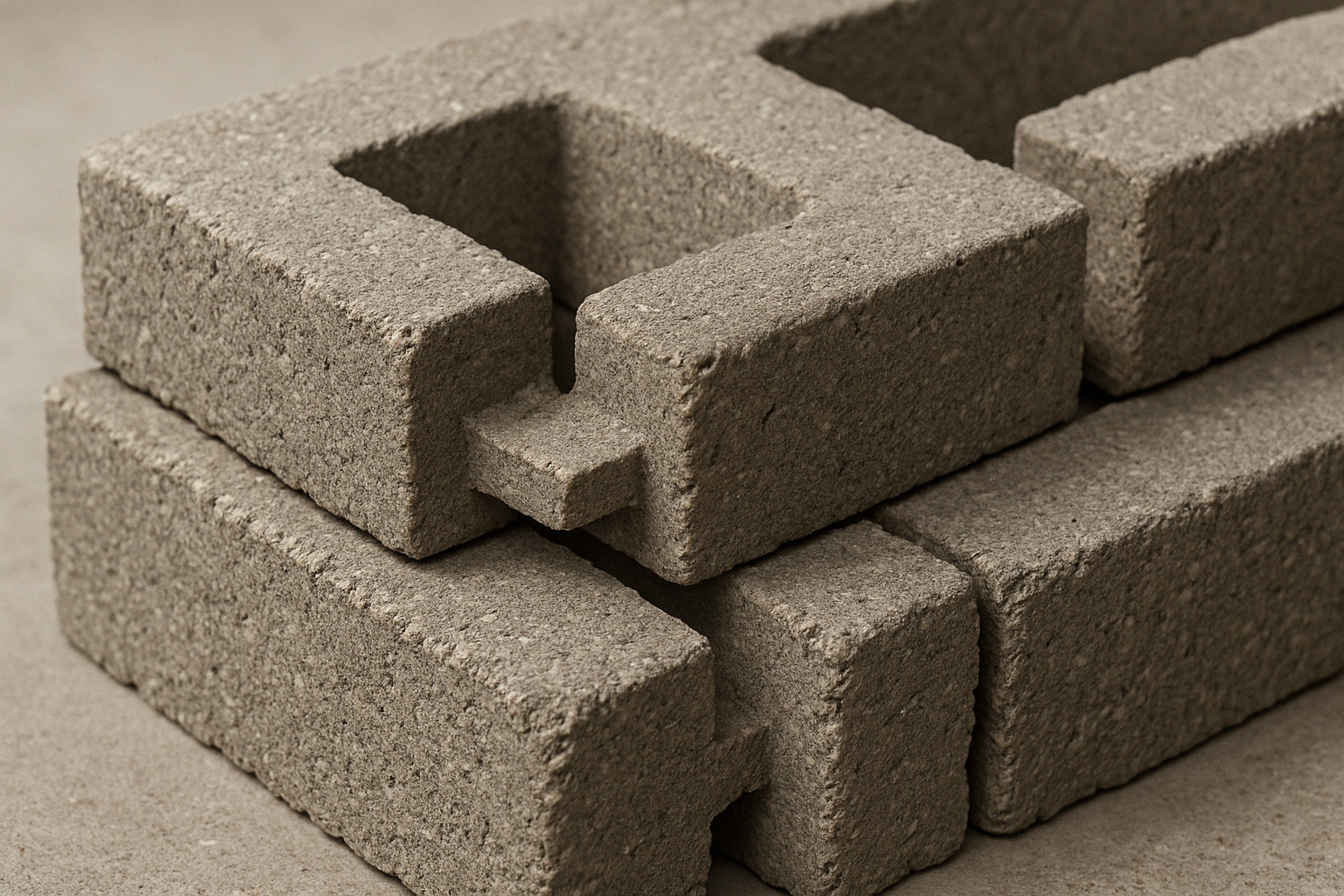
If retaining walls were a family, the interlocking concrete retaining wall blocks would be the smart cousin who makes everything look effortless. These clever blocks have revolutionized how we approach retaining wall construction, offering a perfect blend of strength, simplicity, and good looks.
What makes these blocks special is their built-in connecting systems. Rather than relying on messy mortar or complicated adhesives, interlocking blocks feature specially designed edges that fit together like pieces of a three-dimensional puzzle. You might find them with lip and groove systems, pin connections, V-style edges, or tongue and groove designs – all engineered to create rock-solid structures that stand the test of time.
The genius of interlocking blocks lies in how they handle pressure. When that heavy soil starts pushing against your wall (and believe me, it will), these blocks work as a team. Instead of each block facing that pressure alone, the interlocking features distribute the force throughout the entire wall. It’s the “all for one, one for all” approach to retaining walls!
Stability that makes you sleep better at night is perhaps the most compelling reason to choose interlocking blocks. The interconnected structure creates a unified wall that stands strong against soil pressure. One of our clients in North Reading told us, “After three Massachusetts winters with heavy snow and spring thaws, my interlocking wall hasn’t budged an inch.”
Ground movement flexibility gives these walls a distinct advantage over rigid mortared options. Massachusetts soil can shift slightly with freeze-thaw cycles, but interlocking walls can accommodate these minor movements without cracking or failing. They bend but don’t break, so to speak.
Speed of installation is another major plus. Without mixing mortar or waiting for it to cure, your wall goes up remarkably quickly. As one contractor put it to me, “No mortar means no mess, no mixing, and a much faster build time.” For busy homeowners in Methuen or Andover who want their yards back ASAP, this is a significant benefit.
DIY-friendly design makes smaller interlocking blocks (usually under 50 pounds) accessible to ambitious homeowners. While we’re always happy to handle your project at Dube Property Maintenance & Hardscaping, we understand that some folks enjoy tackling landscape projects themselves. The interlocking design helps prevent placement errors – once your base course is level and properly positioned, the blocks essentially guide themselves into place.
Natural drainage capabilities help prevent water pressure buildup behind your wall. The small gaps between blocks allow water to seep through rather than pooling behind the structure. This natural drainage reduces hydrostatic pressure – a leading cause of retaining wall failure.
I’ve watched countless clients’ faces light up when they see their finished interlocking walls. They’re particularly popular in residential settings throughout our service area where that perfect balance of strength and beauty matters. From the hilly properties in Andover to the sloped yards in Salem, these walls create usable space while enhancing landscape aesthetics.
One landscaper who’s been installing these systems for over 20 years shared this wisdom: “The beauty of interlocking blocks is that they remove the guesswork. Each block literally tells the next one where to go. It’s almost like they want to create a beautiful wall all by themselves.”
For deeper insights into your interlocking options, check out our comprehensive guide to Interlocking Retaining Wall Blocks. You’ll find detailed information about the various systems available and which might work best for your specific property challenges.
When you need serious earth-holding power, large precast concrete retaining wall blocks are the heavyweight champions of the landscaping world. These massive units aren’t built on site – they’re manufactured in controlled environments where quality and structural integrity can be carefully monitored before they ever reach your property.

You might be surprised by just how substantial these blocks really are. The most common sizes we work with include the 2′ x 2′ x 3′ blocks (weighing about 1,800 pounds – heavier than a grand piano), the 2′ x 2′ x 6′ giants (tipping the scales at approximately 3,600 pounds), and the truly massive 3′ x 3′ x 6′ blocks (weighing in at a staggering 7,200 pounds – about the weight of a full-size SUV).
What makes these blocks so effective is beautifully simple: pure mass. They create what engineers call “gravity walls” – structures that resist soil pressure primarily through their immense weight. This straightforward approach often eliminates the need for complicated geogrid reinforcement, making installation more straightforward while still delivering rock-solid performance.
“The first time I saw these blocks being placed, I was amazed at how quickly a substantial wall took shape,” shares Mike, one of our project managers. “What would take weeks with traditional methods was accomplished in days.”
These mammoth blocks really shine in demanding applications. For commercial properties with significant elevation changes, they provide an efficient, low-maintenance solution. Along roadsides, their durability stands up to the constant vibration and pressure. In flood control situations, their weight and stability make them invaluable for managing water flow. They even serve as effective security barriers for facilities needing physical protection, and create sturdy material containment bins for bulk storage.
Of course, moving these concrete behemoths isn’t like tossing around paver stones. Transportation logistics become a major consideration – typically only 12-22 standard blocks can fit on a single delivery trip. And don’t plan on placing them by hand – heavy machinery like excavators or cranes is absolutely essential. These logistical realities need to be factored into both your timeline and budget.
One project we completed for a commercial client in Burlington illustrates why these blocks are worth the extra logistics. The client needed both substantial grade management and improved security. Using large precast blocks, we constructed a 200-foot retaining wall in just four days – something that would have taken weeks with poured-in-place concrete. Three years later, that wall looks as good as the day it was installed, with zero maintenance required.
For properties throughout our service area – particularly in communities like Burlington, Winchester, and Woburn with significant commercial development – these large-scale solutions offer an unbeatable combination of performance, longevity, and installation efficiency. When you need serious earth retention that will stand the test of time, these giants deliver peace of mind that’s literally set in stone.
Ever walked past a retaining wall that stopped you in your tracks? That’s the magic of decorative concrete retaining wall blocks at work. These aren’t just functional workhorses holding back soil—they’re landscape features that can completely transform your outdoor space.

“My clients often come in thinking retaining walls are purely functional,” says Mark, one of our landscape designers at Dube. “Then I show them our decorative options and their eyes light up. Suddenly, they’re seeing possibilities they never imagined.”
Today’s manufacturing techniques have revolutionized what’s possible with concrete retaining wall blocks. Want the look of natural stone without the hefty price tag? Modern blocks can convincingly mimic cut limestone, weathered fieldstone, stacked slate, quarried granite, or even river rock. The change is so convincing that visitors will need to tap the wall to realize it’s not actually natural stone!
The surface textures available will satisfy any design vision. Split-face textures give you that rough-hewn stone appearance that looks centuries old. If you’re after a more modern look, smooth finishes create clean lines for contemporary landscapes. For something truly special, hammered textures deliver that artisanal, hand-crafted appearance, while weathered finishes make your new wall look like it’s been part of your landscape for decades.
Color options have come a long way too. Beyond basic earth tones, manufacturers now offer multi-color blends that perfectly mimic natural stone variations. Some clients even opt for custom color matching to complement their home’s exterior. The weathered color patterns are particularly impressive—they suggest decades of natural aging, giving your landscape instant maturity.
“The attractive multipiece design and blended colors offer an alternative look to traditional retaining wall blocks,” notes Sarah, a landscape architect we work with. “We’re creating installations that appear to have been part of the landscape for generations, even though they were installed just last week.”
What really sets these blocks apart are the specialized finishing options. Some systems include blocks with built-in lighting receptacles—perfect for creating dramatic evening landscapes. Others feature planter blocks that accommodate vegetation, allowing you to incorporate greenery directly into your wall. Cap stones with specialized edge treatments add that perfect finishing touch, while corner pieces with decorative faces on multiple sides ensure your wall looks fantastic from every angle.
These decorative options typically come in more manageable sizes than their purely structural cousins—usually ranging from 4″ to 12″ in height, 8″ to 18″ in width, and 6″ to 12″ in depth. This human-scale sizing allows for more intricate patterns and designs while still providing excellent structural performance for walls up to about 4 feet in height (or higher with proper engineering and reinforcement).
We’ve installed these beautiful walls throughout communities like Lynnfield, Reading, and North Andover—areas where architectural aesthetics are just as important as solving grade challenges. Homeowners love how these walls improve curb appeal while seamlessly blending into their overall landscape design.
The best part? These decorative options don’t sacrifice any of the durability or performance you need from a retaining wall. They’re still hard-working concrete retaining wall blocks at heart—they just happen to look spectacular while doing their job.
When it comes to clever engineering in landscaping, hollow-core concrete retaining wall blocks might just take the cake. These innovative blocks maintain all the strength you need while cutting down on weight and materials—a win-win for both installers and property owners.
Think of hollow-core blocks as the smartest kid in class—they’ve figured out how to do more with less. Instead of being solid concrete all the way through, these blocks feature thoughtfully designed void spaces inside while maintaining a strong outer shell. The clever part? They still provide excellent structural support where it matters most.
Material efficiency is perhaps the biggest advantage of these blocks. By using up to 40% less concrete than their solid counterparts, hollow-core blocks are kinder to the environment and often gentler on your wallet too. Less concrete means a smaller carbon footprint and reduced energy consumption during manufacturing—something more and more of our Massachusetts and New Hampshire customers are prioritizing.
The weight reduction makes a world of difference during installation. As one manufacturer puts it: “Each block covers 8 sq. ft. (0.74 sq. m.) of wall area while requiring less material and energy to produce.” This lighter weight means transportation costs less and installation requires less heavy equipment. For properties with tricky access—which we encounter frequently in places like Methuen and Andover—this can be a game-changer.
I remember a particularly challenging project in North Reading where the only access to the backyard was through a narrow garden gate. The hollow-core blocks made what seemed impossible completely doable, without sacrificing an ounce of wall stability.
The drainage capabilities of certain hollow-core systems solve one of the biggest challenges in retaining wall construction. Some designs are actually permeable, allowing water to flow through rather than building up behind the wall. This “reduces hydrostatic pressure and improves drainage,” according to engineering specifications we’ve worked with. In our New England climate, where freeze-thaw cycles can wreak havoc on hardscaping, this feature adds years to your wall’s lifespan.
Perhaps my favorite application is when hollow-core blocks create living walls. Some designs include spaces specifically created to hold soil and plants, changing what could be an imposing concrete structure into a verdant, living part of your landscape. These green walls soften the visual impact while providing additional environmental benefits like improved air quality and habitat for pollinators.
One of our landscape contractors recently shared: “The hollow blocks allow us to install up to 30% more wall area per day compared to solid blocks of similar size. That efficiency translates directly to cost savings for our clients.” When we’re working on tight timelines—which, let’s be honest, is most of the time—this efficiency is invaluable.
For properties throughout Methuen, Lawrence, Haverhill, and beyond, hollow-core systems strike that perfect balance between performance, aesthetics, and installation efficiency. They’re particularly valuable in environmentally sensitive areas or for homeowners who want to minimize their ecological footprint while still solving their landscaping challenges.
When it comes to serious earth retention needs, segmental retaining wall (SRW) systems take concrete retaining wall blocks to a whole new level of engineering sophistication. Think of these as the problem-solvers of the retaining wall world – they’re designed to handle just about any height challenge you might encounter on your property.
What makes these systems special is how they combine the visual appeal of decorative blocks with serious structural engineering. It’s like getting the best of both worlds – a wall that looks beautiful and can hold back mountains of soil without breaking a sweat.
The facing units – those blocks you actually see – feature clever interlocking designs that fit together perfectly. They’re manufactured with consistent dimensions, so installation is precise and predictable. Most have a slight backward lean (typically 3-15 degrees) built right into their design. This isn’t a mistake – it’s intentional engineering that creates optimal stability against soil pressure.
“The beauty of segmental systems is how they combine aesthetics with serious structural capability,” explains Tom Ramirez, a retaining wall specialist. “You’re looking at something that can be both beautiful and incredibly strong.”
Behind the scenes is where the real magic happens. These systems incorporate geogrid reinforcement – synthetic mesh materials that extend back into the soil behind the wall. This creates what engineers call a “reinforced soil mass” – essentially turning the soil itself into part of the structural system. This reinforcement dramatically increases the wall’s ability to resist pressure.
Drainage components are absolutely critical to these systems. Without proper drainage, water pressure can build up behind the wall and compromise even the best design. That’s why professional installations include granular backfill materials, perforated drain pipes, and filter fabrics to manage water effectively.
The engineering capabilities are truly impressive. According to industry standards, “Segmental retaining walls can be designed for heights in excess of 50 ft (15.24 m)” – that’s taller than a four-story building! For context, most residential applications rarely need anything close to this height, but it’s good to know the capability exists if your property has extreme grade changes.
The National Concrete Masonry Association (NCMA) has developed comprehensive guidelines for these systems, ensuring that properly engineered walls will stand the test of time. When designed and installed correctly, these walls will likely outlast the people who build them.
What makes segmental systems particularly valuable is their flexibility. Need curves? No problem. Corners? Easy. Want to incorporate stairs or terraces? These systems can handle it all with grace. The modular nature means your wall can follow the natural contours of your landscape rather than forcing a rigid, unnatural line.
For properties throughout Massachusetts and New Hampshire – especially in communities like Billerica, Burlington, and Winchester where significant grade changes are common – segmental retaining wall systems offer the perfect balance of performance and beauty. They’re particularly valuable when you need to manage elevation changes within limited property boundaries.
If you’re facing a challenging slope on your property, these engineered systems might be exactly what you need. The investment typically pays off through increased usable space, improved property value, and decades of worry-free performance.
For those interested in the technical details behind these remarkable systems, the Guide to Segmental Retaining Walls from the NCMA provides a wealth of information about design principles and performance standards.
Let’s talk dollars and cents – because your budget matters just as much as your design vision when it comes to concrete retaining wall blocks. While these sturdy workhorses deliver exceptional value over their lifetime, the upfront investment varies widely depending on the type of block you choose.
Important Note: The following are average costs based on internet data and not actual costs for Dube Property Maintenance & Hardscaping. Actual project costs may vary significantly based on site conditions, design requirements, and other factors.
When our customers in Methuen, Andover, and surrounding areas ask about pricing, I always emphasize that quality retaining walls are an investment in your property’s value. A well-built wall can last for decades with minimal maintenance – something worth considering when comparing options.
The price tag on your concrete retaining wall blocks will depend largely on their size, style, and special features. Those small decorative blocks that are perfect for garden borders? They typically run between $2-12 per block for basic units, while premium decorative versions with special finishes might cost $8-36 each. If you’re looking at cap stones to give your wall a finished look, expect to pay $6-45 per linear foot.
For more substantial projects, standard precast blocks (those 2’x2’x4′ workhorses) generally cost between $50-150 each. Their smaller siblings, half blocks, run about $40-120 per unit. If your project demands truly massive blocks, the 3’x3’x6′ giants that excel at heavy-duty retention typically command $85-255 each.
“I was initially shocked at the price difference between basic and premium blocks,” shares Carol, a homeowner from North Reading who recently completed a terraced garden project. “But seeing them installed, the premium blocks transformed my entire backyard’s appearance. Worth every penny!”
When you’re calculating materials, don’t forget to account for specialty pieces like corners and caps. These finishing touches not only complete the look but provide structural benefits as well. While they might seem like small additions, they can add 15-25% to your material costs.
Buying in bulk can substantially reduce your per-block costs. For larger projects, ask about quantity discounts – savings of 10-20% aren’t uncommon when ordering full pallets or truckloads.
The blocks themselves are just one piece of the puzzle. Installation represents a significant portion of your overall investment, and this is where many homeowners face tough decisions about DIY versus professional installation.
For those brave souls considering DIY installation (suitable only for small walls with manageable blocks), you’ll need to factor in equipment rental ($100-900 per day for mini-excavators and compactors), base materials ($3-9 per square foot), and a substantial time investment – typically 16-40 hours for a modest 40’x4′ wall. That’s an entire weekend or more of hard physical labor!
Professional installation brings expertise and efficiency to the table, with costs typically ranging from:
– $15-45 per square foot for small decorative/interlocking walls
– $20-60 per square foot for standard precast block walls
– $25-75 per square foot for large precast block walls
– $30-90 per square foot for engineered segmental walls
“The longevity of concrete block walls is phenomenal when properly installed,” notes Kevin Bailey, a retaining wall specialist we often collaborate with. “This makes them a cost-effective solution over their lifetime despite higher initial costs compared to some alternatives.”
What many homeowners don’t initially consider are the “hidden” costs that can affect your bottom line: site preparation, access challenges requiring specialized equipment, drainage systems (absolutely essential for long-term performance), quality backfill materials, and landscape restoration after construction. These factors can add 25-50% to basic installation costs.
For a typical residential project in our service area – say a 40-foot long, 4-foot high wall – you might expect to invest anywhere from $2,400 to $14,400 for professional installation, depending on block type, site conditions, and design complexity.
Proper installation is the key to longevity. We’ve repaired too many DIY walls that failed prematurely due to inadequate base preparation or improper drainage. Sometimes the most expensive wall is the one you have to build twice!
For more detailed information about approaches to retaining wall construction and cost considerations specific to your property, visit our Building a Retaining Wall resource page. We’re always happy to provide a detailed estimate for your specific project needs.
When it comes to eco-friendly landscaping options, concrete retaining wall blocks might surprise you with their green credentials. These sturdy workhorses offer impressive environmental benefits that many homeowners don’t realize.
First and foremost is their incredible longevity. A properly installed concrete block wall can stand strong for 50-100 years or more! This remarkable durability means fewer replacements and less resource consumption over time. Think about it—a single well-built wall could serve several generations of homeowners without needing replacement.
The local factor is another environmental plus. Unlike exotic stone that might travel thousands of miles, concrete retaining wall blocks are typically manufactured regionally. Your blocks probably didn’t rack up massive transportation miles to reach your property, significantly reducing their carbon footprint compared to imported materials.
Modern block designs have become impressively resource-efficient too. The hollow-core blocks we discussed earlier use up to 40% less concrete than their solid counterparts while maintaining structural integrity. Some manufacturers take sustainability even further by incorporating recycled materials into their products—crushed glass, fly ash, and even recycled concrete aggregate can find new life in your retaining wall.
Water management gets a boost from certain block systems designed with permeability in mind. These clever designs allow rainfall to infiltrate rather than run off, supporting natural groundwater recharge and reducing erosion concerns. As one manufacturer proudly states: “We’re committed to protecting the planet by using recycled concrete and clay bricks in our production process, as well as reusing breakages.”
For the nature lovers among us, some block systems even accommodate vegetation, creating living walls that provide habitat for beneficial insects and small wildlife while improving air quality. These green walls blend hardscape with landscape for a truly harmonious outdoor space.
Good news! One of the greatest advantages of concrete retaining wall blocks is their relatively carefree nature. With proper installation, they’ll serve you well with minimal fuss—but a little attention goes a long way toward maximizing their lifespan.
Make it a habit to give your wall a good once-over each spring. Look for any signs of block movement or shifting, cracks in individual blocks, or drainage issues. Catching small problems early prevents them from becoming major headaches later. Pay special attention after severe weather events that might have stressed your wall.
Drainage is absolutely crucial to wall longevity. Keep those drain outlets clear of leaves, soil, and debris. Ensure water continues to be properly diverted away from the wall base, and maintain appropriate grading both above and below your wall. Water is both friend and foe to landscapes—we need it for plants but need to direct it away from structures.
For decorative walls that contribute to your home’s curb appeal, a bit of surface care keeps them looking their best. Address stains promptly using appropriate cleaners (avoid harsh chemicals that might damage concrete or nearby plants). Consider applying a quality sealer every 3-5 years for walls in prominent locations. This simple step can refresh the appearance while adding protection. If you notice moss or algae taking hold, remove it before it can trap moisture against your blocks.
Be mindful of what grows near your wall. While those flowering vines might look charming cascading over your retaining wall, aggressive root systems can eventually compromise structural integrity. For plantable wall systems, stick with appropriate plant types and sizes. As a general rule, keep large trees and shrubs with extensive root systems at a respectful distance from your wall.
Should you notice any minor issues developing, address them promptly. Replace damaged blocks before problems can spread, regrade any settled areas behind the wall, and restore compromised drainage features. An ounce of prevention truly is worth a pound of cure when it comes to wall maintenance.
For more detailed guidance specific to your particular wall system, we invite you to explore our Concrete Retaining Wall Block resource page.
The DIY approach certainly has its appeal—especially when you’re looking at those attractive displays of concrete retaining wall blocks at your local home improvement store. But before you load up your truck, let’s have an honest conversation about when professional installation makes sense.
Professional installers bring specialized knowledge that proves invaluable for wall performance. They understand the nuances of proper base preparation, can perform structural calculations for wall height and loads, design effective drainage systems, and know when and how to implement geogrid reinforcement. This expertise translates directly into wall longevity and performance.
The equipment factor can’t be overlooked either. Our professional crews arrive with appropriate excavation equipment, compaction tools for proper base and backfill preparation, lifting equipment for larger blocks, and specialized tools for precise alignment and leveling. This proper equipment not only speeds up the process but ensures quality results that simply can’t be matched with household tools.
Safety concerns provide perhaps the most compelling reason to consider professional installation. Retaining wall failures can cause significant property damage or even personal injury. Excavation presents real hazards, and those heavy blocks pose serious lifting and crushing risks. As one homeowner told us after attempting a DIY wall: “I wish I’d known how physically demanding this project would be—the blocks looked manageable in the store!”
Time efficiency is another major advantage of hiring pros. Our experienced crews can complete in days what might take a homeowner weeks of weekends. As one contractor notes: “Experienced crews can install up to 80m² of wall per day.” Your time has value too!
Many homeowners don’t realize that professional installation typically includes workmanship warranties, and some block manufacturers actually void warranties on improperly installed walls. That peace of mind alone can be worth the investment in professional services.
Generally, we recommend professional installation for:
– Walls exceeding 3 feet in height
– Any wall requiring building permits
– Walls supporting structures or driveways
– Sites with poor soil conditions or water management challenges
– Projects using large precast blocks
For smaller decorative walls using lightweight interlocking blocks, DIY installation may be perfectly feasible with proper research and preparation. If you’re considering this approach, our How to Build a Landscape Block Retaining Wall guide provides valuable information to help you succeed.
A well-built retaining wall is an investment in your property that should provide decades of service. Making the right installation choice now pays dividends for years to come.
Navigating concrete retaining wall blocks can feel overwhelming at first, but I hope our journey through the options has made your path clearer. Finding that perfect balance between function, beauty, and budget is absolutely possible with today’s diverse concrete block solutions.
Throughout our exploration, we’ve uncovered some essential wisdom worth remembering:
First and foremost, matching your blocks to your specific needs makes all the difference. That charming decorative block might be perfect for your garden border, but your steep hillside might need the robust support of large precast units. Concrete retaining wall blocks aren’t one-size-fits-all – they’re specialized tools for specific landscaping challenges.
Remember too that successful retaining walls are complete systems. The blocks themselves are just the visible heroes of a team that includes proper drainage, solid foundation work, and sometimes reinforcement materials working behind the scenes. Skipping any of these supporting players often leads to premature wall failure.
Today’s manufacturing techniques have given us concrete retaining wall blocks that would amaze builders from generations past. You can now enjoy structural integrity alongside beautiful aesthetics – whether you prefer the look of natural stone, sleek contemporary lines, or even living plant walls.
Some block systems are genuinely DIY-friendly, especially the smaller interlocking varieties for modest-height walls. Others, particularly for walls over three feet tall or those supporting structures, really do benefit from professional installation. Being honest about your skills and the project requirements will save headaches later.
Quality matters tremendously with retaining walls. While budget-friendly options exist, the relatively small premium for better blocks often pays dividends in longevity, appearance, and performance. When you consider that a well-built wall can last decades, spreading that modest upfront investment over its lifespan makes the higher-quality choice look quite economical.
Here at Dube Property Maintenance & Hardscaping, we’ve installed countless retaining walls throughout Massachusetts and New Hampshire. From the coastal properties of Salem to the rolling terrain of Andover, our team has developed expertise with every type of concrete retaining wall block on the market. We love helping homeowners and business owners find their perfect match among the options.
Whether you’re in Methuen, North Reading, or any community we serve, we’re ready to guide your project from initial concept through professional installation. Our goal is always a retaining wall that performs flawlessly for decades while making your property more beautiful, functional, and valuable.
Ready to transform your landscape with the perfect concrete block retaining wall? Visit our Retaining Walls resource page for more inspiration, or contact us today to discuss how we can bring your vision to life. Your ideal outdoor space is closer than you think!