
Concrete driveway replacement is often a necessary home improvement project. It brings new life to your property, making it safer and more attractive. When your old driveway shows serious signs of wear, replacement offers a fresh start.
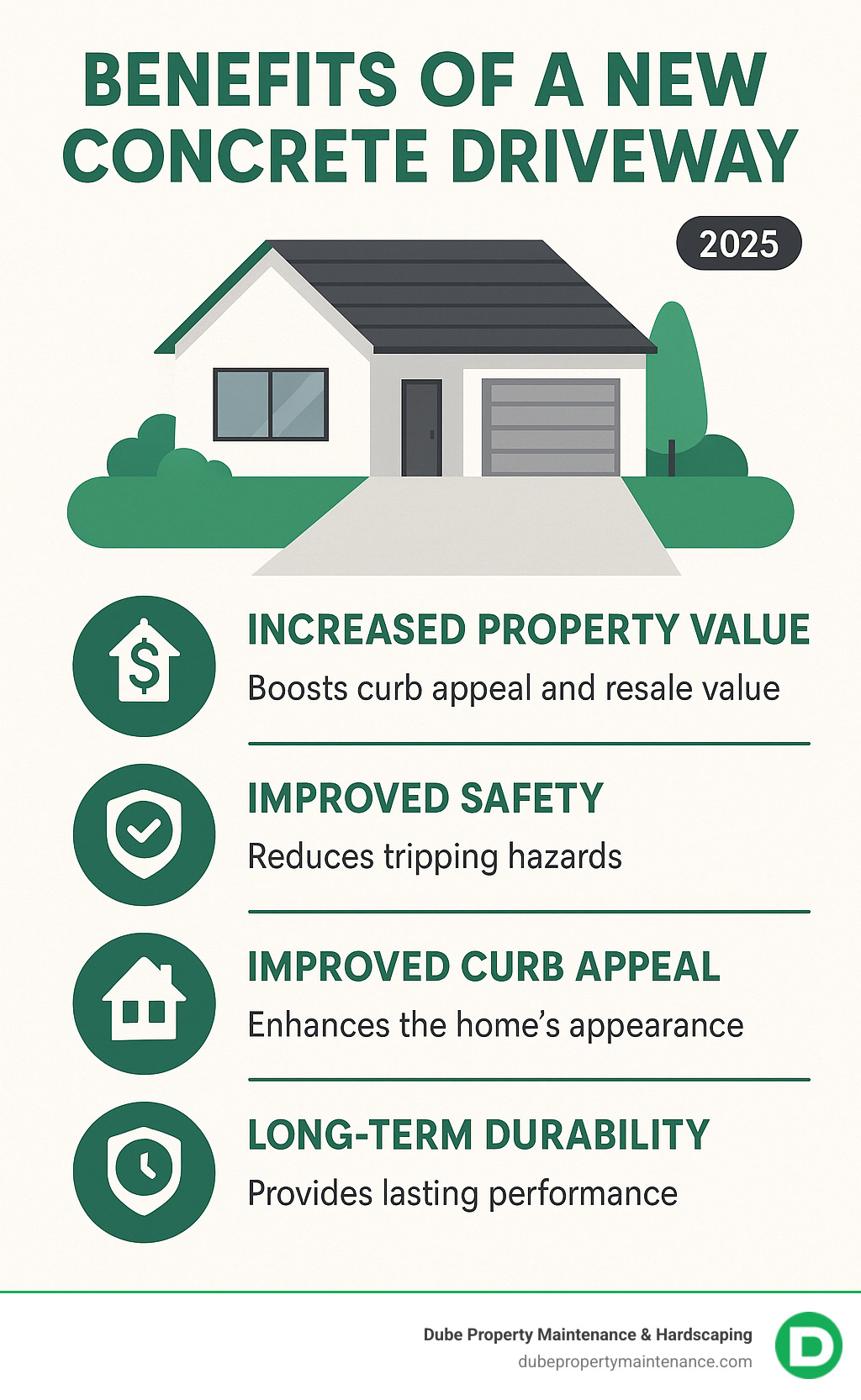
Here’s a quick look at why homeowners choose to replace their concrete driveways:
Don’t let a failing driveway detract from your home. Understanding the process helps you make the best decision for your property. This guide will walk you through everything you need to know.
Important Concrete Driveway Replacement terms:

Knowing whether to repair, resurface, or completely replace your driveway is crucial for your budget and home’s appearance. While minor issues can be patched, a full concrete driveway replacement is often the smartest long-term solution for significant damage. It’s important to recognize the key signs that indicate a replacement is needed to ensure lasting structural integrity and surface durability. For even more insight, consult reputable industry resources or speak with an experienced local contractor.
While small surface cracks are often harmless, large ones are a major red flag. Look for cracks that are deep, wide (more than 1/8 inch), or form an interconnected “alligator” pattern. These indicate structural failure, allowing water to penetrate the base. In our New England climate, this leads to damage from freeze–thaw cycles. Patching such significant cracks is usually only a temporary fix that won’t address the underlying problem.
When sections of your driveway are noticeably uneven, it’s often due to a poorly compacted subgrade or soil erosion. These issues create dangerous trip hazards and point to a problem with the driveway’s foundation. While a single sunken slab can sometimes be lifted, widespread settling requires a full concrete driveway replacement to properly correct the subgrade. On sloped properties, retaining walls to manage soil and prevent erosion may also be necessary for a long-term solution.
Spalling refers to the flaking, chipping, or pitting of your concrete’s surface. This is often caused by exposure to deicing salts, a poor initial mix, or general age-related wear. While minor spalling can be repaired, widespread damage or crumbling concrete indicates the need for a replacement. Resurfacing a crumbling driveway is ineffective because the new layer won’t adhere properly to the deteriorating base.
Puddles that linger on your driveway, especially near your home, signal a drainage problem. This can lead to foundation damage, soil erosion, and concrete staining. Persistent drainage issues often stem from an improper slope or an unevenly settled base. A full concrete driveway replacement allows for proper re-grading to ensure water flows away from your home. We can also incorporate hardscaping solutions to improve drainage for comprehensive property protection.

A concrete driveway replacement is a significant project, but with experienced professionals, it’s a straightforward, organized process. Our goal is to deliver a high-quality, durable driveway that lasts for decades. Here are the typical steps involved so you know what to expect.
The first step is to break up the old driveway using specialized equipment like jackhammers and skid steers. These tools allow us to work safely and efficiently. Once broken into manageable pieces, the heavy debris is loaded and hauled away. We prioritize recycling the old concrete, which is often crushed and reused as a base material in other projects. This step also allows for an initial inspection of the ground underneath.
This is the most critical step for your new driveway’s longevity. After demolition, we prepare the subgrade—the ground beneath the concrete. This involves excavating and grading the soil to ensure proper drainage away from your home’s foundation. We then compact the soil base to prevent future settling and add a layer of gravel for stability. Finally, we set up wooden forms to define the driveway’s shape and install reinforcement, such as rebar or wire mesh, for added strength and durability.
With the forms and subgrade ready, we pour commercial-grade ready-mix concrete, typically to a standard 4-inch thickness for residential use. Our crew spreads and levels the wet concrete to a consistent depth. As it sets, we apply a finish, often a “broom finish,” which creates an attractive, non-slip texture. A crucial final step is adding control joints. These planned grooves guide the concrete’s natural expansion and contraction, preventing random cracking and ensuring the driveway’s long-term integrity.
A typical concrete driveway replacement takes about five to seven days from start to finish, though we never rush quality. Several factors can influence this timeline:

When considering a concrete driveway replacement, understanding the associated costs, available materials, and customization options is key to making an informed decision. It’s an investment, but one that significantly improves your home’s value and functionality.
The cost of a concrete driveway replacement varies based on several factors. Please note that the prices mentioned here are average costs based on internet data and not actual pricing for Dube Property Maintenance & Hardscaping. We provide custom estimates for every project.
Generally, new concrete driveways can range from $5 to $25+ per square foot. Standard concrete is the most affordable, while decorative options like stamped patterns or custom colors increase the price. For example, a 500-square-foot standard driveway might cost between $3,500 and $6,000, while decorative finishes could raise the price to $7,500-$10,000 or more.
Key factors influencing the final price include:
For more detailed information on pricing, you can check out More info about new driveway costs.
Beyond basic gray, you have several material options:
For any finish, we can add reinforcement like rebar or wire mesh for improved structural integrity. We also recommend sealing the cured concrete to protect it from stains and damage, extending its life.
Customization options like stamped patterns, colors, and exposed aggregate finishes allow you to create a unique driveway that improves your home’s curb appeal. In New England, climate is a major factor. We face harsh winters with freeze-thaw cycles and de-icing salts. To ensure longevity, we use air-entrained concrete, which contains microscopic air bubbles to resist freeze-thaw damage. This is a critical practice for our climate, unlike hotter regions that may require different curing methods. Our expertise ensures your driveway is both beautiful and built to withstand local conditions.

A concrete driveway replacement is a significant investment, and the quality of the work directly impacts its longevity and appearance. That’s why choosing the right contractor is paramount.
Choosing the right contractor for your concrete driveway replacement is essential. Here’s what to look for:
At Dube Property Maintenance & Hardscaping, we are a fully licensed and insured professional team dedicated to providing high-quality outdoor solutions for clients in Methuen, MA, and surrounding areas.
As a homeowner, be aware of these common mistakes to ensure a quality installation:
It’s completely normal to have questions when you’re thinking about a big project like a concrete driveway replacement. We hear a lot of the same ones from homeowners, and we’re always happy to help clear things up! Here are some of the most common questions we get:
Patience is key after your new driveway is poured. You can typically walk on it after 24 to 48 hours. However, you should wait at least 7 days before driving light vehicles on the surface to allow it to gain sufficient strength. For heavier vehicles, a longer wait may be necessary. Concrete continues to cure and strengthen for up to 28 days, reaching its maximum durability. Weather can affect this timeline, with cooler temperatures slowing the process. This waiting period is crucial for the long-term health of your driveway. You can Learn more about the concrete curing process.
The best solution depends on the extent of the damage.
In the Methuen, MA, area, the best time for a concrete driveway replacement is during the moderate temperatures of spring and fall. Concrete cures best when temperatures are consistently above 50°F (10°C). We avoid pouring during:
Planning your project for spring or fall helps ensure your new driveway cures properly for maximum strength and longevity.
Think of a full concrete driveway replacement as more than just a home repair – it’s a fantastic investment! It truly boosts your home’s curb appeal, makes things more functional, and adds real value for decades to come. A properly installed and well-cared-for concrete driveway isn’t just about looking great; it’s designed to last 30 years or even longer, welcoming you home with a durable and attractive entrance every single day.
The secret to this kind of longevity? It all comes down to careful preparation, using only quality materials, and having an expert team handle the installation. Choosing the right materials for your specific needs and partnering with a qualified contractor means you’ll have a successful project that you’ll be proud of for years.
For our neighbors in the Methuen, MA area, and throughout our extensive service region, Dube Property Maintenance & Hardscaping is truly your trusted partner. We bring years of hands-on experience, a deep commitment to quality, and a comprehensive approach to every single project. We’re here to make sure your new driveway is built to last, perfectly suited to our local climate and your home’s unique style.
We proudly serve many communities across Massachusetts, including Andover, Billerica, Boxford, Burlington, Chelmsford, Danvers, Dracut, Georgetown, Groveland, Haverhill, Lawrence, Lowell, Lynnfield, Merrimac, Middleton, Newburyport, North Andover, North Reading, Peabody, Reading, Saugus, Stoneham, Tewksbury, Tyngsborough, Wakefield, Wilmington, Winchester, and Woburn. We also extend our services to many towns in New Hampshire, such as Atkinson, Auburn, Brentwood, Chester, Danville, Derry, East Kingston, Epping, Exeter, Fremont, Hampstead, Kensington, Kingston, Londonderry, New Castle, Newfields, Newington, Newmarket, Newton, Plaistow, Salem, Sandown, Stratham, and Windham.
A professionally installed driveway isn’t just a convenience; it can truly transform your property, making it safer, much more appealing, and ready to welcome you home for years and years to come.
Ready to improve your entire outdoor living space?
Explore our hardscaping services for a complete outdoor solution.