
When those first snowflakes begin to fall, your business faces a critical moment of truth. Will your property remain accessible and safe, or will winter weather bring operations to a costly halt? For businesses across snow-prone regions, the answer often depends on one crucial document.
A Commercial Snow Removal Contract is your winter safety net—a legally binding agreement between your business and a snow removal provider that clearly outlines the terms for keeping your property clear and safe during winter months. This document covers everything from plowing and shoveling to ice management and prevention.
Think of it as winter insurance for your property. As one property manager noted in a forum discussion about HOA snow removal: “What you are paying for is the guarantee that your snow removal will be done in a timely first priority basis.” This priority service becomes invaluable during major storms when contractors are fielding desperate calls from every direction.
Whether you operate a busy retail center with customer safety concerns, manage an office complex where employee access is essential, or run a shipping facility that can’t afford weather-related downtime, your snow removal contract must be customized to your specific operational needs and budget realities.
For quick reference, here’s what you need to know about these vital agreements:
| Contract Element | Key Information |
|---|---|
| Purpose | Ensures timely snow removal, reduces liability, maintains business continuity |
| Common Types | Per-push, per-event, seasonal, time-based, full-service |
| Essential Components | Trigger depths, scope of work, pricing structure, liability terms, equipment specifications |
| Average Cost | $150-$1,500 per visit depending on property size and region |
| Typical Insurance Requirements | $1M per occurrence, $2M aggregate liability coverage |
The stakes couldn’t be higher. A single slip-and-fall lawsuit can cost your business thousands in legal fees and settlements. Insurance premiums often spike after winter-related incidents. And every hour your business remains closed due to inaccessibility translates directly to lost revenue.
With median commercial snow removal costs in the Midwest ranging from $150 to $500 per visit (though costs can vary widely depending on property specifics), investing in a comprehensive contract now represents smart preventative spending. The right agreement doesn’t just clear snow—it protects your bottom line, your property, and potentially your business’s future.
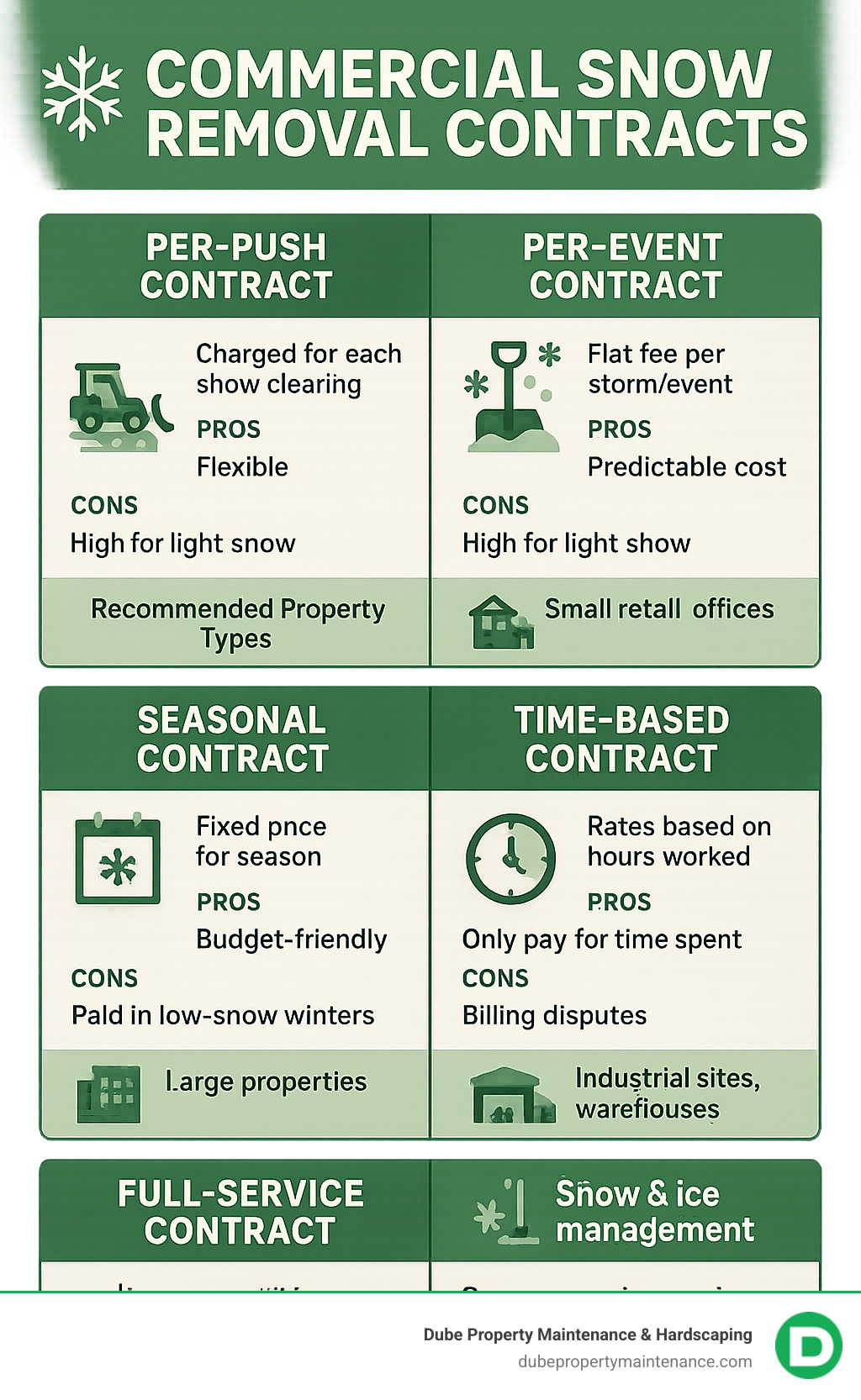
Important Commercial Snow Removal Contract terms you’ll encounter include services like commercial sidewalk snow plow operations that keep pedestrian areas clear, snow blowing services near me for targeted removal, and comprehensive business snow removal solutions that address your entire property’s winter maintenance needs.
When winter strikes, the difference between business continuity and costly closure often comes down to having the right agreement in place before the first flake falls.
A Commercial Snow Removal Contract is much more than paperwork—it’s your business’s first line of defense against winter’s worst. These agreements spell out exactly when the plows will arrive, how much snow triggers service, and who’s responsible if someone slips on ice.
Think of these contracts as your winter insurance policy. They transfer weather-related risks from your property to professionals equipped to handle them. The Bureau of Labor Statistics reports that slip and fall injuries cost businesses billions each year in worker’s compensation, lost productivity, and legal settlements. A solid contract helps keep those costs off your balance sheet.
“The weather may not be reliable, but a good contract shows that your business is,” as industry experts often say. This reliability comes from clear language about service triggers, response times, and exactly what areas will be cleared and when.
When winter storms hit, businesses without proper snow removal contracts face serious consequences:
Legal liability becomes a major concern when walkways remain slippery. A single slip-and-fall lawsuit can cost tens of thousands in legal fees and settlements—far more than what you’d spend on professional snow removal.
Revenue protection matters too. Snow-covered parking lots and blocked entrances directly translate to lost customers. For retail businesses, this can mean thousands in lost sales during critical winter shopping periods when every day counts.
Budget predictability is another key benefit. Instead of scrambling to find help after a major storm (when prices are highest), a structured contract—especially seasonal agreements—allows you to plan your winter maintenance costs regardless of how many storms actually hit.
Compliance requirements can’t be overlooked either. Many towns and cities have ordinances requiring businesses to clear adjacent sidewalks within specific timeframes after snowfall. Missing these deadlines can result in citations and fines.
One property manager of a 250-unit association shared that they budget $30,000 annually for snow removal—a significant but necessary expense to ensure resident safety and limit their liability exposure.
Understanding the language in a Commercial Snow Removal Contract helps you negotiate better terms:
Plowable Event/Trigger refers to the snow depth that activates service, typically 1-2 inches. As one contract sample states: “A snow event is generally defined as any accumulation of more than 2 inches of snow, but this threshold should be negotiated and defined by the parties.”
De-icing involves applying materials to melt existing ice or prevent snow from bonding to surfaces. This service is often billed separately from plowing and can be crucial for preventing accidents.
Zero-Tolerance Policy means immediate clearing of any accumulation, regardless of depth. This premium service level is common for hospitals, emergency services, and high-traffic retail locations where safety is paramount.
Hold-Harmless Clause protects the snow removal contractor from liability for accidents if they’ve performed services according to the contract terms. Understanding these protections is essential for both parties.
Estimate Tonnage calculates expected de-icing material needs based on your property’s size and typical winter conditions, helping both you and the contractor plan for material costs.
Knowing these terms helps you steer contract discussions with confidence and ensure your business gets the right level of protection when winter arrives. A properly structured contract doesn’t just clear snow—it clears the path for your business to operate safely all winter long.
Choosing the right Commercial Snow Removal Contract is a bit like picking the perfect winter coat – it needs to fit your specific needs while providing the right amount of protection. Each contract type distributes risk differently between you and your contractor, directly affecting both your budget and peace of mind during those snowy months.
If you’re looking for simplicity and transparency, Per-Push Contracts might be your best bet. Think of these as “pay as you go” arrangements – your contractor visits, clears snow, and you pay for that specific service.
These contracts work beautifully for businesses in areas with unpredictable snowfall patterns. You’ll only pay when snow actually needs clearing, which can be a budget-saver during milder winters. As one contractor I spoke with put it, “This gives clients complete clarity on what each visit will cost them upfront.” The downside? During snowier seasons, those bills can pile up faster than the snow itself.
On the other hand, Per-Event Contracts offer a middle ground approach. Instead of paying for each visit, you pay one fixed rate to clear an entire snowfall event – regardless of whether it takes one push or five to get the job done.
What makes these contracts appealing is their tiered pricing structure. A light 1-3 inch dusting might cost one rate, while a heavier 6-9 inch snowfall commands a higher price. This approach gives you better cost predictability during major storms while still ensuring you only pay for the snow you actually receive. For retail businesses and medical offices that need reliable access but want to control costs, per-event contracts often hit the sweet spot.
If “no surprises” is your winter maintenance mantra, Seasonal Contracts deserve your attention. These agreements provide unlimited service for a fixed annual fee, giving you complete budget certainty regardless of whether Mother Nature delivers a dusting or a blizzard.
Contractors typically calculate these rates based on 10-15 years of historical snowfall data for your region. While you might pay a premium during light winters, you’ll be thanking yourself during heavy snow years when your costs remain stable while others scramble to cover unexpected expenses.
“The peace of mind that comes with knowing exactly what your snow removal will cost, no matter what the winter brings, is invaluable for financial planning,” explains one property manager I interviewed. Many seasonal contracts include reasonable caps or additional fees for truly extreme snowfall years (typically defined as 25% above historical averages), so be sure to review these details.
Taking predictability even further, Multi-Year Agreements lock in your rates for extended periods, typically 3-5 years with modest annual increases around 2%. These arrangements benefit everyone – you gain long-term budget stability, while your contractor secures reliable revenue that helps them invest in better equipment and staff.
One homeowners association I spoke with pays approximately $15,000 monthly during winter (November through March) – about $340 per unit annually. While this might seem steep, their priority service during major storms has proven invaluable when other properties struggle to find available contractors at any price.
For businesses interested in optimizing their winter maintenance budget, check out more information about cost-effective snow management for small businesses.
For properties with complex needs, Full-Service Contracts offer comprehensive winter maintenance under one umbrella. These agreements typically bundle plowing, shoveling, de-icing, and sometimes even pre-treatment services before storms arrive.
Full-service contracts shine for high-traffic commercial properties like shopping centers, medical facilities, and office complexes where continuous safe access is non-negotiable. Rather than coordinating multiple vendors, you’ll have a single point of contact responsible for keeping your property safe and accessible. Most importantly, these contracts include specific performance standards that define exactly when services will be performed and to what quality level.
For unique properties or those with special requirements, Time-Based Contracts bill according to hours worked and materials used. This approach offers complete transparency – you’ll receive detailed invoices showing exactly what equipment was used, for how long, and what materials were applied.
Hourly rates vary widely based on equipment type and region, typically ranging from $40-$155 per hour for standard equipment, with specialized machinery commanding higher rates. Material costs are billed separately, with salt and de-icing compounds priced by the ton or application.
While time-based contracts offer flexibility, they require diligent oversight to verify billing accuracy. They work best for properties with unique layouts or changing needs where standardized pricing might not apply. The trade-off is that most financial risk shifts to you, as the property owner, since costs can escalate quickly during challenging winter conditions.
When considering any contract type, average pricing can vary dramatically based on your property size, region, and specific requirements. While internet sources suggest commercial snow removal might range from $150 to $1,500 per visit, actual costs could be significantly higher or lower depending on your specific circumstances.
Ever wonder what makes the difference between a winter nightmare and smooth sailing through snow season? It’s all in the details of your Commercial Snow Removal Contract. Let’s break down what turns a basic agreement into a comprehensive safety net for your business.
The heart of any snow removal contract is crystal clear about what’s getting cleared—and when. Think of this section as your winter playbook.
A good contract includes detailed property maps showing exactly which areas need attention. Your parking lots (with priority zones clearly marked), sidewalks, loading docks, and emergency routes should all be specifically identified. Don’t forget to designate snow stacking areas—those massive piles have to go somewhere!
Service triggers are another critical element. Most commercial properties set these between 1-2 inches of accumulation, but you might want different triggers for different areas. I’ve seen smart businesses specify “zero tolerance” for main entrances while allowing more accumulation in secondary areas.
“Our contract states ‘Trigger depth for plowing: 1 inch before business hours, 4 inches during business hours,'” shared one property manager. “This clarity has prevented countless disagreements about when crews should arrive.”
The frequency of service during extended storms needs careful attention too. Will your contractor provide continuous clearing during a 12-hour snowfall, or just come once after it’s done? The difference can mean accessibility—or closure—for your business.
Walking your property with your contractor before winter hits is worth its weight in gold. Together you can identify potential hazards, drainage issues, and special needs that might not be obvious on paper.
Nobody likes surprise bills, especially during winter’s already tight budgets. Your contract should spell out every penny you’ll spend.
Fixed rates give you predictability—whether you’re paying per visit, per event, or seasonally. Average commercial snow removal costs in the Midwest typically range from $150 to $1,500 per visit, while hourly equipment rates run from $40 for hand shoveling to $155 for a loader with a containment blade. These are average costs based on internet data and not actual costs for Dube Property Maintenance and Hardscaping.
Payment terms matter too. Will you be billed monthly? After each storm? Is payment due in 15 days or 30? Seasonal contracts often offer payment plans—typically monthly installments—rather than requiring the full amount upfront.
Be watchful for potential extra charges. Materials like salt and sand, emergency call-out fees, and fuel surcharges can add up quickly if not accounted for. One well-crafted seasonal contract I reviewed included: “Seasonal accumulation thresholds: credits below 24 inches, over-charge above 72 inches.” This protected both the property owner and the contractor from extreme weather variations.
This section might seem like boring legal jargon, but it’s actually your financial shield when accidents happen.
Standard insurance requirements include general liability coverage ($1M per occurrence, $2M aggregate is typical), workers’ compensation, commercial auto liability, and umbrella coverage. Always request certificates of insurance before the season begins—don’t just take their word for it.
Indemnification clauses define who’s responsible when things go wrong. A fair contract protects the contractor if they’ve performed services according to specifications, while still holding them accountable for negligence.
The slip-and-fall protocol might be the most important element you hope never to use. It should outline exactly what happens if someone falls on your property: how quickly you must be notified, what documentation is required, and how evidence should be preserved.
“Our contractor maintains comprehensive documentation of service times and conditions,” noted one property manager. “When we had a slip-and-fall claim last year, those records proved invaluable in demonstrating we’d taken reasonable care.”
For guidance on legally sound contracts, the Minnesota Pollution Control Agency offers excellent model contracts that ensure compliance with current standards.
The tools and materials your contractor uses directly impact both safety and environmental responsibility.
Your contract should specify exactly what equipment will keep your property clear. Truck-mounted plows, skid-steers with special attachments, front-end loaders with containment blades—each has specific applications where it works best. For sensitive areas like decorative walkways, look for language like: “Contractor shall use rubber-edged plows on all sensitive surfaces.”
De-icing materials deserve special attention. Will they use traditional rock salt, more effective (but pricier) calcium chloride, or environmentally friendly alternatives? Application rates should be specified to prevent over-salting, which damages concrete and harms the environment.
Speaking of the environment, more businesses are requesting eco-friendly snow management practices. These might include salt reduction strategies, careful management of runoff, and special protections for environmentally sensitive areas on your property.
“We switched to calibrated spreaders last year,” one facility manager told me. “It reduced our salt usage by 30% while maintaining excellent safety standards.”
Want to learn more about the equipment that will be maintaining your property? Check out our guide to commercial snow removal equipment. For businesses looking to reduce their environmental footprint, we also offer information about eco-friendly snow management practices.
Finding the right snow removal partner isn’t just about getting the lowest bid—it’s about securing reliable service when winter storms threaten your business operations. Let’s walk through how to select, negotiate with, and contract the right provider for your Commercial Snow Removal Contract.
The foundation of a successful snow removal partnership starts with thorough evaluation. Begin by scheduling pre-season walkthroughs with potential contractors. These site visits serve multiple purposes: contractors can accurately bid your property, you can point out specific concerns, and together you can identify ideal snow storage locations that won’t block visibility or create drainage issues when melting occurs.
“The walkthrough saved us thousands,” shared one property manager. “We identified existing cracks in our sidewalk that might have been blamed on the snow removal equipment later.”
Document everything during these assessments. Take photos of existing property damage, mark potential hazards like fire hydrants or low retaining walls, and clearly designate priority areas that need immediate attention during storms.
Verification is your next critical step. Request current business licenses and insurance certificates—don’t just take their word for it. A legitimate contractor will happily provide proof of $1M per occurrence and $2M aggregate liability coverage at minimum. Call references, particularly from similar commercial properties, and ask pointed questions about reliability during major storms when every client is demanding immediate service.
Modern snow removal has gone high-tech, so evaluate contractors’ technology integration capabilities. GPS tracking provides real-time service verification, while digital logging systems document exactly when and how services were performed—invaluable for both liability protection and billing verification. As one business owner noted, “The digital logs saved us during a slip-and-fall claim when we could prove exactly when de-icing was applied.”
Timing matters when negotiating your Commercial Snow Removal Contract. Secure contracts in late summer or early fall when contractors are building their winter client roster—this gives you maximum leverage for favorable terms. Multi-year agreements often yield 5-10% discounts while providing budget certainty for both parties.
Customize service levels based on your specific needs. A medical facility might negotiate zero-tolerance for entrances while accepting higher trigger depths for overflow parking areas. One retail manager shared, “We negotiated different trigger depths for our main entrance versus our employee lot, saving thousands without compromising customer safety.”
Financial terms deserve careful attention. If you manage multiple properties, request volume discounts of 10-15%. Consider performance incentives—some contracts include bonuses for exceptional service or penalties for missed response times. With fuel prices constantly fluctuating, discuss fuel surcharge caps or exclusions entirely.
Build flexibility into your agreement. Some savvy property managers include opt-out clauses for de-icing applications with timely notification, giving them control over this significant expense when weather forecasts change. Negotiate service caps with clearly defined additional costs for extraordinary snowfall seasons, and for first-time contracts, consider including a trial period with modified termination rights.
“The most valuable clause in our contract allows us to approve or decline salt application with a two-hour notice,” explained one HOA board member. “It’s saved us thousands while still maintaining safety.”
Even carefully negotiated contracts can contain hidden problems. Watch for vague service descriptions like “significant accumulation” instead of specific measurements, or ambiguous response time expectations like “as soon as possible” rather than “within 2 hours of reaching trigger depth.” These ambiguities inevitably lead to service disputes during the most critical times.
Documentation gaps create major headaches. Ensure your contract includes detailed property maps highlighting service boundaries, comprehensive pre-season condition reports documenting existing damage, and specific service verification requirements. Clear communication protocols specifying who to contact during emergencies are essential—the middle of a blizzard is the worst time to be searching for phone numbers.
Insurance and liability language deserves attorney review. Beyond adequate coverage limits, verify your business is named as an additional insured on the contractor’s policy. Clear indemnification language and specific slip-and-fall incident procedures protect both parties when accidents occur.
Financial ambiguities lead to billing disputes that damage relationships. Ensure all potential additional costs are clearly defined, including what constitutes “extreme weather” warranting surcharges. Price escalation should have reasonable caps, and payment terms should align with your accounting procedures.
“The most expensive mistake I ever made was signing a contract without clearly defined additional service costs,” admitted one property manager. “A single ice storm cost us three times our monthly budget because of vague language about ice management services.”
Q: What trigger depth is standard for commercial properties?
A: While 1-2 inches is the most common trigger depth, your specific needs should dictate this critical specification. High-traffic retail locations and medical facilities often benefit from lower triggers (0.5-1 inch) or zero-tolerance policies, while industrial properties with less foot traffic might find 2-3 inch triggers more economical. Your contract should clearly define different triggers for different areas of your property based on usage and risk.
Q: How are emergency storms billed in different contract types?
A: Each contract type handles major storms differently. Seasonal contracts typically include language defining “extreme events” (often 12+ inches) with additional billing provisions. Per-push contracts may increase rates for depths exceeding certain thresholds, while time-based contracts often include premium rates for off-hours service. Many comprehensive contracts include a “Winter Storm Clause” detailing modified operations and billing for extraordinary events exceeding 12 inches.
Q: Who’s liable for slip-and-fall injuries on my property?
A: Property owners retain primary premises liability in most situations, but liability can be shared depending on contract language and circumstances. Snow removal contractors may share responsibility if negligence in service delivery can be proven. Well-crafted hold-harmless clauses protect contractors who performed according to contract specifications. The most important protection is thorough documentation of services performed, which is why GPS tracking and digital service logs have become industry standards.
When selecting a snow removal partner, you’re not just buying a service—you’re establishing a critical relationship that protects your business, employees, and customers during winter’s most challenging conditions. Learn more about our comprehensive commercial snow management services that keep businesses operating safely all winter long.

Winter’s unpredictability doesn’t have to leave your business vulnerable. A thoughtfully developed Commercial Snow Removal Contract acts as your shield against the season’s challenges, protecting not just your property, but your customers, employees, and financial health too.
Throughout this guide, we’ve walked through the essential elements that create a contract that truly works for your business. The right agreement isn’t just paperwork—it’s peace of mind when the forecast turns threatening.
The most successful businesses approach winter preparedness with strategic thinking. Your contract should reflect your specific needs, whether that means the flexibility of per-push arrangements, the clarity of per-event pricing, or the budget certainty that comes with seasonal agreements. Each option transfers risk differently, and your choice should align with your operational priorities and financial approach.
Service clarity saves headaches later. By defining exact trigger depths, response timeframes, and maintenance areas upfront, you establish expectations that prevent disputes during crucial storm events. The most effective contracts leave no room for interpretation about what constitutes proper service.
Insurance and liability protections might seem like fine print, but they’re actually the heart of your contract’s protective value. As one property manager put it, spending $70 per unit annually on reliable snow removal is “insignificant compared to liability risks” that come with inadequate service. Those certificate requirements and indemnification clauses aren’t just formalities—they’re your financial safeguard.
Documentation becomes your ally throughout the season. From pre-service property condition reports to GPS-verified service logs, maintaining clear records protects both parties and builds the accountability that defines professional relationships. When questions arise, evidence speaks louder than recollections.
Today’s businesses also recognize the importance of environmental responsibility in their winter maintenance. By specifying eco-friendly de-icing options and salt-reduction strategies, you can maintain safety while demonstrating commitment to sustainable practices that matter to customers and communities alike.
At Dube Property Maintenance & Hardscaping, we understand that Massachusetts and New Hampshire businesses face unique winter challenges. Our team brings both the equipment and expertise needed to develop customized snow management solutions that keep your operations running smoothly when others might be forced to close.
The worst time to think about snow removal is when flakes are already falling. Take the proactive step to secure your winter maintenance plan now, before the season’s first storm appears on the forecast. Your business deserves the confidence that comes from knowing your winter preparedness is handled professionally.
For more information about how our comprehensive commercial snow management approaches can be custom to your specific property needs, visit our commercial snow management page. Let us help you create winter confidence through preparation and professional service.
