The Foundation of Success: Why Your Commercial Property Needs a Retaining Wall
Commercial retaining wall services provide essential engineering solutions that transform challenging terrain into functional, safe, and valuable commercial spaces. Whether you’re a property manager in Methuen, MA dealing with erosion or a business owner in Andover looking to maximize usable land, understanding these services is critical.
What Commercial Retaining Wall Services Include:
Site Assessment & Geotechnical Evaluation – Soil testing and slope analysis to determine structural requirements.
Engineering & Design – Custom systems engineered for specific property conditions and loads.
Material Selection – Choosing from segmental blocks, natural stone, concrete, or MSE systems.
Professional Installation – Expert construction including excavation, foundation work, and drainage.
Regulatory Compliance – Navigating permits and building codes for Massachusetts and New Hampshire projects.
Project Management – Coordinated execution from initial concept through final completion.
A well-built retaining wall is a foundational investment in your property’s safety and value. From managing slopes in Haverhill, MA to creating tiered landscapes for a North Andover business, these structures are essential assets. Industry data shows that leading contractors have installed millions of square feet of retaining walls globally, proving they are reliable solutions. Authoritative groups like the National Concrete Masonry Association provide extensive design guidance.
This guide covers the lifecycle of commercial retaining wall services, from initial concept to final completion, ensuring your investment performs for decades.
Maximizing Value: Key Benefits and Applications of Commercial Retaining Walls
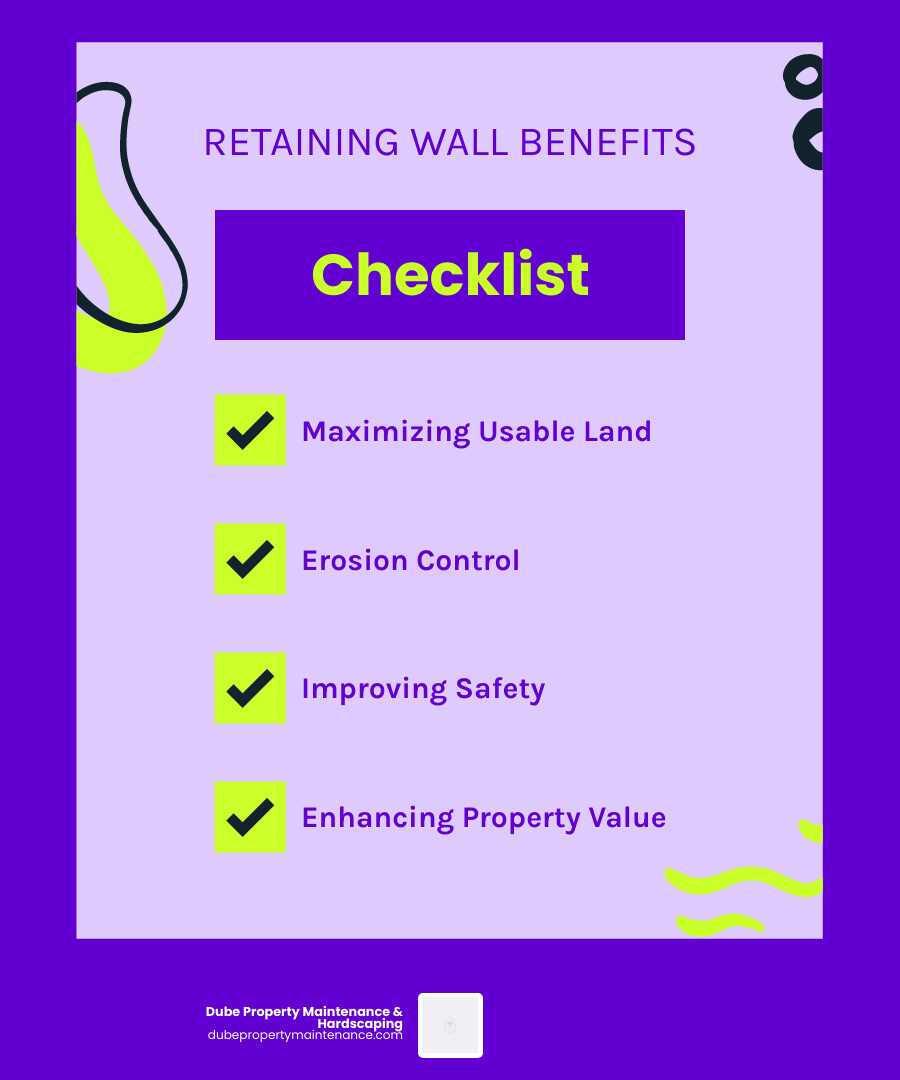
For businesses in Dracut, MA, and Salem, NH, commercial retaining walls are strategic investments that improve functionality, safety, and property value.
Common Applications for Commercial Properties
Site Stabilization: Prevents soil erosion and stabilizes sloped ground, crucial for protecting structures and utilities in areas like Lowell, MA.
Erosion Control: Manages water runoff to prevent damage to foundations and infrastructure.
Maximizing Usable Space: Reclaims steep slopes for additional parking, amenity space, or building expansions.
Aesthetic Improvement: Creates architectural features that integrate with landscape retaining walls to create a professional environment.
Water Management: Incorporates drainage systems that divert water away from buildings and manage stormwater effectively.
Beyond Structural Support: Adding Value and Appeal
Parking Lot Support: Creates level parking on sloped sites or expands existing lots.
Foundation Support: Provides essential support for buildings on sloped sites or during basement excavation.
Improving Site Accessibility: Creates level paths and ramps for pedestrians and vehicles.
A Guide to Commercial Retaining Wall Systems, Materials, and Innovations
Choosing the right system is crucial for longevity and cost-effectiveness. Millions of square feet of retaining walls have been installed nationwide, proving the reliability of modern systems.
Types of Commercial Retaining Wall Systems
Gravity Walls: Rely on mass to resist soil pressure. Suitable for shorter walls using concrete blocks or natural stone.
Cantilever Walls: Use a reinforced concrete “T” shape footing to resist overturning; efficient for taller walls.
Sheet Piling Walls: Interlocking sheets driven into the ground, ideal for limited space or soft soil.
Anchored Walls: Incorporate cables or rods driven into the soil for very tall walls or significant loads.
Mechanically Stabilized Earth (MSE) Walls: Use modular blocks and geogrid reinforcement. Popular for large projects due to cost-effectiveness.
Gabion Walls: Rock-filled wire cages, excellent for erosion control and natural environments.
The Project Lifecycle: Expert Commercial Retaining Wall Services
A successful project requires meticulous planning and engineering to ensure the final structure is safe and built to last.
Step 1: Geotechnical Evaluation
Soil Testing: Determines composition and moisture to predict behavior under load.
Slope Analysis: Assesses stability and identifies movement risks.
Water Table Assessment: Vital for managing water pressure behind the wall.
Bearing Capacity: Determines the weight the soil can support for foundation design.
Site Survey: Provides topographic data and identifies existing utilities.
Soil properties, like clay versus sand, necessitate different design approaches. Guidance from the U.S. Geological Survey highlights how stability affects long-term performance.
Step 2: Design and Engineering
Key Factors: Engineers consider height, soil, and surcharge loads (e.g., 100 psf for light traffic, 250 psf for roads). Walls over 6 feet require professional engineering.
Drainage Planning: Designs manage hydrostatic pressure using toe drains and wall rock. Walls over 4 feet typically require drain pipes.
Delivery Methods:
Design-Build: Integrated team for better coordination and cost savings.
Design-Bid-Build: Traditional method with separate design and bidding phases.
Effective management ensures on-time completion through clear communication, timeline coordination, and budget adherence. Finding a qualified Retaining Wall Contractor is essential for complex projects in MA and NH.
Ensuring Longevity: Maintenance, Regulations, and Environment
Maintenance and Longevity Considerations
With proper care, a commercial retaining wall can last 50 to 100+ years.
Routine Inspections: Check for signs of distress like cracks or leaning.
Frequently Asked Questions about Commercial Retaining Walls
How tall can a commercial retaining wall be before it needs an engineer?
Generally, walls over 4 feet in height, or any wall supporting a critical load, require a licensed engineer’s design in Massachusetts. The Massachusetts State Building Code sets these structural standards.
What is the most critical factor for a retaining wall’s longevity?
Proper drainage is the most critical factor. Managing hydrostatic pressure with geotextile fabric and drainage pipes prevents the most common causes of wall failure.
How long does a commercial retaining wall typically last?
With professional installation, a wall can last 50 to 100 years. Segmental concrete block and natural stone walls are known for their exceptional durability.
Partner with the Experts for Your Commercial Retaining Wall Project
From Lowell, MA to Salem, NH, a professionally executed retaining wall is a powerful asset. Dube Property Maintenance & Hardscaping provides comprehensive solutions custom to the unique demands of your commercial property throughout northeastern Massachusetts and southern New Hampshire.
Our professional team can assist with:
Site evaluation and geotechnical coordination
Engineered retaining wall design and material selection
For 25+ years Dube Property Maintenance & Hardscaping has provided top-rated residential and commercial landscape design, installations, hardscaping, irrigation systems and commercial snow and ice management. Our hardscaping division proudly serves the Merrimack Valley, Middlesex and Essex County and Southern, NH regions, transforming outdoor spaces into stunning works of art.