
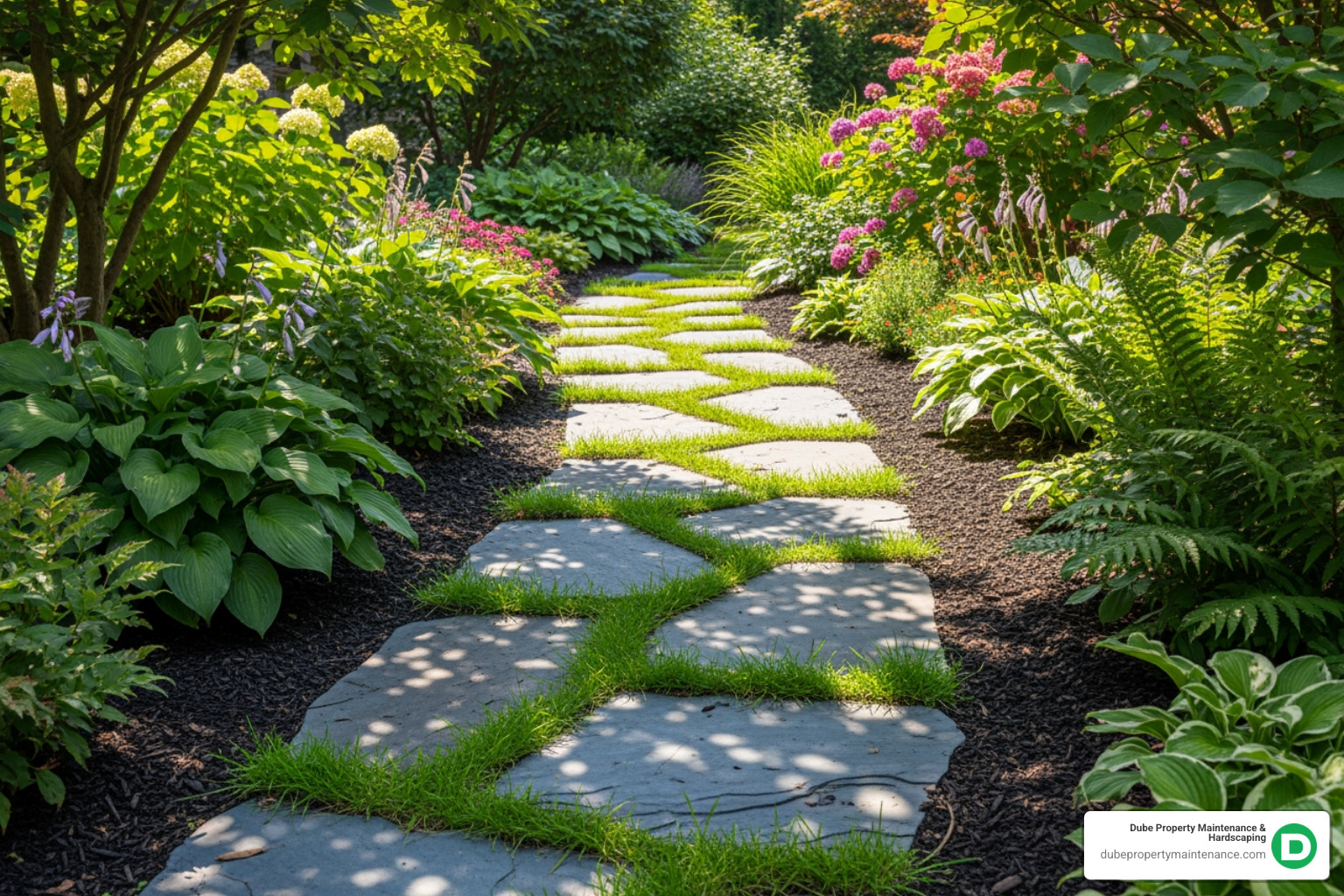
Bluestone stepping stone walkways offer homeowners in Massachusetts and New Hampshire a stunning way to connect outdoor spaces while adding lasting value to their property. These natural stone pathways combine beauty, durability, and functionality in a way that few other materials can match.
Quick Guide to Bluestone Stepping Stone Walkways:
The appeal of bluestone is rooted in both history and practicality. This sedimentary rock, formed nearly 400 million years ago, has been the foundation of walkways in Northeastern cities for over a century—many of those original paths remain in service today. At a cost of $4 to $7 per square foot for materials, bluestone represents an investment in permanence and beauty.
Unlike concrete pavers or brick, bluestone stepping stones don’t require edge constraints and rarely shift, even through New England’s harsh freeze-thaw cycles. When a root or frost heave does move a stone, repositioning it is straightforward. The natural texture and varied color palettes—from deep grays to warm blues—complement nearly any landscape design, whether you’re creating a rustic garden path in Andover or a formal entrance in Haverhill.
This guide will walk you through everything you need to know about bluestone stepping stone walkways: from design inspiration and material selection to the professional installation process that ensures your pathway will last for generations. We’ll also cover costs, maintenance, and how to make the most of this timeless hardscaping choice for your Massachusetts or New Hampshire property.
Handy Bluestone stepping stone walkway terms:
When considering materials for your outdoor pathways, bluestone stepping stone walkways stand out for a multitude of reasons. We’ve seen how this natural stone lifts the aesthetic and functionality of properties across Massachusetts and New Hampshire.
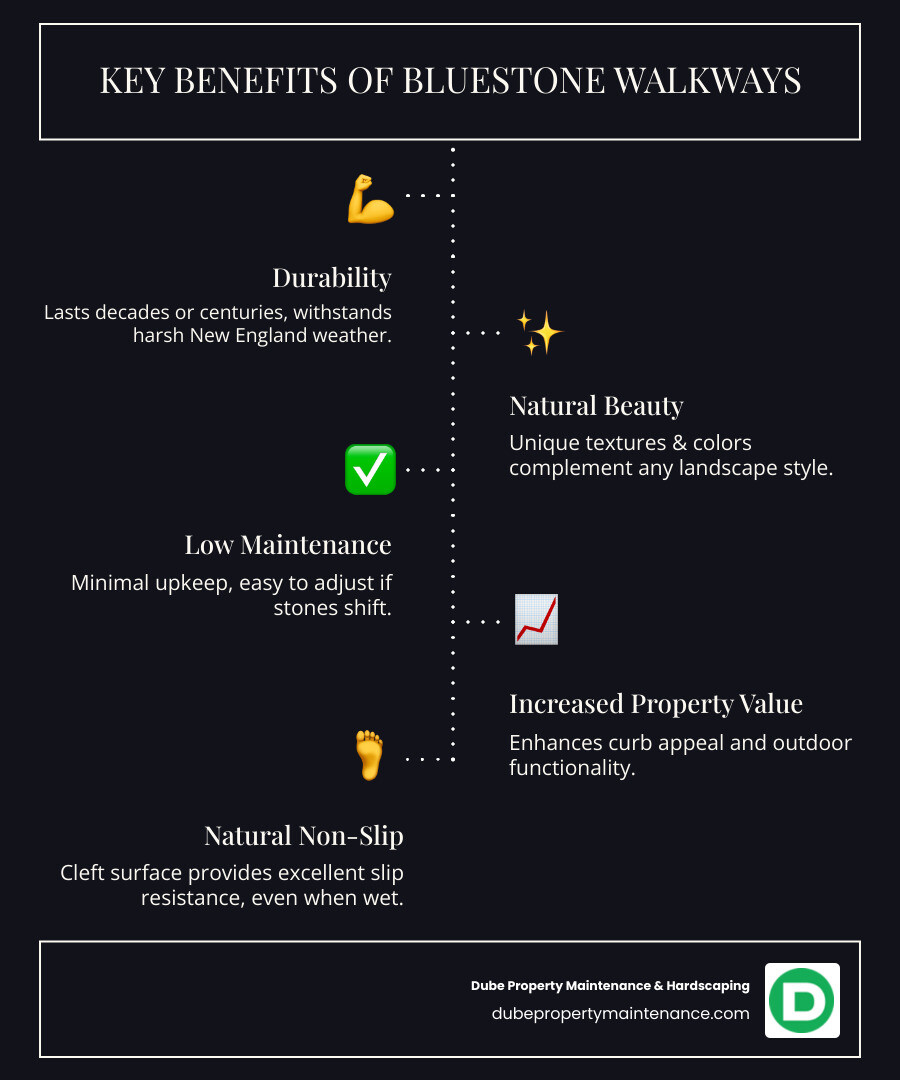
Aesthetic Advantages: Bluestone offers a natural texture and a sophisticated color palette of blues, grays, and purples that manufactured materials can’t replicate. Each unique stone contributes to a rich appearance that improves your landscape’s natural beauty. It harmonizes effortlessly with diverse architectural styles, from historic Concord homes to modern residences in Salem, NH.
Durability and Longevity: Bluestone is incredibly dense and hard-wearing. Many bluestone sidewalks installed over a century ago in the Northeast are still in use. This remarkable longevity means a professionally installed bluestone walkway is a permanent addition to your property, resisting foot traffic and the test of time.
Natural Non-Slip Texture: Safety is paramount in our region’s varied weather. Bluestone’s naturally cleft surface provides excellent slip resistance, even when wet. This makes it a safer choice than smoother materials, reducing the risk of slips and falls for homeowners from Andover to Pelham.
Resistance to New England Weather: Our local climate is tough on outdoor materials. Bluestone is versatile and durable, handling the region’s freeze-thaw cycles exceptionally well. With proper installation, it resists shifting, cracking, and heaving from snow or heavy rain.
Versatility in Landscape Design: Whether you envision a formal entryway, a meandering garden path, or a sturdy connection between outdoor living spaces, bluestone adapts beautifully. Its natural elegance complements diverse landscape styles, creating a seamless transition that improves your property’s overall appeal.
Low Maintenance Requirements: Once installed, bluestone asks for very little in return. It doesn’t require the constant sealing or joint maintenance that some other materials demand. If a stone does shift due to a root or frost heave, repositioning it is relatively easy. This minimal upkeep allows you more time to enjoy your outdoor space rather than maintaining it.
To help you visualize the benefits, here’s a quick comparison:
| Feature | Bluestone Stepping Stone Walkway | Concrete Pavers | Brick |
|---|---|---|---|
| Durability | Exceptional; often lasts over a century; resists shifting well. | Good; can last for decades; prone to fading and cracking over time. | Good; can last for decades; prone to cracking and moss growth. |
| Aesthetics | Natural, unique textures and colors; timeless, neat appeal. | Uniform, manufactured look; can mimic natural stone but lacks authenticity. | Classic, rustic charm; color can fade; limited design versatility. |
| Cost (Material) | $4-$7 per square foot (material only). | Typically $2-$5 per square foot. | Typically $1-$3 per square foot. |
| Maintenance | Low; rarely needs edge constraints; easy to reposition. | Moderate to high; requires edge constraints; joints need sealing. | Moderate; requires edge constraints; joints need periodic refilling. |
| Slip Resistance | Excellent due to natural cleft surface. | Varies by finish; can be slippery when wet. | Good when dry; can be slippery and absorb moisture. |
For a long-lasting, beautiful, and low-maintenance pathway that stands up to New England’s demands, bluestone is an outstanding choice. Learn more about our comprehensive hardscaping services that can transform your outdoor living areas.
One of the most exciting aspects of incorporating bluestone stepping stone walkways into your landscape is the sheer variety of design possibilities. Whether your home is a charming colonial in Groton or a contemporary masterpiece in Lexington, bluestone can be custom to fit your aesthetic.
Natural and Rustic Styles: For a softer, more organic look, consider irregular flagstone shapes. These free-form pieces create a picturesque path that blends seamlessly with garden beds and natural landscapes. Imagine a winding bluestone path through a lush garden in Carlisle, with each stone unique in shape and size. This style often feels like it has always been there, a natural extension of your property.
Modern Geometric Patterns: If your taste leans towards clean lines and contemporary design, cut dimensional bluestone offers a sleek alternative. These precisely cut squares and rectangles can be laid in uniform patterns, creating a formal and sophisticated walkway that perfectly complements modern architecture. A straight bluestone path with sharp edges and minimal gaps can provide a striking visual leading to your front door in Andover, MA.
Curved and Meandering Paths: A curved bluestone path can add a sense of findy and whimsy to your garden. It invites exploration, guiding visitors through different sections of your landscape, perhaps around a beautiful planting bed or towards a hidden seating area.
Straight Formal Walkways: For a grand entrance or a direct route, a straight bluestone walkway conveys elegance and purpose. This is particularly effective when leading to a main entrance or connecting distinct outdoor rooms, offering a clear and defined passage.
Gap Filler Options: What you place between your bluestone slabs significantly impacts the walkway’s final look and feel.
Integrating Landscape Lighting: To improve both safety and ambiance, consider integrating landscape lighting along your bluestone walkway. Low-voltage path lights can illuminate the stones, highlight surrounding plantings, and create a warm, inviting glow for evening strolls. This is particularly effective for properties in Dracut or Lowell, where outdoor living extends into the evening.


For more ideas on how to seamlessly integrate pathways into your property, explore our services for walkway installation.
While installing bluestone may seem straightforward, achieving a flawless, long-lasting result requires professional expertise. The details of site preparation and base construction are critical, as the longevity of a bluestone walkway is overwhelmingly about the quality of the base beneath it. A skilled team with the right tools—like plate compactors and masonry saws—ensures your investment withstands New England’s challenging climate and prevents issues like shifting or cracking.
This initial phase is critical for a stable, well-drained foundation. We begin by marking the walkway’s path with stakes and string, outlining an area slightly wider than the finished path for base preparation. Before any digging, we contact Dig Safe (811) to locate underground utility lines, a non-negotiable safety step for projects in Haverhill, Methuen, or Salem, NH.
We then excavate to a depth of 6-8 inches, depending on soil conditions, removing all grass and debris. The area is graded for proper drainage away from structures. For sloped or uneven terrain, our expertise is crucial. We can construct integrated bluestone steps or expertly prepare the subgrade to create a level foundation, preventing future settling.
For more general guidance on stone walkway installation, you can refer to resources like How To: Install a Stone Walkway.
The base is the unsung hero of any hardscaping project. A strong foundation prevents stones from shifting or cracking due to our region’s freeze-thaw cycles. After compacting the subsoil, we spread a 3-inch layer of 3/4-inch crushed stone. This sub-base is applied in layers, with each layer thoroughly compacted with a plate compactor to create a dense, stable foundation. On top, we lay a 1 to 1.5-inch setting bed of stone dust, which provides a stable, adjustable surface for the bluestone.
With the base prepared, we begin laying the bluestone. The first stone is crucial, setting the reference for the rest. We thoughtfully arrange the stones according to the chosen pattern, maintaining consistent spacing (often around 3/4-inch) for a professional look. Each slab is placed on the stone dust bed and gently tapped into position with a rubber mallet. We constantly check the level of each stone relative to its neighbors to create a smooth, trip-free surface, adjusting the stone dust underneath as needed. For custom fits around curves or obstacles, we use a masonry wet saw for clean, precise cuts.
The final steps involve filling the joints and adding finishing touches. The joint filler is key for both aesthetics and function.
We can also install optional steel edging for a crisp, defined border. Finally, the entire walkway is thoroughly cleaned and rinsed to remove any dust or debris, revealing the true beauty of the bluestone for your property in towns like Westford or Billerica.
Investing in a bluestone stepping stone walkway adds significant value and beauty to your property. Understanding the costs and maintenance helps you plan effectively.
When budgeting for a bluestone walkway, consider both material and professional installation costs.
Disclaimer: The prices provided here are average costs based on internet data and do not reflect the actual costs of Dube Property Maintenance & Hardscaping. We always provide a detailed, customized quote for each project.
Material Costs: Bluestone slabs typically cost between $4 to $7 per square foot. This varies by type (irregular vs. dimensional cut), thickness, and supplier. Additional costs include crushed stone and stone dust for the base and joints (around $50 per cubic yard each).
Professional Installation Costs: A professionally installed bluestone walkway can range from $25 to over $90 per square foot, depending on various factors. This cost includes materials, labor, equipment, and expertise.
Cost Factors: Several elements influence the final price:
While the initial investment is higher than some alternatives, bluestone’s durability and low maintenance make it a wise long-term choice.
A key benefit of a bluestone stepping stone walkway is its low maintenance. Proper installation ensures your path requires minimal upkeep.
Routine Cleaning: Periodically sweep away leaves and debris to prevent staining. For a deeper clean, a gentle rinse with a hose and stiff brush is usually sufficient.
Sealing the Bluestone for Protection: While durable, sealing bluestone every few years offers extra protection. A quality sealer repels water, resists stains, and improves the stone’s natural color, prolonging its pristine look.
Addressing Weeds: Small weeds may occasionally sprout in joints. These are easy to pull by hand or treat with a targeted weed killer. A proper base and joint filler significantly reduce weed issues.
How Professionals Fix Common Issues: Shifting or cracking is rare with a professional installation. However, if a stone shifts from frost heave or a root, we can easily lift it, adjust the base, and reset it. Similarly, a cracked stone can be replaced individually without disturbing the entire walkway.
The Role of a Proper Base in Preventing Problems: The best maintenance is preventative. A properly compacted base is the strongest defense against shifting, cracking, and weeds, ensuring your walkway remains stable for years. For complex repairs, our masonry services are always available.
We often hear similar questions from homeowners interested in bluestone stepping stone walkways. Here are some common inquiries and our expert answers:
Yes, bluestone can absolutely be installed on a slope, but it requires professional expertise. For gentle slopes, our team can carefully grade the base to create a subtle incline that allows for proper drainage without compromising stability. For steeper grades, we would engineer and construct safe, stable bluestone steps or terraces. This approach ensures both functionality and aesthetic appeal, seamlessly integrating the walkway with your property’s natural contours, especially crucial in the varied terrain found across Massachusetts and New Hampshire.
With a professionally installed base, a bluestone walkway is considered a permanent feature. Many bluestone-paved sidewalks in Northeastern cities have been in service for well over a century. You can expect your bluestone walkway to last for decades, often exceeding 100 years, making it an exceptional long-term investment for your property. Its durability and resistance to the elements ensure it remains a beautiful and functional part of your landscape for generations.
No, bluestone is not typically slippery when wet. This is one of its key advantages, especially in our region’s climate. Bluestone has a naturally cleft (or textured) surface, which provides excellent inherent slip resistance. This makes it a very safe choice for walkways, even during rain, snowmelt, or icy conditions, offering good traction and reducing the risk of slips and falls.
We hope this guide has illuminated the many benefits and beautiful possibilities of a bluestone stepping stone walkway. From its enduring beauty and natural slip resistance to its remarkable durability and low maintenance, bluestone offers an unparalleled solution for enhancing your outdoor spaces.
The key to open uping the full potential and longevity of a bluestone walkway lies in professional installation. Our experienced team at Dube Property Maintenance & Hardscaping is dedicated to creating custom bluestone walkways that not only meet your aesthetic desires but are also built to last through every New England season. We take pride in delivering high-quality, comprehensive outdoor solutions to our residential and commercial clients across our service areas.
Whether you’re envisioning a charming garden path in Methuen, a sophisticated entryway in Haverhill, or a durable connection between outdoor living areas in Salem, NH, we have the expertise to bring your vision to life.
Ready to transform your landscape with the timeless elegance of bluestone? Contact us to discuss your walkway project and find how we can create a stunning, long-lasting pathway for your property.
